

Ever wondered what's running the show behind a company's phone system? It's not magic—it's a Private Branch Exchange, or PBX. Think of it as your own private, in-house telephone network, a smart switchboard that handles every call coming in, going out, or circling between desks. This guide breaks down how PBX technology works, how to deploy it securely, and why modern businesses are overwhelmingly choosing virtual solutions.
Long gone are the days of needing a separate, expensive phone line for every single employee. Today’s systems have evolved from those clunky hardware boxes in the server closet to sleek, powerful Virtual PBX solutions hosted entirely in the cloud, often on high-performance infrastructure like ARPHost's high-availability VPS hosting.
Understanding the Core of Business Communication
At its heart, a PBX is about making communication smart, affordable, and professional. Instead of paying the phone company for dozens of individual lines, a business can operate with just a handful of shared lines, known as trunks. The PBX is the traffic cop, intelligently routing calls to the right desk phone, computer softphone, or even a mobile device on the go.
This simple shift—from one line per person to a shared, managed network—was a total game-changer for businesses. It's the technology that unlocked all the features we now take for granted, like:
- Extension Dialing: Just punch in a three or four-digit number to reach a colleague. No more looking up full phone numbers.
- Call Transfers: Seamlessly hand off a caller to the right person or department without dropping the call.
- Automated Greetings: A digital receptionist that gives your company a polished, professional first impression 24/7.
- Call Queues: The backbone of any sales or support team, neatly organizing incoming calls so they can be answered efficiently.
Before we go any further, let's nail down some of the key terms you'll encounter. This quick table breaks down the jargon into simple definitions and explains why each piece matters to your business.
Key PBX Concepts at a Glance
| Term | Simple Definition | Business Impact |
|---|---|---|
| PBX | Your company's private phone network. | Centralizes call management, cuts costs on phone lines, and adds professional features. |
| Trunk | A shared line that connects your PBX to the public phone network. | Allows multiple employees to make and receive external calls simultaneously using fewer lines. |
| Extension | A unique short number (e.g., 101, 102) assigned to each employee or phone. | Simplifies internal calling and makes transferring calls easy. |
| IVR | Interactive Voice Response; the "press 1 for sales, press 2 for support" menu. | Automates call routing, freeing up staff and getting callers to the right place faster. |
| VoIP | Voice over Internet Protocol; technology that sends voice calls over the internet. | The foundation of modern phone systems, enabling lower costs and advanced features. |
| Virtual PBX | A PBX system hosted in the cloud by a provider, not on your premises. | Eliminates hardware costs, simplifies management, and offers incredible flexibility. |
With these concepts in mind, it’s easier to see how all the pieces of a modern phone system fit together to create a seamless communication hub.
The Modern Shift to Virtual and Cloud PBX
Let's be clear: the industry is ditching physical hardware, and fast. The global hosted PBX market was valued at a huge USD 11.20 billion in 2023, but it's expected to explode to USD 31.07 billion by 2030. That kind of growth tells you everything you need to know—businesses are moving to the cloud in droves for flexibility and cost savings. You can discover more insights about this market shift and see how companies are adapting.
A modern Virtual PBX system, like the managed solutions we offer at ARPHost, runs entirely from secure, redundant data centers. This means no more expensive server hardware to buy, no maintenance contracts to sign, and no need for a specialized IT guru to manage it. Your entire phone system is delivered right over your internet connection, giving you a predictable monthly cost and the power to scale up or down in minutes. It's how a traditional phone system becomes a powerful communications platform that truly grows with your business.
The Evolution from Analog Switchboards to Virtual PBX
To really appreciate what a modern business phone system can do, it helps to glance back at where it all started. The journey began with those clunky, manually operated switchboards you've seen in old movies—the ones requiring a dedicated person to physically connect calls by plugging and unplugging wires. It was slow, expensive, and a single mistake could drop an important call.
The first real breakthrough was the Private Branch Exchange, or PBX. These on-site systems automated the switching, finally freeing businesses from needing a full-time operator just to connect internal calls. This shift was huge, boosting efficiency and cutting costs for any company big enough to afford the hardware.
From Hardware Racks to the Internet
This slow march of progress continued for decades, with phone systems getting smaller and smarter. While the first standard PBX showed up way back in 1902, it came with a massive price tag. By the 1960s, the Private Automatic Branch Exchange (PABX) automated things even further, but the true game-changer didn't arrive until the 1990s: IP PBX technology.
This was the turning point. By using the internet to route calls, businesses could slash setup costs compared to old-school analog systems. It was the beginning of the end for the dedicated phone closet. You can dig deeper into how the market grew by checking out this industry analysis on the hosted PBX market.
Today, that journey has led us to cloud-based solutions, allowing businesses to run their entire communication network without a single piece of hardware on-site.
The Rise of the Virtual PBX
This brings us to the final, and most important, step in the evolution: the Virtual PBX. Instead of a physical box humming away in your server room, the entire system lives in a secure, high-performance data center and is delivered right to you over the internet. This model brings a few key advantages to the table that legacy systems could never dream of matching:
- Zero Hardware Maintenance: Forget about updates, security patches, or failed hardware. Your provider handles all of it.
- Predictable Costs: The days of massive upfront capital expenses are over. Now, it's a simple, scalable monthly subscription.
- Unmatched Flexibility: Need to add a new employee or another phone line? It takes minutes, not weeks.
- Remote Workforce Ready: Your team can connect to the company phone system from literally anywhere with an internet connection.
This progression—from a person manually plugging in wires to a fully managed ARPHost Virtual PBX—is really the story of making business communication more accessible, powerful, and affordable. It's more than just a product; it’s the result of decades of innovation aimed at solving real business problems.
How a Modern PBX System Actually Works
Let's demystify how a modern PBX system operates. The easiest way to think about it is as your company's own private, intelligent postal service, but for phone calls. Instead of sorting physical mail, it routes digital calls with incredible speed and accuracy. At the heart of this entire operation, a few core components work together seamlessly.
The "brain" of the system is the PBX server. In a modern setup like an ARPHost Virtual PBX, this isn't a clunky box humming away in your server closet anymore. It's powerful software running on high-availability infrastructure inside a secure data center. This central hub manages all the call logic—from directing an incoming call to the sales team to handling features like voicemail and call forwarding.
Core Components of a Modern PBX
Connecting this brain to the outside world are SIP trunks. Think of these as the digital equivalent of old-school phone lines. They use your internet connection to carry voice traffic, allowing you to handle tons of calls at once without needing a separate physical line for each one. This is a huge reason why VoIP-based systems are so much more affordable and scalable than their analog ancestors.
Finally, you have the endpoints. These are simply the devices your team uses to make and receive calls. Common examples include:
- IP Phones: Your standard desk phone that plugs directly into the network.
- Softphones: An application on your computer or smartphone that acts as a phone.
- Conference Phones: Specialized gear designed for meeting rooms.
All these pieces are tied together by your office network. For any modern PBX to work well, you have to get the networking right. That means understanding the basics of your infrastructure, from firewall configuration to the physical cabling itself.
The infographic below shows just how far PBX systems have come, evolving from simple analog boxes to the internet-powered IP PBX we use today.
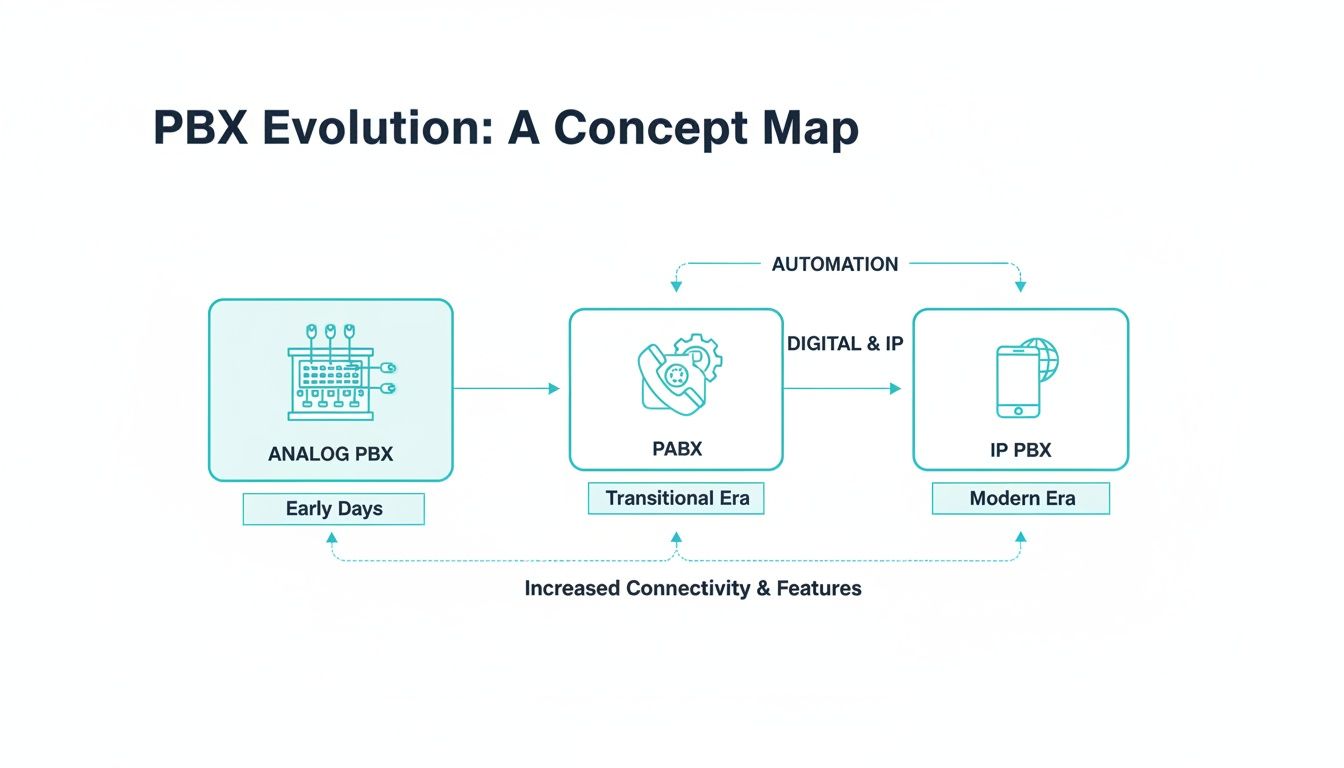
This journey from hardware-heavy setups to flexible, software-driven solutions is what gives modern businesses so much power and connectivity.
Choosing Your PBX: On-Premise vs. Hosted Cloud Systems
When it’s time to pick a PBX system, you’re really facing one fundamental choice: do you want the hardware sitting in your own server closet (on-premise), or do you want to let a provider handle everything in the cloud (hosted)? Each path comes with its own set of trade-offs around cost, control, and day-to-day management. The right answer really hinges on your company's budget, in-house IT muscle, and where you see the business heading.
An on-premise IP PBX means you buy, own, and manage all the physical server hardware and software right there at your office. This approach gives you absolute, hands-on control over every single setting and feature of your phone system. The flip side? You’re on the hook for everything. That includes the hefty upfront investment, plus all the ongoing maintenance, security updates, and eventual hardware replacements. It’s a path often taken by large corporations with dedicated IT teams and very specific compliance requirements.
Hosted Virtual PBX: The Modern Way Forward
Contrast that with a hosted Virtual PBX, where you offload the entire infrastructure to a provider like ARPHost. Here, the PBX hardware and software run in a secure, professionally managed data center, and you get your phone service delivered straight over the internet. This model completely sidesteps the massive capital expense for hardware, swapping it for a predictable, manageable monthly fee. For the vast majority of businesses today, it’s simply the smarter choice.
A hosted PBX frees your IT team from the relentless cycle of server maintenance. Instead of losing sleep over hardware failures or security patches, your team can focus on projects that actually grow the business, leaving the 24/7 communications grind to the experts. This shift from a capital expense to an operational one is a huge win, both financially and strategically.
This isn’t just a conversation about saving money; it’s about agility. Let's say you need to bring on ten new employees for a seasonal project. With a hosted solution, it’s a quick phone call or email. With an on-premise system, you could be looking at buying new hardware or licenses, a process that burns both time and cash. Before you commit, it's worth diving into a detailed business phone systems comparison to see the full picture.
On-Premise IP PBX vs Hosted Virtual PBX: A Technical Comparison
To really grasp the differences, it helps to see the two models side-by-side. The table below cuts through the noise and compares the critical factors that will impact your business, your budget, and your IT team's sanity.
| Factor | On-Premise IP PBX | ARPHost Managed Virtual PBX | Key Takeaway |
|---|---|---|---|
| Upfront Cost | High (servers, software, installation) | Low to none (no hardware purchase) | Hosted models avoid the big initial cash outlay, preserving capital for growth. |
| Ongoing Costs | Variable (maintenance, power, IT staff) | Predictable (fixed monthly subscription) | A fixed monthly fee makes budgeting simple and predictable. |
| Maintenance | Your IT team is fully responsible. | ARPHost manages all updates and security. | Offloading maintenance frees up your internal IT resources for strategic tasks. |
| Scalability | Complex and costly to add capacity. | Seamless; add or remove users on demand. | Cloud solutions scale up or down with your business needs effortlessly. |
| Security Control | Full control, but also full responsibility. | Managed security with proactive monitoring. | You get expert-level security without having to manage it yourself. |
| Remote Work | Requires complex configuration (VPNs). | Natively supports remote and mobile users. | Hosted systems are built from the ground up to support a modern, distributed workforce. |
While an on-premise system might seem appealing for its promise of total control, the practical reality is that the benefits of a hosted Virtual PBX are too compelling for most to ignore. Lower costs, zero maintenance headaches, and the ability to scale at a moment's notice make it the clear winner.
Find out how ARPHost’s managed Virtual PBX solutions can bring your business communications into the modern era.
Must-Have Features of a Modern Business Phone System
A modern business phone system is so much more than a dial tone. Think of it as a productivity engine, packed with tools built to make your company more efficient, professional, and responsive. To really get what a PBX can do, you have to look past just making calls and see the powerful features that create a real competitive edge. These aren't just bells and whistles; they're vital for day-to-day operations.
The best features work together to automate workflows, sharpen customer interactions, and unlock valuable business insights.
Your Digital Front Desk and Call Management Tools
First impressions count, and the Auto-Attendant is your 24/7 digital receptionist. It greets every single caller with a polished, custom message and routes them through a simple menu ("press 1 for sales, press 2 for support"). This instantly makes your business look bigger and more organized, all while getting callers where they need to go without anyone lifting a finger.
For any team with high call volumes, like customer support or sales, Call Queues are a lifesaver. Instead of hitting a busy signal, callers are placed in a line and hear music or custom messages until an agent is free. This simple tool dramatically cuts down on dropped calls and frustration, turning potential chaos into an orderly process.
Capturing Information and Improving Performance
In a fast-paced business, critical details can easily fall through the cracks. Voicemail-to-Email is the fix. It automatically transcribes voicemails and sends the audio file and text straight to an employee's inbox. This lets your team quickly read or listen to messages from anywhere, prioritize who to call back first, and keep a documented trail of every interaction. For a deeper dive, you can learn about setting up voicemail-to-email delivery in our dedicated guide.
Another game-changer for training, compliance, and quality control is Call Recording. A sales manager can review a new hire's calls to offer coaching on their pitch. A support supervisor can use recordings to make sure agents are following company protocol and delivering top-notch service.
These features transform a phone system from a simple utility into a strategic business asset. The goal is to automate routine tasks and capture data, freeing up your team to focus on what they do best: serving customers and growing the business.
At ARPHost, our managed Virtual PBX administration takes these powerful tools and dials them in for your exact needs. We don't just hand you the features; our experts will configure your Auto-Attendant scripts, set up smart call queue routing, and ensure your call recording policies meet any compliance standards. This hands-on approach guarantees your phone system actively solves your specific operational challenges from day one.
Integrating and Securing Your PBX System
Setting up a PBX isn't just about plugging in phones and hoping for the best. To get the performance you expect, it demands smart integration into your existing network and a serious approach to security. A successful rollout turns your phone system from a simple utility into a secure, reliable cornerstone of your business operations.
Without proper planning, your voice calls are left to fight for bandwidth with every other piece of data on your network—think emails, file downloads, and video streams. The result? Choppy audio, dropped calls, and a whole lot of frustration. And on the security front, a poorly configured system is an open invitation for toll fraud and eavesdropping, putting both your money and your sensitive conversations at risk.
Best Practices for Network Configuration and Performance
The clarity of your calls boils down to one thing: the health of your network. Prioritizing voice traffic isn't just a good idea; it's non-negotiable if you want to sound professional.
- Implement Quality of Service (QoS): This is the single most important step. QoS policies tell your network routers to give voice packets a "front-of-the-line" pass, ensuring they aren’t held up by less urgent data. This is what delivers that crystal-clear audio, even when your network is busy. For example, using a managed Juniper firewall, you can configure class-of-service policies to prioritize the
ef(Expedited Forwarding) traffic class used for VoIP. - Ensure Sufficient Bandwidth: While VoIP is pretty efficient, it’s not magic. You still need enough bandwidth to handle your call volume. Take a moment to calculate your needs based on the maximum number of simultaneous calls you expect and make sure your internet plan can handle the load without breaking a sweat.
- Use a Managed Network: A firewall that isn't configured for VoIP can be a huge headache, blocking traffic and causing bizarre issues like one-way audio or calls that never connect. Using a managed network service takes the guesswork out of the equation, ensuring your security rules are optimized for voice without leaving you exposed.
A properly configured network is the foundation of a reliable PBX. Think of it as building a dedicated express lane for your voice traffic on the digital highway. Without it, your calls are stuck in rush-hour traffic with everything else, leading to delays and frustration.
Securing Your Communications Hub
Because a modern PBX lives on the internet, it's a potential target for bad actors. Securing it is absolutely essential. The basics include using strong, unique passwords for every extension and admin portal and, just as importantly, keeping your PBX software updated to patch any security holes.
Beyond that, enabling features like fail2ban can automatically block IP addresses that show signs of an attack, like repeated failed login attempts. To really get a handle on how your system works behind the scenes with your network, our guide on what a STUN server is and its role in VoIP is a great place to start.
At ARPHost, we believe you shouldn't have to become a security expert just to have a phone system. Our fully managed IT services are designed to lift this burden entirely. We handle the proactive firewall and network management needed to protect your PBX, configuring and monitoring your environment to stop threats before they can impact your business. This ensures your communications are always secure, private, and performing exactly as they should—and it's the clearest value of working with a truly managed provider.
Common Questions About PBX Systems
Even after getting the hang of what a PBX system does, a few questions almost always pop up when it's time to make a decision. We get these all the time, so let's clear them up with some quick, straight answers.
Is PBX the Same as VoIP?
Not quite, though they work together. PBX is the phone system itself—the central brain that directs calls and unlocks all the cool features. VoIP (Voice over Internet Protocol) is the technology that actually sends your voice across the internet.
You can think of it this way: the PBX is the car, but VoIP is the fuel that makes it go. Modern systems, like a Virtual PBX, are built to run on VoIP, making them incredibly efficient and flexible.
Do I Need Physical Phones with a Virtual PBX?
Nope, you don't have to. While you can absolutely plug in sleek IP desk phones and they'll work great, one of the biggest wins of a virtual system is freedom from hardware.
Your team can handle all their business calls right from their computers or smartphones using a softphone application. This is a game-changer for remote teams or any business looking to ditch the cost and clutter of desk hardware.
How Secure Is a Cloud-Based PBX System?
With a reputable provider, it's incredibly secure—often more so than an on-premise system you have to manage yourself. When you have a server sitting in your office, all the security falls on your shoulders. With a managed provider like ARPHost, you're tapping into a fortress of network-level protections.
With a managed Virtual PBX, you benefit from enterprise-grade security measures, including managed firewalls, proactive threat monitoring, and regular system updates, which are often far more advanced than what a small business can maintain in-house. This expert oversight is a core benefit of choosing a managed solution.
Ready to modernize your business communications with a secure, scalable phone system? ARPHost offers fully managed Virtual PBX solutions that eliminate hardware headaches and deliver crystal-clear call quality. Request a managed services quote today and let our experts design the perfect system for your needs.