

You’ve probably felt this already. A product grows, one release starts touching half the repo, and a “small fix” turns into a coordinated event across backend, frontend, QA, and ops. The code still works, but shipping it starts to feel heavier than building it.
Microservices architecture is the architectural response to that pressure. It splits a large application into small, independently deployable services so teams can develop, release, and maintain parts of the system separately, instead of redeploying one giant codebase for every change. That shift matters because the market for microservices has moved into the mainstream, with one analysis estimating USD 7.7 billion in 2024 and projecting USD 49.91 billion by 2035, with an 18.52% CAGR over 2025 to 2035, which reflects a broader enterprise push to modernize legacy systems and support cloud computing.Microservices architecture market analysis
It’s a useful reference when the term starts to blur together with APIs, containers, and cloud tooling.
The Problem That Microservices Architecture Solves
The pain usually shows up in small, familiar ways. One team changes checkout logic and a completely unrelated deploy fails. Another team waits on a shared library update. A third team hesitates to touch code because nobody wants to be the person who breaks the whole platform.
That’s the problem microservices tries to solve. Instead of one large application doing everything, you split it into small, independent services that map to business capabilities and can be built, released, and operated separately. In practice, that means a catalog change doesn’t have to ride along with payment code, and a shipping update doesn’t need a full-system redeploy.
What the term means in plain English
A microservices system is not just “small pieces of code.” It’s a design approach where each service has a clear job, its own deployable unit, and a defined way to talk to other services through APIs. Atlassian describes this independently deployable, API-based model as the defining characteristic of microservices, and the same basic idea appears across Google Cloud, Microsoft, AWS, and Atlassian documentation.Atlassian microservices architecture guide
That makes microservices different from a monolith, where one application contains most or all business logic in a single deployable. It’s also different from classic SOA in one important way, microservices usually emphasize smaller service boundaries, lightweight communication, and stronger ownership around each bounded capability.
Practical rule: if a change still forces a full-platform redeploy, you haven’t really separated the system yet.
For teams trying to learn the pattern without getting lost in jargon, a microservices guide that starts with service boundaries, deployability, and communication patterns is worth the time. That’s the mental model to keep in view before any tooling discussion starts.
Core Principles Behind a Healthy Microservices Design
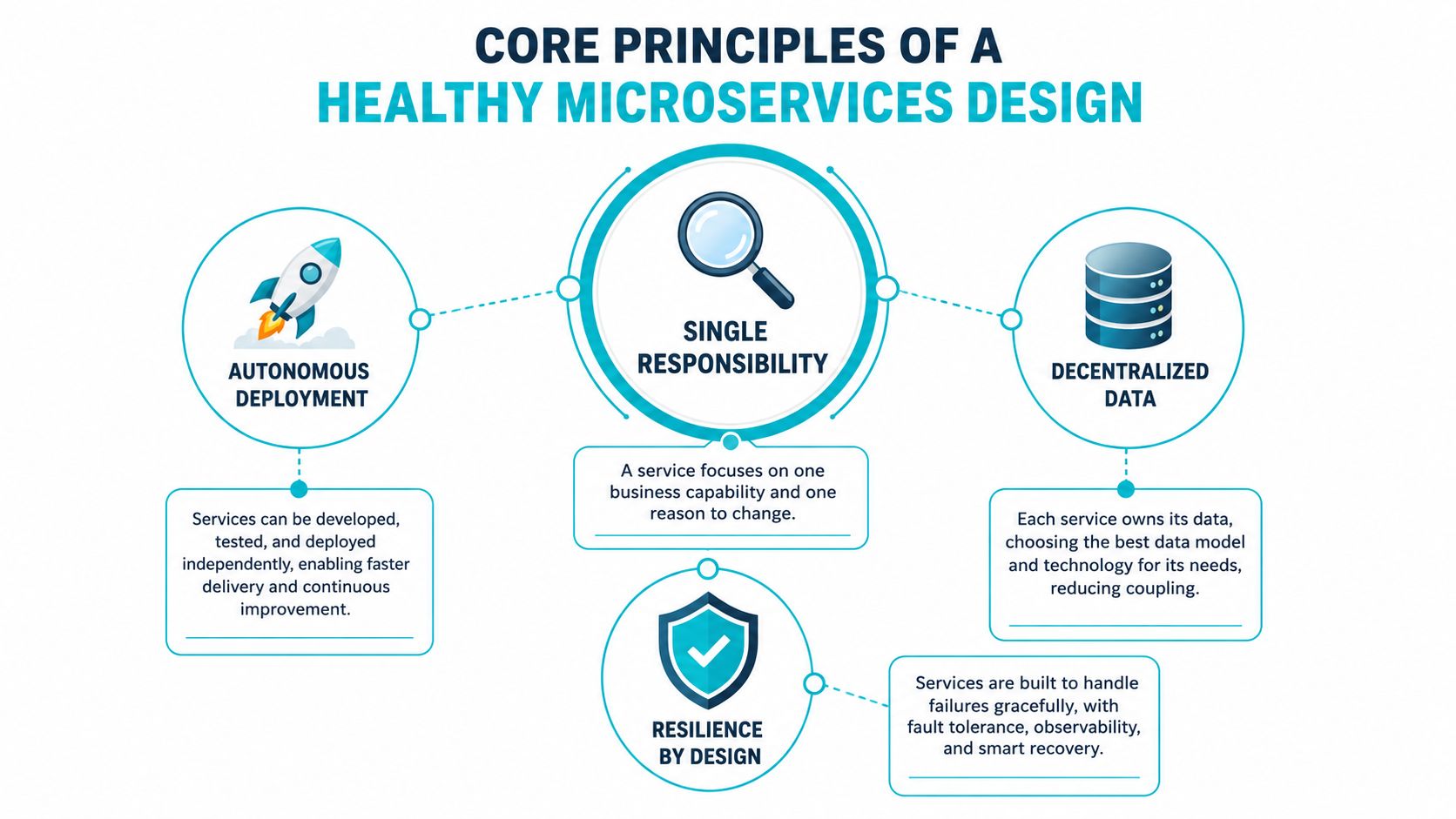
A real microservices architecture isn’t just “many services.” It has rules that keep the system from turning into a distributed monolith. Microsoft’s guidance is especially clear here, each service should implement a single business capability, be self-contained, and be deployed independently, with its own data storage where possible.Microsoft microservices architecture style Red Hat’s material adds an important warning, shared databases and shared schemas rebuild coupling even when the code is split apart.Red Hat microservices design principles
Four principles that actually matter
Start with an online store. A clean split might be Catalog, Cart, Checkout, and Recommendations. Each one owns a different business outcome, so each one can evolve at its own pace.
- Single business capability: Catalog handles product data. Checkout handles order completion. If a service starts doing three jobs, it’s drifting back toward a monolith.
- Bounded context ownership: The team responsible for checkout owns checkout behavior, contracts, and data rules. That boundary keeps domain decisions local.
- Independent deployability: You can ship a pricing tweak in Catalog without waiting on Cart or Recommendations. That’s the promise teams care about most.
- Decentralized data: Each service owns its own database or schema. That reduces schema-level dependencies and stops one domain’s migration from cascading into another.
An API gateway often sits at the edge as the client entry point. It routes requests, handles authentication, and can aggregate responses, while internal services stay focused on their own work.Microservices pattern overview
Keep the boundary where the business boundary is. If the service map mirrors the org chart but not the domain, the design usually gets messy fast.
A good test is simple. If a proposed microservice still depends on a shared database table, shared release cycle, and shared codebase conventions, it may be a smaller monolith wearing a microservices label.
Benefits and Drawbacks Engineers Actually Live With
Microservices do bring real upside, but the costs show up just as clearly. The mistake many teams make is counting the benefits twice and the overhead not at all.
The trade, not the slogan
Independent deployability is the big win. Teams can ship a change to one service without coordinating a platform-wide release. The matching tax is operational, more pipelines, more release checks, more things that can fail.
Technology freedom is useful when a service has a special need. One team may choose a different language or datastore because it fits the task better. The cost is polyglot operations, more build tooling, more runtime knowledge, and more support burden when incidents happen.
Scalability is also real. Hot services can scale without inflating the entire application. But scaling across services means you need better tracing, stronger observability, and a clearer understanding of where latency is coming from.
Team autonomy helps large organizations move faster. The downside is that every service boundary needs an explicit contract, versioning discipline, and a willingness to say no when teams want to bypass the interface.
Microservices don’t remove complexity, they move it from the codebase into the network, the pipeline, and the operations stack.
That’s why smaller teams and earlier-stage products often lose the trade. They get the coordination overhead before they get enough scale to justify it.
For a deeper look at performance trade-offs around service design and deployment, ARPHost’s application performance guidance is relevant when the bottleneck is no longer code alone but the platform around it.
Communication, Data, and Design Patterns
Microservices succeed or fail on how services talk to each other and how they own data. The architecture isn’t only about split code, it’s about choosing the right mechanics for distributed work.
Choosing the right communication style
For request-response flows, teams usually use REST or gRPC. That works when one service needs an immediate answer from another service, such as price lookup or identity validation. For slower or loosely coupled work, asynchronous messaging through queues or event streams is better because it decouples the sender from the receiver.
That choice affects failure modes. Synchronous calls are easier to reason about, but they also create direct dependency chains. Asynchronous flows are more tolerant of delay, but they require idempotency, retry discipline, and clearer event design.
An API gateway helps here by giving clients one entry point while internal services stay hidden behind routing, auth, and response aggregation. It also keeps the surface area smaller for external callers, which reduces the number of places that need to know internal service names or topologies.
Data ownership is the real fault line
Each service should own its data. That’s the database-per-service rule, and it exists to stop schema changes in one domain from breaking another domain. If Catalog owns its product schema and Checkout owns its order schema, each team can evolve independently.
That doesn’t mean database choice is trivial. If you’re deciding whether a service should live in MongoDB or SQL, a structured comparison can help you separate document fit, relational fit, and operational fit. choose between MongoDB and SQL is the kind of reference worth reading before you lock a service boundary into the wrong storage model.
When one business flow spans multiple services, distributed transactions become the hard part. The saga pattern is the common answer, because it coordinates steps with compensating actions instead of pretending one transaction can cover everything. For a Checkout flow, that may mean reserving inventory, charging payment, and rolling back each step if a later step fails.
Deployment, Orchestration, and Operations
Independent deployability only matters if the operating model can support it. Without the right tooling, microservices turn into a pile of separately broken pieces.
The operational stack you actually need
At minimum, each service needs a container image so it can run consistently across environments. Then you need an orchestrator to schedule, restart, and scale services, plus CI/CD pipelines so each service can move from commit to deploy without manual handoffs. Observability finishes the job by giving you logs, metrics, and traces across the whole system.
That stack is why microservices are not just a development pattern. They’re an operations pattern too. If you skip tracing, debugging gets slow. If you skip automated deployment, release coordination gets ugly. If you skip service-to-service traffic control, a noisy service can create problems everywhere else.
If a team says it wants microservices but doesn’t want observability, it really wants the label without the responsibility.
Service meshes add another layer for traffic shaping, mTLS, and retries, especially in larger environments. They’re not mandatory for every deployment, but they become valuable when internal traffic volume and policy needs grow.
For platform planning, ARPHost’s Kubernetes alternatives page is relevant when you need orchestration benefits without assuming one stack fits every business.
A lot of small and medium businesses don’t need the biggest possible platform, they need predictable performance and enough operational support to keep the system healthy. Dedicated hardware and private clouds help when noisy neighbors, shared capacity, or resource contention would make service behavior hard to trust.
When Microservices Are the Wrong Answer
A small team with one product usually doesn’t need the coordination overhead of microservices. A clean monolith, or a modular monolith with strong internal boundaries, often ships faster and breaks less because there’s only one deployable and one debugging surface.
The decision changes when the organization starts to feel real pressure from scale. A team might justify microservices when separate parts of the system need different scaling profiles, different release cadences, or stricter isolation for compliance or operational reasons. If none of those pressures exist, the extra machinery usually slows delivery down.
The middle path people skip
A modular monolith is the under-discussed compromise. You keep one deployable, but you still enforce boundaries inside the codebase so future decomposition doesn’t require a rewrite. That gives you room to grow without paying the full distributed-systems tax too early.
The hidden cost of microservices is mostly operational. You need better logging, better alerting, better contracts, and stronger dependency management. If a team can’t support that yet, the architecture will feel elegant in diagrams and exhausting in production.

That’s why the best first question isn’t “Can we do microservices?” It’s “Do we have enough separate pressure points to justify them?”
Migration Strategies and Infrastructure Choices
The safest migrations don’t start by breaking everything apart. They start by identifying one boundary that carries enough value to justify the work, then moving gradually.
Two migration paths
The strangler fig approach wraps new services around the old monolith and slowly absorbs functionality over time. It’s slower at first, but it lowers risk because you can redirect pieces of the system in stages. The greenfield approach starts fresh, which can be cleaner, but it puts more pressure on data migration, rollback planning, and release discipline.
Both paths need a careful read on infrastructure. A service that handles a small workload may fit comfortably on a virtual server, while a memory-heavy database, Proxmox cluster, or multi-tenant node often deserves dedicated hardware. That choice matters because container orchestration and service-to-service traffic behave better when the underlying platform is predictable.
| Workload | Recommended Infrastructure | Why It Fits |
|---|---|---|
| Small, isolated service | VPS hosting | Low overhead, flexible scaling, simpler operations |
| Memory-heavy database | Bare metal server | Predictable resource access and stronger performance isolation |
| Multi-service cluster | Dedicated Proxmox private cloud | Clear boundaries, full root access, and dedicated hardware control |
| Mixed production services | Managed services plus VPS or bare metal | Offloads monitoring, patching, and backup work |
For legacy systems, a practical migration plan often starts with one service boundary, one data owner, and one rollback path. ARPHost’s legacy system modernization strategies align well with that approach when the goal is to modernize without taking unnecessary outage risk.
Scaling This with ARPHost and Your Next Steps
Microservices architecture solves a real problem, but only when the problem is real enough to pay for the added complexity. The four principles matter most, single responsibility, bounded ownership, independent deployability, and decentralized data, and the four trade-offs always come with them, pipeline overhead, polyglot operations, tracing complexity, and stricter contract management.
If your team is splitting services, the operational burden matters as much as the design. That’s where managed infrastructure can reduce the load, especially for observability, patching, backups, and release support.
Scaling this with ARPHost
Fully managed services can absorb day-to-day operations for teams that want to focus on service design instead of server care. Secure VPS hosting and high-availability KVM plans fit workloads that need virtualization without building a full platform team. Dedicated Proxmox private clouds and bare metal servers make more sense for clusters, memory-heavy services, and multi-tenant setups where predictable performance matters.
ARPHost also supports managed migration work for teams moving away from legacy stacks, which is useful when you want to decompose gradually instead of forcing a risky rewrite. If you’re comparing hosting options for a new service split, start with the workload shape, then map it to the infrastructure that can carry it safely.
For a practical next step, review your current release pain, identify the service boundary that hurts most, and decide whether the right move is to split now or harden the monolith first. Then request a quote or ask for a migration plan that matches your current platform, not an idealized one.
A CTA for ARPHost, LLC.