

When you hear the term dedicated server hosting, think of it as the top-tier, powerhouse option for your digital operations. You're not just renting a slice of a server; you're getting the entire physical machine all to yourself.
Every ounce of its resources—CPU, RAM, and storage—is exclusively yours. This setup is built for high-traffic websites, massive databases, and mission-critical applications that simply can't afford to share resources or risk downtime.
What Is Dedicated Server Hosting, Really?
Let's use a simple real estate analogy to break it down.
Shared hosting is like renting an apartment in a huge building. You're sharing the building's foundation, plumbing, and maybe even the Wi-Fi with dozens of other tenants. A Virtual Private Server (VPS) is a step up, like a townhouse—you have your own defined space and front door, but you still share the underlying land and some walls with your neighbors.
Dedicated server hosting is like owning a standalone house. The entire property, from the foundation to the roof, is yours and yours alone. You control who comes and goes, what you do with the space, and you never have to worry about a neighbor's noisy party slowing you down.
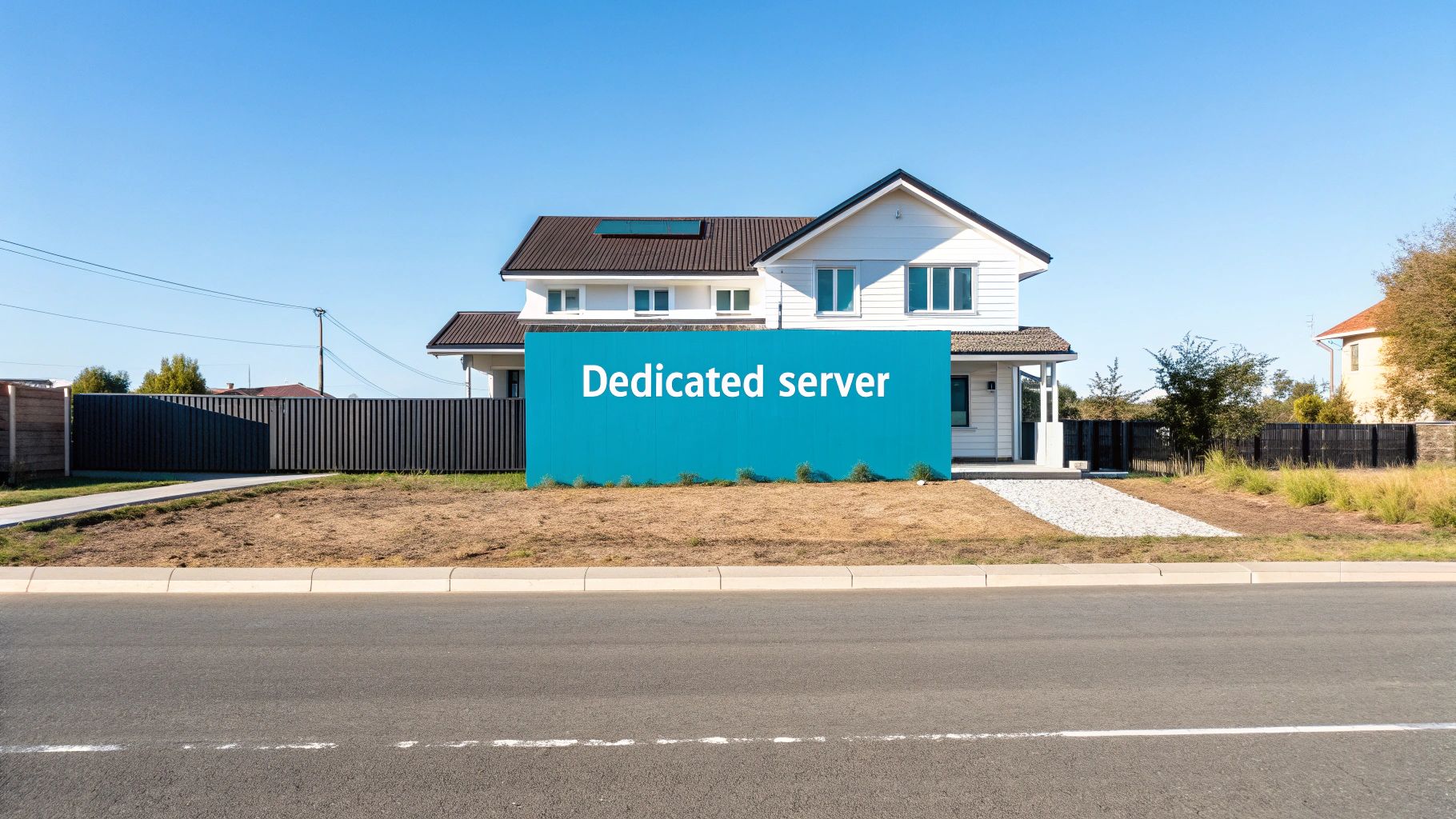
This exclusive ownership directly translates to how your website or application performs. No more competing for bandwidth or processing power.
Dedicated Server Hosting At A Glance
To make it crystal clear, here’s a quick table breaking down the fundamental differences between having a dedicated server and sharing one.
| Attribute | Dedicated Server Hosting | Shared/VPS Hosting |
|---|---|---|
| Resources | 100% exclusive access to CPU, RAM, etc. | Resources are shared among multiple users. |
| Performance | Consistently high and predictable. | Can fluctuate based on "neighbor" activity. |
| Security | Completely isolated from other users. | Potential for "noisy neighbor" vulnerabilities. |
| Customization | Full root access; install any OS/software. | Limited by the hosting provider's environment. |
| Control | Total administrative control over the server. | Restricted; provider manages the core system. |
This table really highlights why businesses with demanding needs make the leap to dedicated hardware.
The Core Benefits of Exclusive Ownership
Having an entire physical server at your disposal unlocks advantages that are simply impossible to achieve in a shared environment. For businesses where performance is tied directly to revenue, these benefits are non-negotiable.
- Unmatched Performance: With 100% of the server's processing power, memory, and disk I/O available at all times, your applications run lightning-fast. That means quicker load times, a smoother user experience, and better conversion rates.
- Rock-Solid Security: Since you're completely isolated, the risk of a security breach from another user on the same machine is zero. You have full command over your firewall, security protocols, and access policies, creating a much harder target for bad actors.
- Total Control and Customization: Need a specific operating system? A custom software stack? No problem. You have the freedom to configure the server precisely to your needs, which is essential for complex applications or industries with strict compliance requirements.
This is the kind of raw power that drives serious digital infrastructure. To see how this trend is shaping the industry, you can explore the growing dedicated server hosting market.
At ARPHost, our Bare Metal Servers deliver this exact level of performance, giving you the dedicated hardware and root access you need to handle even the most demanding workloads without compromise.
The Building Blocks of a Dedicated Server
To really get what a dedicated server offers, you need to look under the hood. It’s not some abstract service in the cloud; it’s a real, tangible piece of high-performance hardware where every component plays a crucial part in how your applications run. Think of it like building a custom race car—every single part is handpicked for raw power and absolute reliability.
At ARPHost, we build our Bare Metal Servers with enterprise-grade components from the ground up. This isn't off-the-shelf stuff. It's about delivering the consistent, raw power you need for operations that absolutely cannot fail. Let's pull back the curtain on the core components.
The CPU: The Engine of Your Server
The Central Processing Unit (CPU) is the server's brain, its engine. It's what executes the instructions from your software, crunches the data, and performs all the calculations. For a server, that means everything from running complex database queries to serving up web pages to thousands of users at once.
When you're looking at a CPU for a server, two numbers matter most:
- Clock Speed: Measured in gigahertz (GHz), this tells you how many instructions a single core can blast through per second. Higher clock speeds are a game-changer for tasks that depend on rapid, single-threaded performance, like hammering a database with specific requests.
- Core Count: Modern server CPUs aren't just single-core anymore; they’re packed with multiple processing units working in parallel. A high core count is non-negotiable for handling tons of simultaneous tasks, like serving hundreds of website visitors or running multiple virtual machines without breaking a sweat.
Imagine a busy e-commerce site during a Black Friday sale. A multi-core CPU is what ensures that inventory lookups, payment processing, and customer logins all happen in the blink of an eye, even with a massive flood of traffic.
RAM: The High-Speed Workbench
Random Access Memory (RAM) is your server’s short-term memory, or maybe a better analogy is its main workbench. It’s where the CPU keeps all the data it needs to get to right now—the operating system, active applications, and current user data. The more RAM you have, the bigger your workbench, and the more things you can juggle at once without everything slowing to a crawl.
An undersized RAM is one of the most common—and painful—performance bottlenecks out there. When a server runs out of RAM, it's forced to use the much slower storage drive as temporary memory (a process called "swapping"). The result? A massive, noticeable drop in application speed.
For a data analytics application chewing through huge datasets, having enough RAM means it can load the entire dataset right into memory for lightning-fast analysis, instead of slowly pulling bits and pieces from a storage drive.
Storage: The Warehouse for Your Data
If RAM is the workbench, then storage is the server's long-term warehouse. It’s where your operating system, applications, and all your precious data are permanently kept. The type of storage you choose has a huge impact on everything from how fast your server boots up to how quickly your applications load.
You can dig deeper into how these components fit together in our guide on choosing a dedicated server with unmetered bandwidth.
Here’s a quick breakdown of the main storage types:
- HDD (Hard Disk Drive): These are the old workhorses. They use spinning platters to store data, offering massive capacity for a low price. HDDs are perfect for things like mass data storage and backups where raw speed isn't the top priority.
- SSD (Solid-State Drive): A massive leap forward from HDDs, SSDs have no moving parts, making them incredibly fast. They've become the standard for hosting operating systems and databases because they slash load times and make everything feel snappier.
- NVMe SSD (Non-Volatile Memory Express): This is the top of the food chain for storage performance. NVMe drives plug directly into the motherboard's PCIe bus, completely bypassing older, slower data transfer protocols. This gives them the lowest latency and highest speeds you can get. For a high-traffic database or a private cloud environment, NVMe storage means data retrieval feels practically instant.
Comparing Dedicated Servers to VPS, Cloud, and Shared Hosting
Choosing the right hosting solution can feel a lot like picking the right tool for a job. You wouldn't use a sledgehammer to hang a picture frame, and you wouldn't use a tiny screwdriver to break up concrete. The same idea applies to your digital infrastructure, where the differences between dedicated servers, VPS, cloud, and shared hosting are critical to your success.
Let's break down the common options with a simple analogy: housing.
A dedicated server is like owning your own house. You have complete control over the property, every room is yours, and no one else can use your resources. It offers the ultimate in privacy, power, and security.
A VPS (Virtual Private Server) is like living in a townhouse. You have your own defined space with your own walls and front door, but you share the underlying land and some infrastructure with neighbors. It’s a great balance of privacy and cost.
Cloud Hosting is like using a modern co-living space or a high-tech hotel. You can scale your room size up or down instantly, pay only for what you use, and access a wide range of shared amenities. It’s incredibly flexible but can feel less permanent and potentially more expensive at scale.
Shared Hosting is the classic apartment building. You have your own small unit, but you share everything else—the building's plumbing, electricity, and common areas—with dozens or even hundreds of other tenants. It's affordable, but a noisy neighbor can definitely ruin your day.
This diagram shows the core components that make up any server: the Engine (CPU), the Workbench (RAM), and the Warehouse (Storage). In a dedicated server, all of these are 100% yours.
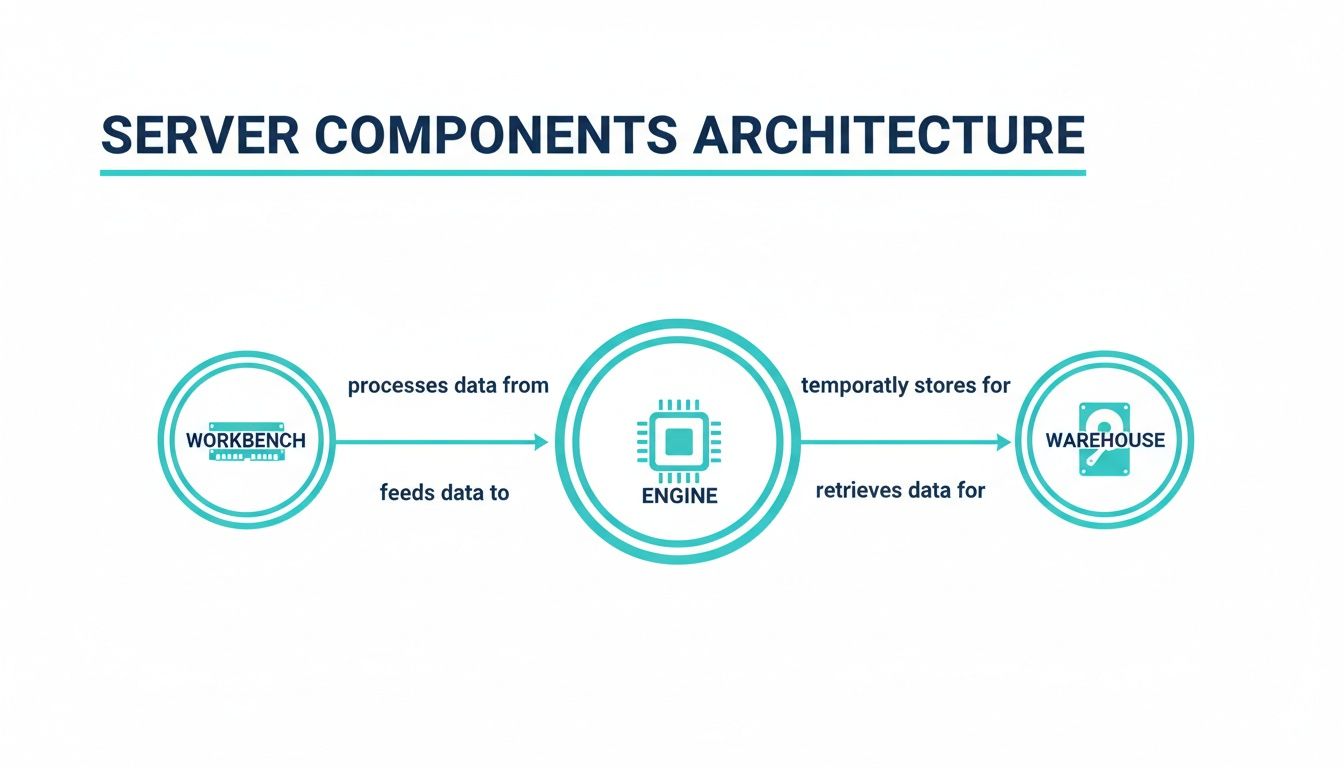
With a dedicated server, you never have to worry about someone else's activity slowing you down. That performance is consistent and entirely predictable.
To make the choice clearer, let’s compare these four hosting models side-by-side.
Hosting Comparison: Dedicated vs. VPS vs. Cloud vs. Shared
This table breaks down the key differences to help you see where each solution shines.
| Feature | Dedicated Server | VPS Hosting | Cloud Hosting | Shared Hosting |
|---|---|---|---|---|
| Performance | Highest & Consistent | Good & Consistent | Variable & Scalable | Lowest & Inconsistent |
| Resources | 100% Dedicated | Guaranteed Slice | On-Demand Pool | Shared Pool |
| "Noisy Neighbors" | None | Possible, but limited | Mitigated by architecture | Very Common |
| Control/Root Access | Full Control | Full Control (within VM) | API-driven, less hardware control | None |
| Scalability | Vertical (add RAM/CPU) | Vertical (easy upgrades) | Horizontal & Vertical (elastic) | Limited |
| Security | Highest (isolated) | Good (isolated VM) | Good (shared responsibility) | Lowest (shared environment) |
| Cost | Highest | Moderate | Pay-as-you-go (can be high) | Lowest |
| Best For | High-traffic sites, large databases, mission-critical apps | Growing businesses, dev environments, medium-traffic sites | Startups, variable workloads, SaaS applications | Personal blogs, portfolios, static sites |
Ultimately, the best choice depends entirely on your project's specific needs for performance, control, and budget.
Performance and Resource Allocation
The biggest difference comes down to one word: uncontended. With a dedicated server, you get 100% of the hardware resources, 100% of the time. For a busy e-commerce store during a Black Friday sale or a database crunching millions of records, that kind of guaranteed power is non-negotiable.
A VPS, on the other hand, carves up a single physical server into multiple virtual ones. While you get your own guaranteed slice of RAM and storage, you're still sharing the physical CPU and network connection. This can sometimes lead to the "noisy neighbor" effect, where another user's resource spike momentarily impacts your performance.
With a dedicated server, performance is a known quantity. You don't have to worry about external factors impacting your application's speed, which is vital for maintaining a great user experience and meeting service-level agreements (SLAs).
Control and Customization
Nothing beats a dedicated server for raw control. You get full root access, meaning you can install any operating system you want, tweak kernel-level settings, and deploy custom software that would never be allowed in a shared environment.
This complete control is essential for complex applications or businesses that need to meet strict compliance standards like HIPAA or PCI-DSS. For true performance purists, this level of access even allows for advanced configurations like deploying Kubernetes on bare metal, which strips out the virtualization layer entirely for maximum speed.
While VPS hosting gives you significant control inside your virtual bubble, you're still ultimately limited by the provider's platform. Cloud hosting takes this a step further, abstracting the hardware away in favor of API-driven services.
Scaling From a VPS to a Dedicated Server
Many businesses wisely start out on a VPS. It hits that sweet spot of cost, performance, and control. But eventually, growth happens, and the limitations of a shared environment can start to feel like a ceiling.
Here are the tell-tale signs it’s time to make the jump:
- Performance Bottlenecks: Your site or app feels sluggish even after you've optimized everything. You suspect "noisy neighbors" are hogging resources.
- Custom Software Needs: You need to install a specific operating system or a piece of software that your VPS provider doesn't support.
- Security and Compliance: Your business is growing and now needs to meet strict data isolation and security rules that demand dedicated hardware.
If this sounds familiar, our deep dive on dedicated server and VPS hosting is a great next read.
Here at ARPHost, we make this transition smooth. Our KVM-based High-Availability VPS plans provide a rock-solid and powerful starting point. When you're ready for that ultimate, uncontended power, migrating over to one of our Bare Metal Servers is a logical and seamless next step.
When a Dedicated Server Is the Right Choice
Making the jump from a shared server or a VPS to a dedicated server isn't just an upgrade; it's a strategic move. It’s the point where performance, airtight security, and total control stop being nice-to-haves and become absolutely essential for your business to function and grow. There comes a time when sharing resources with other users creates unacceptable risks and frustrating bottlenecks.
Let's walk through the real-world scenarios where a dedicated server isn't just a good idea—it's the only logical next step. We'll look at why having your own exclusive hardware is the key to unlocking the raw power and reliability your most demanding applications need.
High-Traffic E-commerce and Web Applications
Picture your online store on Black Friday, or a SaaS app that suddenly goes viral. In those moments, every millisecond of lag can mean a lost sale or a user who never comes back. A dedicated server gives you the raw, guaranteed horsepower to handle thousands of simultaneous connections without even breaking a sweat.
- Consistent Performance: With exclusive access to CPU cores and RAM, your e-commerce site can process payments, update inventory, and serve high-res product photos instantly, even when traffic is hammering your site.
- Database Power: Busy websites live and die by their database. A dedicated server ensures your database has the focused I/O and processing muscle it needs, eliminating the slowdowns that are common in shared environments.
- Security Isolation: You're handling sensitive customer data and credit card info. A dedicated server walls you off from the security risks of "noisy neighbors," making it much easier to meet stringent standards like PCI compliance.
For exactly these situations, an ARPHost Bare Metal Server delivers the pure, unvirtualized power necessary to keep your application blazing fast and responsive, protecting both your revenue and your reputation.
Data-Intensive Applications and Big Data Processing
If your work involves crunching massive datasets, running complex analytics, or training machine learning models, you know these applications have an insatiable hunger for resources. Whether it's scientific simulations, financial market analysis, or AI development, a dedicated server provides the high-performance computing environment you need to get the job done.
When your application needs to read and write terabytes of data, the storage and memory performance of a shared platform simply won't cut it. A dedicated server with NVMe storage and high-speed RAM can reduce data processing times from hours to minutes.
This is possible because the hardware is 100% yours. You can pack it with multi-core CPUs for parallel processing and load it up with massive amounts of RAM to hold entire datasets in memory for lightning-fast analysis.
Private Cloud and Virtualization Environments
For businesses that want the benefits of the cloud but need full control over their infrastructure, a dedicated server is the perfect foundation. Using virtualization software like Proxmox VE, you can transform a powerful bare metal machine into your own multi-tenant private cloud, capable of hosting numerous virtual machines (VMs) and containers.
This approach gives you the best of both worlds: the agility of cloud computing combined with the rock-solid security and performance of dedicated hardware.
- Complete Resource Control: You decide precisely how CPU, RAM, and storage are allocated to your VMs, with no provider-imposed limits.
- Enhanced Security: By building your own isolated network, you maintain total control over firewalls, traffic, and access policies, creating a secure fortress for your applications.
- No Hypervisor Tax: Unlike public cloud platforms, you aren't paying a premium for the provider's management layer. You get to use the hardware's full potential, directly.
ARPHost's Dedicated Proxmox Private Clouds are engineered specifically for this. We offer high-performance clusters starting at just $299/month, giving you a turnkey solution to deploy a secure, scalable private cloud with full root access.
High-Performance Gaming and Media Streaming
Online gaming and media streaming are all about two things: low latency and high bandwidth. A multiplayer game server needs to process player actions in real-time, while a streaming server has to push high-quality video to thousands of viewers simultaneously without buffering.
A dedicated server is the only way to guarantee the consistent, low-latency network connection and raw CPU power these applications demand. You get an entire machine focused on one thing: delivering a flawless, real-time experience to your users.
If your business has outgrown its current hosting, explore our powerful Bare Metal Server solutions and see how dedicated hardware can solve your performance challenges.
Managed vs. Unmanaged Servers: Do You Want to Be the Driver or the Mechanic?
Once you’ve settled on a dedicated server, you hit your first major fork in the road. This choice boils down to a simple question that defines your entire relationship with the hardware: do you want to be the mechanic, or do you just want to drive the car? This is the core difference between unmanaged and managed dedicated servers.
Unmanaged Servers: The DIY Approach for Experts
An unmanaged dedicated server is like being handed the keys to a high-performance machine with the hood wide open. You get full root access and complete control to install, configure, and fine-tune any software you can dream of. For seasoned DevOps teams and system administrators who live and breathe server management, this is paradise.
With an unmanaged server, your team owns everything from the ground up:
- Initial Server Setup: Configuring the operating system and all the core software.
- Security Patching: Diligently applying OS and application updates to stay ahead of vulnerabilities.
- Performance Monitoring: Keeping a sharp eye on CPU, RAM, and network traffic to squash bottlenecks before they happen.
- Backup Configuration: Building and managing your own disaster recovery plan from scratch.
This is the ultimate in flexibility, but it demands a serious commitment of time and deep technical skill. Every hour your team spends patching a kernel or troubleshooting a service is an hour they aren't spending on your actual product.
Managed Servers: Your Fully-Staffed Pit Crew
On the other side, managed dedicated server hosting gives you a dedicated pit crew. You get all the raw power and exclusive hardware, but a team of experts handles the daily grind of maintenance, security, and monitoring for you. This frees up your internal team to focus on innovation and growth instead of getting bogged down in routine admin tasks.
The market backs this up. In 2023, North America dominated 40% of the global dedicated server market, with managed services being a massive driver of that growth. Why? Because a good managed plan can slash administrative time by up to 70%, letting businesses reallocate those precious IT resources where they matter most. You can read the full research on the dedicated server market to get a better sense of the industry dynamics.
When you're weighing your options, understanding what a third-party expert can do is key. For example, this article on choosing a managed service provider offers some great insights into finding the right partner, even though its focus is on the cloud.
Why ARPHost Excels Here: Our Fully Managed IT Services aren't just a support line; we become an extension of your team. We don't wait for things to break. We proactively monitor your server's health, manage security patches, and maintain bulletproof backup solutions. You get all the uncontended power of a bare metal server without any of the management headaches.
With our managed services, you can count on:
- Proactive Monitoring and Alerts: We watch your server 24/7, often fixing issues before you even know they exist.
- Expert Security Management: We harden your server against threats, from firewall configuration to malware scanning with tools like Imunify360.
- Reliable Backup and Disaster Recovery: We set up and verify automated backups, so your data is always safe and recoverable.
- 24/7 Expert Support: Our team is always on standby to help with any server-related issue, giving you complete peace of mind.
Ready to offload server management and get back to building your business? Request a quote for ARPHost’s managed services and let our experts handle the heavy lifting.
How to Select the Right Dedicated Server Provider

Picking your dedicated server hardware is only half the battle. The provider you choose is just as critical—maybe even more so. A great partner ensures your investment actually translates into rock-solid performance, while the wrong one can drag you into a nightmare of downtime and security scares.
Let’s be clear: your provider is the foundation your entire digital operation rests on. A shaky foundation will undermine even the most powerful server. That’s why digging into a provider’s infrastructure, support quality, and security measures isn’t just a good idea; it’s non-negotiable for any serious business.
Evaluate Core Infrastructure and Network Quality
The provider's hardware and network backbone are what dictate your server's real-world speed and reliability. Don't get distracted by flashy server specs alone. You need to investigate the quality of the entire ecosystem that server lives in.
Here’s what to scrutinize:
- Hardware Quality: Is the provider using enterprise-grade components from names you trust? If you see consumer-grade parts mentioned, that’s a massive red flag for any production environment.
- Network Performance: A beast of a server on a sluggish network is completely useless. Look for providers that have redundant, high-speed connectivity from multiple top-tier carriers.
- Uptime Guarantee (SLA): A Service Level Agreement of 99.9% or higher isn't a luxury; it's the industry standard. This is the provider's promise to keep you online.
Why ARPHost Excels Here: We don't cut corners. Our Bare Metal Servers are built exclusively with enterprise-grade hardware. Our network is powered by high-performance Juniper devices, which means you get the low latency and maximum throughput your mission-critical applications demand.
Scrutinize Security and Support Expertise
A dedicated server gives you isolation, but top-notch security is a team sport between you and your provider. And when something inevitably goes wrong, the quality of their support team can be the difference between a five-minute fix and a five-hour outage.
Think about these critical elements:
- Security Features: Does the provider offer essentials like built-in DDoS mitigation, firewalls, and proactive server monitoring? These aren't optional add-ons; they are fundamental layers of defense. For a deeper dive, check out our guide on dedicated server DDoS protection.
- Support Availability: Tech problems don’t care about business hours. Access to 24/7 expert support through phone, chat, and tickets is absolutely vital.
- Technical Expertise: You need to be talking to actual engineers, not just someone reading from a script. Test their knowledge during the sales process—ask them specific, technical questions and see how they handle it.
Your Provider Checklist
Use this simple checklist to compare potential providers. It helps you focus on what really matters and find a true partner, not just a vendor selling you a box.
| Criteria | What to Look For |
|---|---|
| Hardware | Enterprise-grade components, transparent specs |
| Network | Redundant, high-speed, Juniper or Cisco-powered |
| Uptime SLA | Minimum 99.9% uptime guarantee |
| Security | DDoS protection, managed firewalls, Imunify360 |
| Support | 24/7/365 access to expert engineers |
| Pricing | Clear, transparent pricing with no hidden fees |
| Services | Offers a growth path (e.g., managed services, private clouds) |
Choosing a provider is a long-term relationship. By focusing on these core pillars—infrastructure, security, and support—you can build a stable and secure foundation for your business to grow on.
Ready to build a server that meets your exact specifications? Consult with our experts at ARPHost to design a custom solution backed by our enterprise-grade infrastructure and 24/7 support.
Still Have Questions? Let's Clear Things Up.
Thinking about making the leap to a dedicated server usually brings up a few practical questions. Let's tackle the big ones: cost, the migration process, and figuring out the perfect time to upgrade. Getting these answers straight is key to making a smart move for your business.
How Much Does A Dedicated Server Typically Cost?
The price tag on a dedicated server can swing pretty wildly depending on what you need under the hood and how much hands-on help you want. You might see entry-level, unmanaged servers advertised for under $100 per month. But for a real powerhouse machine—we're talking multiple CPUs, tons of RAM, and blazing-fast NVMe storage, all wrapped up with full management—you'll be looking at several hundred dollars or more.
The trick is to avoid overpaying for power you don't need. At ARPHost, our Bare Metal Servers are priced transparently and predictably. You can spec out your hardware to match your workload perfectly, so your budget goes exactly where it needs to, with no surprise fees.
Is Migrating To A Dedicated Server A Huge Headache?
Honestly, it depends on what you're moving. The complexity hinges on your current operating system, how many applications you're running, and the size of your databases. A migration can definitely be a detailed technical project, but it absolutely does not have to be a nightmare.
With ARPHost, you've got options. If your team has the skills and wants to handle it, we give you all the tools and backup support you need for a self-managed migration. On the other hand, you can just hand the keys over to us. Our fully managed IT services team includes migration pros who will handle the entire move from start to finish, ensuring everything goes off without a hitch and with next to no downtime.
When Should I Finally Ditch My VPS For A Dedicated Server?
Knowing when you've outgrown your VPS is crucial for keeping your site fast and reliable. The writing is usually on the wall when you start hitting one or more of these roadblocks:
- You're Hitting the Ceiling: Your app is constantly maxing out its CPU or RAM, causing it to slow to a crawl during busy periods.
- The "Noisy Neighbor" Problem: Your site feels sluggish even when your own traffic is low. This often means other users on the same shared hardware are hogging all the resources.
- You Need More Control: You have to run a specific operating system, make a custom kernel tweak, or install a software stack that your VPS provider just doesn't allow.
- Compliance Becomes a Big Deal: Your business needs to meet strict security standards like HIPAA or PCI DSS, which demand the total data isolation of single-tenant hardware.
If you’ve reached the point where performance and control are no longer negotiable, an ARPHost dedicated server is the logical next step. It’s your guarantee of having 100% of the resources, 100% of the time.
Ready to take control with unmatched performance and security? At ARPHost, our experts are here to help you build the perfect bare metal solution for your exact needs. Explore our Bare Metal Server plans and get started today!