

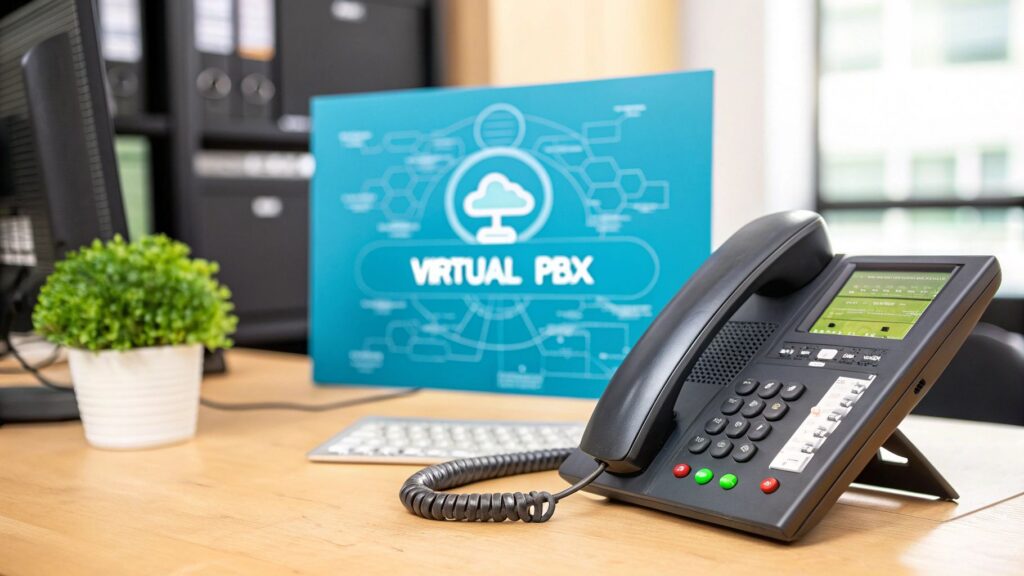
A PBX telephone system is a private phone network built for your business. Think of it as your own internal, automated switchboard that manages all your calls—both between employees and with the outside world. It allows your entire team to share a set of external phone lines, eliminating the need for a dedicated line for every single desk.
So, What Exactly Is a PBX System?
PBX stands for Private Branch Exchange. It’s the engine that powers a business's internal phone system, routing calls, managing extensions, and connecting everyone under one roof (or across multiple locations). For modern businesses, this engine is often a virtual machine running on a high-performance platform, like ARPHost's KVM-based High-Availability VPS Hosting, ensuring reliability and uptime.
This isn't a new concept. Early adopters back in the late 19th century saw telephony costs drop by up to 70% by switching from individual lines to shared extensions. It was a game-changer then, and its evolution continues to drive business value today.
Today, the technology has evolved dramatically. The market is dominated by cloud-hosted PBX solutions, which hit a massive USD 11.20 billion market share in 2023. And it's not slowing down; projections show it rocketing to USD 31.07 billion by 2030, growing at a steady 16.7% each year. You can dive deeper into the numbers in the hosted PBX market report by Grand View Research.
The Big Wins at a Glance
So why does almost every business use some form of PBX? It boils down to a few key advantages that you just can't get with a bunch of separate phone lines.
- Free internal calls make it easy for teams to collaborate without racking up a bill.
- Auto attendants act as virtual receptionists, directing callers to the right person or department automatically.
- Shared SIP trunks let you pool your phone lines, cutting service costs by optimizing bandwidth.
- Simple extensions (like x101, x102) make it dead simple to transfer calls and manage users.
The real shift has been from clunky, on-premise hardware to flexible, cloud-based virtual systems. Here’s a quick look at how they stack up.
Traditional On-Premise PBX vs Modern Virtual PBX
This table lays out the fundamental differences between the old-school closet full of hardware and today’s cloud-powered solutions, often hosted on robust platforms like ARPHost's Proxmox private clouds.
| Feature | On-Premise PBX | Virtual PBX (Hosted) |
|---|---|---|
| Cost Model | High upfront hardware & licensing costs | Simple, predictable subscription fees |
| Scalability | Limited by physical hardware capacity | Easily adjustable—add or remove users in minutes |
| Maintenance | Requires dedicated in-house IT to manage | Fully managed by the provider, no hardware fuss |
| Updates | Manual, often costly and disruptive upgrades | Automatic, seamless software improvements |
| Flexibility | A fixed feature set that rarely changes | Constant new features and integrations |
For most growing teams, the choice is clear. The flexibility and cost-effectiveness of a virtual system make more sense. You get all the advanced routing and features of a legacy PBX but at a fraction of the cost and without the management headaches.
Want to explore this further? Our detailed guide on what is a PBX system offers a much deeper dive into deployment models and how to choose the right vendor for your needs.
Why Businesses of All Sizes Are on Board
A modern PBX isn't just for massive corporations anymore. It’s a tool that adapts to whatever workflow you throw at it.
- Small businesses can share a few phone lines among the whole team, keeping costs way down.
- Large enterprises can efficiently manage thousands of extensions across multiple offices.
- Remote teams stay connected with softphones on their laptops or mobile devices, no matter where they are.
- Call centers improve customer experience with smart call routing and interactive voice menus (IVRs).
Whether you stick with an on-premise box or move to a hosted solution, a PBX is the backbone of modern business communication, especially when integrated with tools like your CRM.
How to Choose the Right PBX Provider
Making the right choice comes down to asking the right questions. Don’t just look at the price tag—think about your team’s actual needs, both today and a year from now.
- Count Your Users: Start by figuring out how many people need a line and which features are must-haves versus nice-to-haves.
- Compare the Fine Print: Look closely at pricing models (per-user, per-month) and what level of support is included.
- Check for Reliability: Ask about uptime guarantees (look for 99.9% or better) and where their data centers are located.
- Confirm Integrations: Make sure the system can work with your existing phone lines, SIP trunks, or essential business software like a CRM.
Ultimately, understanding what a PBX telephone system can do is the first step toward transforming your office communications. With a provider like ARPHost, you get the power of a Virtual PBX backed by 24/7 support and proactive monitoring, so you can focus on your business, not your phone system.
How a Modern PBX System Routes Your Calls
When someone calls your business, the journey from their phone to your employee's desk feels instant. But behind the scenes, a sophisticated process is unfolding, managed entirely by your PBX. Think of the PBX as your company’s air traffic controller for all voice communication. It seamlessly directs incoming, outgoing, and internal calls to make sure every conversation lands exactly where it needs to, without anyone plugging in a single cable.
The whole thing kicks off the moment a call hits your main business number. Instead of ringing a single, hardwired phone, the call arrives at your central PBX server. This server, which might be a virtual machine running on high-availability infrastructure like ARPHost's managed VPS hosting, is the brains of the operation. It instantly recognizes the incoming call and checks its programmed rules to decide what happens next.
This diagram gives you a quick visual of how that basic call flow works in a modern setup.
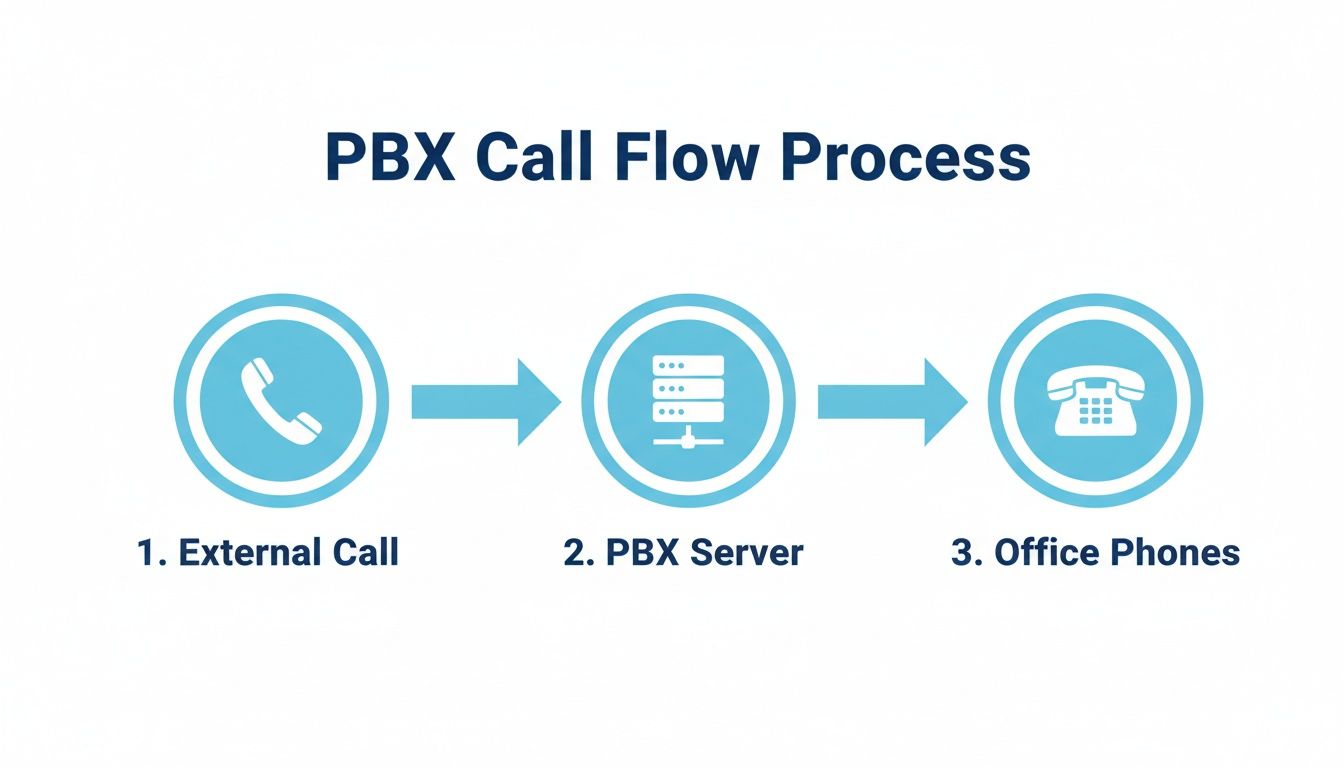
As you can see, the PBX server acts as the central hub, intelligently connecting callers from the outside world to the right people or departments inside your company.
The Core Components of Call Routing
So, how does it actually work? Let’s break down the key players involved in routing a call through a modern, IP-based PBX.
- The PBX Server: This is the heart of your phone system. It runs the software that manages everything—extensions, call queues, auto-attendants, and voicemail. With a solution like ARPHost's Virtual PBX phone systems, this server is fully managed and optimized for you right out of the box.
- SIP Trunks: These are the digital pathways connecting your PBX to the outside world over the internet. Instead of old-school copper wires, SIP trunks give you virtual phone lines, which means huge gains in flexibility and cost savings. For a deeper dive, check out our guide on how SIP trunking works.
- Endpoints: These are simply the devices your team uses to make and receive calls. We're talking about everything from traditional desk phones (now called IP phones) to softphone apps on computers and mobile apps on smartphones.
A Typical Call's Journey
Let's follow a call from start to finish to see these components in action. A customer dials your business number. That call travels over a SIP trunk and hits your PBX server. The server immediately springs to life, often greeting the caller with an automated message or menu, like "Press 1 for Sales, Press 2 for Support."
A key feature of how a modern PBX system routes your calls is its advanced call forwarding capabilities, ensuring no important call is missed. If a line is busy or goes unanswered, the PBX can automatically send the call to another extension, a cell phone, or a voicemail box based on the rules you’ve set.
If the caller presses "1" for Sales, the PBX instantly routes the call to the sales department's extension group. It can ring all the sales phones at once or cycle through them one by one until someone picks up. Once connected, the PBX maintains the call, ensuring the audio quality is crystal-clear. This entire sequence happens in milliseconds, creating a polished, professional experience for every caller, all managed quietly in the background by a powerful hosting environment.
Exploring the Different Types of PBX Systems
Not all PBX systems are created equal. Choosing the right one means digging into the key differences to find a solution that actually fits your budget, team skills, and future ambitions. The whole landscape has shifted dramatically, moving from dusty hardware closets to powerful, cloud-based platforms. Each option comes with its own set of trade-offs.
This evolution is one of the biggest transformations we've seen in business telephony. It's been driven by a massive move to the cloud, which exploded from just 20% market penetration back in 2015 to over 55% by 2024. The Virtual PBX market alone was valued at USD 6.54 billion in 2024 and is on track to hit USD 24.29 billion by 2033.
Traditional Analog and Digital PBX
Let's start with the originals, often called "legacy" systems. These were built on physical copper wiring and the old-school Public Switched Telephone Network (PSTN). These on-premise dinosaurs required a hefty upfront investment in hardware, not to mention the costs of installation and constant maintenance.
- Analog PBX: The oldest of the bunch, using traditional phone lines. They were simple and reliable for basic calls, but that’s where the features ended.
- Digital PBX: This was a step up from analog, converting your voice into digital signals. This meant better call quality and the introduction of basic features we now take for granted, like caller ID and call transfers. Still, it was all tied to a physical box in your office.
While dependable in their day, these systems are a nightmare to scale and lack the modern tools a flexible workforce needs. Adding a new employee often meant literally running a new wire through the walls.
On-Premise IP PBX
The next step in the evolution was the on-premise IP PBX. This brought the technology in-house but modernized it by using Voice over Internet Protocol (VoIP). In this setup, a server sitting in your office runs the whole show, giving you complete control over both the hardware and software.
It uses your company’s local network (LAN) to handle internal calls and connects to the outside world using SIP trunks. While this gives you more control than the old legacy systems, it also saddles you with a lot of responsibility.
Key Takeaway: An on-premise IP PBX puts you in the driver's seat, but you're also the mechanic. You're on the hook for all the maintenance, security patches, and hardware replacements. This can be a huge drain on your IT team and your budget. This is a primary reason businesses migrate to managed solutions like ARPHost's bare metal servers, where hardware management is handled for you.
Hosted or Virtual PBX
This is where most modern businesses have landed. A Virtual PBX—also known as a Hosted PBX or Cloud PBX—flips the model entirely. The entire phone system is moved off-site and runs in a provider's secure data centers. Your business simply accesses all the features and phone lines over the internet.
This completely eliminates the need for any expensive on-premise hardware, turning your phone system into a flexible, subscription-based service. When you're looking at different PBX types, it's also important to understand how calls are managed, and a hosted system is brilliant at this thanks to advanced call routing. A great guide on identifying landline, mobile, or VoIP numbers can give you more context on this.
With a provider like ARPHost, your Virtual PBX phone systems operate on seriously robust infrastructure, like our Dedicated Proxmox private clouds. This means you get enterprise-level reliability, security, and uptime without any of the management headaches. You can focus on running your business while we handle everything on the backend.
Business Benefits of a Modern Virtual PBX
Switching to a Virtual PBX telephone system is so much more than just an equipment upgrade. It's about giving your business a real competitive edge. The benefits directly hit your bottom line, supercharge productivity, and make you more adaptable—transforming your phone system from a simple utility into a powerful business tool.

The first thing you'll notice is the impact on your budget. Hosted models can slash capital expenses by 60-75% because you're no longer buying or maintaining expensive on-site servers. In 2024 alone, US businesses saved an estimated $15 billion in phone costs by moving to a cloud PBX. For companies already using ARPHost's colocation or shifting from VMware to our Proxmox private clouds, adding a Virtual PBX is a natural and seamless next step. You can read more about the hosted PBX market's rapid growth and financial impact to see just how big this shift is.
Drive Productivity and Professionalism
A Virtual PBX gives your team a suite of powerful tools that not only streamline their day but also make your business sound like a Fortune 500 company to every single caller. These aren't just for the big guys anymore; they're accessible and affordable for everyone.
- Auto-Attendant: Think of it as your virtual receptionist. It greets callers with a professional menu and gets them to the right person or department without anyone having to lift a finger.
- Voicemail-to-Email: This one's a game-changer. Voicemails land directly in your team's email inboxes as audio files, so they can listen and respond from literally anywhere.
- Call Recording: An invaluable tool for training, quality control, or settling a dispute. It helps ensure your team delivers a consistent, high-quality experience every time.
These features work in concert to make sure no call gets dropped and every customer interaction is handled like a pro, which boosts both your team’s efficiency and your clients' happiness.
Enable a Flexible, Remote Workforce
Today, work isn't a place you go—it's a thing you do. A Virtual PBX completely untethers your communications from the office, letting employees stay connected with a softphone on their laptop or a mobile app on their smartphone.
With a Virtual PBX, an employee's extension follows them from their home office to a client site. They can make and receive calls using the main business number, maintaining a professional presence regardless of their physical location.
This kind of flexibility is a must-have for attracting top talent and keeping the business running no matter what. A small business running on ARPHost's secure web hosting bundles can integrate a Virtual PBX and grow from two to twenty remote employees almost overnight, with zero new hardware needed. You can find out more about how ARPHost saves businesses thousands with Virtual PBX. By moving your phones to the cloud, you empower your team to be just as productive from anywhere with an internet connection.
Setting Up Your Virtual PBX System
Getting a modern Virtual PBX up and running is surprisingly straightforward, especially when you have a managed provider in your corner. Forget the days of needing technicians, complex wiring closets, and weeks of planning. A cloud-based system gets you launched in just a few logical steps, letting you focus on your business, not the tech.
The entire process is built to be user-friendly, moving you from initial idea to a fully functioning phone system without the usual headaches. With a partner like ARPHost, our experts handle the heavy lifting at every stage, making the transition seamless.
Step 1: Define Your Communication Needs
Before you even look at a pricing page, take a few minutes to map out what your business actually needs from its phone system. A little bit of planning here ensures you get a solution that fits like a glove from day one and can grow right alongside you.
Start by asking a few practical questions:
- How many users need an extension? Be sure to count everyone who makes or takes calls—that includes remote staff and even part-timers.
- What features are must-haves? Do you need an auto-attendant to direct callers, call recording for training, or voicemail-to-email for your team on the go?
- What’s your peak call volume? Think about your busiest time of day. How many calls are happening at once? This helps ensure you have enough capacity and no one gets a busy signal.
This quick assessment gives you a clear blueprint to build the perfect communication hub for your team.
Step 2: Choose the Right Plan
With your requirements in hand, you can now find a plan that lines up with your user count, feature list, and budget. Steer clear of one-size-fits-all packages. The best providers offer tiered plans so you only pay for what you actually use.
At ARPHost, our Virtual PBX phone systems are all about flexibility. Whether you’re a small startup needing a couple of lines or a growing business that needs advanced call center tools, we have a plan that fits. Our team will help you match your needs to the right package, ensuring you get top performance without overspending.
Step 3: Port Your Existing Business Number
One of the biggest worries for any business is losing that phone number customers have known for years. The good news? Number porting is a standard, seamless part of setting up a Virtual PBX. You don't have to change a thing on your business cards or website.
Your new provider handles the whole process, working with your old carrier behind the scenes to transfer the number with zero downtime. With ARPHost's fully managed IT services, we take full ownership of the porting, coordinating all the technical details so you can just keep working.
Step 4: Configure Your Call Flows
This is where the magic happens. You get to tell your phone system exactly how to handle incoming calls. Using a simple control panel, you’ll set up extensions, create ring groups, and design your auto-attendant menu ("Press 1 for Sales, Press 2 for Support").
- Assign Extensions: Give each team member their own unique extension.
- Build Your Auto-Attendant: Upload professional greetings to guide callers smoothly.
- Set Business Hours: Create rules for how calls are routed during and after business hours, so you never miss an important call.
You’re not on your own here. With ARPHost, our managed VoIP administration includes helping you configure these call flows to match your real-world business process. We ensure every caller has a professional and efficient experience from the very first ring.
Ready to launch a phone system that just works? Explore ARPHost's Virtual PBX solutions at arphost.com/virtual-pbx-phone-systems/ and let our experts handle the setup for you.
Why ARPHost for Your Managed Virtual PBX?
A modern phone system is only as solid as the foundation it's built on and the experts who stand behind it. This is where ARPHost truly shines. While other providers are happy to resell you a slice of a crowded public cloud, our Virtual PBX phone systems run on enterprise-grade hardware inside our own secure data centers. The result? Superior performance and stability you can actually count on.
Your business needs a communications partner, not just another vendor. Our 24/7 expert support team is here to act as an extension of your own staff, handling proactive VoIP administration and stamping out issues long before they can affect your operations.
A Unified, High-Performance Ecosystem
The real power of choosing ARPHost is how seamlessly our services work together. Our Virtual PBX isn’t a standalone product; it’s designed to integrate perfectly with our entire suite of solutions, creating a robust, unified IT environment.
- Secure Web Hosting Bundles: Pair your phone system with our high-performance web hosting to build a complete and professional online presence. Our secure VPS bundles with Imunify360 ensure your website and email are as reliable as your phone lines.
- Bare Metal Servers: Connect your PBX with powerful dedicated hardware to run your most resource-intensive business applications without a hitch.
- Dedicated Proxmox Private Clouds: For the ultimate in control and security, run your communications on a private, hyperconverged infrastructure built just for you, starting at just $299/month for a high-performance cluster.
With ARPHost, you're not just buying a phone service. You're investing in a fully managed communication strategy designed to grow right alongside your business. This holistic approach guarantees that every piece of your IT puzzle—from your servers to your phones—works together flawlessly.
Choosing ARPHost means building your communications on a foundation of reliability and deep expertise. Ready to see what a real IT partnership feels like? Request a quote for our fully managed IT services and experience the difference yourself.
Common Questions About PBX Systems
When you're looking at a new phone system, a few questions always seem to come up. Getting clear on the answers helps cut through the noise and makes choosing the right tech feel a lot less intimidating.
Is a PBX System Just Outdated Technology?
Not at all. While the clunky, on-premise PBX hardware of the past is fading, the core idea is more alive than ever. Today’s modern Virtual PBX phone systems are the evolution of that concept, using VoIP to offer features, flexibility, and remote work capabilities that old-school systems couldn't dream of. They are, without a doubt, the new standard for business communications.
Are PBX and VoIP the Same Thing?
It's a common point of confusion, but no, they're different pieces of the same puzzle. Think of it like this:
- A PBX is the "brain"—the private network that juggles all your internal extensions, routes incoming calls, and connects your entire team.
- VoIP (Voice over Internet Protocol) is the "vehicle"—it’s the technology that actually carries the voice data over the internet, instead of traditional copper phone lines.
So, a modern Virtual PBX uses VoIP as its transport method. You get the intelligent call handling of a PBX combined with the cost savings and anywhere-access of internet calling.
Can I Keep My Current Business Phone Number?
Absolutely. You’ve worked hard to build recognition with that number, and you don’t have to give it up. The process is called number porting, and it's a completely standard, seamless part of switching to a new provider.
Your number gets transferred to the new service without any downtime. Your customers won't notice a thing, except maybe clearer calls. At ARPHost, our fully managed IT services team handles the entire porting process for you, making it completely hands-off.
How Does a Virtual PBX Support Remote Work?
This is where it truly shines. A cloud-based system untethers your business phone from a physical desk. Your team can make and take calls from literally anywhere using:
- Softphone apps right on their work laptops or desktops.
- Mobile apps on their personal or company smartphones.
- A pre-configured IP phone plugged in at their home office.
No matter where they are or what device they use, every call still goes through your main business number. It keeps your company looking professional and unified, even if your team is spread across the country.
Ready to move up to a phone system built for how business works today? ARPHost delivers reliable, secure Virtual PBX Phone Systems backed by our 24/7 expert support.
Explore our Virtual PBX solutions at arphost.com/virtual-pbx-phone-systems/