


A Direct Inward Dialing (DID) number is a virtual phone number provisioned by a telecommunications provider that allows a call from the Public Switched Telephone Network (PSTN) to bypass a main receptionist or Interactive Voice Response (IVR) system and route directly to a specific endpoint within a private telephone network. This endpoint can be an individual user’s desk phone, a software client (softphone), a call queue, or an automated service.
Understanding How a DID Number Works
From a network architecture perspective, a traditional business phone system with a single main number functions like a single-entry point network. All incoming traffic hits a central point, the receptionist or auto-attendant, which then internally routes the call. This introduces latency and a single point of failure.
A DID number provides a direct virtual circuit to a specific extension or resource. When a caller dials a DID, the call is routed through the PSTN to the provider’s gateway, where it is mapped to a Session Initiation Protocol (SIP) address. This SIP URI is then passed over a SIP trunk directly to the business’s Private Branch Exchange (PBX). The PBX reads the dialed number information in the SIP header and executes a pre-configured dial plan to route the call to its final destination.
This architecture offers significant advantages over traditional telephony infrastructure:
- Direct Access: Eliminates the need for manual call transfers, reducing call setup time and improving caller experience.
- Scalability: DID numbers are virtual resources. Provisioning hundreds of DIDs for a new department or marketing initiative can be done programmatically via an API or portal in minutes, without requiring new physical line installations.
- Geographic Flexibility: A business can provision DIDs with local area codes from any market, regardless of its physical location. A headquarters in New York can use a DID with a San Francisco area code, with all calls terminating on their core PBX infrastructure.
A common misconception is that each DID number represents a dedicated physical line with its own capacity. In reality, a DID is a logical address. An organization can have thousands of DIDs, all utilizing the concurrent call capacity of a single SIP trunk. This resource pooling is a primary driver of cost efficiency in VoIP systems.
The core function of a DID is to streamline inbound call routing. When a call arrives at the PBX, the system identifies the DID in the To header of the SIP INVITE message and executes the corresponding routing logic in the dial plan. This process is deterministic, efficient, and occurs in milliseconds.
The Technical Process Behind DID Call Routing
When an external user dials a DID number, a precise technical sequence is initiated to bridge the legacy Public Switched Telephone Network (PSTN) with modern VoIP infrastructure.
The call originates on the PSTN and is routed to a gateway operated by the VoIP/SIP trunking provider. This gateway acts as a signaling and media translator, converting the PSTN’s ISUP signaling to SIP (Session Initiation Protocol) and the TDM-based audio stream into RTP (Real-time Transport Protocol) packets.
These SIP and RTP packets are then transmitted over a SIP trunk to the organization’s IP-PBX. This PBX can be a dedicated bare-metal server, a virtual machine running on platforms like Proxmox VE or VMware, or a cloud-hosted PBX service. For a detailed technical breakdown of SIP trunk functionality, review our guide here.
This direct, IP-based connection is what enables the system’s flexibility and efficiency.
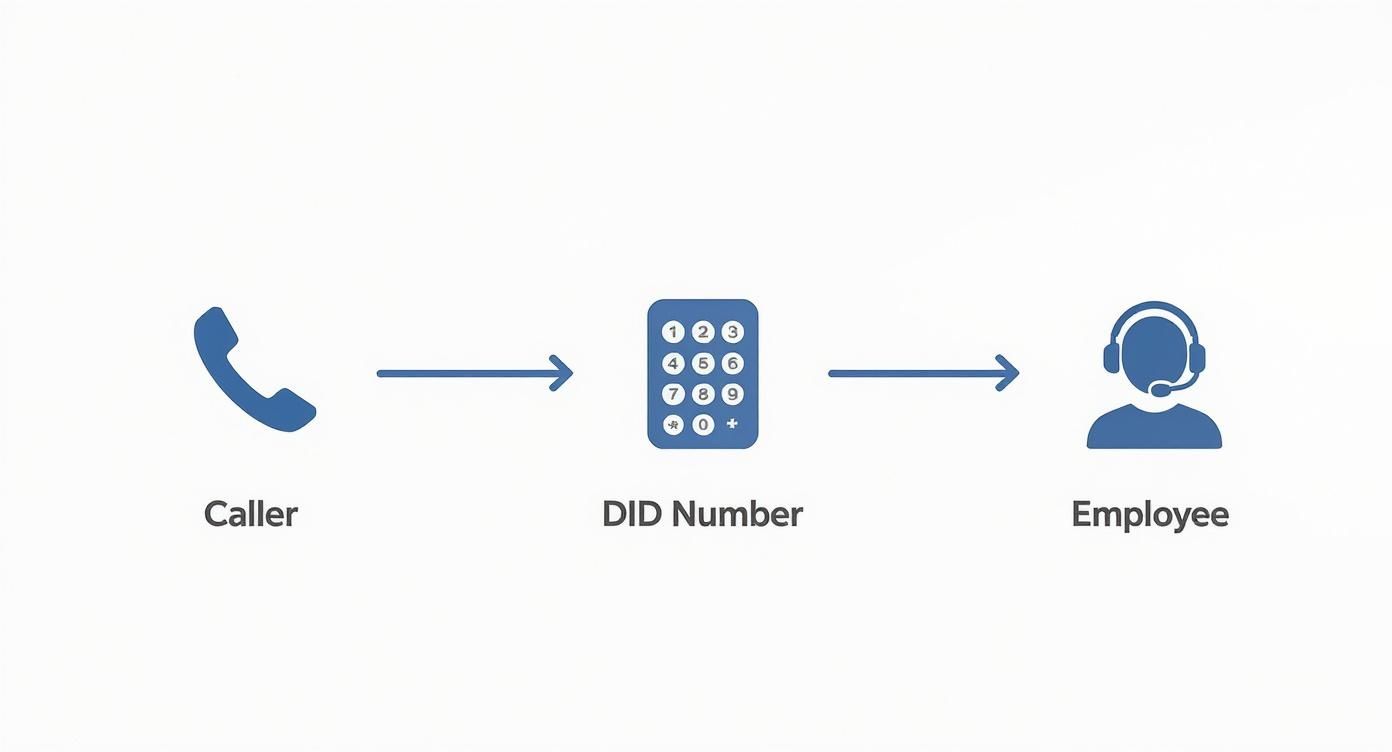
The DID number serves as a unique identifier that directs the call flow from the global telephone network to a specific endpoint within a private IP telephony environment.
How The PBX Manages Incoming Calls
Once the SIP INVITE request arrives at the PBX, its dial plan processing engine takes over. The PBX parses the request, extracts the DID number from the Request-URI or To header, and matches it against its routing table to determine the appropriate action.
This is where IT administrators and sysadmins configure the system’s logic. For example, in an Asterisk-based PBX, the extensions.conf file might contain a context for handling incoming calls from the SIP trunk. A specific entry would look like this:
[from-sip-trunk]
; Route incoming call for DID 555-123-4567 to SIP extension 101 (e.g., a desk phone)
exten => _5551234567,1,NoOp(Call received for Sales Team DID)
 same => n,Dial(SIP/101,30,T)
 same => n,Hangup()

; Route incoming call for DID 555-123-9876 to a ring group for the Support team
exten => _5551239876,1,NoOp(Call received for Support Team DID)
 same => n,Dial(SIP/201&SIP/202&SIP/203,20,m)
 same => n,Voicemail(200@default)
 same => n,Hangup()
This configuration snippet demonstrates two distinct routing rules:
- A call to
555-123-4567is logged and then directly attempts to ring the SIP device at extension101for 30 seconds. - A call to
555-123-9876simultaneously rings three extensions (201,202,203). If unanswered after 20 seconds, it’s sent to a general voicemail box.
This level of granular control, managed through simple configuration files or a GUI, is what makes DIDs a powerful tool for building sophisticated call flows. For more information on the software layer, explore different types of call routing software.
Choosing the Right Type of DID Number
Selecting the appropriate DID number type is a strategic decision that impacts brand perception, customer accessibility, and operational costs. The choice depends entirely on the business objective for that specific communication channel.
The most common type is the Local DID. These numbers are associated with a specific geographic rate center (e.g., area codes 212 for New York City or 415 for San Francisco). For businesses targeting specific regional markets, local DIDs create a sense of local presence and trust, increasing the likelihood that prospects in that area will answer or return calls.
Expanding Your Reach Nationally and Globally
When business operations scale beyond a single locality, specialized DIDs become critical components of the communications infrastructure.
- Toll-Free Numbers: These numbers (e.g., 800, 888, 877 prefixes) are non-geographic and allow callers to connect without incurring long-distance charges. They are the industry standard for national customer support lines, sales contact centers, and any scenario where removing the cost barrier for the caller is paramount.
- International DIDs: For global operations, an international DID provides an in-country local number that routes back to a central office or contact center, regardless of its physical location. A business in Chicago can have a London-based phone number, allowing UK customers to call them without dialing internationally. This is crucial for reducing friction in global commerce.
- Vanity Numbers: These are typically toll-free numbers that spell out a word (e.g., 1-800-CONTACTS). From a technical standpoint, they are identical to standard DIDs, but their marketing value lies in their memorability, making them highly effective for advertising campaigns.
The strategic deployment of DIDs is a global practice. The United States leads in enterprise adoption, representing approximately 45% of DID use cases. Concurrently, the Asia-Pacific market is experiencing rapid growth, with a compound annual growth rate exceeding 40% since 2022, largely driven by digitalization initiatives.
Aligning DID Strategy with Business Needs
Best practice involves creating a DID portfolio where each number is mapped to a specific business function. For example, a managed service provider might deploy:
- Local DIDs for regional sales teams in key markets.
- A toll-free number for its 24/7 Network Operations Center (NOC).
- A unique vanity number for a webinar or trade show marketing campaign.
The core principle is to map each DID to a specific business outcome. Is the goal to increase sales leads in a new territory? Deploy a local DID. Is the objective to improve first-call resolution for support? Use dedicated DIDs for different support tiers.
Modern unified communications platforms, including a self-hosted or managed cloud PBX provider, provide a centralized interface for managing this entire portfolio. From a single dashboard, administrators can provision new numbers, configure complex call routing rules, and analyze call detail records (CDRs) to measure the performance of each DID. This enables an agile, data-driven approach to communications management.
Practical Business Use Cases for DID Numbers
The true value of a DID number is realized when it is applied to solve specific business challenges. DIDs are not just for connecting calls; they are tools for optimizing workflows, generating business intelligence, and improving the customer journey.
A primary use case is marketing campaign tracking. Instead of using a single main number for all marketing efforts, a unique DID is assigned to each campaign (e.g., one for a Google Ads campaign, another for a trade show, and a third for a webinar). This allows the marketing team to precisely measure call volume from each channel by simply tracking the calls to each DID. This data provides clear, unambiguous ROI metrics, enabling data-driven decisions on budget allocation.
This transforms the phone system into a native analytics tool, eliminating the “how did you hear about us?” question and providing empirical data on campaign performance.

Enhancing Customer Support and Regional Presence
Another powerful application is service-level segmentation in customer support. Instead of a single, monolithic support queue, separate DIDs can be provisioned for different customer tiers.
- A dedicated DID for enterprise or VIP clients can route directly to Tier 2 or senior engineers.
- A general DID can route standard inquiries to a Tier 1 queue.
This strategy achieves two key objectives:
- Guarantees Service Level Agreements (SLAs): High-priority customers receive the expedited support they pay for, improving retention.
- Increases Team Efficiency: Agents are assigned to queues that match their skill sets, leading to faster resolution times and better resource allocation.
The underlying strategy is to use DIDs to create specialized, purpose-built communication channels. Each DID has a defined function, ensuring every inbound call is routed with maximum efficiency and context, which is fundamental for scaling service operations.
For market expansion, a local DID is an invaluable tool. An IT services firm in Miami can provision a DID with a Chicago area code to target clients in the Midwest. This creates an immediate local presence, which has been proven to significantly increase answer rates, as users are more inclined to answer calls from familiar local numbers.
Managing this requires a robust platform. ARPHost’s hosted Virtual PBX solutions, for instance, enable businesses to provision and manage DIDs for these exact use cases without capital expenditure on hardware or complex on-premise configurations.
Streamlining Departmental Communications
Finally, DIDs are essential for optimizing internal workflows in larger organizations. Assigning unique DIDs to departments such as Sales, Human Resources, and Billing eliminates the need for a receptionist or auto-attendant to act as a manual call router.
A sales lead can dial a number that routes directly to the sales team’s call queue. An applicant can reach the HR department instantly. This not only improves the external caller’s experience but also frees up administrative resources for higher-value tasks. The result is a more efficient, professional, and scalable communication architecture for the entire organization.
How to Get and Manage Your DID Numbers
Acquiring and managing Direct Inward Dialing numbers is a core administrative function in VoIP telephony. The process involves either provisioning new numbers from a carrier or porting existing numbers from a previous provider. In both scenarios, the outcome is a centralized inventory of numbers that can be configured and routed via a provider portal or directly within the PBX.
When provisioning new DIDs, an administrator selects a provider and chooses numbers based on location (area code), quantity, and type (local, toll-free). With most modern providers, this process is automated and nearly instantaneous—numbers can be added to an account and configured for routing within minutes.

Bringing Your Old Numbers with You: Number Porting
For businesses with established phone numbers printed on marketing materials and integrated into business processes, abandoning them is not an option. Number porting (Local Number Portability or LNP) is the regulated process of transferring a phone number from one carrier to another.
This process is critical for a seamless transition to a new VoIP provider and follows a standardized procedure:
- Initiate the Porting Request: Submit the numbers you wish to transfer to your new provider.
- Submit a Letter of Authorization (LOA): This is a legally required document that proves you own the number and authorizes the new provider to take control of it. The information on the LOA (business name, address, account number) must match the old carrier’s records exactly. Any discrepancy will cause the port to be rejected.
- Carrier Coordination: The new and old carriers communicate to schedule the transfer.
- Activation: On the scheduled date and time, the number is activated on the new provider’s network. A correctly executed port results in zero downtime.
Best Practice: Never cancel service with your old provider before the number porting process is confirmed as 100% complete by your new provider. Prematurely closing the account can result in permanently losing ownership of your phone numbers.
Day-to-Day DID Management and Fine-Tuning
Once numbers are in your inventory, they must be configured. This involves assigning DIDs to specific endpoints within the PBX, such as extensions, ring groups, or IVR menus. For example, a DID can be configured to ring an engineer’s desk phone for 20 seconds, and if unanswered, forward the call to their mobile device.
Advanced configurations often involve hunt groups (or ring groups), where a single DID rings multiple extensions simultaneously (simultaneous ring) or sequentially (linear or circular hunt).
Finally, ongoing management involves monitoring call analytics. Reviewing Call Detail Records (CDRs) provides insight into call volumes per DID, peak traffic hours, and abandoned call rates. This data is essential for optimizing staffing levels and refining call routing logic to improve efficiency and customer experience.
Building Your Communication System on a Solid Foundation
An effective DID strategy is contingent upon the underlying infrastructure. A feature-rich virtual PBX is useless if it runs on an unstable, under-provisioned, or insecure platform. Call quality, reliability, and security are non-negotiable, and these depend entirely on the performance of the hosting environment.
At ARPHost, we provide this foundation through managed services, private cloud infrastructure, and bare metal servers. These solutions offer the dedicated compute, memory, and network resources required to host a high-performance, scalable virtual PBX, ensuring the system can handle fluctuating call volumes without compromising quality of service (QoS).
Integrating VoIP with High-Performance Hosting
Our SIP Trunking services are engineered to integrate seamlessly with virtual PBX software deployed in high-performance virtualization environments like Proxmox VE or VMware. This architecture provides superior control, security, and performance compared to shared, multi-tenant VoIP solutions. When your communications platform is built on a dedicated, managed infrastructure, the benefits in reliability and call quality are immediate.
Partnering with a professional managed service provider for your hosting abstracts away the complexity of infrastructure management. We handle network configuration, firewall rules, security patching, and proactive monitoring, allowing your IT team to focus on core business applications and strategy.
The importance of robust infrastructure is highlighted by the rise of Decentralized Identifiers (DIDs), a core technology in emerging digital identity frameworks. The decentralized identity market is projected to reach $20 billion by 2027, a trend driven by the need for secure, resilient, and privacy-centric systems. As shown in reports on AI adoption driving growth, the kind of mission-critical infrastructure we provide is purpose-built to support these demanding applications.
Questions We Hear All the Time About DIDs
To conclude, here are answers to common technical and operational questions regarding Direct Inward Dialing.
Can a Single DID Number Be Used by Multiple People at Once?
Yes. A single DID number does not need to terminate at a single endpoint. This is one of its most powerful features.
Through a PBX feature known as a hunt group or ring group, a single DID can be configured to ring multiple extensions. The ringing can be simultaneous (all phones ring at once) or sequential (phones ring one after another in a predefined order). This configuration is standard practice for routing calls to departments like sales or support, where the objective is for the first available agent to answer the call.
Is a DID Number the Same as a Virtual Number?
These terms are often used interchangeably, but there is a subtle distinction. “Virtual number” is a broad term for any phone number not tied to a specific physical telephone line. A DID number is a type of virtual number with a specific purpose: direct inward dialing to an endpoint.
While all DIDs are virtual numbers, not all virtual numbers function as DIDs. For example, a virtual number might be used solely for outbound call presentation (caller ID) or route to a general auto-attendant, rather than a specific extension.
The key differentiator is that DIDs provide a direct, pre-configured path to a specific destination (person, queue, etc.), bypassing a central operator. They are the mechanism for direct access.
How Is DID Number Pricing Typically Structured?
DID pricing from carriers and providers typically has two components: a one-time setup fee (often waived for standard numbers) and a recurring monthly charge per number. The monthly cost is generally low, making it economically feasible to provision large blocks of numbers for specific use cases.
In addition to the monthly rental fee for the number itself, calls made or received on the DID consume the concurrent channel and minute capacity of the associated SIP trunk, which is billed separately.
Do I Need a Physical Phone System to Use DID Numbers?
No. On-premise PBX hardware is no longer a prerequisite for a professional phone system. DID numbers are ideally suited for cloud-based phone systems, commonly referred to as hosted PBX or Virtual PBX solutions.
This model allows an organization to manage its entire telephony infrastructure—including DID inventory, call routing logic, voicemail, and analytics—through a web-based portal. Configuration changes can be made from any location with an internet connection, providing maximum administrative flexibility.
Ready to build a smarter, more scalable communication system? ARPHost provides the high-performance infrastructure and expert support you need, from SIP trunks and Virtual PBX to managed Proxmox private clouds. Explore our solutions and see how we can help your business connect and grow. Learn more at ARPHost.