


For IT professionals managing high-performance infrastructure, the distinction between “unmetered” and “unlimited” bandwidth is critical. An unmetered bandwidth dedicated server operates on a transparent principle: you pay a fixed monthly fee for a dedicated network port speed, not for the volume of data transferred through it.
This model is analogous to leasing a private highway. Your recurring cost is determined by the number of lanes, your port speed, typically 1Gbps or 10Gbps, not by the amount of traffic you run on it. You can sustain a constant data flow 24/7 without incurring overage charges. This contrasts sharply with metered plans, which function like a toll road where every gigabyte of data transfer adds to your bill.
For enterprise applications, this approach delivers two primary advantages:
- Predictable Costs: Budgeting becomes straightforward with a fixed monthly expense. Traffic spikes from viral marketing campaigns, large-scale data migrations, or unexpected user surges do not impact your invoice.
- Unrestricted Performance: With no data caps, you can confidently deploy bandwidth-intensive applications like video streaming services, Content Delivery Networks (CDNs), or robust off-site backup solutions without fear of throttling or financial penalties.
A single 1Gbps unmetered port can theoretically sustain a data throughput of over 300TB per month. This capacity is sufficient for streaming thousands of HD videos concurrently without incurring additional costs. For a broader comparison of hosting models, this overview of hosting services VPS in Australia helps contextualize the value proposition of dedicated infrastructure.
Ultimately, unmetered bandwidth empowers you to optimize application performance without the overhead of data consumption monitoring. It is the ideal networking model for a bare metal server provides dedicated resources, where maximizing hardware utilization is the primary objective.
Bandwidth Models Compared Metered vs Unmetered vs Unlimited
A precise understanding of bandwidth billing models is essential for making an informed infrastructure decision. Let’s dissect the three common approaches providers use.
| Attribute | Metered Bandwidth | Unmetered Bandwidth | Unlimited Bandwidth (Marketing Term) |
|---|---|---|---|
| Billing Model | Pay-per-use. Billed for total GB/TB transferred. | Flat monthly fee based on a fixed port speed (e.g., 1Gbps). | Flat monthly fee, but with hidden “fair use” speed limits. |
| Primary Limitation | The data transfer allowance (e.g., 20TB/month). | The port speed (e.g., 1Gbps or 10Gbps). | Vague “fair use policies” and potential speed throttling. |
| Cost Predictability | Low. Costs can spike unexpectedly with traffic surges. | High. Your bill is the same every single month. | Medium. The monthly fee is fixed, but performance can degrade. |
| Performance | Consistent speed up to your port limit, until you hit your data cap. | Consistent, dedicated speed up to your subscribed port limit. | Often on a shared, contended network. Prone to throttling. |
| Ideal Use Case | Low-traffic sites, startups, or applications with predictable, low data usage. | High-traffic sites, streaming, CDNs, backups, and mission-critical apps. | Small personal websites, blogs, or brochure sites on shared hosting. |
| Transparency | High. You know exactly what you’re paying for per GB. | High. You get a dedicated port speed for a fixed price. | Very Low. “Unlimited” is a marketing term, not a technical promise. |
As the table illustrates, “unlimited” is a misnomer in a professional context. For any serious business application, the decision lies between the predictable operational expense of an unmetered plan and the variable, consumption-based cost of a metered one.
Getting Real About Unmetered Connections
While an unmetered bandwidth dedicated server eliminates overage fees, its performance is governed by physical constraints. Any system administrator must understand these technical realities, the most critical of which is port speed. This is the hard ceiling on the rate of data ingress and egress from your server at any given moment.
Think of port speed as the physical width of a data pipe. A 1Gbps port is a substantial connection, while a 10Gbps port provides an enterprise-grade uplink. Even a 10Gbps connection, if saturated continuously, would max out at approximately 3,200 TB per month. While this is a colossal amount of data, it remains a finite number defined by the hardware.
This concept map illustrates the direct relationship between port speed and billing on an unmetered plan.
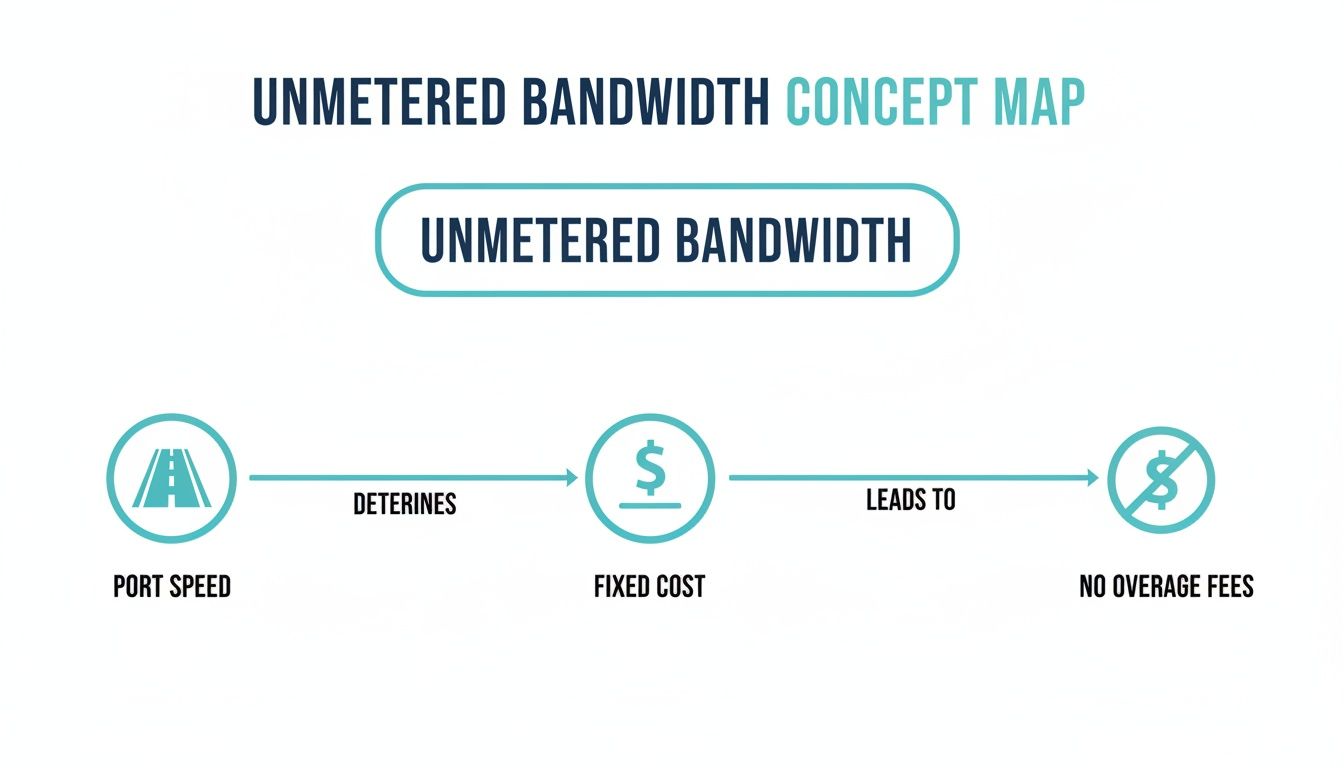
The model is simple: you select a port speed, which dictates your fixed monthly cost, insulating your budget from traffic-related fee volatility. This predictability is the core value.
Decoding Fair Use and the 95th Percentile Rule
To maintain network integrity and performance for all clients, hosting providers implement standard governance policies. These are not arbitrary restrictions but industry best practices to prevent network abuse.
- Fair Use Policy (FUP): This policy prevents a single client from monopolizing network resources through sustained, maximum-capacity usage, which could degrade performance for others on the same network segment.
- Acceptable Use Policy (AUP): This legal framework outlines prohibited activities, such as sending unsolicited bulk email (spam), launching DDoS attacks, or hosting illicit content. Violating the AUP typically results in immediate service suspension.
Most legitimate business operations will never conflict with these policies. They are designed to mitigate malicious activity, not to penalize high-traffic applications.
A critical concept in bandwidth management is 95th percentile billing. This industry-standard method ensures you are billed for sustained usage, not for brief, anomalous traffic spikes.
Here is the technical breakdown of its implementation:
- Continuous Sampling: The provider’s network monitoring system samples your server’s bandwidth usage every five minutes throughout the billing cycle.
- Peak Discarding: At the end of the cycle, these thousands of data points are sorted from highest to lowest. The top 5% of the highest usage samples are discarded entirely.
- Baseline Determination: Your billable usage is based on the next highest data point remaining after the top 5% has been removed.
This methodology is highly advantageous. It means your billing reflects your typical, sustained workload. A sudden traffic surge from a successful marketing campaign is likely to fall within the discarded 5%, ensuring your invoice remains predictable and fair.
When to Choose an Unmetered Dedicated Server

Selecting an unmetered dedicated server is a strategic decision for workloads that demand predictable costs and unthrottled performance. For business models dependent on high-volume or unpredictable traffic patterns, a metered plan introduces significant financial risk.
For industries like streaming media and SaaS, unmetered servers are the standard. They provide port-speed-based connectivity that effectively eliminates data caps, facilitating scalable growth. This preference for fixed-cost infrastructure is a key driver behind the global server market’s $366 billion valuation.
High-Volume Content Delivery
If your core business function is the distribution of large files to a broad audience, an unmetered connection is a foundational requirement.
- Video Streaming Platforms: Both live and on-demand streaming generate immense data transfer volumes. A metered plan would create an unsustainable and wildly fluctuating operational cost tied directly to viewership.
- Content Delivery Networks (CDNs): CDNs function by caching and delivering assets globally, a process that involves constant, high-volume data transfer. A fixed bandwidth cost is essential for maintaining profitability and low-latency performance.
- Large File Hosting & Distribution: For distributing software installers, large datasets, or high-resolution media, unmetered bandwidth ensures users can download assets without imposing transfer-limit anxiety on the provider.
E-Commerce and Transactional Platforms
E-commerce traffic is characterized by significant fluctuations. An unmetered server provides the necessary headroom to accommodate major sales events without financial penalty.
Consider an e-commerce platform on a metered plan during a Black Friday event. The resulting traffic surge, while beneficial for sales, could trigger massive bandwidth overage fees that erode profit margins. An unmetered server absorbs these surges as a fixed operational expense. This is a critical factor when choosing a cloud provider, where cost, performance, and security are intertwined.
Data-Intensive Operations and Gaming
Any workload involving constant, heavy data transfers or high sensitivity to latency is an ideal candidate for an unmetered model.
A metered plan forces you to treat bandwidth as a limited, costly resource. An unmetered plan transforms it into a fixed, operational expense, allowing you to scale services without fear of financial surprises.
Key technical use cases include:
- Backup and Disaster Recovery: Regularly transferring terabytes of data to off-site storage for disaster recovery will quickly exhaust a metered allowance. For example, a nightly backup of a 500GB database to a remote location consumes over 15TB per month, a volume that would be cost-prohibitive on many metered plans.
- High-Performance Game Servers: Online gaming requires sustained, low-latency connections. Unmetered plans prevent lag spikes and connection drops that occur when data caps are reached during peak gaming hours.
Selecting the right infrastructure partner is paramount. Our guide on the 5 key factors to consider when choosing a hosting provider can aid in this evaluation process.
Configuring Your Ideal Unmetered Server Setup
Let’s transition from theory to practical implementation. Architecting the right unmetered bandwidth dedicated server involves strategic component selection that aligns with your specific workload. This section covers the critical hardware and network configurations that form the foundation of a high-performance, resilient system. Misconfiguration can create a performance bottleneck that negates the benefit of a high-speed connection.
The initial decision is port speed. Resist the urge to select the highest available option without analysis. A 1Gbps connection is more than sufficient for many high-traffic websites and applications. However, for video streaming, CDN nodes, or large-scale data transfer operations, a 10Gbps port is a mandatory baseline for ensuring low latency and high throughput.
Selecting Core Components and Add-Ons
With the network port selected, the next step is to configure the server’s internal hardware and essential services. These choices directly influence performance, security, and manageability.
- Storage Technology: The choice between NVMe SSDs and traditional HDDs depends entirely on the I/O profile of your application. NVMe SSDs offer superior read/write speeds, making them essential for database-intensive applications and frequently accessed content. For instance, a database server running on NVMe can handle significantly more transactions per second (TPS) than one on HDDs. HDDs, in contrast, provide cost-effective bulk storage, ideal for archival data and backups.
- DDoS Mitigation: In-line, hardware-based DDoS protection is non-negotiable for any public-facing server. It filters malicious traffic upstream, before it reaches your server, preventing network port saturation and service outages.
- Out-of-Band Management: This provides a critical, secondary access channel to your server. An IPMI (Intelligent Platform Management Interface) or KVM-over-IP connection grants you direct, BIOS-level control, independent of the server’s operating system or primary network interface. If the OS freezes or the network becomes unreachable, IPMI is your lifeline for remote reboots, OS reinstalls, or diagnostics.
A server’s performance is only as strong as its weakest link. Pairing a 10Gbps port with slow storage or neglecting DDoS protection undermines the entire setup. A balanced configuration ensures every component works together to deliver consistent, reliable performance.
Optimizing for Network Quality
The server hardware is only one part of the equation; the provider’s network architecture is equally critical. A premium unmetered bandwidth dedicated server relies on a robust, well-connected network to deliver low latency and high availability.
When evaluating providers, look for a multi-homed network utilizing multiple Tier 1 carriers and extensive public/private peering. This ensures redundant, optimized data paths to end-users globally, minimizing latency and packet loss.
The demand for dedicated servers with unmetered bandwidth remains strong, driven by cybersecurity imperatives and performance requirements. A recent survey shows 86% of global IT professionals still rely on them over shared cloud environments for mission-critical workloads.
Modern configurations featuring NVMe SSDs with speeds exceeding 3,000 MB/s and DDR5 RAM can easily saturate a 1Gbps link, making them ideal for RAID storage arrays in media-intensive applications. To explore real-world examples, you can learn more about these powerful server configurations and their benefits. Careful component selection results in an infrastructure that is not just powerful but also resilient.
How to Monitor and Manage Network Performance

Deploying an unmetered bandwidth dedicated server is the first step. Proactive monitoring and management are essential for maximizing its value. Without effective monitoring, you are operating blind to performance bottlenecks, unable to conduct accurate capacity planning, or identify anomalous traffic patterns.
Effective network management begins with real-time visibility. Using standard command-line utilities, a system administrator can gain an immediate, granular view of traffic flowing through the server’s network interfaces. This is fundamental for diagnosing performance degradation, identifying security threats, and understanding application bandwidth consumption.
Real-Time Monitoring with Linux CLI Tools
For immediate, hands-on traffic analysis on a Linux-based server, several lightweight CLI tools are indispensable. These provide a live view of network utilization directly from the terminal.
Here are three essential utilities for every sysadmin’s toolkit:
iftop: This tool displays bandwidth usage per connection, allowing you to quickly identify which source or destination IPs are generating the most traffic. To install and run on a Debian/Ubuntu system:sudo apt-get update sudo apt-get install iftop sudo iftop -i eth0 # Replace eth0 with your network interfacenload: Provides a simple, real-time graph of incoming and outgoing traffic, including current, average, and total data transferred. It’s excellent for a quick visual overview.sudo apt-get install nload nloadvnStat: While capable of live monitoring,vnStat‘s primary strength is its long-term data logging. It runs as a lightweight daemon, collecting historical bandwidth data for generating daily, weekly, and monthly reports, which are invaluable for capacity planning.
Proactive network management means ditching the old “fix-it-when-it-breaks” mentality. By constantly keeping an eye on performance, you can solve problems before they ever affect your users, guaranteeing a smooth and reliable experience.
Leveraging Provider Graphs and Automated Alerts
In addition to CLI tools, your hosting provider offers a high-level view of network performance, typically through a client portal. These graphs, usually generated via SNMP, visualize bandwidth usage over various timeframes. Analyzing these trends is key to making informed infrastructure decisions.
Monitor for sustained usage patterns that approach your port’s capacity. While occasional spikes are normal, if your server consistently utilizes 80% or more of its port capacity, it is a clear indicator that an upgrade is necessary to maintain performance headroom.
Implement automated alerting to avoid being caught off-guard. Most managed hosting providers can configure notifications that are triggered when bandwidth usage crosses a predefined threshold for a specific duration. For example, an alert can be configured to notify you if traffic on a 1Gbps port exceeds 800Mbps for more than 15 minutes. This early warning allows you to investigate the cause—be it legitimate traffic growth or a volumetric attack—and take corrective action, such as engaging DDoS protection for your dedicated server or planning a port upgrade.
Common Questions About Unmetered Dedicated Servers
Even with a solid technical understanding, specific questions often arise regarding unmetered dedicated servers. This section addresses the most common inquiries to provide complete clarity.
Consider this a final checklist to ensure you are making a fully informed decision.
Is Unmetered Bandwidth Truly Unlimited?
No. This is the most critical distinction. “Unmetered” refers to the billing model, not infinite physical capacity. You pay a fixed monthly fee for a network port of a specific speed (e.g., 1Gbps), and you are not charged for the volume of data that traverses it.
Your actual throughput is physically limited by that port’s speed. The primary benefit is cost predictability, eliminating the risk of unexpected overage fees.
How Much Traffic Can A 1Gbps Unmetered Port Handle?
A 1Gbps (Gigabit per second) port has a theoretical maximum throughput of approximately 324 Terabytes (TB) per month if saturated 24/7. In practice, real-world usage is never a flat line due to traffic fluctuations.
However, this substantial capacity is more than adequate for the vast majority of high-traffic websites, streaming media platforms, and large-scale data backup operations, providing significant headroom for growth.
When Should I Choose Unmetered Over A Metered Plan?
Transition to an unmetered server when your bandwidth requirements are consistently high, subject to unpredictable spikes, or on a clear growth trajectory. It is the superior choice for data-intensive workloads.
Consider switching if you operate:
- Video Streaming Services or CDNs: Where high-volume data delivery is the core business function.
- Popular Game Servers: Where consistent throughput and low latency are critical for user experience.
- Busy eCommerce Sites: Particularly those experiencing significant traffic surges during promotional events.
As a general guideline, if your monthly data transfer consistently exceeds 20-30TB, an unmetered plan is typically more cost-effective and provides greater operational stability.
What Is The 95th Percentile Rule?
The 95th percentile rule is a fair and standard billing methodology for unmetered services. It is designed to prevent you from being penalized for brief, atypical traffic bursts that do not represent your server’s sustained usage.
Here’s how it works: Your provider samples your bandwidth usage at regular intervals (usually every 5 minutes). At the end of the month, they toss out the top 5% of your highest measurements. Your billable usage is then based on the very next highest sample, which better represents your sustained traffic level.
This system ensures that your costs are based on your server’s normal operational workload, not on short-lived peak events, accommodating the natural variability of internet traffic while maintaining cost stability.
Ready to put bandwidth overage fees in the rearview mirror and get total control over your infrastructure? The team at ARPHost, LLC lives and breathes high-performance bare metal servers built for demanding workloads. Explore our unmetered dedicated server solutions and build your ideal configuration today!