


For many small businesses, IT feels less like a tool and more like an anchor—a constant drain on time, money, and focus. But it doesn't have to be that way. Cloud solutions are the new engine for growth, flipping the script on traditional IT and turning it from a costly burden into your biggest competitive edge.
Think of it this way: instead of buying, housing, and babysitting physical servers in a dusty closet, you access powerful, secure infrastructure on a flexible, pay-as-you-go basis. This model kills the painful cycle of expensive hardware refreshes and gives you the power to scale your resources up or down at a moment's notice.
Why Cloud Solutions Are Your New Growth Engine

If you're staring down rising IT costs and watching your team get bogged down by operational headaches, you're not alone. The cloud isn't just another piece of tech; it's a fundamental shift that completely levels the playing field, allowing you to go toe-to-toe with larger competitors. It lets you take the budget once sunk into hardware and redirect it toward what actually matters: growing your business.
Instead of building and running your own office from the ground up, you're moving into a state-of-the-art business center. Suddenly, you have access to enterprise-grade tools, security, and scalability, all without the crippling upfront investment.
From Cost Center to Competitive Advantage
Adopting the right small business cloud solutions fundamentally rewires your company's operational DNA. It’s what lets you handle a massive, unexpected spike in e-commerce traffic without a crash, support a secure remote workforce from anywhere, and automate the tedious tasks that once ate up your day.
Working with a strategic cloud partner makes this jump feel less like a leap of faith and more like a logical next step. The benefits become obvious almost immediately:
- Financial Agility: Forget dropping huge sums on hardware. You convert large capital expenditures (CapEx) into predictable operating expenses (OpEx). Instead of a $10,000 server you'll need to replace in a few years, you might choose a scalable $299/month Proxmox Private Cloud.
- Operational Resilience: With built-in redundancy and automated backup solutions, you’re protected from the kinds of hardware failures or data loss events that could put an on-premise setup out of business for good.
- Enhanced Security: You gain access to enterprise-grade security tools—like managed firewalls, proactive monitoring, and threat detection—that are often far too expensive and complex for a small business to implement on its own.
By offloading infrastructure management, you free up your team to focus on core business goals. An expert provider like ARPHost handles the server maintenance, security patching, and network administration, turning your IT from a reactive cost center into a proactive growth driver.
Cloud solutions also give you the power to amplify your digital visibility. To make the most of your new online foundation, choosing the best SEO company is a critical next move. You can also dig deeper into modernizing your tech stack with our guide to small business IT infrastructure.
Decoding Your Cloud Deployment Options
Choosing a cloud model can feel like navigating a minefield of buzzwords. Public, Private, Hybrid—what do they even mean for your business? Getting this right is about more than just tech; it’s about building a foundation that is secure, affordable, and ready to grow with you.
Each option comes with its own set of trade-offs. The best choice isn't a one-size-fits-all answer. It depends entirely on what you need when it comes to control, security, and your budget.
Think of a Public Cloud as the city’s subway system. Providers like AWS, Google Cloud, and Microsoft Azure own and operate massive infrastructure that anyone can use. It’s cheap to get on, gets you where you need to go, and you only pay for your ride. But you’re sharing the tracks and cars with everyone else.
The Power of the Private Cloud
A Private Cloud, on the other hand, is like owning your own delivery truck. The entire environment—all the processing power, storage, and networking—is yours and yours alone. This single-tenant setup gives you unmatched security, consistent performance, and total control.
This is exactly what ARPHost's Dedicated Proxmox Private Cloud Environments deliver. We give you a turnkey private cloud on dedicated hardware. You get full root access and complete command over the virtualization layer, letting you spin up your own virtual machines and containers in a completely isolated environment.
For a small business handling protected health information (PHI) or processing high-volume financial transactions, a private cloud isn't a luxury—it's a necessity. The isolation ensures that your operations are never impacted by the "noisy neighbor" effect common in public clouds and provides a more secure posture against external threats.
Finding Balance with a Hybrid Approach
So what if you want a bit of both? That’s where a Hybrid Cloud comes in. This model mixes a private cloud with one or more public cloud services, letting you move data and apps between them as needed. It’s all about flexibility.
With a hybrid setup, you can keep your sensitive data locked down on a secure private cloud while using the public cloud’s massive scale for things like your public-facing website or less-critical apps.
This multi-cloud strategy is catching on fast. Cloud adoption among small businesses is accelerating, with their public cloud workloads expected to jump from 55% to 63% by 2026. This trend shows smaller companies are getting smart about their infrastructure, with 86% now using a mix of providers to get the best performance for the best price. You can check out more of these cloud migration stats on Auvik's blog.
To help you cut through the noise, here’s a straightforward comparison of how each model stacks up for a small business.
Cloud Deployment Models Compared for Small Businesses
This table breaks down the key differences between Public, Private, and Hybrid clouds to help you weigh the pros and cons for your specific needs.
| Factor | Public Cloud | Private Cloud (e.g., ARPHost Proxmox) | Hybrid Cloud |
|---|---|---|---|
| Control | Low; you manage your instances, but not the underlying hardware. | Full; complete root access to dedicated hardware and virtualization layer. | High; control over the private portion, less over the public. |
| Cost | Low initial cost; pay-as-you-go pricing can become unpredictable. | Higher initial cost; predictable monthly fee for dedicated resources. | Variable; combines predictable private cloud costs with public cloud usage fees. |
| Security | Shared responsibility model; you secure your apps, provider secures the infrastructure. | Highest; dedicated, isolated environment provides superior protection. | Complex; requires careful security management across different environments. |
| Performance | Variable; can be impacted by other tenants ("noisy neighbors"). | Consistent & High; dedicated resources ensure predictable performance. | Balanced; high performance for private workloads, scalable for public. |
Ultimately, choosing the right model is a strategic decision. If you need ironclad security and guaranteed performance for the applications that run your business, a dedicated private environment is the clear winner.
Ready to see what it feels like to be in complete command of your infrastructure? View Proxmox Private Cloud plans starting at $299/month and build a foundation that puts you in the driver's seat.
Choosing a Cloud Setup That Fits Your Business
Alright, let's get practical. Theory is great, but now it's time to pick a cloud configuration that actually works for your business. There’s no magic bullet here—the best small business cloud solution is never a one-size-fits-all product. It’s a setup carefully matched to your performance needs, your budget, and frankly, how much time you want to spend managing it.
Think about it this way: a brand-new e-commerce store has a completely different set of needs than a medical office. The online store needs to be affordable but ready for traffic spikes during a sale. Starting with a Secure Web Hosting Bundle or a scalable KVM VPS from just $5.99/month is a smart, cost-effective move. These plans give you a solid, secure foundation with tools like Imunify360 and CloudLinux OS, letting you grow without breaking the bank.
Now, consider a medical clinic handling patient records under strict HIPAA rules. For them, security isn't just a feature; it's a legal necessity. The only real answer is something like a Dedicated Proxmox Private Cloud. This creates a completely isolated, single-tenant environment, giving them the maximum control and data protection required.
Assessing Your Core Requirements
Before you can choose, you need to be honest about what you're trying to solve. This means taking a hard look at three things: performance, budget, and your team's technical skills.
Performance (CPU, RAM, Storage): How much horsepower do your applications really need? A simple brochure website can run on fumes, but an interactive web app with a busy database will demand a lot more CPU and RAM. For storage, it's not just about the gigabytes. If your data is mission-critical, you should be looking at High-Availability VPS plans with resilient CEPH storage to prevent data loss.
Budget: Your budget is the reality check that guides every decision. It's all about finding the sweet spot between cost and value. A cheap shared hosting plan looks great on paper, but if it leads to downtime, you'll lose far more than the few dollars you saved. A slightly more expensive VPS can be a business-saving investment.
Technical Skills: Be realistic about who's going to run this thing. Do you have an IT pro on staff who loves getting their hands dirty with full root access? Great. If not, a solution with fully managed IT services that handles all the monitoring, backups, and security might be the smarter choice. That frees you up to do what you do best: run your business.
This decision tree gives you a visual guide for how priorities like cost and control should shape your choice.
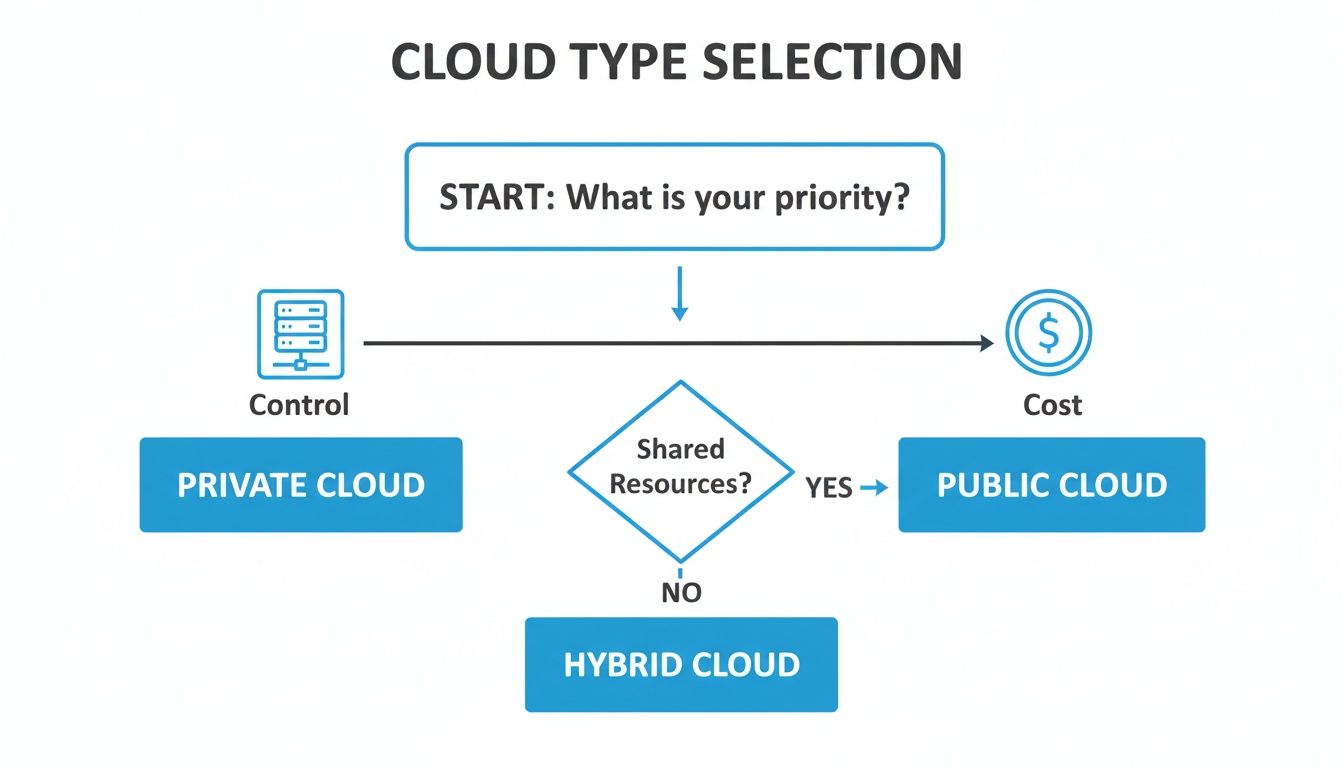
As you can see, if minimizing your upfront spend is the top priority, shared hosting or an entry-level VPS makes perfect sense. But if having total control and dedicated, unshared resources is non-negotiable, a private cloud is the only way to go.
The move toward these kinds of scalable models is more than just a trend. Small and medium-sized businesses (SMBs) are pouring money into the cloud, with the global market predicted to soar from $190.35 billion in 2025 to $234.98 billion in 2026. That’s a massive 23.4% jump, driven by businesses realizing that subscription models can slash upfront hardware costs by up to 30%. You can dig deeper into how SMBs are driving this change with these cloud spending insights from CIO Influence.
Why ARPHost Excels Here
We believe the right solution is one that fits your business, not one that forces your business to fit a predefined package. Our consultative approach means we listen first. We work with you to understand your goals, technical requirements, and budget to build a tailored solution that drives results, not headaches. With straightforward pricing, 24/7 expert support, and a comprehensive toolbox of services—from secure managed VPS hosting to dedicated Proxmox private clouds—we provide the building blocks for the perfect infrastructure.
With straightforward pricing and a whole toolbox of services, we give you the building blocks to create the perfect infrastructure. Whether you just need a single high-availability VPS with CEPH storage, a fully managed bare metal cluster for a beast of an application, or a rock-solid private cloud for compliance, ARPHost has you covered.
Ready to find your perfect fit? Start with our $5.99/month VPS or request a custom private cloud quote to talk with our experts about what you really need.
Your Step-By-Step Cloud Migration Checklist

Moving your business to the cloud isn't a leap of faith. A successful migration is never about luck; it’s all about a solid plan and methodical execution. Let's break down what can feel like a massive project into a series of clear, manageable steps.
Think of this like any other critical business project. By giving it structure and distinct phases, you ensure nothing falls through the cracks, and your new cloud setup is ready to perform from day one.
Phase 1: Audit Your Current Infrastructure
Before you pack a single digital box, you need to know exactly what you're moving. That means taking a complete inventory of every application, data source, and server that keeps your business running.
- Application Inventory: List every piece of software you rely on. Which ones are absolutely critical for daily operations? Which hold sensitive data? And which are the resource hogs?
- Data Assessment: Figure out where all your data lives. How much is there? Is it structured data sitting neatly in a database, or unstructured stuff like documents, images, and emails? This is vital for planning your storage.
- Dependency Mapping: This is the big one. You need to understand how your systems talk to each other. Does your CRM pull customer info from your accounting software? Mapping these connections is how you prevent things from breaking after you move.
Phase 2: Select the Right Cloud Partner
Your cloud provider is much more than a vendor—they're a strategic partner. A good one offers more than just cheap servers. They bring expertise, reliable support, and solutions that actually align with your business goals.
When you're looking at different providers, go beyond the flashy marketing. Ask about their support response times. Dig into their experience with migrations like yours. What specific security measures do they have in place? A provider like ARPHost offering fully managed IT services essentially becomes an extension of your team, giving you the technical horsepower you need to pull this off.
Key Takeaway: A partner’s true value is measured by their ability to solve problems and support your growth. Always prioritize expertise and responsive support over rock-bottom pricing—a botched migration will cost you far more in the long run.
Phase 3: Plan Your Migration Strategy
Not all migrations are created equal. Your approach depends entirely on how complex your applications are and what you want to achieve long-term.
- Lift-and-Shift (Rehosting): This is the most straightforward path. You basically copy your applications and data from your in-house servers to the cloud with minimal changes. It’s fast and perfect for getting to the cloud without a major overhaul.
- Refactor/Re-architect: This is a more involved strategy where you modify your applications to truly take advantage of cloud-native features. It demands more effort upfront but can pay off big time with better performance and lower costs down the road.
For many small businesses, a simple lift-and-shift to a KVM VPS or a Dedicated Proxmox Private Cloud is the perfect starting point. You get the benefits of the cloud without having to rebuild everything from scratch.
Phase 4: Execute, Test, and Optimize
With a solid plan in hand, it’s go-time. This is where you actually transfer the data and set up your applications in their new home.
- Pre-Migration Backup: Let's be crystal clear: this is non-negotiable. Before you move a single byte, perform a complete, verified backup of everything.
- Execute the Migration: You can schedule this over a weekend or during off-peak hours to minimize disruption. For more complex environments, a phased approach—moving one application at a time—is often the safest bet.
- Post-Migration Testing: Once everything is moved, test it all. Rigorously. Verify that every bit of data is intact, that all those dependencies you mapped are working, and that performance is where you expect it to be.
- Optimize: After you're live, keep a close eye on your new environment. You’ll almost certainly find opportunities to right-size your server resources or tweak configurations for even better performance and cost savings.
A well-planned migration minimizes headaches and downtime, setting your business up for whatever comes next. For a deeper dive, check out our guide on cloud migration best practices.
Putting Cloud Solutions to Work in Your Business

It’s one thing to understand cloud models in theory, but it’s another thing entirely to see them solve real-world business problems. Now, it’s time to connect the dots and see how the right tech can fix what’s broken, improve what’s working, and unlock new growth.
Let’s get practical. These aren’t just abstract concepts; they are tools designed to tackle your everyday challenges. Each example below is a mini-guide showing how you can use small business cloud solutions—specifically ARPHost’s managed services—to directly support your operations.
Run Secure High-Performance Websites and Apps
Your website is your digital storefront. Your applications run your business. If they're slow, unreliable, or insecure, you're losing customers and damaging your reputation. It's that simple.
For any business that depends on its online presence, a Secure Web Hosting Bundle is the non-negotiable starting point. It's about building on a hardened foundation from day one.
- CloudLinux OS: Think of it as creating a private, virtualized bubble for your website, even on a shared server. It stops a noisy neighbor’s resource spike from ever slowing you down, keeping your site’s performance stable and predictable.
- Imunify360 Security: This isn’t just a basic firewall. It’s a multi-layered security suite that actively hunts down and stops malware, brute-force attacks, and other common threats before they become a problem.
- Webuzo Control Panel: Deploy hundreds of popular apps like WordPress or Magento, manage your email, and oversee databases, all without needing to be a server guru.
This combination gives you a powerful, secure foundation so you can focus on running your business, not managing servers.
Why ARPHost Excels Here: Our Secure VPS Bundles come with these tools baked in from the start. We believe security isn't a costly add-on; it's a core requirement. We deliver an environment that’s ready for production, backed by 24/7 expert support when you need it.
Explore our Secure VPS Bundles and see how you can launch a fortified website in minutes.
Modernize Your Business Communications
Let's be honest: old-school, on-premise phone systems are clunky, expensive, and chain you to the office. A modern business needs its communication tools to be as flexible as its team. This is exactly where a Virtual PBX phone system shines.
By hosting your entire phone system in the cloud, you get enterprise-grade features—like auto-attendants, call forwarding, and voicemail-to-email—without the clunky, expensive hardware. Your team can make and receive calls on your main business line from their desk phone, computer, or a mobile app, no matter where they are.
The impact is immediate. With business continuity and real-time data access driving cloud adoption, a staggering 94% of businesses report major security improvements after moving to the cloud. Subscription models are especially attractive because they eliminate upfront hardware costs, a huge win for small businesses. In fact, 73% of SMBs spend less than $50,000 a month on these services, giving them the power to scale without breaking the bank. You can see how small businesses are transforming with cloud spending in this report.
Need a phone system that just works, wherever you are? Learn more about our Virtual PBX Phone Systems and unify your communications.
Power Your Mission-Critical Applications
Some applications simply cannot fail. We’re talking about your central database, custom inventory system, or that heavily used client portal. If they go down, your business grinds to a halt. For these essential workloads, you need an infrastructure built from the ground up for resilience.
This is where High-Availability KVM VPS plans come in. They are engineered with redundancy at their core to eliminate single points of failure.
- KVM Virtualization: This gives you true hardware-level isolation. Your resources are your resources, period. No more fighting with neighbors for CPU time or memory, just consistent, predictable high performance.
- CEPH Storage: This is the secret sauce for data resilience. It automatically replicates your data across multiple physical drives. If a drive fails, your data is safe and your server keeps humming along without skipping a beat.
This kind of setup offers true peace of mind, ensuring the applications that run your business are protected from the most common hardware failures.
Protect Your Business with Proactive Backups
A disaster recovery plan isn't a "nice-to-have" feature; it's essential business insurance. The question is never if you'll face a data loss event—it's when. Whether it's hardware failure, a ransomware attack, or simple human error, a robust, automated backup strategy is your only real defense.
ARPHost’s Proxmox Backup as a Service is designed for exactly this. It creates off-site, encrypted backups that are immutable—meaning they can't be altered or deleted by ransomware. With scheduled, automated backups, you can set it and forget it, knowing you can restore your entire system in a worst-case scenario.
Don't wait for a disaster to force your hand. Request a managed services quote and let us build a bulletproof backup strategy for your business.
Maximizing Value with Managed Services and Private Clouds
So you’ve made the leap to the cloud. That’s a huge first step. But getting your infrastructure online is just the beginning. The real question is, how do you turn that cloud presence into a high-performance engine for your business?
This is where you shift from just using the cloud to mastering it. It’s about moving beyond basic server upkeep and focusing on what you do best: growing your company. For most small businesses, this next step is powered by two game-changing small business cloud solutions: fully managed IT services and dedicated private clouds.
Free Your Team with Fully Managed IT Services
What if you could have an expert IT team on call 24/7, proactively keeping your servers, security, and backups in check—all without the overhead of a full-time staff? That’s the heart of managed services. Think of it as plugging an entire IT department directly into your business.
Instead of your team getting bogged down by tedious but critical tech chores, a managed services provider (MSP) takes care of it all. This isn't just about fixing things when they break; it's about preventing problems in the first place.
- Proactive Monitoring: We spot and fix issues before they can cause downtime.
- Patch Management: Your software and systems stay updated, closing doors to potential vulnerabilities.
- Advanced Security: We deploy and manage serious security tools like enterprise-grade firewalls and threat detection.
- Automated Backups: Your data is kept safe, secure, and ready for a quick restore if disaster ever strikes.
By handing off infrastructure management, you get back your team's most valuable resource—time. You can finally stop putting out IT fires and start focusing on the core activities that actually drive revenue.
The Ultimate Control of a Dedicated Proxmox Private Cloud
For businesses needing the absolute highest level of performance, security, and control, a Dedicated Proxmox Private Cloud is the final word. This isn't shared hosting; it’s your own exclusive, single-tenant environment built on hardware that’s 100% yours. You get the raw horsepower of bare metal servers paired with the unmatched flexibility of a full virtualization platform.
With complete root access, you are in total command. You can spin up, manage, and scale your own virtual machines (VMs) and containers (LXC) in a completely isolated space. This setup is perfect for:
- Handling sensitive data that falls under strict compliance rules like HIPAA.
- Running high-transaction databases or performance-hungry applications without a hitch.
- Guaranteeing total separation from other tenants, so you'll never deal with "noisy neighbor" performance dips again.
This model gives you a clear growth path from a single VPS to a powerful, private infrastructure, all without ever giving up control. You can learn more about how we make this work for businesses like yours by reading about our managed IT services for small business.
ARPHost is here to be your long-term partner, guiding you through every stage of this growth. We bring the expertise and the infrastructure to help you build an environment that’s a perfect fit for your business goals.
Ready to graduate to a fully optimized infrastructure? Request a managed services quote or explore the power of total control with our Dedicated Proxmox Private Clouds.
Your Cloud Questions, Answered
When you're running a small business, moving to the cloud can feel like a big step. You've probably got a few key questions about how it all works—especially when it comes to your budget, your data's safety, and how much technical know-how you'll need. Let's clear those up.
So, What's This Actually Going to Cost?
The beauty of the cloud is you're not locked into a huge, fixed expense. It's more like a utility—you pay for what you use, and the costs scale right alongside your business.
For instance, a startup or a small project can get off the ground with a powerful ARPHost KVM VPS for as little as $5.99/month. That gets you a real, secure server without having to sink a bunch of cash into hardware upfront.
Then, as you grow, you might need more muscle. That's when something like a Dedicated Proxmox Private Cloud makes sense. You get your own private, high-performance environment for a predictable monthly cost. The whole point is to avoid paying for idle equipment, making it a much smarter financial move than buying and maintaining your own servers.
Is My Business Data Truly Secure in the Cloud?
This is a big one, and the short answer is yes. In fact, a good cloud provider can offer a level of security that’s tough for most small businesses to match on their own. At ARPHost, we don’t just rent out space; we actively defend it with a multi-layered strategy.
It's not just a single firewall. It's a whole system working together:
- Managed Firewalls: These act as your first line of defense, filtering out malicious traffic long before it ever gets near your server.
- Imunify360 Protection: Think of this as your 24/7 security guard. It’s always scanning for malware, viruses, and web attacks and neutralizes them on the spot.
- Private Cloud Isolation: We use Proxmox VE to build completely walled-off environments. Your resources are yours alone—never shared with another customer.
And while our backup and disaster recovery systems are rock-solid, we also know that sometimes things happen on your end. For data on older physical systems or in unique situations, it's good to know that options like professional data recovery services exist.
Do I Need to Be a Tech Expert to Use This?
Not at all. While we offer unmanaged servers for the experts who want total control, many of our solutions are built for business owners who would rather focus on their business, not server maintenance.
Our fully managed IT services are like having an expert on your team. We handle the server updates, security monitoring, and backups for you.
Plus, you get tools like the Webuzo control panel, which gives you a simple, graphical interface to launch apps, manage your sites, and set up email. No command line, no headaches. Just point, click, and get back to work.
At ARPHost, we believe powerful cloud solutions should be accessible and easy to manage for every small business.
Ready to see how easy it can be? Start with our $5.99/month VPS and get your project online today.