

Server migrations are high-stakes technical projects where a single misstep can lead to downtime, data loss, and significant business disruption. A successful migration isn't a matter of luck; it’s the direct result of meticulous planning and flawless execution. This process is critical whether you're moving from an on-premise data center, upgrading legacy hardware, or transitioning from VMware to a modern Proxmox private cloud. A structured, technical approach is non-negotiable for maintaining business continuity.
This comprehensive server migration checklist breaks down the entire process into 10 actionable stages, packed with technical tips, CLI commands, and real-world scenarios. We will guide you through every critical step, from initial inventory and architecture design to the final data transfer and post-migration optimization. The goal is to provide a clear, repeatable framework that minimizes risk and maximizes efficiency.
Throughout this guide, we'll demonstrate how leveraging enterprise-grade infrastructure, such as ARPHost's Dedicated Proxmox Clouds or Secure KVM VPS, can transform a complex technical project into a strategic business advantage. You will learn not just what to do, but how to execute each step with precision, ensuring your new environment is more secure, performant, and scalable. By following this checklist, you can confidently navigate the complexities of any server migration, ensuring a smooth transition to a superior hosting solution.
1. Pre-Migration Assessment and Planning: Your Foundation for Success
Every successful server migration begins with a meticulous assessment. This foundational step involves creating a comprehensive inventory of your entire infrastructure, including all servers, applications, databases, and network configurations. Failing to document your environment accurately is a leading cause of migration failures, resulting in unexpected downtime, data loss, and compatibility conflicts. A thorough plan acts as the blueprint for your entire project, ensuring every component is accounted for.
This initial discovery phase is crucial for identifying hidden dependencies and potential roadblocks. For instance, an e-commerce store might discover its payment gateway integration has strict TLS 1.2 requirements, necessitating a server OS upgrade on the new environment before migrating. Similarly, a manufacturing firm might uncover undocumented legacy applications on an old server that require special handling or a dedicated environment, like one of ARPHost’s flexible Bare Metal Servers, to function correctly. This detailed planning is a cornerstone of effective data center migration best practices.
Key Actions for Assessment
To build a robust server migration checklist, focus on these actionable steps:
- Automate Discovery: Use tools like
nmapornetdiscoverto automatically map your servers, services, and open ports. This speeds up inventory creation and reduces human error. For example, runnmap -sV -p- 192.168.1.0/24to scan a subnet for open ports and running services. - Document Everything: Create a detailed spreadsheet or use a Configuration Management Database (CMDB) to log server hostnames, IP addresses, OS versions, hardware specs (CPU, RAM, storage), installed software, and their business functions.
- Identify Dependencies: Map the relationships between applications, databases, and external services. Use tools like
lsof -iandnetstat -tulpnto identify active network connections and understand which systems communicate with each other to avoid breaking critical workflows. - Involve Stakeholders: Collaborate with application owners and department heads. They possess invaluable knowledge about application usage, business criticality, and specific configuration needs that automated tools might miss.
2. Choose Target Infrastructure and Architecture
After mapping your existing environment, the next critical step is selecting the right destination. This decision isn't just about finding a new server; it's about choosing an architecture that aligns with your performance needs, budget, and long-term growth strategy. The choice between bare metal, virtual private servers (VPS), or a dedicated private cloud will dictate your control, scalability, and management overhead for years to come, making it a pivotal part of any server migration checklist.
The wrong choice can lead to overspending on unused resources or, worse, performance bottlenecks that cripple your applications. For instance, a high-traffic Magento store with a 50GB product database requires the raw, predictable power of Bare Metal Servers to handle 10,000 concurrent users without latency. Conversely, a WordPress multisite agency might opt for flexible KVM VPS plans to handle seasonal traffic spikes without committing to expensive hardware. Enterprises with strict compliance and control requirements often choose a Proxmox Private Cloud for complete isolation and resource management.
Key Actions for Infrastructure Selection
To ensure your new environment is a perfect fit, focus on these actionable steps:
- Match Workloads to Tiers: Analyze your application's resource demands. High-I/O databases and CPU-intensive applications thrive on dedicated bare metal, while development, staging, and less critical web applications are perfect for cost-effective VPS hosting. ARPHost's Secure Web Hosting Bundles (starting at $5.99/month) are ideal for these workloads.
- Plan for Scalability: Consider your three-to-five-year growth plan. Will you need to add more servers, CPU, or RAM? Platforms like Proxmox offer seamless scalability within a private cloud, while KVM VPS allows for quick vertical scaling.
- Evaluate Management Overhead: Assess your team's technical expertise. Unmanaged servers offer maximum control but require significant hands-on administration. If your team is lean, ARPHost’s fully managed IT services can handle the monitoring, patching, and security, freeing you to focus on your business.
- Factor in Backup and Recovery: Your backup strategy should be a primary consideration, not an afterthought. ARPHost's Dedicated Proxmox Private Clouds integrate seamlessly with Proxmox Backup Server, providing secure, encrypted, and efficient disaster recovery capabilities.
3. Backup and Create Recovery Point
Before making any changes to your live environment, creating a complete and verified backup is the most critical safety measure in any server migration checklist. This step establishes a secure recovery point, safeguarding your business against data loss, corruption, or unexpected failures during the transition. A reliable backup is not just a copy of your data; it's a tested, restorable snapshot of your entire system, including configurations, databases, and application states, ensuring you can revert to a known-good state instantly.
The value of this safety net cannot be overstated. For example, a SaaS company might discover database corruption only after the migration has started; an immutable backup ensures they can restore a clean version without losing critical customer data. Similarly, an e-commerce site that experiences a ransomware attack mid-migration can recover from encrypted, offsite backups without paying a ransom. Effective strategies for data backup and cloud migration are a fundamental component of a resilient IT infrastructure and form the backbone of any successful disaster recovery plan.
Key Actions for Backups
To ensure your backups are dependable and your migration is protected, follow these actionable steps:
- Test Your Restore Process: A backup is worthless if it cannot be restored. Before the migration, perform a full test restore to a non-production environment—like a low-cost ARPHost VPS—to verify data integrity and confirm your recovery procedures work as expected.
- Use Offsite and Encrypted Storage: Store backups in a physically separate location. This protects against on-site disasters and ransomware. ARPHost's Proxmox Private Clouds support encrypted backups to remote storage targets, securing your recovery points.
- Document Everything: Maintain clear documentation of backup locations, access credentials, encryption keys, and step-by-step restoration procedures. This documentation is vital for a swift recovery during a high-stress incident.
- Verify Backup Integrity: Use checksums to verify that the backup files have not been corrupted during transfer or storage. A simple command like
sha256sum your_backup.tar.gzcan confirm integrity before and after transfer.
4. Network Configuration and DNS Planning
Often overlooked until the final hour, network and DNS planning is the critical link that makes your new server accessible to the world. A flawless data transfer means nothing if users cannot connect to the new environment due to misconfigured firewalls, incorrect IP addresses, or lingering DNS cache. Proper network planning ensures a seamless cutover, preventing the dreaded "site not found" errors and maintaining service continuity throughout the migration.
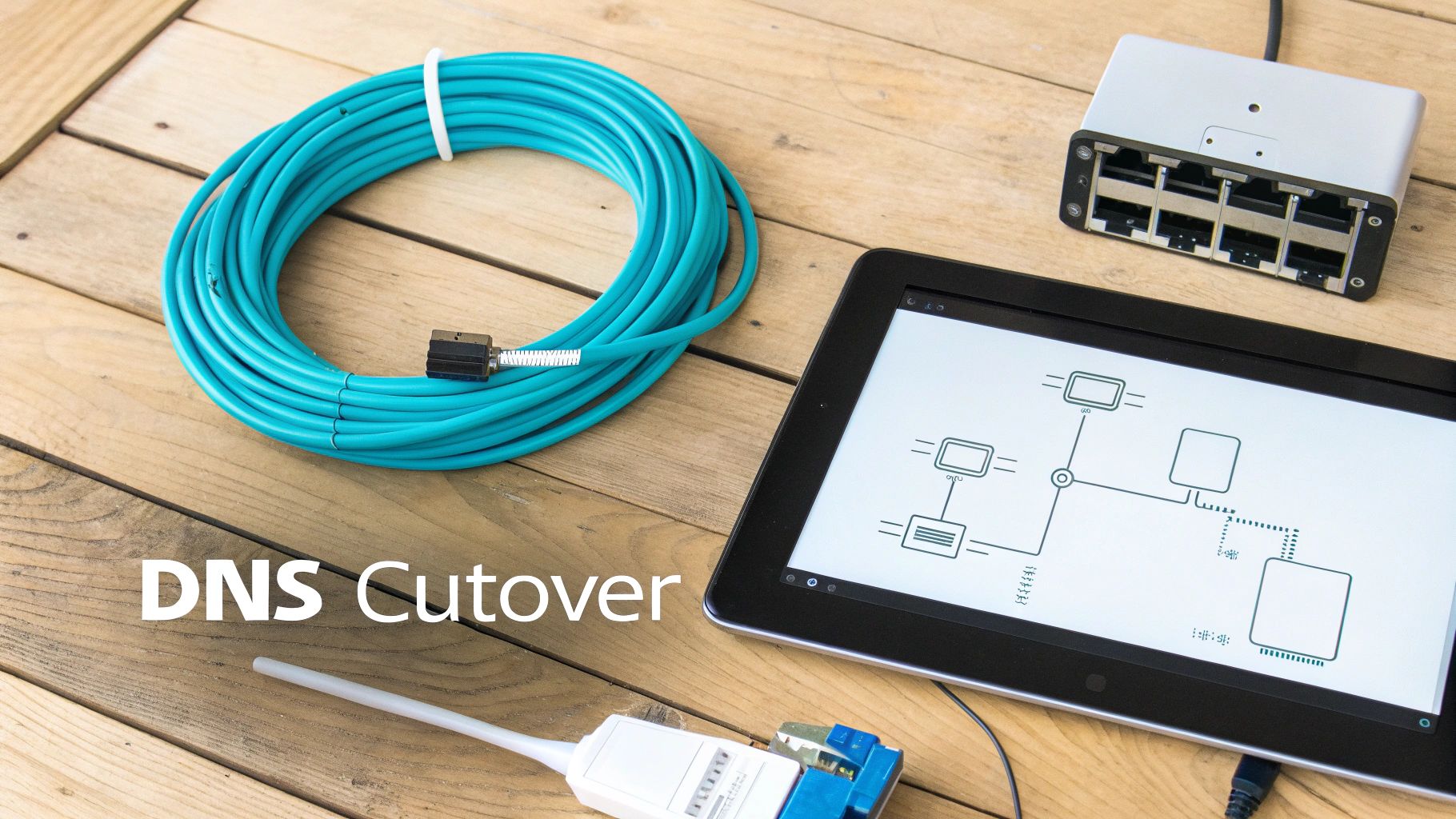
This step involves meticulously mapping out every network component, from IP address assignments to firewall rules and DNS records. For example, a SaaS company can use weighted DNS routing to gradually shift traffic to their new ARPHost High-Availability VPS, monitoring performance before completing the full cutover. A financial services firm, on the other hand, might pre-configure new Juniper firewall rules and lower their DNS TTL to just five minutes, enabling an almost instantaneous switch and a rapid rollback path if any issues arise. This detailed approach is a non-negotiable part of any professional server migration checklist.
Key Actions for Network and DNS
To ensure a smooth transition and avoid connectivity blackouts, integrate these steps into your plan:
- Lower DNS TTL Values: At least 24-48 hours before the migration, reduce the Time-to-Live (TTL) on relevant DNS records (A, AAAA, CNAME, MX) to a low value like
300seconds (5 minutes). This ensures resolvers worldwide will query for the new IP address quickly after the change. - Document and Replicate Firewall Rules: Catalog every existing firewall rule and its business purpose. Re-create these rules in the new environment, whether it's
iptableson a Bare Metal Server or a network-level firewall managed by ARPHost's managed network services. - Plan IP Address Assignment: Document the new IP addresses for all servers and services. Update all internal application configurations, scripts, and connection strings that rely on hardcoded IPs to use the new addresses or, preferably, DNS hostnames.
- Stage and Test Connectivity: Before the final cutover, use a staging domain or local
hostsfile modifications (/etc/hosts) to test all network paths to the new server. Verify that applications can connect to their databases and external APIs without issue.
5. Application and Data Migration
With the new environment provisioned and ready, the core of the server migration checklist begins: the actual transfer of applications and data. This critical phase involves moving every component from the source server to its new destination, including application code, databases, media files, and user configurations. The success of the entire project hinges on executing this step with precision to ensure data integrity, preserve permissions, and minimize downtime.
This is where the detailed planning from earlier stages pays off. Different applications require unique migration strategies. For example, migrating a VMware VM to a Proxmox VE 9 environment involves a different toolset than moving a live website to a Secure VPS Hosting plan with Imunify360. ARPHost's expertise shines here, whether you're moving to a flexible VPS Hosting plan or a high-performance Bare Metal Server, as our team has managed countless complex application transfers. Understanding these nuances prevents data corruption and ensures a smooth cutover.
Key Actions for Migration
To ensure a seamless transfer of your digital assets, focus on these actionable steps:
- Use
rsyncfor File Transfers: Leverage thersynccommand for efficient and incremental file synchronization. Running an initial sync ahead of time with a command likersync -avz --delete /path/to/source/ user@new.server:/path/to/destination/copies the bulk of the data, and a final, quick sync during the cutover window minimizes downtime. - Handle Databases Separately: For databases like MySQL or PostgreSQL, use native tools like
mysqldumporpg_dump. A typical command would bemysqldump -u root -p [database_name] > backup.sql. Importing the dump on the new server is often more reliable than setting up complex, temporary replication. - Preserve File Permissions: Data is useless if the application can't access it. Use commands like
rsync -aortar -pto ensure that file ownership and permissions are perfectly replicated on the new server. - Verify Data Integrity: After the transfer, don't just assume everything worked. Use checksums (
md5sumorsha256sum) on critical files or rundiff -ron directories to confirm that all data arrived intact and uncorrupted. This is a vital part of any successful migration, and it is a core competency when leveraging professional VMware migration tools and services.
6. Service Testing and Validation: The Final Quality Check
The migration is technically complete, but the job isn't done until you’ve rigorously tested every component. This crucial validation phase is where you systematically verify that all applications, services, and integrations function correctly on the new hardware. Skipping this step is like building a car and not test-driving it; you’re leaving the discovery of critical flaws to your end-users, which can lead to reputational damage, lost sales, and emergency rollbacks.
This process uncovers hidden configuration mismatches that are invisible during data transfer. For example, a Magento store's migration might seem successful until testing reveals that the new environment's firewall is blocking outbound connections to its payment processor, causing checkout timeouts. Similarly, a WordPress site might show its homepage but return a "white screen of death" on internal pages due to missing database references or incorrect file permissions. Proper service testing transforms a technically "complete" migration into a business-ready one.
Key Actions for Validation
A comprehensive test plan is a non-negotiable part of any professional server migration checklist. Build yours with these steps:
- Create a Detailed Test Plan: Before the migration, document every user-facing feature, backend process, and external integration. This plan should cover common workflows (e.g., user login, form submission) and critical edge cases.
- Verify Connectivity and Functionality: Test database connections, API endpoints, and file access permissions. Ensure that all cron jobs and scheduled tasks are running correctly on the new server by checking
crontab -land system logs. - Validate External Services: Check that email delivery is working and that SPF/DKIM records are configured for the new IP address to avoid being flagged as spam. Confirm that SSL certificates are correctly installed and trusted by browsers.
- Monitor System Logs: During testing,
tail -fapplication, web server (/var/log/nginx/error.log), and system logs (/var/log/syslog). These logs often reveal silent warnings or errors that indicate underlying problems before they cause a noticeable failure.
7. Scheduled Downtime and Cutover Execution
The cutover is the moment of truth in your server migration checklist. This is the carefully orchestrated phase where you finalize the transition, redirecting traffic from the old infrastructure to the new environment. A well-executed cutover minimizes service disruption and customer impact by performing the final data synchronization, updating network configurations, and restarting services within a planned maintenance window. Poor execution at this stage can lead to prolonged outages, data inconsistencies, and a frantic rollback.
This step is critical because it represents the culmination of all prior planning and testing. For example, a SaaS provider can schedule their cutover for a Saturday at 2 AM, notifying customers two weeks in advance. During the window, they stop the application on the source server, run a final rsync for any last-minute data changes, and update the DNS A records to point to their new High-Availability VPS environment at ARPHost. By providing status updates every 30 minutes, they maintain customer trust and successfully complete the migration with minimal perceived downtime.
Key Actions for Cutover Execution
To ensure a smooth and predictable transition, focus on these actionable steps:
- Communicate Proactively: Inform all stakeholders, especially customers, at least one to two weeks in advance. Provide clear details about the maintenance window, expected duration, and potential impact. Use a status page for real-time updates during the event.
- Finalize Data Synchronization: Stop services on the source server (
systemctl stop nginx php-fpm mysql) to prevent new data writes. Perform a final, incremental backup and restore or a finalrsyncto ensure the new server has the absolute latest information. - Execute the Network Switch: Update DNS records, reconfigure load balancers, or update firewall rules to direct traffic to the new server's IP address. Use online tools like
dnschecker.orgto verify DNS propagation from multiple geographic locations. - Monitor and Validate: Once services are live on the new server, continuously monitor error logs, CPU load (
top), memory usage (free -h), and application responsiveness. Have the team perform a series of pre-defined tests to confirm all critical functionality is working as expected before declaring the migration a success.
8. Performance Monitoring and Optimization
Successfully launching your server in its new environment is not the finish line; it’s the beginning of a new performance lifecycle. Post-migration monitoring is a critical step in your server migration checklist that validates the success of the move and ensures the new infrastructure meets or exceeds performance expectations. This phase involves establishing a new performance baseline and proactively identifying bottlenecks before they impact end-users, guaranteeing a smooth transition and long-term stability.
This continuous optimization process is where the true value of the migration is realized. For instance, a high-traffic WordPress site might discover that specific database queries are running slower on the new hardware. By analyzing slow query logs, administrators can add a missing index, reducing page load times from two seconds to under 500 milliseconds. Similarly, an e-commerce store could find that implementing Redis caching for product data on their new VPS Hosting plan drastically improves checkout performance, directly boosting conversions and revenue.
Key Actions for Monitoring
To ensure your new server environment is performing optimally, focus on these actionable steps:
- Establish a New Baseline: Immediately after migration, capture performance metrics for CPU, memory, disk I/O, and network throughput under normal load using tools like
sar,vmstat, andiostat. Compare these against the pre-migration baseline to confirm performance parity or improvement. - Set Up Proactive Alerting: Configure monitoring tools (e.g., Zabbix, Prometheus) to send alerts when key metrics exceed predefined thresholds (e.g., CPU utilization > 80% for 5 minutes). This allows you to address issues before they cause downtime.
- Analyze Application-Specific Metrics: Go beyond server health. Monitor application response times, database query performance, and user transaction speeds. For a SaaS platform, this could mean identifying a single customer's API calls consuming excessive resources and optimizing their access patterns.
- Leverage Managed Monitoring: For businesses without a dedicated 24/7 operations team, using a managed service is crucial. ARPHost's fully managed IT services provide constant oversight, expert analysis, and rapid response to performance degradation, ensuring your infrastructure is always optimized.
9. Documentation and Knowledge Transfer
A server migration is not complete once the final service goes live; its success is cemented through comprehensive documentation. This critical final step transforms a one-time project into a repository of institutional knowledge, ensuring that future infrastructure changes, troubleshooting, and team handoffs are smooth and efficient. Neglecting documentation is a common mistake that forces teams to rediscover solutions and repeat past errors, increasing operational costs and response times. A well-documented migration provides the 'why' behind every decision, not just the 'what' and 'how'.
This process is about creating a living blueprint of your new environment. For instance, a DevOps team that creates a detailed runbook for restoring a backup on their new ARPHost Proxmox Private Cloud can drastically reduce their Mean Time To Recovery (MTTR) from hours to minutes. Similarly, maintaining updated architecture diagrams enables an operations team to quickly pinpoint and resolve a database connectivity issue after a migration. This documentation becomes an invaluable asset for onboarding new team members and ensures operational continuity, forming a key part of any robust server migration checklist.
Key Actions for Documentation
To build a valuable knowledge base from your migration project, focus on these actionable steps:
- Document As You Go: Do not wait until the project is over. Record decisions, commands, and configurations in real-time. This prevents details from being forgotten and ensures accuracy.
- Create Detailed Runbooks: Develop step-by-step guides for common operational tasks like applying security patches, restoring backups, or scaling resources. Include screenshots and specific CLI commands.
- Visualize the Architecture: Use tools like diagrams.net or Lucidchart to create visual diagrams of your new server environment. Show server connections, data flows, and network configurations to provide an at-a-glance overview.
- Maintain a Change Log: Keep a meticulous log of every modification made during and after the migration. Document the date, the person responsible, the change made, and the reason for it.
- Securely Store Credentials: Use a dedicated, encrypted password manager like Bitwarden or KeePass to store all new credentials, API keys, and access procedures. Never store sensitive information in plain text documents.
10. Decommissioning of Old Infrastructure
The final, and often overlooked, step in a server migration checklist is the secure decommissioning of the old infrastructure. Once your new environment has been running stably for a designated period, typically one to four weeks, it's time to retire the old hardware. This process is not just about shutting servers down; it's a critical security and financial measure that prevents lingering vulnerabilities from unpatched systems and eliminates unnecessary hosting or colocation costs. Proper decommissioning completes the migration lifecycle and solidifies your new, more efficient operational state.
Failing to properly decommission servers can lead to significant problems. For example, a retail business might continue paying thousands in colocation fees for months, unaware the old servers are still online. Worse, an abandoned server connected to the network could become a gateway for attackers. A well-executed decommissioning plan, such as reusing old bare metal servers for a non-production development environment, can also save on future hardware procurement. This final step ensures a clean break, maximizing the financial and security benefits of your migration.
Key Actions for Decommissioning
To ensure a thorough and secure decommissioning process, focus on these actionable steps:
- Establish a Waiting Period: Wait at least 1-4 weeks after the migration is complete and the new system is declared stable. This buffer ensures you can fail back to the old environment if an unforeseen critical issue arises.
- Perform Secure Data Destruction: Before disposal, all data on old storage media must be irreversibly destroyed. Use tools like
shredordd(e.g.,dd if=/dev/urandom of=/dev/sda bs=4096) to overwrite disks multiple times, making data recovery virtually impossible. - Terminate All Related Services: Cancel any associated hosting accounts, software licenses that do not transfer, SSL certificates, and support contracts tied to the old hardware. Inform your accounting team to ensure final bills are processed and recurring payments are stopped.
- Document and Dispose of Hardware: Document the final state of the old servers for archival purposes. If the hardware is still valuable, consider repurposing it for non-critical roles or donating it. Otherwise, work with a certified electronics recycler to ensure responsible disposal.
10-Step Server Migration Checklist Comparison
| Step | 🔄 Implementation Complexity | ⚡ Resources & Speed | 📊 Expected Outcomes | Ideal Use Cases | ⭐ Key Advantages / 💡 Tip |
|---|---|---|---|---|---|
| Pre-Migration Assessment and Planning | High — detailed inventory & dependency mapping | High staff/time; slow to complete | Comprehensive inventory, compatibility & risk list | Large, heterogeneous or legacy environments | Prevents surprises; use automated discovery (nmap) and involve app owners 💡 |
| Choose Target Infrastructure and Architecture | Medium — decision, testing, procurement | Varies by choice (bare metal -> longer); moderate speed | Right-sized, scalable, cost-aligned architecture | New deployments, rehosting, performance-sensitive apps | Align performance to workload; consider ARPHost's managed services 💡 |
| Backup and Create Recovery Point | Low–Medium — routine but essential | Heavy storage needs; restore testing time-consuming | Full rollback capability, compliance-ready recovery points | Any production migration, high-risk data sets | Use encrypted backups and verify restores on a staging VPS before cutover 💡 |
| Network Configuration and DNS Planning | Medium — coordination across systems | Network expertise required; DNS propagation delays possible | Minimal downtime, preserved connectivity and security | Public services, multi-site and VPN-connected systems | Lower TTLs pre-cutover, stage DNS tests, keep old server during transition 💡 |
| Application and Data Migration | High — app-specific handling and integrity checks | Bandwidth dependent; long for large data sets | Accurate data/app transfer with integrity verification | Large DBs, CMS (WordPress/Magento), custom applications | Use incremental rsync, preserve permissions, and verify checksums 💡 |
| Service Testing and Validation | Medium–High — comprehensive test coverage | Time-intensive; requires test plans and tooling | Confirmed functionality, performance and integrations | All migrations before final cutover | Create detailed test plans, tail logs, and test external services (email, APIs) 💡 |
| Scheduled Downtime and Cutover Execution | Medium — high operational pressure | Surge staffing during window; aim for fast execution | Finalized migration with minimized customer impact | Final cutovers requiring coordinated steps | Communicate early, provide status updates, have practiced rollback plan 💡 |
| Performance Monitoring and Optimization | Medium — tool setup and analysis | Ongoing resources; monitoring is immediate, tuning takes time | Bottleneck identification, capacity planning, improved performance | Post-migration tuning, scaling and SLA enforcement | Compare baselines with iostat, set alerts, and analyze slow-query logs 💡 |
| Documentation and Knowledge Transfer | Low–Medium — disciplined documentation effort | Time to produce/maintain; low infra needs | Runbooks, architecture diagrams, change logs for ops | Scaling teams, compliance-focused organizations | Document as-you-go, include runbooks, diagrams and decision rationale 💡 |
| Decommissioning of Old Infrastructure | Medium — secure removal & admin tasks | Disposal & admin effort; wait period recommended | Cost reduction, reduced security risk, recovered assets | Post-stable migrations ready to retire legacy hardware | Wait ~4 weeks, perform secure erasure with shred, update inventory and licenses 💡 |
Partner with ARPHost for a Flawless Migration
Navigating the complexities of a server migration is a high-stakes endeavor. As we've detailed throughout this comprehensive server migration checklist, success hinges on meticulous planning, precise execution, and rigorous post-migration validation. From the initial inventory and dependency mapping to the final decommissioning of legacy hardware, each step is critical. A single oversight in DNS propagation planning, a corrupted backup, or an untested rollback procedure can lead to extended downtime, data loss, and significant financial impact.
The journey from a legacy environment to a modern, high-performance infrastructure involves far more than simply moving data. It requires a deep understanding of network architecture, application behavior, and potential performance bottlenecks. Mastering this checklist empowers your team to anticipate challenges, mitigate risks, and execute a structured, predictable transition. The true value of a well-executed migration lies not just in the new technology but in the enhanced security, scalability, and operational efficiency it unlocks for your business.
From Checklist to Confident Execution
This guide provides the blueprint, but real-world migrations often introduce unique variables. Legacy applications with hidden dependencies, complex database replication needs, or the intricate process of moving from a platform like VMware to a modern Proxmox 9 private cloud demand specialized expertise. This is where the theoretical knowledge of a checklist meets the practical, hands-on experience of a dedicated migration partner.
Consider these critical takeaways from our checklist:
- Planning is Paramount: The initial assessment (Step 1) and infrastructure choice (Step 2) set the stage for the entire project. An error here, such as miscalculating resource needs for a new bare metal server or underestimating network dependencies, can cascade into major issues during cutover.
- Safety Nets are Non-Negotiable: Verified backups (Step 3) and a documented rollback plan are your most important insurance policies. Without them, you are operating without a safety net, exposing your business to unacceptable risk.
- Testing is Everything: Post-migration validation (Step 6) and performance monitoring (Step 8) are not afterthoughts. They are the only way to confirm that the migration has achieved its goals and that your applications are running optimally in their new home.
Why ARPHost Excels Here: Fully Managed Migration Services
Executing every item on this server migration checklist requires significant time, a specialized skill set, and an unwavering focus on detail. For many businesses, dedicating internal resources to such a project is simply not feasible. ARPHost’s fully managed IT services are designed to bridge this gap, transforming a daunting technical challenge into a seamless, professionally managed transition.
Our team of expert engineers becomes an extension of your own, handling the entire migration lifecycle for you. Whether you are moving to one of our High-Availability VPS plans with CEPH storage, deploying a powerful dedicated Proxmox private cloud (starting at $299/month), or migrating a complex enterprise application, we bring years of experience to the table. We don't just provide the infrastructure; we provide the hands-on expertise to ensure your data, applications, and services are moved securely and efficiently, with minimal disruption. By partnering with ARPHost, you can offload the technical burden and focus on what you do best: running your business.
Ready to migrate with confidence? Request a managed services quote today and let our experts handle the heavy lifting.
Don't let the complexities of a server migration disrupt your business. Partner with ARPHost, LLC to leverage our expert-led managed migration services and state-of-the-art infrastructure for a seamless transition. Explore our managed solutions and start your migration planning with a team you can trust at ARPHost, LLC.