

While the cloud brings incredible flexibility and power, jumping in without a plan is like leaving your front door wide open. The security risks are real, ranging from simple (but costly) misconfigurations to sophisticated attacks targeting the very infrastructure you share with other tenants. A solid, proactive security strategy isn't just a good idea—it's absolutely essential.
Why Your Cloud Environment Is a Prime Target
Think of moving to the cloud like swapping a private, secure warehouse for a unit in a massive self-storage facility. In your own warehouse, you control every lock, every entry point, and you know exactly who's coming and going. But in that storage facility? You get convenience, but you give up a ton of control. You're sharing walls, hallways, and a perimeter fence with countless strangers. A single weak lock on a unit down the hall could suddenly put everything you own at risk. That's the public cloud in a nutshell.
This isn't just some abstract theory. The numbers are staggering. A recent report found that 80% of companies got hit with a cloud security breach in the last year alone, and over 60% of those incidents were tied directly to the public cloud. For small and medium-sized businesses, one bad day can mean exposed customer data, crippled operations, or worse. What’s truly alarming is that simple human error—things like misconfigured firewalls or giving someone way too much access—caused 32% of these breaches. It just goes to show how tiny oversights can create catastrophic vulnerabilities.
The Old Rules Don't Apply: Perimeter vs. Identity
Back in the day, on-premise security was all about building a strong digital fortress. You'd throw up firewalls and network controls, and that was your perimeter. That model is broken in the cloud.
Today, the new perimeter is identity.
Why bother trying to smash through a firewall when you can just steal a set of keys—valid user credentials—and walk right in the front door? This fundamental shift demands a completely different security mindset, one that’s obsessed with:
- Granular Access Control: Who can touch what data? And from where? Be specific.
- Continuous Monitoring: What does "normal" activity look like? How quickly can you spot something that isn't?
- Resource Isolation: How do you stop a fire in one corner of your environment from burning the whole thing down?
This is exactly where the choice between a public and private cloud becomes so incredibly important. Public clouds have their place, but they come with built-in risks from sharing hardware and navigating complex, often confusing management panels. A dedicated private cloud, on the other hand, puts the keys back in your hands. It’s your warehouse again.
Solutions like ARPHost's Dedicated Proxmox Private Clouds are built to give you that foundational control. When you have your own dedicated hardware and full root access, you completely eliminate the risks of multi-tenancy. You can implement security controls that fit your specific needs, not some one-size-fits-all policy dictated by a massive provider. You can dig deeper into these critical differences in our guide comparing private vs. public cloud security models.
Top Cloud Security Risks and Their Business Impact
Understanding these threats is the first step toward building a defense. The table below breaks down the most common risks and clarifies the real-world consequences they can have on your business.
| Security Risk | Common Cause | Potential Business Impact |
|---|---|---|
| Data Breaches | Misconfigured cloud storage, weak credentials, API vulnerabilities. | Financial loss, reputational damage, regulatory fines (GDPR, HIPAA), loss of customer trust. |
| Misconfigurations | Human error, lack of security awareness, complex cloud interfaces. | Unintentional data exposure, unauthorized access, compliance violations. |
| Insider Threats | Malicious employees, compromised credentials, accidental exposure. | Data theft, sabotage of critical systems, intellectual property loss. |
| Insecure APIs | Poorly coded APIs, lack of authentication, excessive data exposure. | System compromise, data exfiltration, service disruption. |
| Denial-of-Service (DoS) | Overwhelming servers with traffic, exploiting application vulnerabilities. | Service outages, revenue loss, damage to brand reliability. |
| Account Hijacking | Phishing, stolen credentials, lack of multi-factor authentication. | Complete loss of control over cloud resources, data manipulation, fraudulent activity. |
These aren't edge cases; they are the everyday realities of operating in the cloud. Each risk represents a direct threat to your operations, finances, and reputation, making a proactive mitigation strategy non-negotiable.
Preventing Data Breaches and Critical Misconfigurations
Data breaches and misconfigurations are two of the most insidious security risks of cloud computing, and they often boil down to a single, simple oversight.
Imagine a developer needs to run a quick test. They temporarily allow public access to a server by tweaking a firewall rule, planning to switch it back in a few minutes. But then another task comes up, they get distracted, and the temporary rule is forgotten. Just like that, a secure server becomes an open target, exposing sensitive data to anyone who happens to be scanning for it. It's a frighteningly common scenario that proves a critical truth: the biggest vulnerabilities are often unintentional.
This isn’t just a theoretical problem. According to IBM's "Cost of a Data Breach Report," a staggering 80% of data breaches involve data stored in the cloud. The culprits are rarely sophisticated zero-day exploits; they're usually simple mistakes like overly permissive user roles, unpatched software, or incorrectly configured storage that leaves terabytes of customer data wide open to the public internet.
The Anatomy of a Misconfiguration Breach
A breach caused by a simple misstep usually follows a predictable path. An administrator, focused on getting something to work, might assign overly broad permissions to a user account or service, thinking it's just a temporary fix. Meanwhile, attackers are constantly running automated scans across cloud environments, searching for these exact kinds of mistakes.
Once they find an opening, they can exploit those excessive permissions to access data, move laterally across the network, and quietly exfiltrate your most critical information—often before anyone even realizes something is wrong.
This kind of small mistake can have big consequences. For instance, an admin might set a wide-open firewall rule for SSH access like this:
# Insecure: Allows SSH from any source
ufw allow from any to any port 22
While that certainly makes remote access easy, it also opens the server's main administrative port to the entire internet. A much safer approach is to lock it down to a single, trusted IP address:
# Secure: Allows SSH only from a specific IP
ufw allow from 198.51.100.5 to any port 22
That tiny change reduces the potential attack surface from billions of connections down to just one. The problem is, managing hundreds or thousands of these rules across a complex infrastructure is where human error becomes almost inevitable. Without constant vigilance, a perfectly secure setup can drift into a dangerously vulnerable state.
Why Expert Oversight is Non-Negotiable
The sheer complexity of modern cloud platforms means even seasoned IT pros can make mistakes. A secure environment isn't a "set it and forget it" task; it's a continuous process of monitoring, patching, and auditing. This is where the value of a managed service provider becomes crystal clear.
How ARPHost Locks Down Your Infrastructure
Preventing these security risks requires a combination of robust tools and dedicated human expertise. This is precisely what ARPHost's Fully Managed IT Services are built to deliver. Instead of leaving configuration management to chance, our team of professionals takes a proactive, hands-on approach to your security.
Here’s how we tackle these common threats:
- Proactive Configuration Audits: We don't wait for something to break. Our experts regularly audit your server configurations, firewall rules, and user permissions to spot and fix potential vulnerabilities before they can be exploited.
- Enterprise-Grade Firewall Management: We deploy and manage powerful, enterprise-grade Juniper network devices, implementing security policies that are tailored to your specific needs. This hardens your network perimeter against any unauthorized access.
- Automated Patch Management: One of the most common configuration errors is simply failing to apply security patches. Our managed services include automated, timely patching for your operating systems and applications, closing security holes the moment fixes become available.
- Immutable Backups for Disaster Recovery: Even with the best defenses, you need a rock-solid recovery plan. To see how we protect your data from being altered or deleted during an attack, check out our guide on ARPHost's immutable backup solutions.
By entrusting your infrastructure to ARPHost, you shift the burden of security from your team to our specialists. We handle the meticulous, around-the-clock work of maintaining a secure environment, so you can focus on running your business with complete peace of mind.
Securing Against Compromised Credentials and Insider Threats
It’s easy to get caught up in firewalls and infrastructure, but some of the most devastating security risks of cloud computing walk right in through the front door. Attackers know that tricking a trusted user is often far easier than brute-forcing a hardened digital fortress. This is where compromised credentials and insider threats become a painful reality.
Phishing scams and automated credential-stuffing attacks are relentless, constantly hammering away at employee cloud accounts. All it takes is one weak password for an attacker to get a foothold. Once they're in, they can quietly explore the network, elevate their privileges, and walk out with your data. The threat isn't just external; a disgruntled employee or a well-meaning contractor with too much access can cause just as much damage.
The Central Role of Identity and Access Management
The best defense against these human-centric threats comes down to one thing: rigorously controlling who can access what. This discipline is known as Identity and Access Management (IAM), and it’s not just a good idea—it’s the bedrock of any secure cloud environment. You have to implement robust authentication practices to stand a chance.
The numbers don't lie. A shocking 83% of cloud security breaches are driven by access-related issues. Think about that. The vast majority of breaches aren't sophisticated zero-day exploits; they're someone getting in with credentials they shouldn't have. What's more, 98% of companies have experienced at least one such incident in recent years. It’s clear that a simple username and password just doesn't cut it anymore.
To lock this down, two principles are non-negotiable:
- Multi-Factor Authentication (MFA): This is your digital deadbolt. By requiring a second piece of proof—like a code from a mobile app—MFA stops attackers in their tracks, even if they’ve already stolen a password.
- Principle of Least Privilege (PoLP): This is simple but powerful. People should only have the absolute minimum access they need to do their jobs. Nothing more. This dramatically shrinks the blast radius if an account is ever compromised or an insider goes rogue.
These ideas are fundamental to building a defense that works in layers. For a deeper dive, check out our guide on implementing security in layers.
Gaining True Control with a Private Cloud
While IAM policies are essential, they can only take you so far in a public cloud. You're operating within a massive, multi-tenant environment where the identity systems are complex and often a black box. You don't fully own or control the underlying framework, meaning you're ultimately placing your trust in the provider's ability to secure millions of other tenants alongside you.
This is where a private infrastructure completely flips the script. You're no longer sharing a front door with countless other businesses.
Why ARPHost Excels Here
With an ARPHost Dedicated Proxmox Private Cloud, you aren’t just another number in a colossal system. You get your own dedicated bare metal hardware with full root access. This gives you absolute, sovereign control to build an identity and access system from scratch, tailored perfectly to your policies. You're not relying on anyone else's framework. By carving out your own isolated environment, you eliminate the shared attack surface that makes public cloud identity systems such a tempting target.
Operating on your own dedicated hardware means you control every user, every permission, and every authentication rule. It’s a level of granular control that's simply out of reach in a shared public cloud, making it the clear choice for any organization that wants to shut the door on credential-based attacks for good.
Ready to build a more secure infrastructure with complete control? View Proxmox Private Cloud plans at arphost.com/proxmox-private-clouds/.
Of all the security risks of cloud computing, two of the most insidious are insecure APIs and the subtle dangers of shared infrastructure. They aren't as loud or obvious as a full-blown data breach, but they can be just as damaging. Think of them as the unlocked back doors and hidden weak points in your digital fortress.
APIs (Application Programming Interfaces) are essentially the messengers that let different software services talk to each other. When they're not properly secured, however, they become a direct invitation for an attack. An API lacking proper authentication or validation is a prime target for anyone looking to steal data or cause chaos.
Fortifying Your API Endpoints
Securing your APIs isn't just a good idea—it's an absolutely critical layer of your defense. An attacker who finds a single unprotected API can often sidestep every other security measure you have, gaining a direct line to your databases and core application logic.
Treat this as your non-negotiable checklist for locking down every API endpoint:
- Implement Strong Authentication and Authorization: Never trust an unverified request. Every single API call must be authenticated to confirm who is making it and authorized to ensure they only have permission to see or do what they're supposed to.
- Enforce Strict Rate Limiting and Throttling: You have to protect your system from being overwhelmed. Rate limiting prevents Denial-of-Service (DoS) attacks and brute-force password guessing by capping how many requests a user can make in a set period.
- Validate All Inputs and Outputs: Assume any data coming into or leaving your API is malicious until proven otherwise. Rigorous validation is your best defense against common attacks like SQL injection and cross-site scripting (XSS).
- Use Encryption Everywhere: All data in transit—both to and from your API—must be encrypted using TLS. This simple step shuts down eavesdroppers and man-in-the-middle attacks.
This diagram shows how different access threats, whether from stolen credentials or a malicious insider, can often be traced back to weak API security.
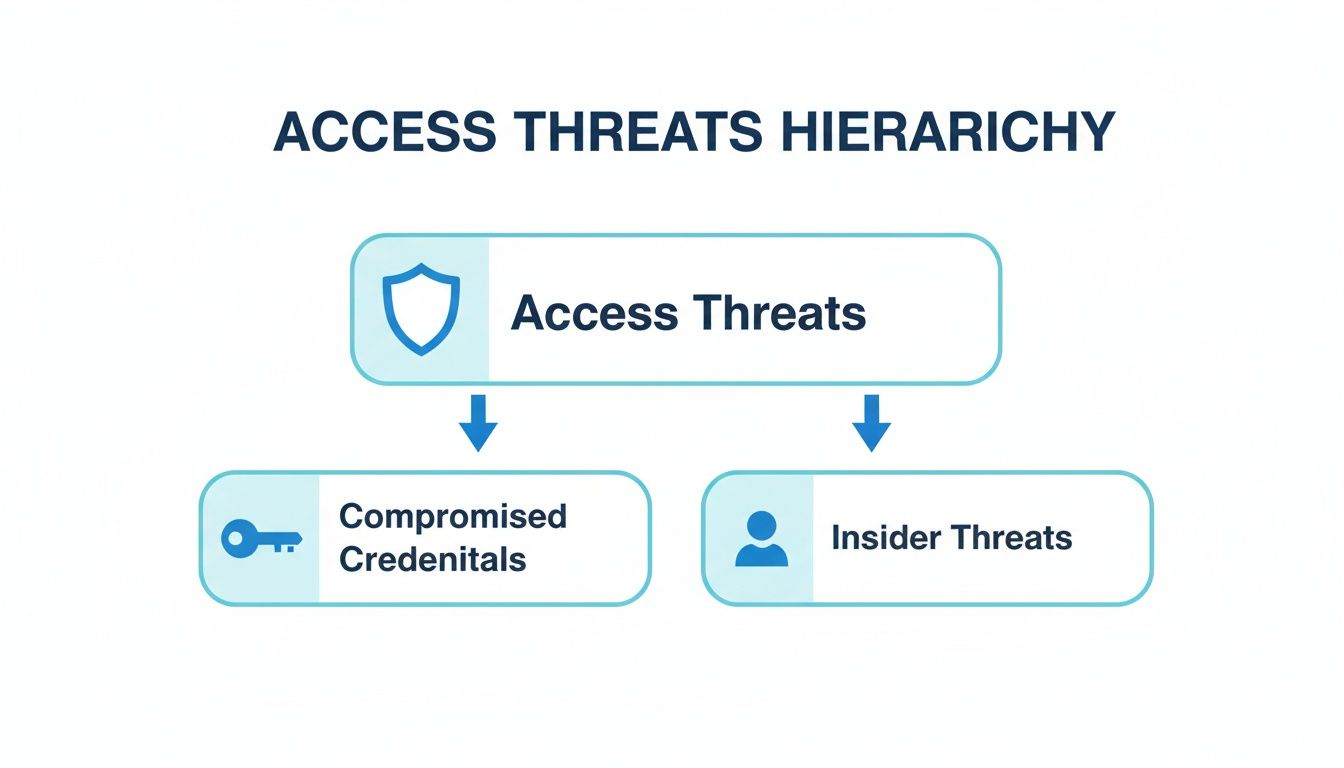
As you can see, no matter if the attack starts with stolen keys or a disgruntled employee, the end goal is always unauthorized access. Insecure APIs just make their job a whole lot easier.
The Hidden Dangers of Multi-Tenancy
Beyond insecure APIs, the very design of the public cloud introduces another major risk: multi-tenancy. When you spin up a virtual machine in a typical public cloud, it's running on the same physical server as workloads from hundreds, or even thousands, of other customers. You’re not just sharing resources; you’re sharing risk.
It's not just about "noisy neighbors" hogging the CPU. A security failure in another tenant's virtual machine could theoretically be exploited to break out of the virtual environment and compromise the underlying physical server. This would put every other tenant on that hardware—including you—in immediate danger. While these "hypervisor escape" vulnerabilities are rare, they represent a fundamental risk you accept in a shared model.
In a public cloud, you have zero control over the security hygiene of the other businesses sharing your physical server. Their misconfiguration or a successful attack against them could create a direct pathway to your data. Real security requires complete isolation.
This is the core difference between the public cloud model and a truly dedicated private environment. The table below lays out just how different the security posture is.
Public Cloud vs ARPHost Private Cloud Security Model
The shared nature of public clouds introduces risks that simply don't exist in a dedicated environment. This table breaks down the crucial differences in control, isolation, and overall security posture.
| Security Aspect | Typical Public Cloud (Shared) | ARPHost Proxmox Private Cloud (Dedicated) |
|---|---|---|
| Resource Isolation | Virtual isolation via hypervisor; physical hardware is shared. | Complete physical isolation on dedicated bare metal servers. |
| Attack Surface | Exposed to risks from thousands of other tenants on the same infrastructure. | Attack surface is limited exclusively to your own environment. |
| Neighbor Impact | A breach or DoS attack on another tenant can affect your performance and security. | Immune to "noisy neighbor" problems and cross-tenant security failures. |
| Control Level | Limited to the provider's management tools and policies. | Full root access to hardware and hypervisor for granular security control. |
Ultimately, a dedicated model gives you the final say over every aspect of your security, removing the unpredictable variable of other tenants.
Scaling This with ARPHost: Why Bare Metal is the Ultimate Security Solution
The only way to truly eliminate the risks that come with shared infrastructure is to get rid of the "shared" part completely. This is the simple but powerful principle behind ARPHost's Bare Metal Servers. When you have your own dedicated physical server, you get true, air-gapped isolation. Your resources are yours and yours alone, putting your security posture firmly back in your own hands.
By building on bare metal, you can create a Dedicated Proxmox Private Cloud that gives you the best of both worlds: the flexibility of virtualization with the uncompromising security of dedicated hardware. This architecture makes it impossible for another customer's security incident to spill over and affect your operations. For any business that takes security seriously, it’s the ultimate peace of mind.
For organizations that can't afford to compromise on security, moving to a dedicated environment is the most direct and effective path forward. Explore our Secure VPS Bundles at arphost.com/vps-web-hosting-security-bundles/.
Building Your Cloud Security Mitigation Plan
Knowing the risks is one thing; doing something about them is another entirely. A proactive mitigation plan is what separates the secure from the sitting ducks. This isn't some dusty document you write once and forget. It's a living, breathing framework that weaves together smart architecture, solid processes, and a healthy dose of constant vigilance. The goal is to build layers, so if one defense fails, another is right there to stop an attack cold.
We need to shift from a reactive, "break-fix" mentality to a security-first posture. That means baking security into your infrastructure from the very beginning, creating bulletproof data protection strategies, and always knowing what’s happening in your environment.
Architecting for Zero Trust Security
The philosophy behind Zero Trust is brilliantly simple: "never trust, always verify." You start with the assumption that every user, every device, and every network connection is a potential threat. Instead of just guarding the perimeter, you force every single access request to prove it belongs there, every single time.
Putting this into practice means a few key moves:
- Network Segmentation: Carve up your network into smaller, isolated zones. If one area is breached, this segmentation acts like a bulkhead on a ship, containing the damage and stopping an attacker from roaming freely across your entire infrastructure.
- Principle of Least Privilege (PoLP): Give users and applications the absolute bare-minimum permissions they need to do their job—and nothing more. If an account gets compromised, its ability to wreak havoc is severely limited.
- Mandatory Multi-Factor Authentication (MFA): This is non-negotiable. Enforcing MFA across all services, especially for admin access, is one of the most powerful moves you can make. It’s been shown to block over 99.9% of account compromise attacks.
At ARPHost, our Fully Managed IT Services are built around these principles. Our team helps you implement a Zero Trust environment from the ground up, managing network segmentation with enterprise-grade Juniper firewalls and enforcing strict access controls to harden your architecture from day one.
Implementing Resilient Backup and Disaster Recovery
Let’s be honest: your data is your business. A rock-solid backup and disaster recovery (DR) plan is the ultimate safety net against ransomware, hardware meltdowns, or the classic "oops, I deleted the wrong thing." But a modern DR plan is more than just making copies; it's about guaranteeing business continuity with as little downtime as possible.
A backup is only as good as your last successful restore. Regular, automated testing of your recovery process is non-negotiable to ensure you can get back online quickly when it matters most.
A resilient DR strategy must include:
- Automated and Frequent Backups: Backups should run like clockwork—daily at a minimum—without anyone needing to lift a finger. In a Proxmox environment, this is easily configured right in the interface to schedule regular snapshots of your virtual machines.
- Geographically Diverse Storage: Never keep all your eggs in one basket. Storing backup copies in a separate physical location protects your data from a site-wide disaster like a fire, flood, or extended power outage.
- Immutable Storage: This is your silver bullet against ransomware. Immutable backups are locked, making them unchangeable and undeletable for a specific period. Attackers can't encrypt or wipe your recovery points, period.
This is exactly where ARPHost's Proxmox Backup as a Service shines. We provide immutable, encrypted offsite storage, guaranteeing your backups are secure, isolated, and ready for recovery the moment you need them. Our managed services team can handle the entire setup and monitoring process for you.
Start protecting your critical data today. Explore ARPHost's immutable backup solutions.
Establishing Continuous Monitoring and Platform Hardening
You can't protect what you can't see. Continuous monitoring is all about using automated tools to keep a 24/7 watch over your infrastructure. These tools spot suspicious activity and alert you to potential threats in real time, letting you catch attacks before they snowball into major breaches.
A thorough monitoring strategy keeps an eye on:
- Log Files and Events: Funnel logs from your servers, firewalls, and applications into one place. Analyzing this data helps you spot tell-tale signs of an intrusion, like a flurry of failed login attempts or unusual data transfers.
- System Performance: Keep tabs on CPU, memory, and network usage. A sudden, unexplained spike could be a DoS attack in progress or a malicious script burning through your resources.
- Security Vulnerabilities: Regularly scan your systems for known vulnerabilities and out-of-date software. This is basic hygiene—closing security holes before attackers find them.
For any business with a website, platform hardening is just as crucial. This involves locking down the underlying operating system and software stack. ARPHost's Secure Web Hosting Bundles do this by layering multiple defenses, including:
- Imunify360: An all-in-one security suite that delivers proactive malware scanning, a robust web application firewall (WAF), and intrusion detection to automatically block threats.
- CloudLinux OS: This clever operating system wraps each hosting account in its own isolated environment. If one account on a server is compromised, it can't spread to affect others.
When you combine continuous monitoring with aggressive platform hardening, you create an environment that actively defends itself. With ARPHost's fully managed services, our team takes on the 24/7 monitoring and security management, giving you enterprise-grade protection without the massive overhead.
Secure your servers with expert oversight. Request a quote for ARPHost's Fully Managed IT Services.
How ARPHost Builds a Genuinely Secure Cloud
Knowing the risks is half the battle. The other half is choosing a partner whose entire architecture is built from the ground up to shut those risks down. At ARPHost, we engineered our infrastructure to move businesses from a reactive, vulnerable position to one of proactive, hardened defense.
Instead of leaving you to navigate the minefield of public cloud security on your own, our solutions are centered on isolation, control, and hands-on expert management. We don’t just offer hosting; we offer a direct countermeasure to each of the major threats we’ve discussed.
Matching ARPHost Solutions to Top Cloud Risks
Our entire stack is designed for one thing: superior security. Whether you're running a lean operation on a resilient VPS or managing an enterprise workload in a fully isolated private cloud, our solutions are built to give you real peace of mind.
Risk: Misconfigurations and Data Breaches
- ARPHost Solution: Our Fully Managed IT Services put our experts in the driver's seat. We handle firewall rules, proactive system monitoring, and critical patch management, effectively eliminating the simple human errors responsible for the vast majority of breaches.
Risk: Shared Infrastructure and "Noisy Neighbors"
- ARPHost Solution: This is where our Dedicated Proxmox Private Clouds and Bare Metal Servers shine. They provide absolute physical isolation. Your resources are yours and yours alone, which means another tenant’s security lapse can never bleed over and affect your operations.
Risk: Compromised Credentials and Insider Threats
- ARPHost Solution: We give you the keys to the kingdom. With full root access on our VPS Hosting and dedicated servers, you have total control over Identity and Access Management (IAM). You can enforce strict policies like multi-factor authentication without being hamstrung by a shared platform’s limitations.
Risk: Ransomware and Data Loss
- ARPHost Solution: Our Proxmox Backup as a Service is your ultimate safety net. It creates immutable, encrypted, offsite copies of your data. Even if a ransomware attack encrypts your live systems, your backups are untouchable and ready for a fast, clean recovery.
From our incredibly affordable High-Availability VPS Hosting plans (starting at just $5.99/month) with resilient CEPH storage to enterprise-grade private clouds, we provide a clear, practical path to a more secure infrastructure. We don't just sell you servers; we provide the tools, the architecture, and the expertise to build a truly defensible cloud environment.
Ready to put these cloud security risks behind you? Request a managed services quote at arphost.com/managed-services/ for a custom solution designed for your specific needs.
Common Questions About Cloud Security
Diving into cloud security can bring up some tricky questions. Let's clear the air and tackle a few of the most common ones we hear from clients.
Is a Private Cloud Always More Secure Than a Public Cloud?
It’s tempting to say yes, but the real answer is a bit more nuanced. By its very nature, a private cloud—like an ARPHost Proxmox Private Cloud—gives you a massive head start. You get total control and isolation, wiping out the risks that come from sharing infrastructure with other tenants.
But here’s the catch: a powerful tool is only as good as the person wielding it. A private cloud that's not configured correctly can leave you just as exposed as any public one. That's precisely why we offer Fully Managed IT Services. Our team handles all the heavy lifting—security hardening, patching, and constant monitoring—to make sure your private environment is truly a fortress.
What Is the Single Most Important Step to Improve Cloud Security?
If I had to pick just one, it would be locking down who can get in. That means implementing a rock-solid Identity and Access Management (IAM) policy with multi-factor authentication (MFA) as a non-negotiable requirement. So many breaches start with a simple stolen password.
This is where having direct control really matters. With an ARPHost VPS or dedicated server, you have full root access. That lets you enforce these strict access policies exactly how you need to, giving you a level of granular control that you just can't get on a crowded, shared platform.
How Can ARPHost Help After a Security Incident?
First, we get you to a safe harbor. If your current environment is compromised, our managed migration services can move your entire infrastructure over to a hardened ARPHost solution, like a Secure VPS running Imunify360.
But recovery is about more than just moving files. Our managed services team will then build a proactive defense for you, setting up continuous monitoring and a solid disaster recovery plan. Using our Proxmox Backup as a Service, we can help you bounce back in minutes, not days, turning a crisis into a lesson learned and building a much stronger security posture for the future.
Ready to stop reacting and start building a secure foundation? ARPHost gives you the isolated, high-performance infrastructure and expert support you need to do it right. Explore our secure VPS hosting plans starting at just $5.99/month and take back control of your cloud environment today.