

You can feel the failure pattern before anyone names it. A ticket says the outage is fixed, the dashboard goes green, and the same class of incident returns in the next maintenance window, sometimes with a different symptom and the same weak explanation. That's usually the point where a team realizes it doesn't have a troubleshooting problem, it has a root cause analysis process problem.
A disciplined RCA process matters because ad hoc firefighting only suppresses symptoms. It keeps the service moving long enough to get through the night, but it doesn't tell you what to change so the next on-call engineer isn't staring at the same alert at 2 a.m. again.
Why IT Teams Need a Real Root Cause Analysis Process
The easiest mistake in infrastructure work is confusing speed with progress. A reboot, rollback, or config tweak can clear an alert fast, but if the underlying trigger is still there, the team has only bought time. That's why the root cause analysis process exists as a management discipline, not just a postmortem habit.
Symptom suppression feels productive
In hosting and IT operations, the same failure can wear different masks. A storage alert clears after a node restart, a VM brownout stabilizes after a traffic shift, and the incident is labeled resolved. The problem is that none of those actions prove the recurrence risk is gone, they only prove the symptom is quieter for now.
A real RCA process shifts the question from “What stopped the alarm?” to “What change would keep the problem from coming back?” That distinction matters even in small teams, because one engineer often owns hypervisors, backups, DNS, patching, and the ticket queue. A process that only rewards fast closure creates a false sense of reliability.
RCA works best as a managed control loop
Historically, RCA evolved from informal troubleshooting into something closer to a quality system. In one measurement framework, organizations track whether investigations start within the required interval, whether 100% of approved corrective actions are completed on time, and whether the intended improvement goals are met, with the core KPIs defined as start interval compliance, on-time corrective completion, and success rate That's a useful mental model for IT teams, because it frames RCA as a process with measurable output, not a narrative after the fact.
ASQ's guidance also treats RCA as a structured, time-bound effort, typically around two months, with meetings at least weekly and sometimes two or three times a week, and each meeting kept to a maximum of two hours That cadence is a good reminder that durable fixes usually require repeated evidence review, not a single late-night huddle.
Practical rule: If the “fix” can't be described as a verified change in recurrence risk, you probably stopped at containment.
A mature process usually moves through stages, from defining the problem to collecting evidence, reconstructing the timeline, testing candidate causes, and then verifying whether the action worked. That sequence is what keeps the work auditable and reproducible instead of anecdotal (structured RCA workflow).
Defining the Problem and Collecting Evidence You Can Trust
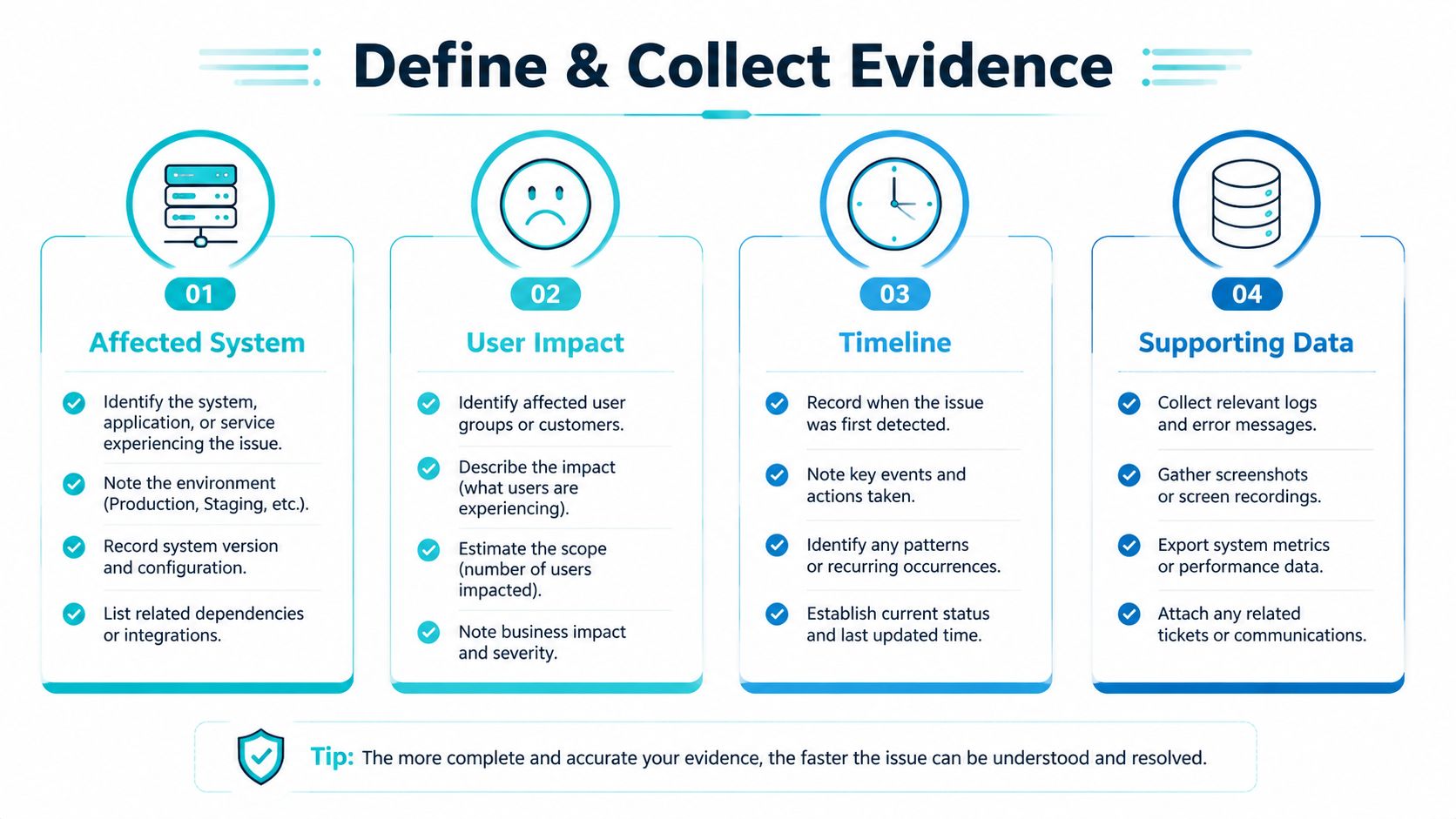
The first failure in most RCAs happens before anyone opens a log file. The team writes a fuzzy problem statement, then spends hours collecting everything except the one evidence set that would let another engineer reproduce the conclusion. A good RCA starts with a narrow, factual statement and a habit of preserving volatile data before anyone touches the system.
Write a problem statement that can survive review
A useful problem statement names the affected system, the user-visible impact, the time window, and the scope of investigation. For a VPS node brownout, that might read like this, the node showed intermittent response lag, tenants reported timeouts from hosted applications, the issue began during the maintenance window, and the investigation is limited to the host, its storage path, and the recent config change set. That level of precision keeps the team from drifting into guesses about unrelated services.
The U.S. Office of Personnel Management's Ishikawa RCA guidance pushes the same discipline, clear problem definition, clear causal relationships, clear linkage between causes and the problem, and clear evidence for each identified cause (OPM RCA methodology). That's the right standard for infrastructure work too, because a vague incident statement produces a vague conclusion.
Preserve evidence before the system changes
A defensible root cause analysis should be based on facts, not assumptions. Investigators should gather real data such as photos, readings, timestamps, operator logs, and maintenance records, and they should review the full timeline from planning through inspection and operation, not only the moment of failure (fact-based RCA guidance).
Facts beat confidence every time. If you reboot first and investigate later, you've already destroyed part of the evidence trail.
For a hosting incident, that usually means capturing:
- Logs and alerts: Pull system, application, hypervisor, and backup logs before log rotation clears the trail.
- Metrics snapshots: Save CPU, memory, storage latency, queue depth, and network error counters at the time of impact.
- Config diffs: Record the exact change set, package update, or control panel adjustment that preceded the event.
- Volatile state: Preserve process lists, open connections, and mounted volumes before anyone restarts the host.
- Ticket notes: Lock down the first user report, escalation time, and change window so the narrative doesn't shift later.
The goal is simple. Another engineer should be able to look at the evidence package and understand why the team reached its conclusion.
Reconstructing the Timeline in a Data-Rich Environment
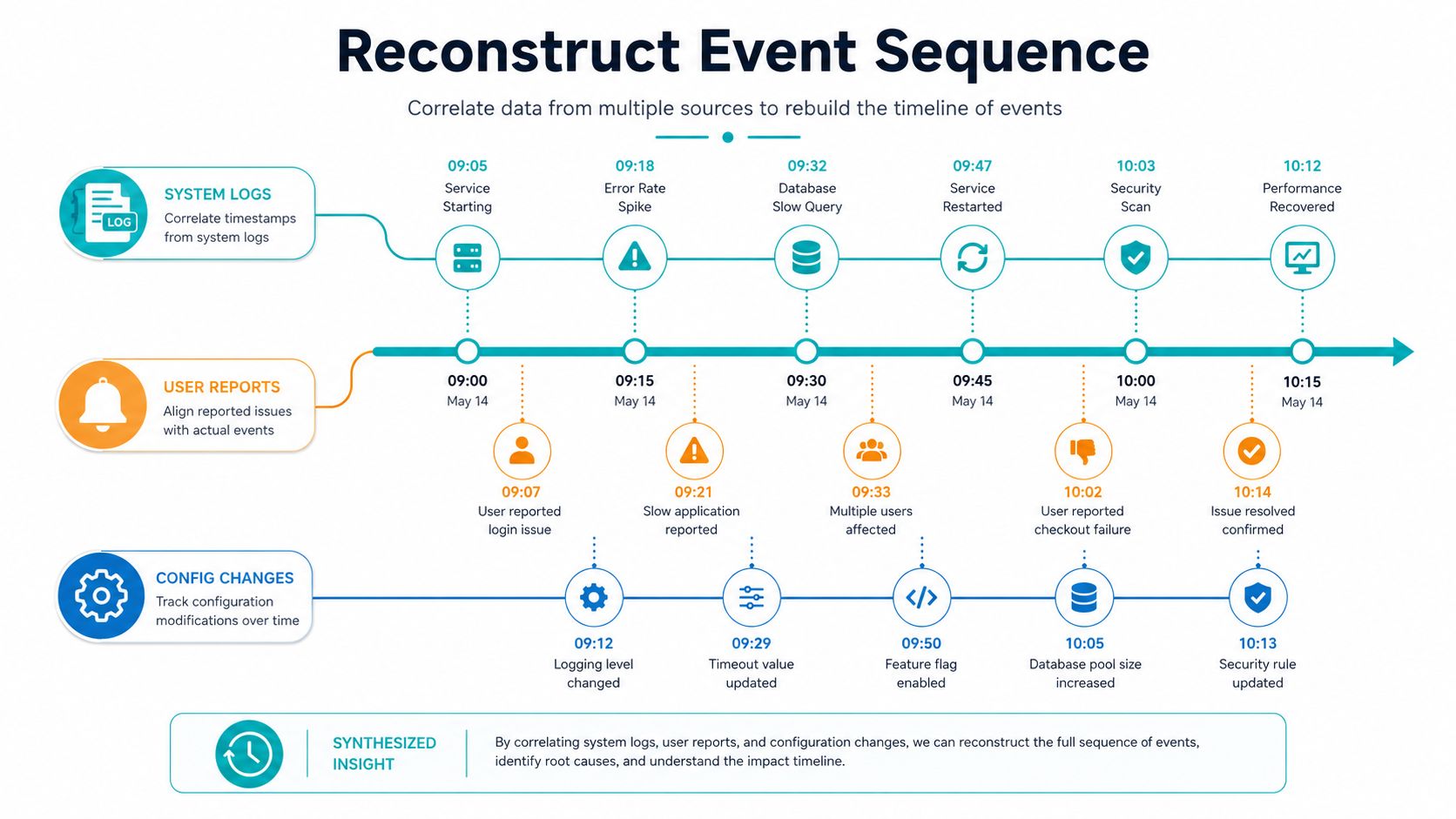
Modern incident work rarely lacks data. It lacks order. Alerts arrive from monitoring, deploy history lives in one system, config diffs live in another, and user complaints sit in a ticket queue. The hard part is building a single timeline that tells the truth about sequence.
Build one canonical sequence
Start with the event that users felt first, then align every other artifact against it. Hypervisor events tell you what the platform saw, application logs explain what the workload saw, and network telemetry shows whether the path in and out of the system was clean. Tickets, chat timestamps, and deploy records fill in the operational narrative around those signals.
Use the most authoritative source for each layer. A storage controller log is stronger than a user complaint for the disk path, while a deployment record is stronger than memory for when a package changed. If clocks drift, note that in the timeline instead of pretending the order is perfect, because a sloppy timestamp is still better than a guessed one when you're comparing systems.
A useful way to think about the result is as a chain of causality, not a pile of logs. The sequence should show what changed, what fired first, what followed, and which dependencies were already unhealthy. That makes it possible for the next engineer to verify the story instead of re-deriving it.
The Department of Defense's Root Cause Investigation Best Practices Guide uses a staged sequence that starts by flowcharting the process, identifying where defects can occur, identifying the factors that can cause the defect, having the team identify causes, and validating those causes with facts and data before updating findings with new potential causes (DoD best practices guide). That staged logic fits hosting work well, especially when the incident spans compute, storage, and network layers.
Match the timeline to the evidence source
A storage firmware update that precedes backup failures is a good example. The change record tells you when the update happened, the backup scheduler log tells you when the job started failing, and the storage telemetry tells you whether latency or path resets happened first. If those sources don't line up, don't force them to.
For teams that want a practical monitoring companion while they build this discipline, the internal reference on infrastructure monitoring best practices is a sensible complement to the timeline work itself.
Choosing the Right Analysis Technique
Not every incident deserves the same level of analysis. A clean human error, a multi-factor reliability issue, and a safety-critical failure call for different tools. The trick is to match the method to the shape of the problem instead of forcing every event through one favorite template.
Pick by complexity, not habit
5 Whys works best when the cause chain is short and the failure mode is relatively clear. If a firewall rule blocked admin access after a rushed change, asking why five times can get you from symptom to mistaken approval path fast enough to be useful. It's a quick lane, not a universal answer.
Fishbone, or Ishikawa, fits incidents with several plausible contributors. Recurring VM snapshot failures are a good example, because the cause might live in storage pressure, backup timing, guest load, or an over-tight retention policy. The value of the diagram is that it forces structured brainstorming without pretending the first idea is the final answer.
Fault tree analysis is heavier, but it earns its keep when uptime or physical systems are on the line. A colocation power event chain, for example, often needs top-down Boolean logic to separate a utility issue, transfer failure, UPS behavior, and downstream load response. It's slower, but it reduces the chance that a team mistakes a convenient story for a real chain.
The table below gives a quick comparison for hosting and IT incidents.
| Technique | Best for | Typical effort | Main risk |
|---|---|---|---|
| 5 Whys | Clear process or human errors | Low | Oversimplifying a multi-cause event |
| Fishbone | Multiple plausible contributors | Medium | Turning the diagram into brainstorming without validation |
| Fault tree analysis | High-availability or safety-critical failures | High | Spending time on detail the incident doesn't need |
If you're using tooling or assisted analysis to organize evidence, the value is in structure, not in letting the tool decide the answer.
Rule of thumb: If the incident spans several teams or layers, start broader than you think you need. You can narrow later, but you can't recover a cause you never looked for.
Validating the Root Cause Before You Fix Anything
A candidate cause is not a root cause until it survives a challenge. The U.S. Nuclear Regulatory Commission's test is a strong one, a valid root cause is one where the problem would not have occurred without it, and if the cause is corrected or eliminated, the same problem will not recur That standard cuts through a lot of hand-waving.
Test causality, not just correlation
In hosting incidents, correlation shows up everywhere. A deploy and an alert can land in the same minute, but that doesn't mean the deploy caused the alert. A backup job can fail after a storage change, yet the cause might be a threshold issue that the change only exposed.
Three validation patterns are usually enough to keep you honest:
- Reproduce in staging. If the failure can be recreated in a controlled environment, you've got a stronger case than a narrative alone.
- Remove the suspect cause. If the problem disappears when the suspected change is removed, the case gets stronger.
- Check precedent. If earlier incidents share the same fingerprint, there may be a deeper recurring pattern instead of a one-off mistake.
That is why the best RCA outcomes aren't just named causes. They're causes that hold up under testing and a fix that changes recurrence behavior. Government and safety guidance often treats cause identification as only one part of preventing recurrence, and that's the right stance for infrastructure too (education and management guidance on RCA boundaries).
Don't stop at the first neat explanation
A single root cause is often too tidy for a real system. A hypervisor issue can be latent until a change window, a backup workload can fail because of load and retention policy together, and a network flap can require both a path change and a brittle failover rule to line up. Treat the first explanation as a hypothesis, then prove or reject it.
For teams that want incident response language around that validation step, the internal guide on incident response is a helpful reference point.
Designing Corrective and Preventive Actions That Stick
Most RCA programs don't fail at diagnosis. They fail when action items live in a ticket queue and never get audited. The literature on patient safety is blunt about this, because implementation is where RCAs often underperform, with recommendation completion only partially or fully achieved in roughly 61.4% to 68.1% of cases, another 20% partially implemented, and only 2 studies (9%) able to show improved patient care (RCA implementation review). That gap is the part IT teams need to close.
A corrective-action list that survives a postmortem has to separate what stops the outage from what prevents the next one. If a storage array is paging and a rollback clears the pressure, that rollback is containment. If the defect is a bad firmware path, the correction is the firmware fix. If the team then adds a pre-change check so the same firmware mismatch cannot reach production again, that is prevention.
Separate containment, correction, and prevention
A useful action plan has three layers. Containment stops the bleeding now, such as rolling back a config drift or moving traffic away from a sick node. Correction removes the underlying defect, such as patching a hypervisor bug or fixing a storage configuration that can't sustain the workload. Prevention changes the system so the same class of change is harder to repeat, such as adding a CI gate that blocks the risky pattern before it reaches production.
That distinction matters because teams often record containment as if it were the fix. It isn't. A rollback may buy stability tonight, but it doesn't guarantee the same mistake won't land again next month.
Practical rule: Every action item needs an owner, a due date, and a validation step. If one is missing, the task is not ready.
Treat completion and verification as control points
A good RCFA measurement framework treats RCA work as a controlled process, not a write-up exercise. It looks at whether actions start on time, finish on time, and produce the expected result, which is the right lens for operational follow-through (RCFA measurement framework). For teams that need a more execution-focused review, the RCA implementation review is a useful reminder that closing the loop is where most programs slip.
A strong action record should answer four questions:
- Who owns it? One named person, not a team label.
- What changes? The exact config, code, process, or control.
- How will it be verified? A test, metric, or audit that proves the change worked.
- What happens if it fails? An escalation path, rollback, or fallback plan.
Managed-service relationships can help here when internal staff can't sustain the loop themselves. The point isn't to hand off accountability. It is to keep monitoring, patching, and verification from falling apart under normal workload pressure.
Prevention also lives in design choices. If a single uplink can take a host cluster down, the fix is not a better apology after the outage. It is network redundancy, plus the discipline to test failover before the next incident forces the issue.
Applying the Process to Real Hosting Failure Scenarios
A clean RCA framework only matters if it survives real incidents. In hosting work, the incidents that hurt most are the ones that look ordinary at first, then turn out to be a layered failure across software, hardware, or operational controls.
Three incidents, three different shapes
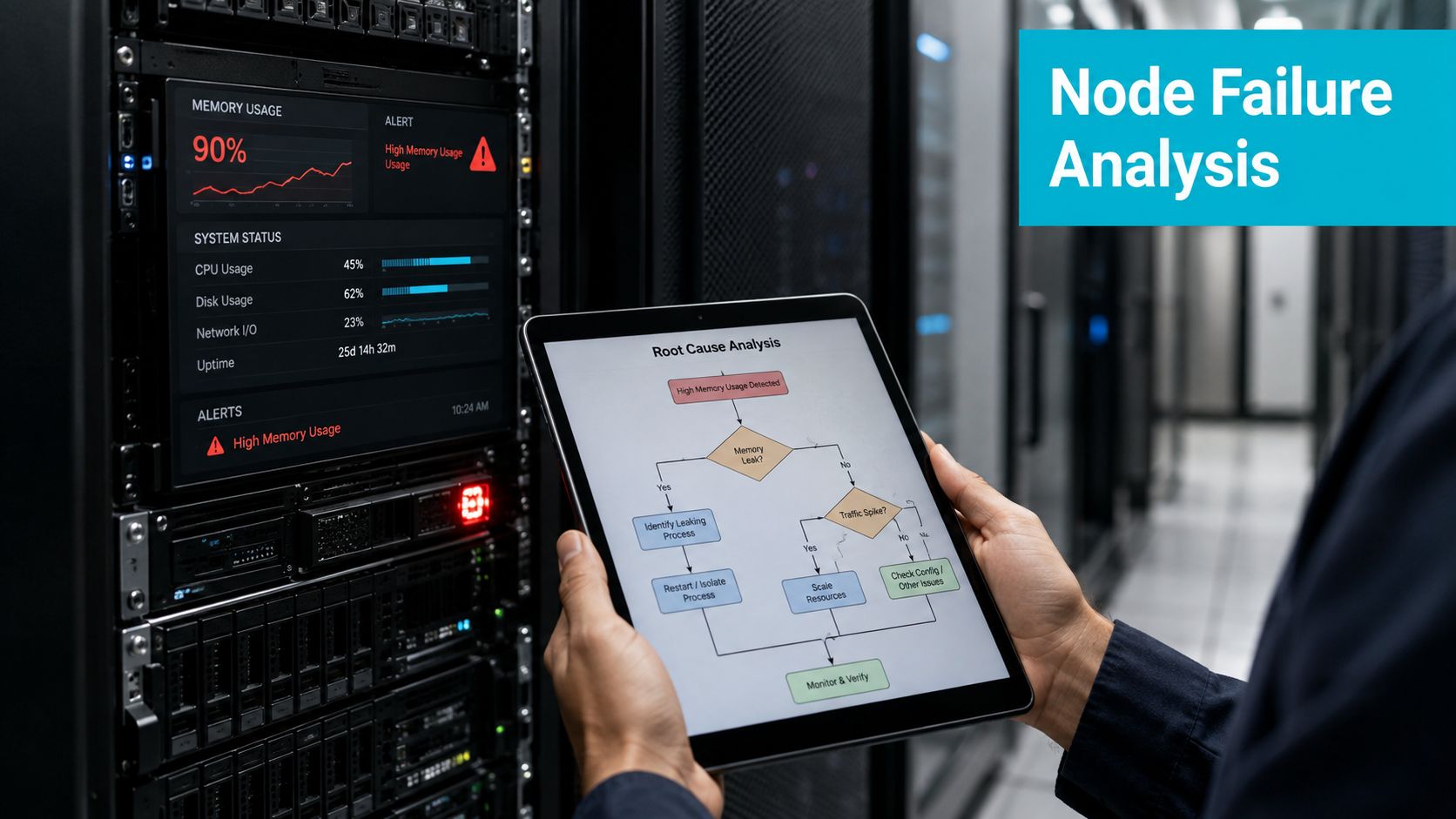
A web hosting node that starts consuming memory after a botched security update needs a problem statement that names the host, the impact, and the exact update window. The evidence set should include package change records, service logs, memory graphs, and any quarantine or scan activity. A fishbone analysis is a reasonable choice because the failure could involve the update itself, a config interaction, or a preexisting resource leak, and the validated action might be rollback plus a revised patch workflow.
A recurring BGP flap between two upstream providers is a different beast. The timeline needs router logs, session state changes, ticket timestamps, and any change on the edge policy side. Fault tree analysis fits better here because you want to separate physical link instability, provider-side issues, and policy behavior before you make routing changes that might hide the fault.
A backup job that corrupts VM images for two weeks is the kind of case that punishes weak validation. The RCA should compare backup logs, restore test results, storage health indicators, and retention settings, then validate whether the corruption began after a change in the backup path or a version mismatch in the image pipeline. In that scenario, correction without a restore test is just optimism with a ticket number.
What the managed loop looks like in practice
When a team has proactive monitoring, patch management, and runbook-driven response already in place, RCA becomes less chaotic. The same evidence collection, timeline reconstruction, and validation steps still apply, but the operating model is steadier because alerts, changes, and backups are already tracked. That's the difference between hoping for clarity and engineering for it.
For infrastructure teams that want this level of support without building every control themselves, the obvious surfaces are managed services, secure VPS bundles, bare metal servers, dedicated Proxmox private clouds, and colocation, because the right platform choice determines how much of the RCA loop can be standardized versus improvised.
If your team is still seeing the same incident classes return with new ticket numbers, ARPHost, LLC can help you tighten the operational loop around hosting, backups, and infrastructure response. Visit ARPHost, LLC to review VPS hosting, bare metal, Proxmox private clouds, and managed services that give you more control over evidence, verification, and prevention.