
You're probably looking at Rackspace because something has stopped feeling right. Maybe support is slower than it should be, maybe mailbox pricing has become hard to justify, or maybe your team needs a cleaner path to move mail, apps, or infrastructure without getting locked into a single operating model. That's the reason businesses start comparing rackspace alternatives, they need a provider that fits the workload, not a legacy package that forces the workload to fit the provider.
The market makes this comparison more complicated than a simple “cheaper host” search. Rackspace sits in a category shaped by very large providers and specialist substitutes, with third-party competitor data showing major scale in the broader ecosystem, including AWS at 98.05% in IaaS market-share estimates and more than 4,859 companies starting to use Rackspace as an IaaS tool worldwide by 2025, which helps explain why buyers now compare hyperscalers, managed providers, private cloud, email-only hosts, and bare metal as separate options (Rackspace competitor analysis, IaaS market share data).
For email specifically, the pricing gap has become impossible to ignore. One 2026 comparison lists Rackspace Email at $2.99+ per user per month with 25 GB of storage, while Microsoft 365, Google Workspace, and Zoho Mail occupy very different price bands, which is one reason teams rethink mailbox architecture instead of just swapping vendors (Rackspace email alternatives comparison).
The smarter approach is to match the alternative to the problem. If you want hyperscale reach, AWS or Azure makes sense. If you want simple developer UX, DigitalOcean or Vultr are easier to live with. If you want managed support without losing control, Liquid Web or ARPHost are more relevant. And if you want a hardware-first setup with private cloud control, bare metal and Proxmox on dedicated infrastructure often beat a generic cloud migration.
1. ARPHost, LLC
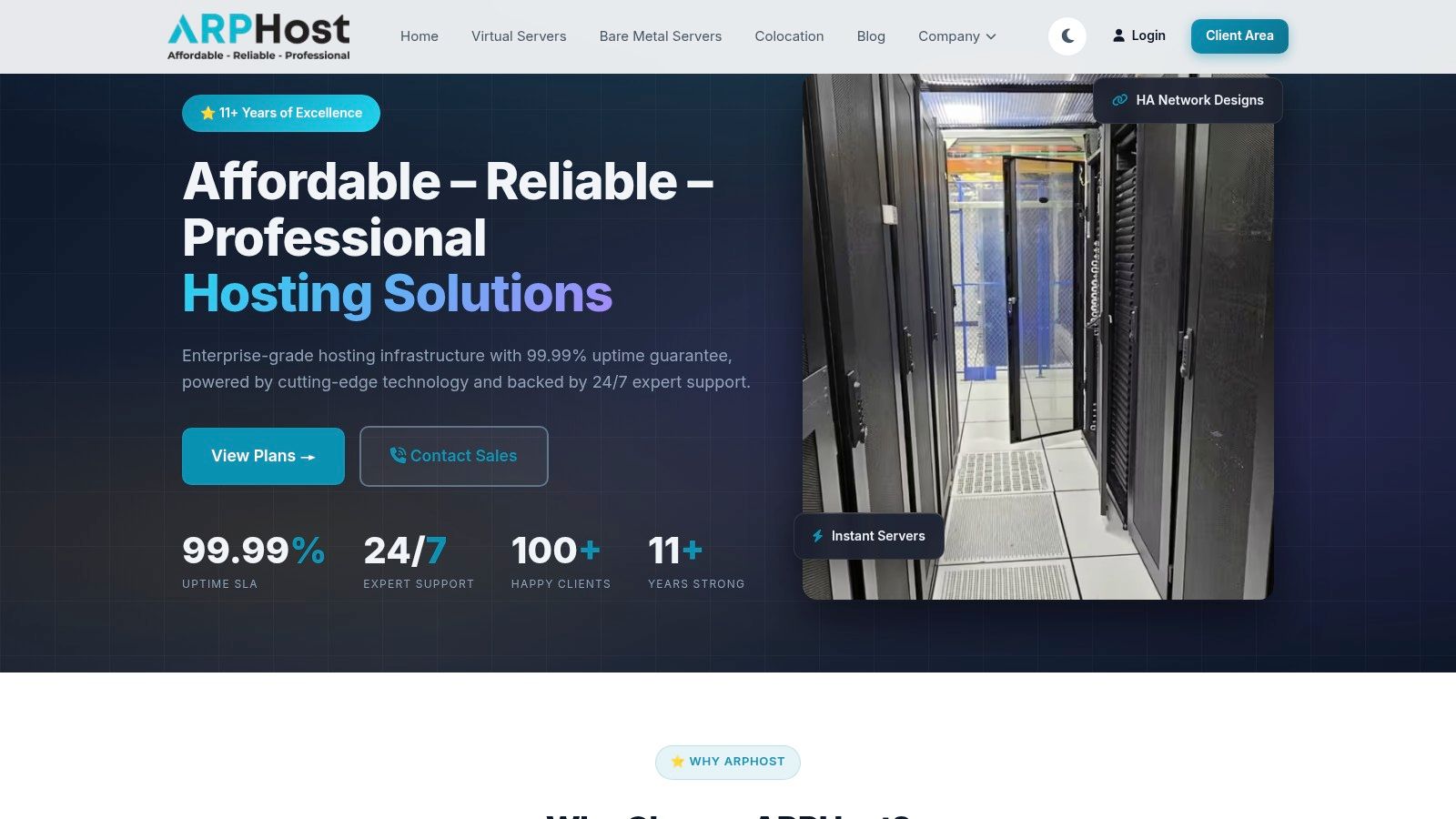
ARPHost is the most practical Rackspace alternative when the requirement is hands-on infrastructure instead of a giant cloud catalog. It combines shared hosting from $5.99/month, VPS from $4/month, bare metal from $99/month, and Proxmox private clouds into one stack, which means a team can move from email hosting, to VPS, to dedicated compute without changing providers or support models. That matters when you're trying to reduce vendor sprawl, not add another layer of it. ARPHost is especially strong for teams that want NVMe storage, multi-Tier-1 connectivity, N+1 power, and a 99.99% uptime SLA from a Tampa, FL facility.
Where ARPHost fits best
The platform lines up well with SMBs, MSPs, and IT teams that need security and control together. ARPHost's security stack includes multi-layer DDoS protection, Imunify360, CloudLinux isolation, and daily backups with one-click restores, which is a better fit than a bare-bones host when the cost of downtime is real. For Proxmox users, ARPHost's dedicated private cloud environments and Proxmox backup services make it easier to run clustered workloads with image-level recovery instead of stitching together your own backup workflow.
Practical rule: choose ARPHost when you want the provider to stay close to the infrastructure, not disappear behind tickets and billing portals.
The support model also matters. ARPHost emphasizes 24/7 U.S.-based support and cites sub-15-minute average response times, which is the kind of operational detail that helps when you're migrating live services or recovering from an outage. If you're planning a private cloud build, a Tampa-based cluster, or a managed migration off Rackspace-style hosting, ARPHost starts to look less like a commodity VPS seller and more like a full replacement platform.
Best for: managed VPS, secure web hosting bundles, Proxmox private clouds, bare metal, colocation, and fully managed IT services.
Watch-outs: the footprint is centered in Tampa, so global failover planning still needs design work, especially for multi-region applications.
2. Amazon Web Services
AWS is the obvious Rackspace alternative when you need the broadest cloud surface area and the easiest path into a hyperscale architecture. Its strength isn't simplicity, it's coverage. Compute, storage, security, databases, analytics, and AI/ML all sit under one ecosystem, so teams can build an infrastructure layer that scales far beyond what a traditional managed host usually offers. For businesses comparing Rackspace alternatives, AWS often becomes the benchmark rather than the competitor.
The catch is operational complexity. AWS works best when someone on the team understands architecture, billing, and governance, because the service catalog is deep enough to create accidental sprawl. Pricing tools help, but egress and inter-service transfer charges can still surprise teams that design by habit instead of by cost model. That's why AWS is usually the right answer for platform teams, not small businesses trying to keep email and web hosting straightforward.
How to think about AWS against Rackspace
The useful comparison is not “which one is easier,” because AWS is rarely easier. It's whether your organization wants to own infrastructure decisions at the cloud-platform level or delegate more of that work to a managed host. If your workload needs regional redundancy, multiple availability zones, and a partner ecosystem that can add managed layers, AWS is strong. If you want a simpler operational footprint, a managed provider or private cloud often gets you there faster.
For buyers deciding between public cloud and a managed environment, this internal guide helps frame the trade-off clearly: private cloud versus public cloud.
Best for: large-scale apps, global workloads, platform engineering, and teams that already have cloud governance in place.
Watch-outs: the learning curve is steep, and billing discipline has to come before scale.
3. Microsoft Azure
Azure is the Rackspace alternative that fits naturally into Microsoft-heavy environments. If your stack already runs on Microsoft 365, Windows Server, SQL Server, or Active Directory, Azure avoids a lot of integration friction. That's especially true in hybrid environments where on-prem hardware, cloud workloads, and identity services need to behave like one system instead of three unrelated ones.
Azure's biggest advantage is alignment, not novelty. Enterprises that want familiar licensing, hybrid tooling, and a broad compliance story often find Azure easier to justify than a provider that forces them to redesign their operational model. The downside is pricing governance. Azure can be completely workable, but only if someone owns policy, tagging, and cost review. Without that discipline, spend drifts quickly.
Where Azure wins and where it doesn't
Azure works best when the infrastructure conversation starts with Windows and identity, not Linux-first simplicity. That makes it a strong fit for enterprise IT, regulated teams, and organizations with Microsoft licensing already in play. It also gives you room to extend into analytics and managed database services without leaving the ecosystem.
It's less attractive if you want small-team simplicity or if you need a provider that is easy to explain to non-specialists. In those cases, the operational overhead can outweigh the platform value. For Rackspace customers, the Azure question is whether you're replacing a host or modernizing a whole enterprise stack. Those are very different projects.
Best for: Microsoft-centric IT, hybrid deployments, enterprise identity, and managed database workloads.
Watch-outs: pricing complexity and policy sprawl can become a problem fast without governance.
4. Google Cloud
Google Cloud is the Rackspace alternative many teams pick when performance, Kubernetes, and data services matter more than legacy hosting patterns. It's a strong fit for modern application teams that already think in containers, managed services, and analytics pipelines. The platform is also easier to approach than some hyperscalers when the workload is cloud-native from day one.
The trade-off is footprint and nuance. Google Cloud is excellent for certain workloads, but it has fewer U.S. regions than AWS or Azure, and some services have regional limitations that matter once you move past the pilot phase. That's not a deal-breaker, but it does mean architecture has to be designed intentionally. If you're comparing Rackspace alternatives for a straightforward business app, Google Cloud can feel like more platform than you need.
What makes Google Cloud a smart fit
Automatic discounts are one of the reasons teams like it. You don't have to squeeze every workload into a long-term commitment to get value, which helps when utilization patterns change. Its Kubernetes service and data tooling are also well suited to teams that want to stay close to modern DevOps practices.
If your organization is moving off Rackspace because the current setup feels too static, Google Cloud may be a good pivot. If you're moving because you want a managed provider to absorb infrastructure complexity, it may be more platform than answer. In those cases, a managed cloud or private cloud option can be the better operational decision.
Best for: containerized applications, analytics-heavy platforms, and development teams comfortable with cloud-native operations.
Watch-outs: region coverage and service nuances need careful review before production rollout.
5. DigitalOcean
DigitalOcean is the Rackspace alternative that makes the most sense when your team wants a clean admin experience and predictable billing. It's popular with developers, startups, and smaller businesses because it removes a lot of the friction that shows up in bigger cloud platforms. Droplets, managed databases, Kubernetes, and object storage are easy to understand, which lowers the barrier to getting something live quickly.
That simplicity is also the reason it gets compared to Rackspace. Many buyers don't want a huge platform, they want a place to host apps without turning infrastructure management into a full-time job. DigitalOcean fits that brief well. It's also attractive when the workload is familiar, like WordPress, common web apps, or lightweight internal tooling.
Why teams switch to DigitalOcean
The pricing model is one of its biggest strengths. Teams can estimate spend more easily than they can in a sprawling hyperscaler environment. The UI is also straightforward, which matters more than people admit when multiple people on the team have to manage servers.
The limitation is scope. DigitalOcean's catalog is smaller than the hyperscalers', and that becomes visible as the environment grows. If you need broader managed services, deeper enterprise tooling, or more region options, you may outgrow it. For Rackspace users who are leaving because they want less friction, though, it remains one of the most practical stops.
For teams comparing developer-friendly hosting choices, this ARPHost page is worth reviewing as well: DigitalOcean alternatives.
Best for: startups, SMB web apps, dev environments, and teams that value simplicity over breadth.
Watch-outs: review costs again as workloads scale, because easy entry can mask later growth friction.
6. Akamai Connected Cloud
Akamai Connected Cloud, formerly associated with Linode, fits the Rackspace alternative conversation when you want developer-friendly cloud compute plus edge delivery in one broader ecosystem. The appeal is straightforward, predictable instance planning, familiar VM and Kubernetes options, and the ability to sit closer to Akamai's global network. That can matter for workloads where delivery, latency, and simple cloud operations all need to coexist.
This is not a hyperscaler-style platform, and that's part of the attraction. Teams that want a clear path for VMs, object storage, and managed databases without climbing into a giant enterprise catalog often like this kind of cloud. The user experience is usually approachable, and long-time users tend to value the consistency.
Where Akamai Connected Cloud makes sense
It works well for developers who want a dependable cloud with less noise. You get enough infrastructure control to build and scale common workloads, but not so much complexity that every project turns into an architecture review.
The main thing to verify is policy and pricing details before commitment, especially if you're depending on a specific region or service family. That matters more now than it did before, because any cloud provider can become less attractive if the operational assumptions don't match the contract or the workload pattern. For businesses comparing rackspace alternatives, this is a reasonable middle path between hyperscale and niche hosting.
Best for: VMs, Kubernetes, global delivery use cases, and teams that want a cleaner cloud experience.
Watch-outs: confirm current billing terms and regional service availability before committing.
7. Vultr
Vultr is the Rackspace alternative that often wins on raw price-to-performance and fast provisioning. It's a strong option for cost-sensitive projects, especially when the team wants cloud compute, Kubernetes, bare metal, or GPU capacity without paying for the overhead that comes with larger enterprise stacks. The infrastructure is broad enough to support real workloads, but still simple enough that small teams can manage it.
The appeal is easy to understand. You can spin up instances quickly, choose from many locations, and keep billing relatively straightforward. That makes Vultr useful for staging environments, application hosting, and workloads that need performance without a huge managed-service layer.
Why Vultr is popular with technical teams
It gives you enough control to build, but not so much platform complexity that routine tasks become painful. For developers who already know what they need, that's a strong value proposition. It's also attractive when you want to place workloads close to users without moving into a giant cloud architecture.
The downside is the smaller service catalog. If your organization expects deep PaaS options, broad compliance tooling, or highly layered enterprise support, Vultr can feel lean. It's strongest when the goal is efficient infrastructure, not a full-service cloud transformation.
Best for: cost-sensitive apps, staging, low-friction compute, and technically capable teams.
Watch-outs: fewer managed platform services than hyperscalers means more responsibility stays in-house.
8. OVHcloud
OVHcloud is a solid Rackspace alternative for teams that want transparent pricing and a large mix of VPS, public cloud, and dedicated hardware. It's especially relevant for buyers who want to compare infrastructure line by line instead of negotiating a custom stack. That clarity can be valuable when budget forecasting matters more than brand familiarity.
Its infrastructure range gives you room to move between virtual servers and dedicated machines, which makes it useful for projects that may start small and later need more hardware control. Geographic flexibility is another plus, especially if you want to keep deployment choices open across U.S. and international locations.
What OVHcloud does well
OVHcloud is most compelling when you want a broad server catalog and straightforward list pricing. That makes it easier to plan around raw infrastructure costs. It's also a reasonable option when you need multiple data center choices rather than a single tightly managed environment.
The caution is that pricing updates and region-specific differences need verification before purchase. That isn't unique to OVHcloud, but it matters when you're trying to keep a migration clean and your cost model stable. For rackspace alternatives, it sits in the “serious infrastructure provider” bucket rather than the “easy starter cloud” bucket.
Best for: VPS, dedicated servers, and cost-conscious infrastructure buyers.
Watch-outs: verify current regional rates and any policy changes before you lock in.
9. Liquid Web
Liquid Web is one of the closest functional comparisons to Rackspace for buyers who care about managed service quality more than raw cloud breadth. It has long positioned itself around fully managed VPS, dedicated, private cloud, and managed WordPress or WooCommerce hosting. That puts it in the right conversation for teams that want support to be part of the product, not an afterthought.
The managed layer is the point. Liquid Web makes more sense than a pure cloud provider when your team would rather pay for operational help than build everything in-house. That's especially relevant for businesses that have a small internal IT team but still need reliable uptime, backups, and maintenance.
When Liquid Web is the better answer
It's strong when the question is “who will run this with us?” rather than “where can we rent compute?” Its published service commitments and U.S.-based support appeal to buyers who want the provider to own more of the operational burden.
The trade-off is cost and platform breadth. You pay more than commodity VPS providers, and you get less raw cloud capability than AWS or Azure. For Rackspace users who are mostly trying to preserve a managed experience, though, that's often an acceptable exchange.
Best for: managed hosting, WordPress/WooCommerce, dedicated servers, and businesses with limited ops bandwidth.
Watch-outs: if you need a broad cloud platform, this is not the same category as a hyperscaler.
10. Hivelocity
Hivelocity is the Rackspace alternative to watch when your priority is bare metal, low-latency U.S. infrastructure, and control over the physical server layer. Its Tampa presence makes it especially relevant for Southeast U.S. workloads, but the larger point is that it serves teams that want direct hardware control with optional management. That makes it a strong fit for performance-sensitive and infrastructure-heavy projects.
This is a good example of why Rackspace alternatives are not a single category. Hivelocity is infrastructure-first. If your workload needs a dedicated server, a VDS, or GPU capacity without abstracting away the machine, it belongs in the comparison. If you need a polished all-in-one managed application platform, it's not trying to be that.
Why hardware control still matters
Bare metal still wins in situations where latency, density, or kernel-level control matter. Teams running databases, virtualization hosts, or specialized workloads often prefer knowing exactly what hardware they own and where it sits. Hivelocity's configurators and deployment model support that style of infrastructure well.
For businesses planning dedicated hardware or a Proxmox deployment, this ARPHost resource is a useful comparison point: best bare metal server provider.
Best for: bare metal, low-latency U.S. workloads, performance-sensitive applications, and teams that want hardware control.
Watch-outs: the service model is more infrastructure-centric, so some administration remains on your team.
Top 10 Rackspace Alternatives Comparison
| Provider | Core services | Performance & reliability | Security & recovery | Pricing & value | Target audience & USP |
|---|---|---|---|---|---|
| ARPHost, LLC 🏆 | Shared, NVMe VPS, Dedicated, Proxmox private cloud, Colocation | ★★★★☆ 99.99% SLA, NVMe, Tier‑1 uplinks, N+1 power | ✨ Imunify360 / CloudLinux, multi‑layer DDoS, daily backups & Proxmox BaaS | 💰 $-$, from $4 VPS / $5.99 shared / $99 dedicated | 👥 SMBs, e‑commerce, MSPs, DevOps, U.S. 24/7 support |
| Amazon Web Services (AWS) | Vast compute/storage/DBs, global regions & services | ★★★★★ Global scale, multi‑AZ reliability | ✨ Extensive security tooling, managed backups & IAM | 💰 $$, on‑demand, Spot, Reserved | 👥 Enterprises, global apps, large-scale workloads |
| Microsoft Azure | Compute, hybrid tooling, DBs, AD/Windows integration | ★★★★★ Strong enterprise SLAs, broad U.S. footprint | ✨ Compliance portfolio, Azure Arc & managed backup options | 💰 $$, enterprise licensing & savings | 👥 Microsoft-heavy enterprises, hybrid IT |
| Google Cloud | Compute, GKE, data/ML, high‑perf backbone | ★★★★★ High‑performance networking & GKE | ✨ Sustained Use / Committed discounts, managed backups | 💰 $$, predictable discounts for steady workloads | 👥 Data/ML teams, containerized apps, analytics |
| DigitalOcean | Droplets, managed DBs, Kubernetes, object storage | ★★★★ Simple UI, fast provisioning | ✨ Snapshots & managed backups, clear control plane | 💰 $ – $, predictable, plan‑based billing | 👥 Startups, SMBs, developers seeking simplicity |
| Akamai Connected Cloud (Linode) | VMs, managed K8s, object storage, CDN edge integration | ★★★★ Predictable instances, global footprint | ✨ Edge/CDN proximity, basic backups & APIs | 💰 $ – $, transparent list pricing | 👥 Developers & SMBs wanting edge + simple cloud |
| Vultr | Cloud Compute, Bare Metal, Kubernetes, GPU | ★★★★ Aggressive price/perf, hourly billing | ✨ Fast provisioning, snapshots & basic DDoS | 💰 $, very cost‑sensitive, hourly caps | 👥 Cost-conscious teams, rapid prototyping |
| OVHcloud (U.S.) | VPS, public cloud, dedicated servers, private networking | ★★★★ Transparent pricing, multi‑region options | ✨ Private networking, snapshot backups | 💰 $ – $, competitive list pricing | 👥 Budget-focused teams needing geographic choices |
| Liquid Web | Managed VPS, dedicated, private cloud, Managed WP/Woo | ★★★★☆ 100% network SLA, fully managed options | ✨ Bundled security, backups & 24/7 U.S. support | 💰 $, higher base price for managed value | 👥 Agencies, SMBs needing hands‑on managed hosting |
| Hivelocity | Instant dedicated, VPS, GPU, private networking | ★★★★ Strong U.S. performance, Tampa presence | ✨ Rapid provisioning, per‑site pricing & private nets | 💰 $, per‑server configurable pricing | 👥 Performance-sensitive US workloads, bare‑metal control |
Making Your Move How to Choose the Right Host
Choosing a Rackspace alternative isn't about chasing the biggest name or the lowest advertised entry price. It's about matching the operating model to the job. If you need global hyperscale reach, AWS or Azure will usually be the closer fit. If you need developer-friendly simplicity, DigitalOcean or Vultr makes the day-to-day easier. If your priority is managed support with a more hands-on feel, Liquid Web and ARPHost belong near the top of the shortlist. If you want hardware control, Hivelocity and ARPHost's bare metal and Proxmox options are more aligned with that goal.
For many businesses, the best answer is not a public cloud migration at all. A Proxmox private cloud on dedicated hardware can deliver the control of on-prem infrastructure with the convenience of a hosted environment, and ARPHost is built around that model. That matters if your workload depends on predictable performance, image-level backups, root access, or the ability to grow without rebuilding every time the architecture changes.
The other issue is support fit. Rackspace alternatives separate into two layers, the infrastructure layer and the management layer. A lot of buyers only compare servers, but the actual cost of migration includes monitoring, backups, patching, firewall work, and recovery planning. If your internal team is small, a provider with fully managed IT services can save you from carrying operational debt into the new platform.
ARPHost stands out because it covers multiple paths in one place. You can start with a secure VPS, move into bare metal servers, deploy a dedicated Proxmox private cloud, or keep email and web hosting under the same operational umbrella. That lets you right-size the solution to the workload instead of forcing everything into one cloud category.
If you're replacing Rackspace because you need a cleaner path forward, start with the architecture first. Decide whether the workload belongs on hyperscale cloud, managed hosting, or dedicated infrastructure, then choose the provider that supports that model day after day.
If you're ready to move off Rackspace with less guesswork, ARPHost can help you choose the right path, whether that's secure managed VPS hosting, dedicated bare metal, Proxmox private clouds, or fully managed IT services. Visit ARPHost, LLC to review the platform, compare options, and plan a migration that fits your workload instead of fighting it.