

The call from a processor usually comes after the change is already live. A small ecommerce team adds subscriptions, keeps using the same VPS, and only then learns that cardholder data touching that server has pulled the whole stack into scope. At that point, pci compliant hosting stops being a shopping term and becomes an architectural decision, because what matters is not the label on the host, it's where card data flows, where it's stored, and what can ever see or log it.
That's why the right question isn't “Which provider says they're PCI compliant?” It's “Which deployment keeps the Cardholder Data Environment as small as possible, and which host can prove the controls that surround it?” A provider can be compliant for one architecture and out of scope for another, even on the same platform, because scope follows the payment flow, not the brand name. security risks of cloud computing
When a Server Becomes a PCI Problem
A merchant often sees the issue only after the site is live. The storefront works, subscription billing goes out, the payment form looks normal, and then the processor or auditor asks where the card data goes. Once raw payment data touches the server, or even passes through systems that can see or log it, the hosting footprint changes from a general web stack to a scoped payment environment.
That distinction matters because PCI-compliant hosting is a scoped infrastructure state, not a product badge. The same provider may fit a hosted checkout flow and still leave a self-managed application in scope if that app handles or exposes card data. Segmentation, isolation, and minimizing data flow shrink the audit surface, and the controls around that design are what an auditor will ask to see. A pricing page claim does not show how the environment is separated, what logs retain, or which systems can reach cardholder data.
What usually trips teams up
- Legacy checkout code stays in place after a redesign, so card data still touches the origin server.
- Logging defaults capture form fields, headers, or request bodies that should never be stored.
- Shared hosting assumptions hide how many unrelated sites and services sit beside the payment stack.
- Tokenization mistakes leave a merchant believing the processor owns the whole problem when the merchant server still influences the flow.
Practical rule: if a system can see the number, even briefly, assume an assessor will ask about it.
A real PCI review usually follows that trail. Auditors ask which systems received the data, which logs retained it, whether backups copied it, who had access, and how the merchant proved the environment stayed segmented. I have seen teams assume a hosted checkout removed them from scope, then discover that one plugin, one reverse proxy, or one verbose log file kept the whole stack in play.
Merchants with even modest payment volume should start with architecture, then choose the hosting tier that matches it. A clean hosted-payment design reduces the number of components that need PCI controls, while a messy direct-post setup expands the list of systems, logs, backups, and admins that come under review. If you are mapping that design on a cloud stack, a useful starting point is this overview of security risks of cloud computing.
What PCI Compliant Hosting Means
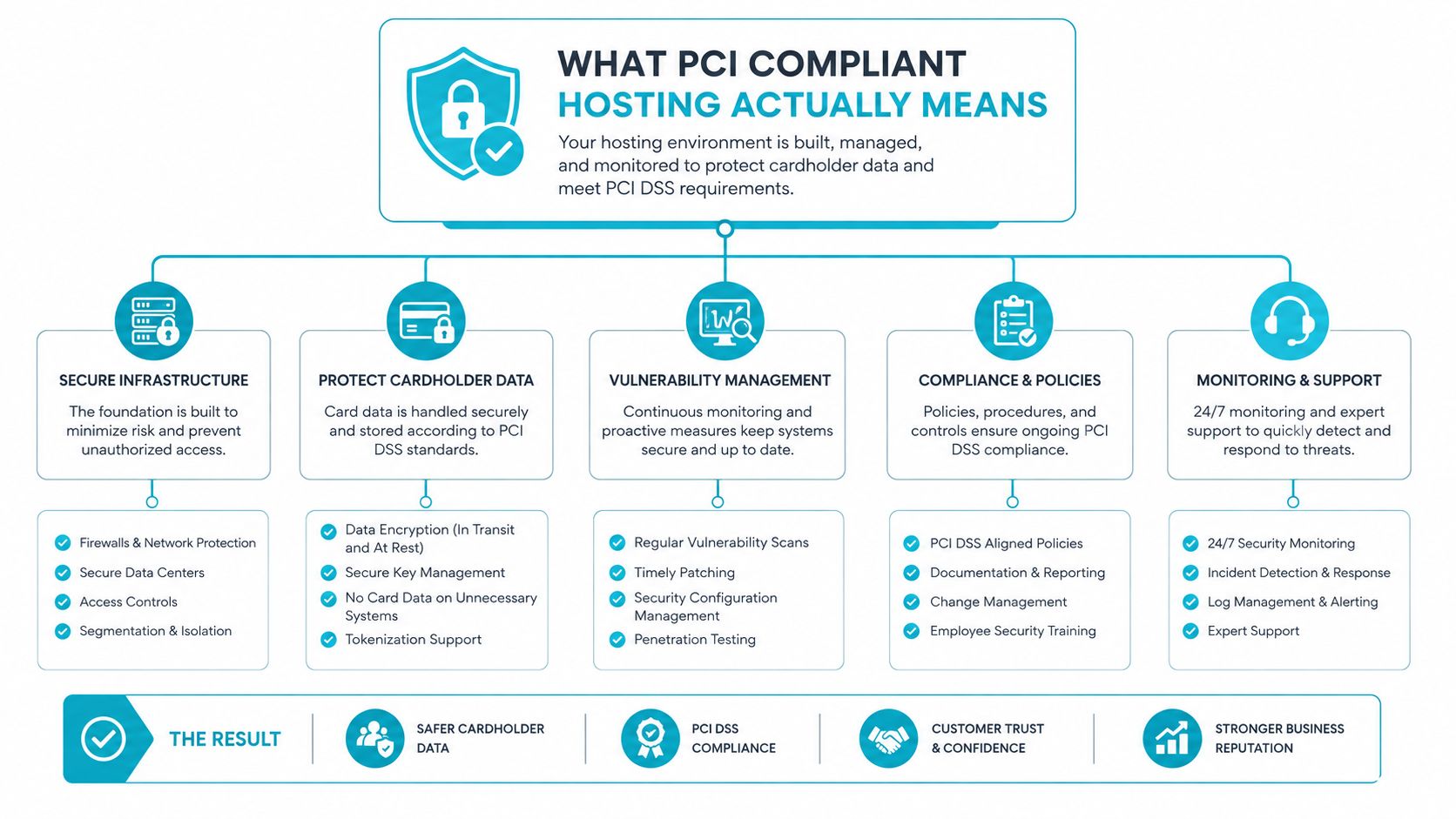
PCI-compliant hosting is the hosting setup that supports a merchant's obligations under the PCI DSS framework. The framework defines 12 core requirements across network security, secure configurations, cardholder-data protection, encryption, malware defenses, access control, logging, testing, and security governance. The current version matters. PCI DSS v3.2.1 was retired on March 31, 2025, so assessments in 2026 must align to PCI DSS v4.0 standards PCI Security Standards Council standards.
The standard in plain English
Those 12 requirement families reduce to a set of controls a real environment has to show. Secure the network. Remove vendor defaults. Protect stored card data. Encrypt transmissions. Use malware defenses. Limit who can reach sensitive systems. Assign unique user IDs. Restrict physical access. Keep logs and monitor them. Test regularly. Maintain an information security policy PCI DSS control families.
The host's role is to harden the infrastructure, isolate workloads, control access, and design the network so the merchant's audit scope stays as small as possible. The merchant still owns the application, the business process, and every system that can touch card data, even if that touch is brief.
PCI DSS v4.0 raises the operational bar as well. Multi-factor authentication is mandatory for all access to the cardholder data environment, and access logs must be retained for 12 months with 3 months immediately available PCI DSS 4.0 control notes. An assessor will not accept policy language by itself. They will ask for configuration output, screenshots, logs, and evidence that the control was active in the environment being reviewed.
The cleanest PCI stack stores the least card data, exposes the fewest systems, and keeps the evidence easy to hand over.
That is the point of compliant hosting. The hosting provider supplies controls around the environment, while the merchant still has to prove what happened inside the application and the rest of the payment flow.
SAQ Levels and Merchant Tiers in Plain English
A merchant can have a clean-looking storefront and still end up with the wrong questionnaire if the payment flow crosses the wrong boundary. A fully hosted checkout usually keeps the merchant in a lighter self-assessment path. A site that shapes the payment page, injects scripts into it, or directly touches card data pulls the merchant into a heavier review because the environment can influence cardholder data.
Matching flow to questionnaire
| SAQ Level | Typical Integration | Card Data on Merchant Server? | Hosting Expectation |
|---|---|---|---|
| SAQ A | Fully hosted payment page or redirected checkout | No | Lower scope, but hosting still needs good isolation and hardened basics |
| SAQ A-EP | JavaScript or direct-post flow that touches the merchant origin | Possibly not stored, but the site can influence the flow | Strong isolation, often VPS or dedicated hosting |
| SAQ D | Any environment that stores, processes, or transmits raw card data | Yes | Highest scrutiny, segmented and tightly controlled infrastructure |
The transaction-volume tiers matter too. Merchants processing more than 6 million transactions annually are PCI Level 1, which means a third-party Qualified Security Assessor audit and an annual Report on Compliance are required PCI SSC merchant tiers. That is the point where casual assumptions about scope stop surviving contact with the auditor. The assessor will want evidence, not a sales description of the stack.
What the host should assume
A hosted checkout can keep your server out of the card path. A direct-post form can still put your origin under scrutiny because the page influences the flow. An on-server form that captures raw card data pulls in the database, application logs, backup targets, and admin access.
The smaller the data footprint, the lighter the audit path. That is why assessors often push stronger isolation, like a VPS or dedicated server, when the merchant's flow is anything beyond a pure redirect. In practice, the host's job is to shrink what can be reached and prove it with segmentation, hardened defaults, and logs the merchant can hand to an auditor. If the architecture still lets payment code, admin tools, or backups brush against card data, the SAQ gets heavier no matter how the hosting plan is marketed.
If the checkout flow needs outside help, use payment guidance from MD TECH TEAM early enough to map the integration before the auditor does.
Shared Responsibility Between Merchant and Host
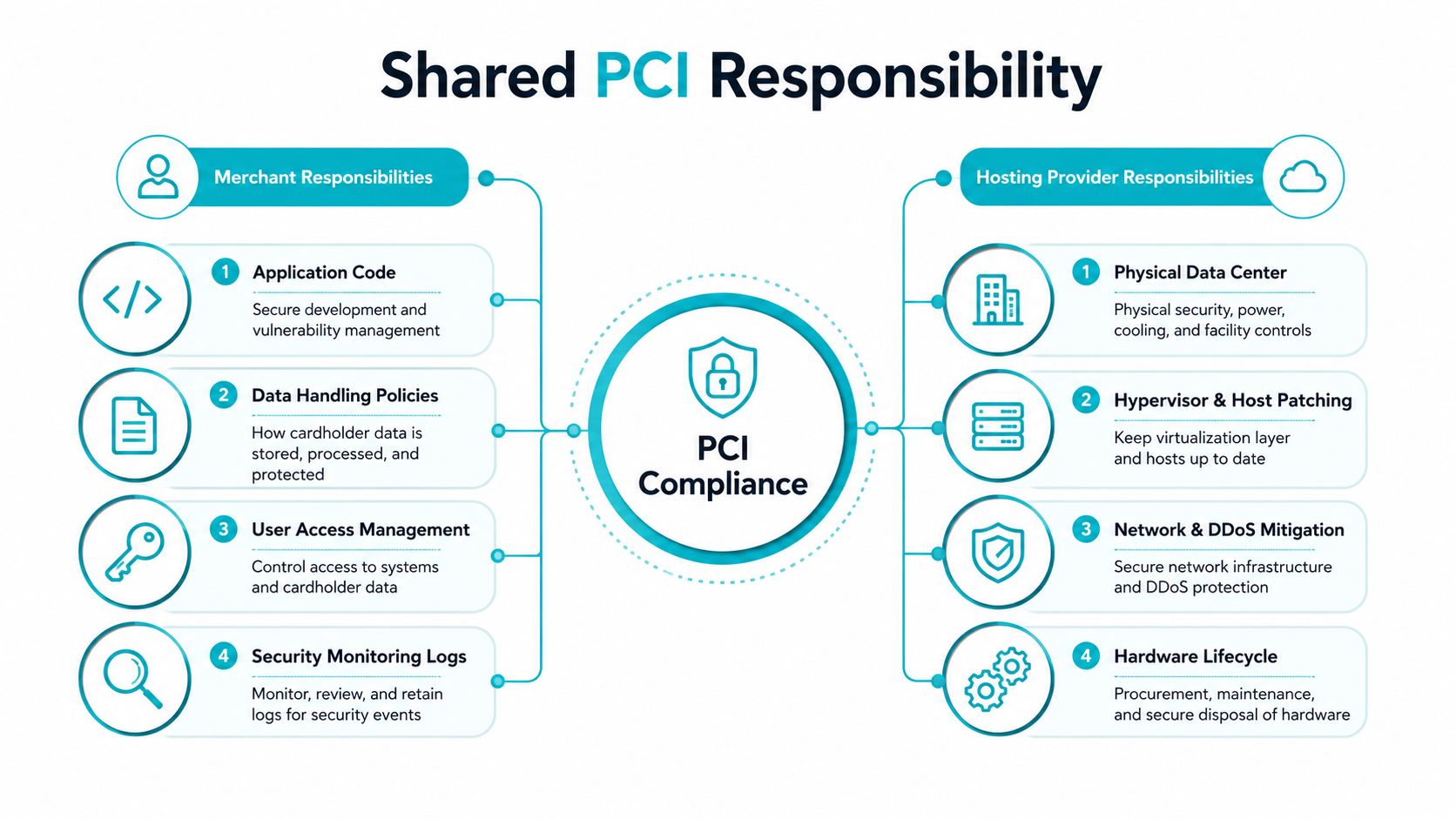
PCI failures usually surface at the boundary between teams. The provider assumes the application owner handles the app. The merchant assumes the host handles the server. The assessor asks for evidence, and both sides discover they own different parts of the same control.
A useful way to frame it centers on control ownership. The provider usually owns the physical data center, hypervisor patching, network DDoS mitigation, firewall baselines, and baseline logging. The merchant owns application code, business rules, user access, web application firewall logic inside the stack, and anything that touches card data.
Who produces which evidence
| Control Area | Host usually provides | Merchant usually provides |
|---|---|---|
| Physical security | Data center access controls and facility safeguards | Vendor due diligence file |
| Network segmentation | Segmentation design and firewall baselines | Application architecture showing what's in scope |
| Patching | Host and hypervisor maintenance evidence | Server patching for guest OS and apps |
| Logging | Central logging platform, retention settings, access model | Proof that app logs don't capture card data |
| Access control | Admin platform restrictions and MFA on provider systems | User provisioning, approvals, and role review |
| Backups | Backup infrastructure and restore support | Backup scope, encryption, and retention decisions |
That split shows up clearly in audits. The host should be ready to show segmentation diagrams, hardening standards, access controls on its side of the environment, and log retention settings. The merchant should be ready with application architecture, scope statements, user access reviews, and proof that the app does not write card data into logs, backups, or admin tools. If the assessor cannot trace a control to an owner, the gap usually lands on the merchant because the merchant signs the attestation.
Compliance drift lives in the space between those two sets of evidence. Analysts at PCI compliance drift data report that many organizations drift out of compliance within a year of certification. That is not a paperwork issue, it is an operational one.
If payment flow design still needs outside review, payment guidance from MD TECH TEAM helps map the handoff between checkout code and processor-side flows before the auditor starts asking questions. For the host side of that handoff, a server hardening checklist for PCI environments gives teams a concrete starting point for the controls they should document. The question is whether the architecture keeps card data off systems the merchant does not want in scope.
Technical Implementation Checklist and Configuration Steps
PCI work gets easier when it is turned into configuration, logs, and repeatable checks. A host can help, but an assessor usually wants to see the actual server settings, firewall rules, log exports, and restore evidence. Every control should leave a trail that someone can hand over during review.
Harden transport first
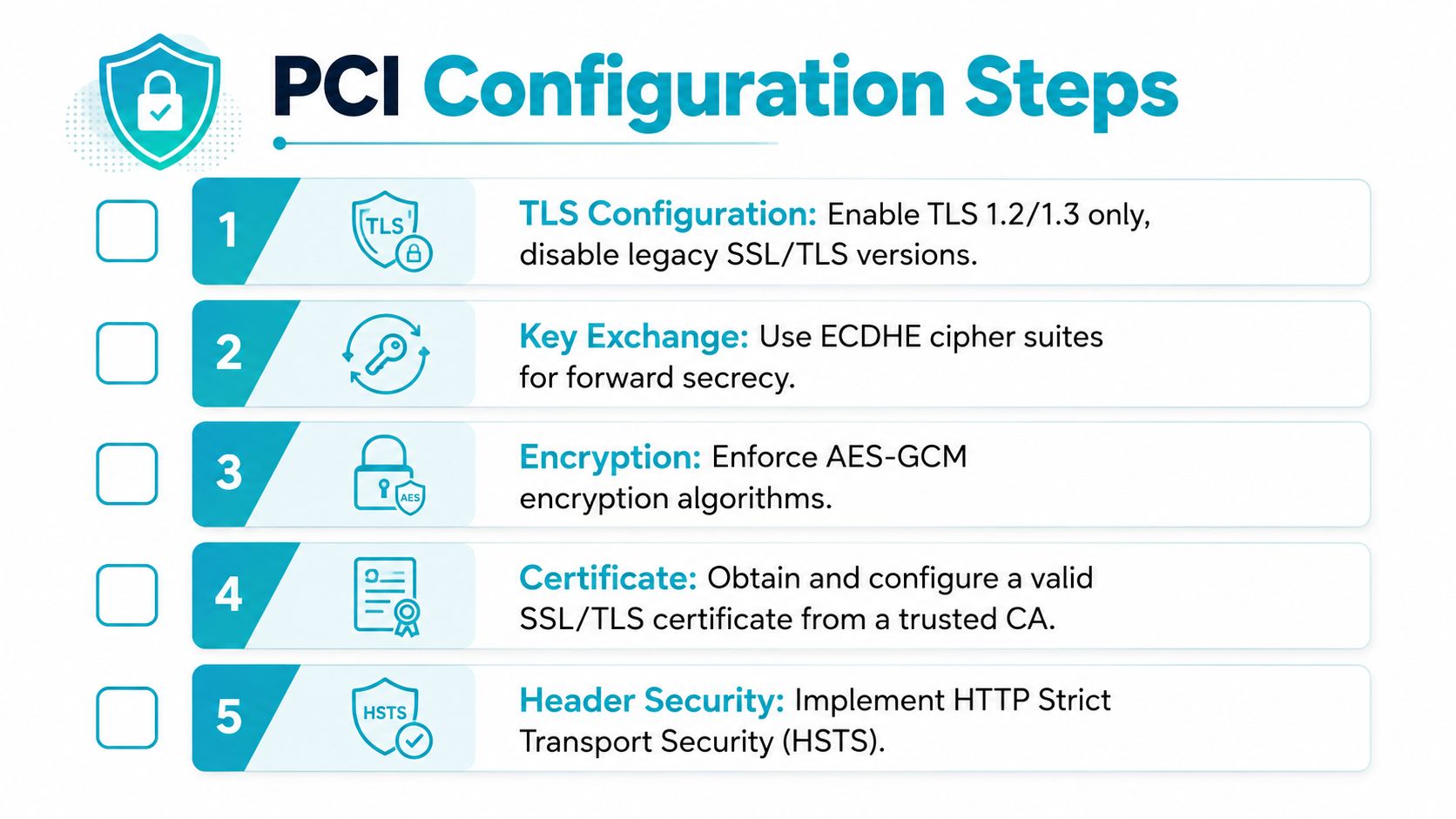
For cardholder data in transit, current TLS settings are the baseline. TLS 1.2 or 1.3 should be the only allowed versions, and SSLv2, SSLv3, TLS 1.0, and TLS 1.1 must be disabled Where cipher choice is under your control, prefer ECDHE with AES-GCM or CHACHA20-POLY1305, and use at least 2048-bit RSA
A simple nginx example looks like this:
ssl_protocols TLSv1.2 TLSv1.3;
ssl_prefer_server_ciphers on;
ssl_ciphers ECDHE-ECDSA-AES256-GCM-SHA384:ECDHE-RSA-AES256-GCM-SHA384:ECDHE-RSA-CHACHA20-POLY1305;
ssl_certificate /etc/ssl/certs/site.pem;
ssl_certificate_key /etc/ssl/private/site.key;
Audit note: save the final config, then capture a screenshot or export after reload. Assessors require captured evidence, such as a saved config, a screenshot, or an export, rather than stated intent.
Segment the cardholder zone
Segmentation keeps one compromised service from turning the whole environment into audit scope. A basic nftables rule set can limit traffic into the CDE subnet and block everything else by default:
nft add table inet filter
nft add chain inet filter input '{ type filter hook input priority 0; policy drop; }'
nft add rule inet filter input ct state established,related accept
nft add rule inet filter input tcp dport 443 accept
nft add rule inet filter input ip saddr 10.20.0.0/24 accept
That is not a full design, but it shows the pattern. The assessor will want to see where the CDE starts and ends, who can reach it, and which controls keep adjacent systems from drifting into scope. A host should also be able to show the segmentation diagram and the access rules that back it up, because those documents usually sit next to the network evidence in a real audit.
Forward logs and verify restores
PCI logging is more than turning on syslog. Logs need a protected destination, routine review, and a path that does not sit in the same failure domain as the systems being monitored. A basic rsyslog forwarder can send events to a central collector:
*.* @@log-collector.example
Backups deserve the same scrutiny. A backup that cannot be restored is a liability, and a backup target that can read card data is still in scope. Verify a backup with an actual restore test, not just a checksum:
proxmox-backup-client restore host/2026-01-01T00:00:00Z root.pxar /tmp/restore-test
A practical resource for tightening the rest of the stack is the server hardening checklist, especially if you are documenting guest OS controls for an assessor. OrderOut's restaurant POS requirements is also useful if you are comparing payment workflows in a retail environment, because POS choices shape scope just as much as web checkout does.
The hard line is simple. Any system that can see or log card data is in scope. That includes logs, backup targets, staging copies, and helper services. If you cannot defend those systems in an audit, they do not support your PCI story, they expand it.
Reducing PCI Scope Through Payment Architecture
The biggest PCI decision happens before you pick a host. It starts with how payment data moves. Hosted payment pages keep card entry on the processor's side, which materially reduces the systems that enter your PCI scope. Direct-post or on-server capture pulls more of your stack into the cardholder data environment, because the merchant site, application, database, logs, backups, and administrators all become part of the audit conversation.
A payment flow that never exposes the raw card number to your environment is much easier to defend. The auditor still wants evidence, but the list is smaller, and the controls are easier to prove. That is why a merchant using a hosted payment page may fit a lighter self-assessment path, while another merchant with the same catalog and traffic may face a far wider scope because the checkout form runs through their own origin.
Three common patterns
Hosted payment pages keep card entry on the processor's side. Your site can hand the buyer off and stay out of the card path, which keeps the environment smaller and reduces the number of systems that need PCI controls.
Direct-post or JavaScript-based forms reduce friction for the buyer, but they also demand more care from the merchant. If the page itself affects the payment flow, the script chain, hosting setup, and page integrity all become part of the review, even when the processor receives the final submission.
On-server capture brings the raw data into your environment. Once that happens, the database, logs, backups, staging copies, administrative access, and any helper services that can see the data all move into scope. That is the point where PCI work stops being a checkout design choice and becomes a wider infrastructure responsibility.
Keeping cardholder data off your servers cuts down scope, risk, and maintenance burden. It also simplifies the auditor's evidence request, because fewer systems need segmentation proof, logging review, access control records, and backup handling evidence. A merchant that routes payment entry through a hosted page can often keep the assessor focused on a narrower control set than a merchant that receives raw card values directly.
I have seen migrations fail on this exact point. The business wanted the convenience of a custom checkout, but the moment the merchant origin touched the card path, the host had to provide stronger isolation, tighter logging discipline, and cleaner documentation for every component that could reach the data. That is the trade-off. A cleaner payment architecture lowers the burden on the host and on the merchant, while a broader checkout flow makes both sides produce more evidence for the audit file.
A practical next step is to use the vulnerability scanning tools page as part of your review process before a migration or renewal. Scanning does not replace architecture, but it does help confirm that the environment you believe is out of scope is staying out of the card path.
Vendor Evaluation Questions and Evidence to Demand
A good PCI host leads with documents like the Attestation of Compliance, segmentation diagrams, logging configurations, and a clear statement of where its controls stop and yours begin. Ask for those items up front. If the provider answers with broad assurances instead of evidence, keep pressing until the responsibilities are named in writing.
Questions that should be on the call
Can you provide your AOC?
Ask for the current attestation, not a sales recap or a promise that the provider is “PCI ready.”Can you show the network segmentation diagram for the CDE?
The auditor will want to see what is isolated, what still shares infrastructure, and how traffic is restricted between those zones.Do you provide centralized logging or syslog forwarding?
Local logs on the host are usually not enough for a real review. You want to know where logs land, who can read them, and how they are retained.How are backups encrypted, where are they stored, and how are restores tested?
Backup handling is one of the first places scope drift shows up, especially after a migration or storage change.What isolation do you recommend for this workload, shared, VPS, or dedicated?
The right answer depends on whether the environment can ever touch card data, admin traffic, or supporting services that see sensitive flows.
A buyer-side scan review still matters here, especially before a renewal or migration. The vulnerability scanning tools page is a useful checkpoint for the operational side of that review, because scans support the evidence file without replacing the architecture or the host's written controls.
The strongest hosts talk plainly about shared responsibility, continuous verification, and change control. Weaker providers lean on the word “PCI” and leave the rest vague. Re-check the evidence every year, and again after any firewall change, new plugin, backup target, or platform move, because scope can change faster than a policy document gets updated.
Scaling This with ARPHost and Frequently Asked Questions
If you're mapping an environment to a real hosting stack, the fit should follow the scope. Secure Web Host VPS bundles with Imunify360, CloudLinux OS, and Webuzo fit application isolation and malware control needs for SAQ A-EP and SAQ D workloads. Standard VPS hosting on NVMe-backed Tampa infrastructure is a cleaner starting point for lighter SAQ A-style environments, while Proxmox private clouds and dedicated bare metal servers are better suited when you need isolated CDE segments and full root control.
For tighter separation, dedicated hardware matters. A Dual Intel Xeon E5-2690 V3 platform in Tampa, with 28 cores, 56 threads, and 64GB DDR4 ECC RAM, makes sense for Proxmox clusters and multi-tenant nodes. An AMD EPYC 4584PX system with 16 cores, 32 threads, 192GB DDR5 RAM, and NVMe storage is the stronger fit for memory-heavy databases and dense virtualization. Colocation is the right answer when you already own compliant hardware and want a controlled Tampa facility.
Why ARPHost fits this topic: it offers VPS hosting, secure web hosting bundles, bare metal servers, dedicated Proxmox private clouds, colocation, instant applications, and fully managed IT services in one operational model. If you're comparing architectures, start with secure VPS bundles, review Proxmox private cloud plans, or check bare metal servers when you need stricter isolation.
Frequently asked questions
Does scope drift happen after a host change? Yes. A migration can change logging paths, backup targets, or admin access, and that can change scope even if the site looks the same.
Is shared hosting ever appropriate for PCI? Only in very limited, well-scoped cases, and usually not when the merchant server can influence payment flow or store card data.
How often should evidence be re-verified? At least annually, and after any material infrastructure or payment-flow change.
ARPHost, LLC provides the hosting, private cloud, colocation, and managed infrastructure pieces that sit around a PCI-sensitive workload, and it can help narrow scope with isolated environments, hardened VPS plans, and dedicated hardware. If you're rebuilding a payment stack or preparing for an assessor review, visit ARPHost, LLC to compare the hosting options that fit your architecture and compliance model.