

A web VPS gets compromised, and the first symptoms look harmless: unexpected outbound connections, failed login bursts, or a monitoring alert from a host that normally talks only to customers. On a flat network, that server may also reach databases, backup storage, hypervisor management, and identity services. The immediate fix is to stop treating the subnet as the security boundary. Start by inventorying allowed flows, place management and storage on separate networks, then enforce default-deny rules between workloads.
For Linux hosts, nftables gives you a practical enforcement point. On a Proxmox cluster, combine host and guest firewall policy with distinct VLANs or bridges for management, VM traffic, storage, and backup. Test every rule before making it persistent, and keep a rollback path open.
Table of Contents
- Why Network Segmentation Matters in Production
- Core Concepts and Segmentation Layers
- Design Principles for Effective Segmentation
- Implementation Steps and Configuration Examples
- Topology Patterns for Different Environments
- Common Pitfalls and How to Avoid Them
- Monitoring, Testing, and Continuous Verification
Why Network Segmentation Matters in Production
A compromised web server shouldn't be able to scan the database tier, open a session to the backup repository, or reach the Proxmox management interface. In production, those paths often exist because the original network design optimized for convenience. A shared subnet makes deployment easy, but it also turns one stolen credential or vulnerable application into a useful launch point.
Network segmentation limits that launch point. It divides internal networks into controlled zones and governs east-west traffic between them. NIST's secure enterprise network guidance describes microsegmentation as dividing a network into isolated segments so traffic between them can be controlled to prevent attack escalation, and places it alongside zero-trust network access and software-defined perimeter patterns (NIST SP 800-215).
Containment is the operational objective
Segmentation doesn't guarantee that an internet-facing service won't be breached. It changes what the attacker can do next. A web workload might still serve its public application, but it shouldn't automatically have permission to initiate administrative sessions, query unrelated tenants, or connect to backup infrastructure.
The difference matters for small infrastructure teams. A flat environment forces responders to investigate a broad set of systems after one host is compromised. A segmented environment gives them defined boundaries, narrower logs, and a clearer containment action. That reduces the number of systems that need immediate isolation, although it doesn't remove the need for incident response.
Production rule: Protect identity, backups, hypervisor management, and administrative access more aggressively than ordinary application workloads.
Why perimeter controls aren't enough
A perimeter firewall can filter traffic entering the facility or cloud edge. It can't enforce trust inside a shared virtual switch unless another control examines the internal flow. NIST's enterprise-network guidance explicitly frames microsegmentation as an internal-network control, where east-west traffic is governed by policy rather than broad trust (NIST enterprise network guidance).
That internal boundary is especially important in multi-tenant VPS, bare metal, and Proxmox environments. Each tenant, VM group, and administrative plane has a different business purpose and risk profile. The practical network segmentation best practices in this article focus on keeping those boundaries understandable, testable, and maintainable instead of drawing a complex diagram nobody can operate.
Core Concepts and Segmentation Layers
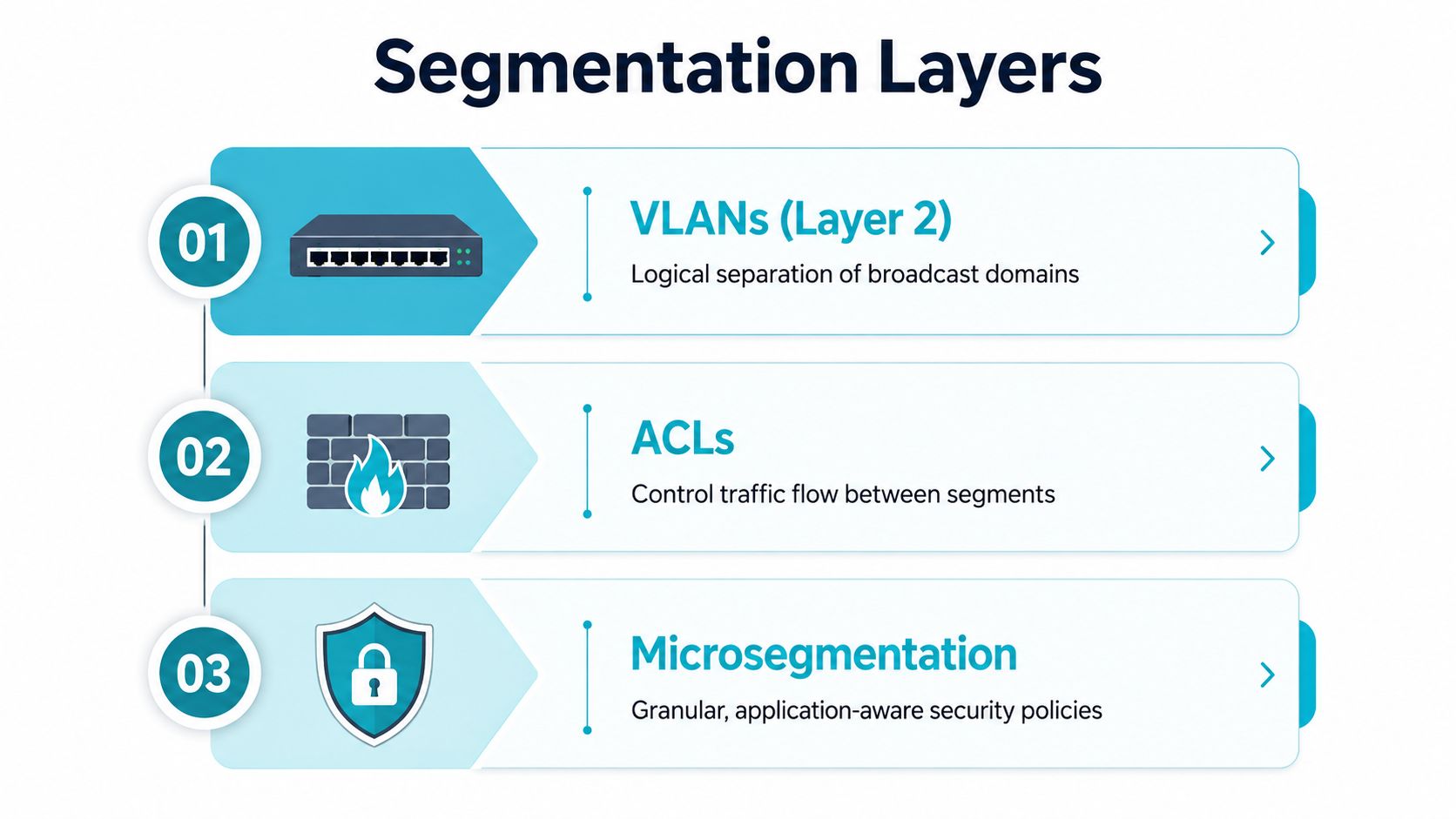
Segmentation works through three control layers. VLANs separate traffic into broadcast domains, ACLs control routed communication between those domains, and microsegmentation applies policy at the workload or identity level. Each layer addresses a different failure mode. A VLAN alone does not restrict routed traffic, while microsegmentation built without flow discovery can interrupt undocumented dependencies.
For SMBs running VPS, bare metal, or Proxmox, the practical sequence is straightforward: establish broad network boundaries, control zone-to-zone paths, then restrict individual workloads where shared subnets still carry different risks.
VLANs create the first boundary
A managed switch can use 802.1Q tagging to place ports, trunks, and virtual machines into separate Layer 2 broadcast domains. Separate VLANs for management, servers, guests, backups, and storage are usually easier to operate than one shared network, especially when Proxmox bridges and bare-metal hosts are involved.
VLANs do not determine whether routed networks may communicate. Put that decision on a router, firewall, or host policy layer. Unmanaged switches also cannot enforce VLAN membership, so verify every trunk, access port, bridge, and upstream connection before treating the separation as a security boundary.
ACLs enforce the path
An ACL or firewall policy defines allowed source, destination, protocol, and service combinations. An application tier might reach a database service, while the database has no arbitrary path back to the application tier.
Microsegmentation narrows the policy unit further. The security-in-layers approach combines network boundaries with host controls, identity checks, and application protections. Use VLANs for broad role-based separation, ACLs for explicit inter-zone access, and microsegmentation when workloads on the same subnet require different policies. In production, apply host rules carefully during migration, because an incorrect default-drop policy can isolate a VM, cluster service, or backup job without changing the VLAN design.
Design Principles for Effective Segmentation
Start with communication flows, not VLAN names. Inventory each workload, owner, service, and dependency before writing rules. Record expected traffic and administrative access. A production database may accept connections from an application tier, backup service, monitoring system, and a tightly controlled administrator path. Treat every other path as unnecessary until someone verifies it.
NIST's Zero Trust Architecture guidance recommends placing enterprise resources in distinct network segments protected by gateway security components. In a VPS, bare-metal, or Proxmox environment, that means routing sensitive traffic through a firewall or policy point instead of trusting a shared bridge or perimeter alone. The boundary should make unauthorized lateral movement difficult and visible.
Start with identity and business function
IP ranges help with routing, but they are weak policy labels. Cloud workloads move, containers are recreated, and a VM can change role without moving to another network. The Department of Defense Zero Trust Reference ArchitectureZT_RA_v2.0(U)_Sep22.pdf) describes microsegmentation through logical attributes such as users, applications, workloads, and devices. It also warns that port and protocol rules alone do not provide enough context.
For an SMB or DevOps team, identity-first design does not require an expensive platform immediately. Name workloads by function, owner, and environment. Apply those attributes through platform labels, security groups, or orchestration policy where available. Use VLANs, addresses, and host firewalls as supporting controls, while documenting which control owns each decision.
Apply least privilege in stages
Capture flows in observe-only mode where the platform allows it. Review logs for legitimate dependencies, identify one service path at a time, and enforce only the traffic the application needs. In a Proxmox cluster, check migration, storage, backup, monitoring, and management traffic separately. A default-drop rule applied before those dependencies are mapped can isolate a VM or interrupt recovery work.
A practical rollout follows this order:
- Protect critical assets: Isolate identity services, backup platforms, hypervisor management, and administrative services first.
- Create shared zones carefully: Let lower-value resources share a trust zone when separate policy would create more operational work than security benefit.
- Separate high-value systems: Give systems with privileged access, sensitive data, or recovery authority their own enforcement boundary.
- Use staged enforcement: Begin with logging, move to explicit allows, and maintain a documented exception process.
Cisco's segmentation survey found that 79% of security professionals called segmentation a top organizational priority, while 33% reported fully implementing both macro-segmentation and micro-segmentation (Cisco segmentation survey). The practical conclusion is straightforward: choose a policy set operators can review, test, and maintain. A smaller boundary that works on every host is safer than an elaborate design nobody can validate.
Implementation Steps and Configuration Examples
The following example targets a Linux server using nftables, the firewall component of the Linux Netfilter subsystem. Red Hat's documentation describes tables as organizational units that group chains and related objects (nftables documentation). Test on Ubuntu or Debian before production, because package versions and distribution firewall integration differ. RHEL-based systems may also have firewalld managing nftables rules, so don't edit an unmanaged ruleset behind its back.

Build a host policy safely
Save the current rules, validate the new file, and load it without restarting the host:
sudo nft list ruleset > /root/nftables.backup
sudo nft -c -f /etc/nftables.conf
sudo nft -f /etc/nftables.conf
sudo nft list ruleset
A minimal host policy can allow established sessions, loopback, SSH from a management interface, and application traffic from an approved application network. Replace the example interface and service values with your actual design.
table inet segmentation {
 chain input {
 type filter hook input priority filter;
 policy drop;

 iifname "lo" accept
 ct state established,related accept
 ct state invalid drop

 iifname "mgmt0" tcp dport 22 accept
 iifname "app0" tcp dport 443 accept

 counter log prefix "segmentation-input-denied " drop
 }

 chain forward {
 type filter hook forward priority filter;
 policy drop;

 ct state established,related accept
 counter log prefix "segmentation-forward-denied " drop
 }

 chain output {
 type filter hook output priority filter;
 policy accept;
 }
}
The Linux firewall segmentation guide provides another reference for structuring host-level controls. On Ubuntu and Debian, enable persistence only after testing:
sudo systemctl enable nftables
sudo systemctl restart nftables
sudo systemctl status nftables
On RHEL-based systems, check whether firewalld owns the policy first:
sudo firewall-cmd --state
sudo nft list ruleset
Apply the pattern to Proxmox and VPS hosts
For Proxmox VE, keep the management bridge or interface separate from guest, storage, and backup traffic. The hypervisor firewall can enforce node and VM policy, but the physical switch and upstream firewall still need matching VLAN and trunk definitions. Don't assume that placing VMs on separate bridges automatically controls every routed path.
For VPS isolation, define tenant or service groups by function, then allow only required service paths. For bare metal, physical interfaces or switch ports can provide an additional boundary for storage and management, while nftables protects the host if a route is misconfigured.
Verify before closing the change
Check counters and logs while testing:
sudo nft list chain inet segmentation input
sudo journalctl -k -f
sudo tcpdump -ni any 'tcp port 22 or tcp port 443'
sudo conntrack -L
From an authorized test host, validate permitted and denied paths with Nmap:
nmap -Pn -p 22,443,5432 --reason server.example
If a rule breaks traffic, restore immediately:
sudo nft flush ruleset
sudo nft -f /root/nftables.backup
sudo nft list ruleset
Keep console or out-of-band access available. A firewall change that removes SSH is a routine incident when operators have no recovery path.
Topology Patterns for Different Environments
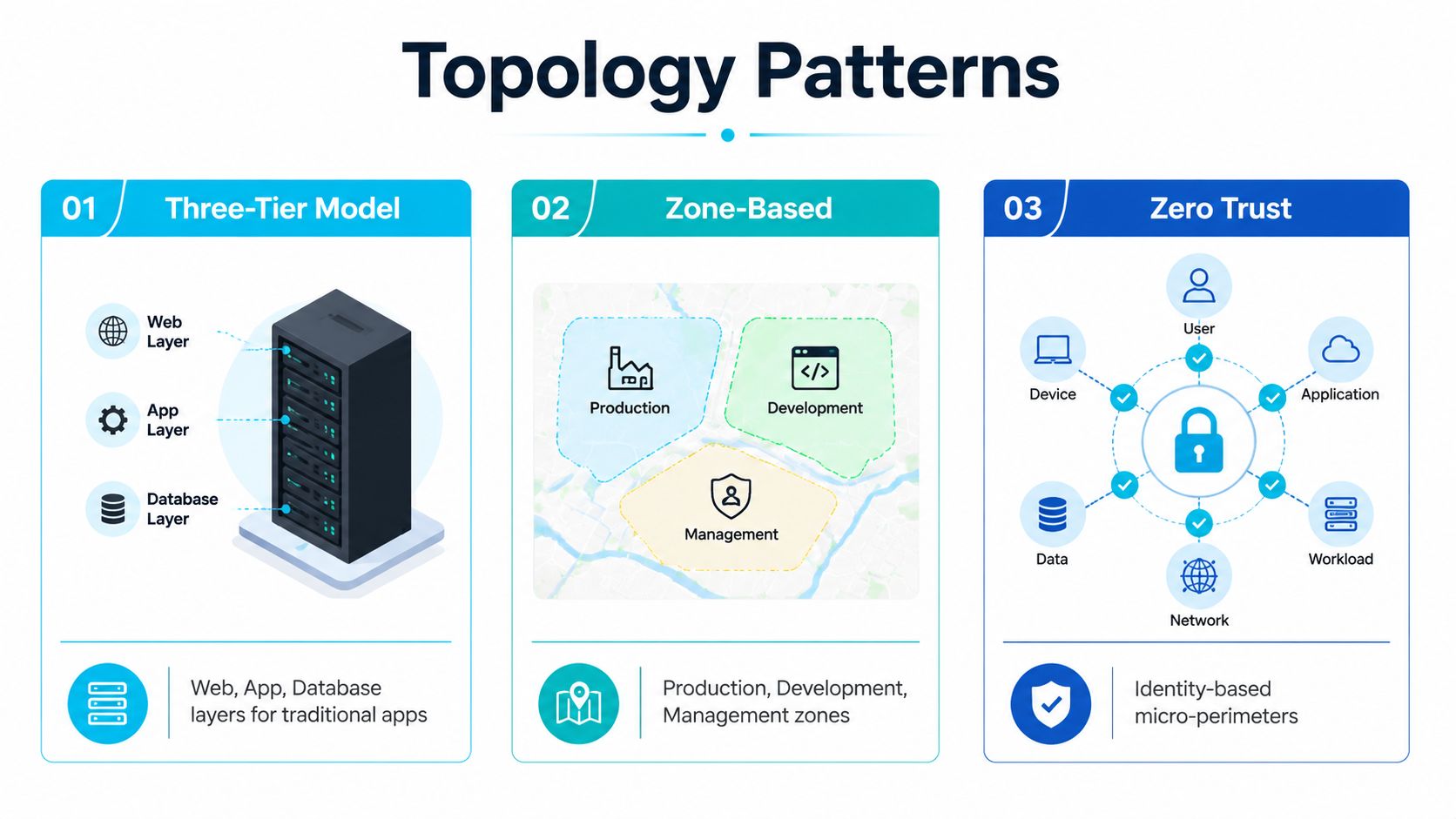
No single topology fits every application. Choose the smallest design that matches the workload's trust boundaries and your team's ability to operate it.
Three-tier networks suit traditional applications
The familiar web, application, and database model remains practical when the application has stable tiers. Internet traffic reaches the web tier, the web tier calls approved application services, and the application tier reaches the database. Administrative access enters through a management boundary rather than through the public service path.
This model is easy to explain and audit. It becomes awkward when services communicate laterally, when one VM hosts unrelated applications, or when containers are deployed inside a shared application segment.
Zone-based designs fit mixed operations
Production, development, management, backup, and storage zones often work better for SMB infrastructure and Proxmox clusters. A Proxmox deployment benefits from keeping VM traffic away from cluster management and storage traffic. Backup paths should also be deliberate, because unrestricted access from guest workloads to recovery systems creates an avoidable risk.
| Pattern | Works well when | Main trade-off |
|---|---|---|
| Three-tier | Application tiers are stable and clearly separated | Less flexible for distributed services |
| Zone-based | Teams operate mixed VPS, bare metal, and virtual workloads | Broad zones can create excess trust |
| Microsegmented | Workloads need distinct identity or application policies | Requires stronger visibility and policy operations |
Microsegmentation belongs where workload identity matters
Containers and rapidly changing cloud workloads often outgrow IP-only rules. A policy tied to workload identity or service labels can survive rescheduling better than a rule tied to a temporary address. The trade-off is operational: teams must maintain labels, deployment policy, logging, and exception handling.
Physical separation still has value. Dedicated interfaces and switch paths can isolate storage or management traffic in bare metal and private-cloud environments, while logical controls provide finer policy. Teams running dense virtualization or Proxmox private clouds may also evaluate dedicated hardware when predictable isolation and resource ownership matter. ARPHost provides bare metal server infrastructure that can fit workloads requiring dedicated compute, including virtualization and private-cloud designs.
For hybrid environments, define which side owns each boundary. A cloud security group, on-premises firewall, host firewall, and service mesh shouldn't all enforce different interpretations of the same flow without a source-of-truth policy.
Common Pitfalls and How to Avoid Them
The most common segmentation failure isn't a missing firewall feature. It's missing visibility. Teams write rules from diagrams, discover undocumented dependencies during enforcement, then add broad exceptions until the original boundary becomes difficult to trust.
Cisco's survey found that 87% of respondents believed their segmentation process needed improvement. It identified complex environments at 54%, lack of visibility at 32%, and difficulty identifying legitimate communication flows at 32% as major issues (Cisco segmentation findings). Those findings align with what operators see in mixed Proxmox, VPS, legacy, and cloud estates.
Treat maintenance as part of the design
A separate industry summary reports that 94% of organizations experience implementation difficulties, with 53% citing policy maintenance and 40% citing inconsistent enforcement points The practical response is to assign ownership for every policy, record its business purpose, and remove exceptions that no longer serve an active dependency.
Avoid these traps:
- Segmenting everything at once: Start with identity, backups, management, and other high-value systems. Expand after you can observe and support the first boundaries.
- Relying only on IP addresses: Combine address rules with workload, device, user, and application context where available.
- Using one enforcement point: Match switch, gateway, host, hypervisor, and cloud controls so a bypass in one layer doesn't nullify the design.
- Blocking without a recovery plan: Keep console access, tested rollback files, and a maintenance window for enforcement changes.
- Calling the project finished: New VMs, services, routes, and administrative tools change the valid communication map.
The 2025 Cisco survey also found that only 33% reported full implementation of macro-segmentation and micro-segmentation (Cisco segmentation survey). The lesson isn't to abandon segmentation. It's to make the first deployment narrow enough that operators can measure it, troubleshoot it, and extend it without replacing the entire network.
Monitoring, Testing, and Continuous Verification
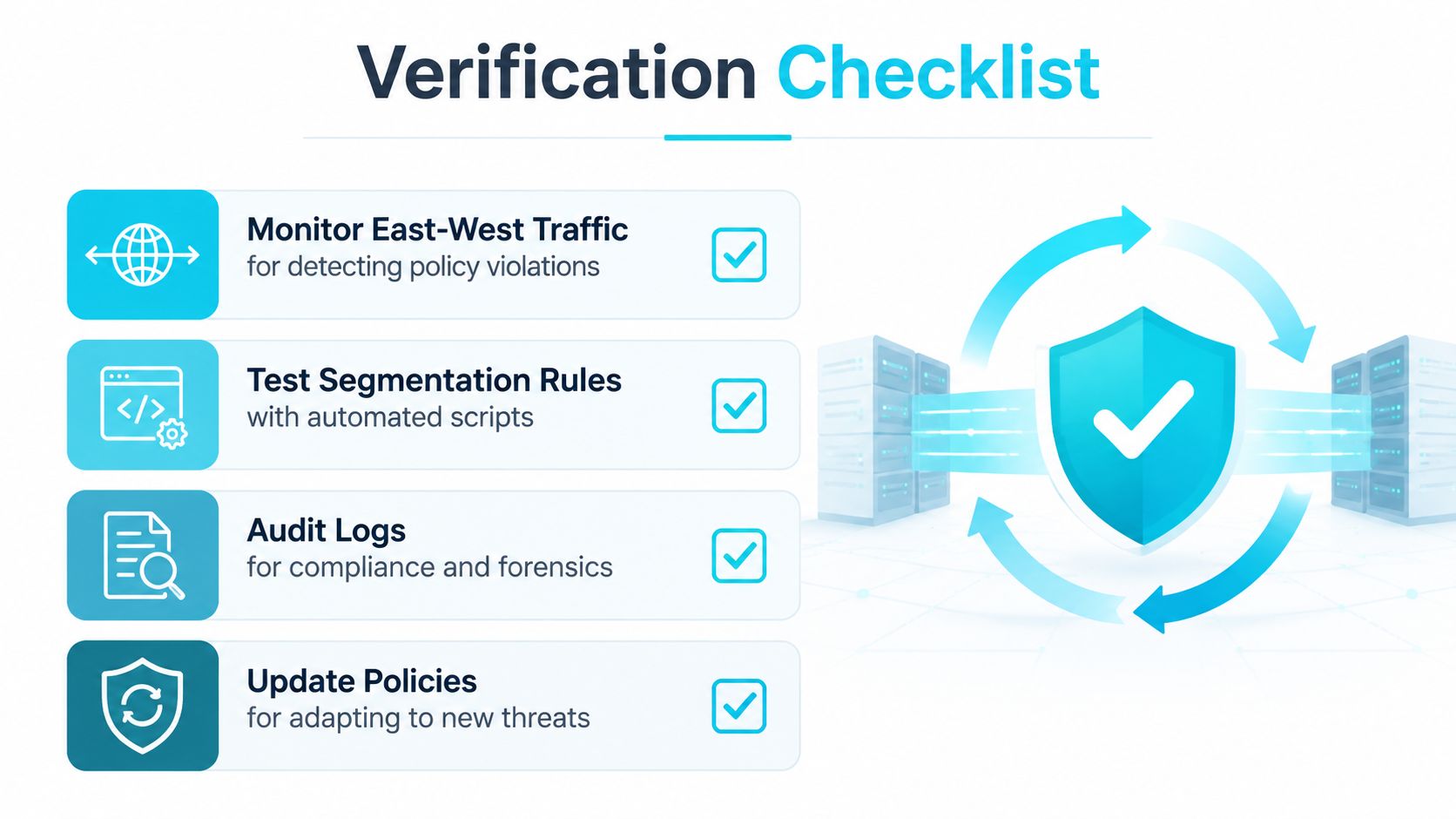
A segmentation policy isn't proven by its configuration file. It's proven when an unauthorized path fails, the event appears in the right logs, and an operator can explain why the permitted paths still work.
Monitor east-west traffic at the host, hypervisor, gateway, and switching layers where possible. On Linux, nftables counters and kernel logs show denied packets. tcpdump helps distinguish a policy block from a service that isn't listening. Connection tracking reveals whether a session was established or merely attempted.
Test the boundary, not just the service
Build a test matrix with approved and prohibited flows. Test from each relevant source zone, including a compromised-workload simulation, and verify both directions where stateful rules could hide an unintended path.
Useful checks include:
sudo nft list ruleset
sudo nft list counters
sudo tcpdump -ni any host server.example
sudo conntrack -L
nmap -Pn -p 22,443,5432 --reason server.example
Automate checks for required rules, unexpected listening services, and drift between nodes. Penetration tests and red-team exercises should attempt lateral movement toward management, identity, backup, and data systems. The objective is containment, not merely a clean firewall audit.
Define measures operators can act on
Track policy coverage, denied-flow review status, and whether simulated lateral movement reaches protected assets. NIST-linked guidance and a Department of Defense cloud segmentation guide both emphasize monitoring east-west traffic and allowing only necessary data-flow paths. A systematic review cited in the verified guidance reports that zero-trust microsegmentation in cloud environments can reduce network exposure by 60–90% when applied to high-risk workloads and services (systematic review summary).
Review policies when applications change, and schedule recurring audits of enforcement points. The infrastructure monitoring practices guide covers the broader operational discipline needed to correlate firewall events, host health, and service behavior. Send logs to a central system, preserve enough context for incident review, and treat every broad allow rule as technical debt with an owner.
ARPHost, LLC supports segmented VPS, bare metal, Proxmox private-cloud, colocation, and managed infrastructure deployments, including firewall and monitoring operations for teams that don't want to run every control alone. If you need help separating management, storage, tenant, backup, and application traffic, visit ARPHost, LLC and discuss the topology with its infrastructure team.

Leave a Reply
You must be logged in to post a comment.