

You've just handed firewall changes, alert triage, and incident escalation to a managed provider. The dashboard says “protected,” but you still need to verify what that means. Ask for the active ruleset, the last configuration backup, the log retention period, and the ticket that records the most recent change. On a Linux host, start with the evidence you can inspect yourself:
systemctl status firewalld
firewall-cmd --list-all-zones
grep -i "DROP" /var/log/firewalld
On Ubuntu or Debian systems using UFW, enable logging and watch denied traffic with:
sudo ufw logging medium
tail -f /var/log/ufw.log
Those checks won't prove that an entire managed service is effective, but they quickly show whether the local control plane is running, which rules are active, and whether the provider's claimed policy is visible in production.
Table of Contents
- What Network Security Management Services Actually Cover
- Core Service Components and What They Include
- SLA Terms, Response Times, and What They Really Mean
- Packaging Models and How Pricing Is Structured
- Evaluating Providers with an Engineering Checklist
- Integrating Managed Security with Your Hosting Stack
- Incident Response Workflows in a Managed Setup
- Compliance, Reporting, and a Pre-Signing Checklist
What Network Security Management Services Actually Cover
Network security management services are an operations contract, not a catalog of security products. The provider takes responsibility for agreed control planes, maintains them, monitors their output, and follows a defined escalation path. A software vendor may sell a firewall license, SIEM subscription, or intrusion detection platform. A managed security service provider, or MSSP, is expected to operate those systems after deployment.
The boundary must be written down. A typical agreement can include perimeter firewalls, intrusion detection and prevention, DDoS mitigation, web application firewall tuning, centralized logging, vulnerability scanning, and network-based endpoint posture checks. It may also include firmware updates, rule reviews, incident triage, and evidence packages for audits.
Control ownership must be explicit
The MSSP usually owns the configuration workflow for the systems listed in the contract. That can mean approving firewall rules, maintaining IPS signatures, investigating alerts, coordinating mitigation with an upstream network, and preserving logs. Your infrastructure team generally retains ownership of application code, business decisions, identity providers, DNS records, data classification, and the hosts that fall outside the managed boundary.
| Control area | Usually managed by provider | Usually retained by customer |
|---|---|---|
| Perimeter firewall | Rules, objects, backups, monitoring, upgrades | Business justification and approval |
| IDS and IPS | Signature tuning, alert triage, blocking policy | Application context and exception approval |
| DDoS response | Detection, scrubbing coordination, escalation | Traffic ownership and continuity decisions |
| Web application firewall | Policy tuning and custom rules | Application behavior and release schedule |
| Identity provider | Monitoring integration where included | Accounts, roles, and authentication policy |
| Application and DNS | Usually outside the core scope | Records, code, releases, and service ownership |
The market reflects this shift toward recurring operations. The managed security services market was valued at USD 39.87 billion in 2025 and is projected to reach USD 104.66 billion by 2034, with an 11.32% CAGR over that period, according to Fortune Business Insights. Providers monetize continuous detection, policy enforcement, incident response, and compliance support rather than a one-time hardware sale.
For an in-house engineer, outsourcing changes the evidence trail. A successful handoff includes ticket IDs, approval records, rule diffs, backup timestamps, alert dispositions, and retention settings. If the provider only supplies a green dashboard, you don't have operational assurance. You have a status page.
Core Service Components and What They Include
A real service is visible in the work queue. Firewall management should produce a request, an approval, a before-and-after configuration diff, a deployment record, and a rollback option. The provider should also document firmware maintenance, failover testing, object ownership, and the location of encrypted backups.
IDS and IPS work is more than installing signatures. Analysts must tune noisy detections, suppress known false positives, decide whether a rule runs in detection-only or inline-blocking mode, and record exceptions. A generic signature pack can create a large queue without improving containment. The operational test is whether alerts are correlated with asset context and closed with a reason.
DDoS mitigation must cover more than volumetric floods. Network-layer, protocol, and application-layer events can require different controls, including upstream scrubbing, BGP rerouting, DNS-based traffic steering, rate limits, and post-event reporting. Cloudflare reported mitigating 23.2 million network-layer DDoS requests and 29.64 trillion HTTP DDoS requests by mid-2026, demonstrating the volume that modern filtering operations may need to process. See Cloudflare's DDoS threat report for the vendor's operational account.
What the provider should deliver
A web application firewall should contain policies tied to a known application profile. OWASP-pattern rules are a starting point, not a finished deployment. Custom rules need test evidence, release coordination, and an exception expiry process.
Continuous monitoring depends on ingestion quality. The provider should identify which firewall, VPN, cloud, hypervisor, administrative, and operating system logs reach the SIEM. Retention must be stated in days or months, along with search performance and export format. Google Cloud's M-Trends executive edition recommends treating virtualization and management platforms as tier-0 assets, centralizing network-device logs, and retaining administrative logs for at least a year because standard 90-day retention can be insufficient for investigations.
Vulnerability management should distinguish authenticated scans from superficial perimeter checks. A useful workflow prioritizes findings, assigns owners, records exceptions, and verifies remediation on supported network devices and server stacks. Endpoint posture enforcement can check whether a network agent, encryption control, or required patch is present, but it isn't automatically a replacement for full EDR.
| Component | Provider Responsibility | Customer Responsibility |
|---|---|---|
| Managed firewall | Rule lifecycle, change control, backups, firmware | Approvals, application context, emergency authority |
| IDS and IPS | Signature tuning, triage, blocking mode | Exception decisions and asset ownership |
| DDoS mitigation | Detection, rerouting, scrubbing, reporting | Continuity decisions and upstream authorization |
| WAF | Policy authoring, testing, tuning | Application changes and business logic |
| SIEM monitoring | Ingestion, correlation, retention, alert workflow | Log-source approval and data classification |
| Vulnerability management | Scans, prioritization, remediation tracking | Patching systems outside the scope |
| Endpoint posture | Agent and access checks | Device lifecycle and identity policy |
Before signing, compare the promised deliverables with the provider's managed firewall services scope. The useful question isn't whether a component appears on a brochure. It's whether its daily output can be inspected.
Practical rule: Every managed control should produce an artifact someone can review, export, or use to reverse a change.
SLA Terms, Response Times, and What They Really Mean
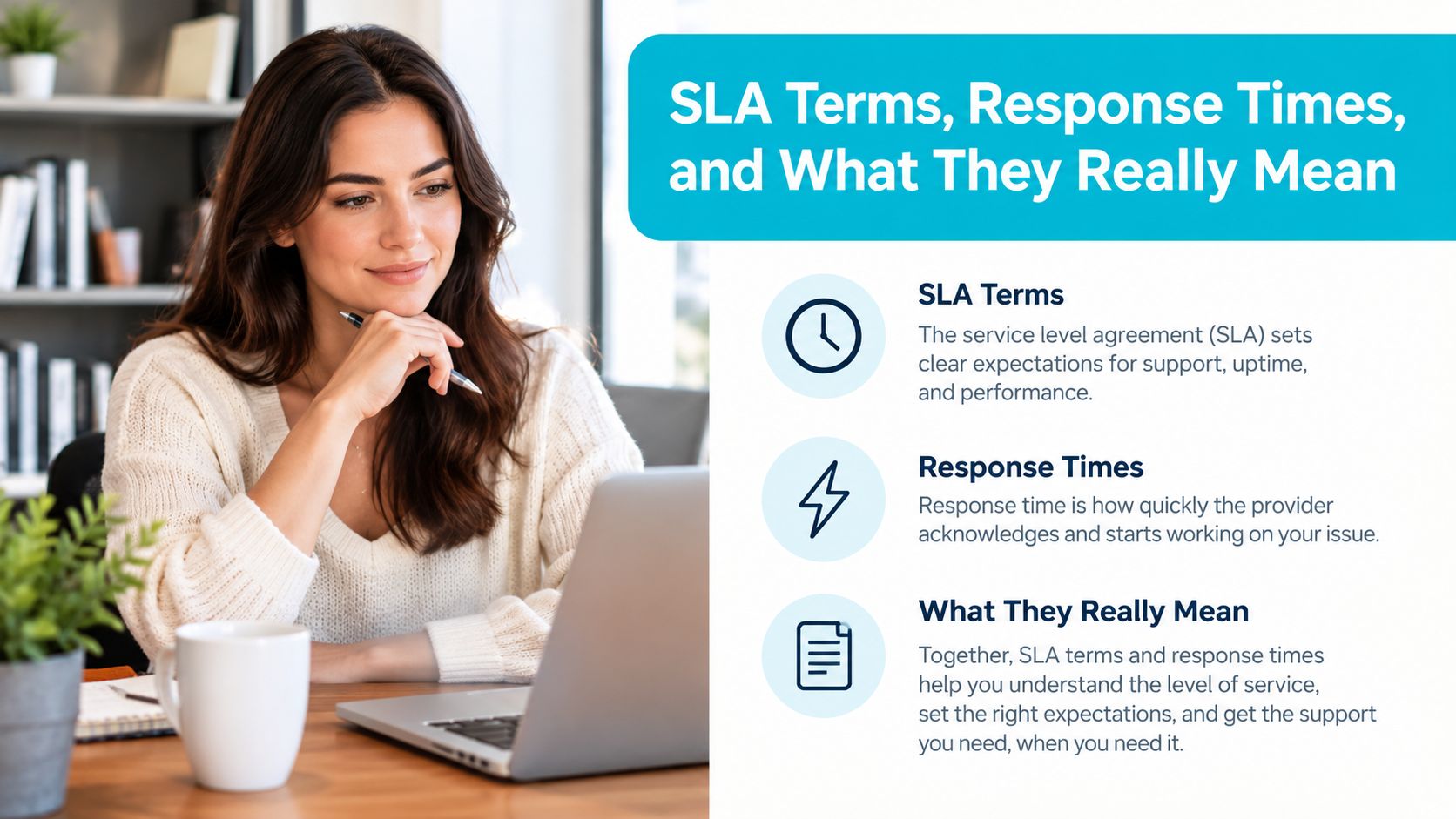
A security SLA contains separate promises. Availability describes whether the managed control is reachable or operating. Response time describes how quickly the provider acknowledges a classified event. Resolution time describes a remediation target, which may depend on customer access, vendor patches, or application owners.
A 99.9 percent firewall availability commitment permits roughly 43 minutes of downtime per month, based on the percentage conversion, and maintenance windows may be excluded if the contract defines them separately. Don't treat that figure as an incident-response promise. A firewall can be available while an alert waits in an unstaffed queue.
Map severity to the actual on-call model
Consider a worked classification. An active data exfiltration event is Severity 1. The contract may require a phone response within 15 minutes. A Severity 3 request to tune a noisy rule may allow 4 business hours by email. Those commitments imply staffed escalation, a monitored phone path, ticket routing, incident ownership, and a handoff process outside local business hours.
The provider should explain whether coverage is local, follow-the-sun, or dependent on an on-call engineer. Ask who can authorize an emergency ACL, who can contact the upstream DDoS provider, and who can approve a BGP or blackholing action. The SLA monitoring service should expose tickets and timestamps, not just a monthly availability color.
Common ambiguities include application-layer outages assigned to shared responsibility, customer-initiated changes excluded from service credits, and penalties described in the contract while the dashboard displays non-cash credits. Validate the staffing model against the written matrix:
- Submit a staged event and record the timestamp.
- Confirm the ticket receives the intended severity.
- Call the emergency number outside the normal maintenance process.
- Ask for the escalation owner and communication cadence.
- Request the final incident and change records.
The video below provides another explanation of SLA response concepts. Treat it as background, then verify every commitment in the signed service schedule.
Packaging Models and How Pricing Is Structured
MSSP proposals usually follow one of three shapes. The first is per-device or per-asset pricing, where the bill follows the number of firewalls, sensors, endpoints, or protected sites. It's easy to audit, but cost grows with every added asset and may leave shared SIEM or response work unclear.
The second is an all-inclusive tier. The provider flattens the service around factors such as bandwidth, seats, log volume, or coverage hours. This can simplify procurement, but “unlimited” language often has a boundary hidden in retention, ingest, change requests, or incident scope.
The third is co-managed or a la carte service. Your team might buy rule reviews, threat hunting, vulnerability scans, or after-hours response separately. This works when internal engineers own routine operations, but it can fail during an incident if authority is split across too many queues.
| Packaging Model | Price Driver | Best Fit | Watch-outs |
|---|---|---|---|
| Per-device or per-asset | Firewall, sensor, endpoint, or site count | Defined estates with predictable growth | Add-on assets and per-change fees |
| All-inclusive tier | Bandwidth, seats, ingest, retention, or coverage | Teams seeking predictable administration | Caps hidden in usage or response scope |
| Co-managed or a la carte | Selected deliverables or service hours | Experienced internal infrastructure teams | Handoffs, gaps after hours, unclear ownership |
Risk profile should guide the choice. A single-region VPS deployment may need hardened host controls, backups, patching, and limited monitoring rather than full enterprise coverage. Multi-site bare metal, regulated colocation, and hybrid environments with several administrative planes justify deeper management because a failure in one control can affect many services.
Hidden cost drivers deserve their own line items. Ask about change request quotas, out-of-scope rule work, VPN user additions, burst DDoS protection, emergency response, log retention upgrades, and custom detection rules. A clean proposal maps every charge to a portal artifact, such as a ticket, report, retained log source, or completed configuration review.
Evaluating Providers with an Engineering Checklist
Procurement becomes useful when the provider has to demonstrate its operating system, not just describe it. Request the change management procedure, firewall failover runbook, redacted monthly report, sample alert closure, and a sample rule-set diff. A mature provider can explain who approves a change, who deploys it, who verifies it, and where the backup resides.
Questions that expose thin delivery
Ask which firewall platforms the provider supports with internal staff and which are subcontracted. Ask whether IPS signatures are tuned per environment or applied generically. For SIEM services, ask how ingest, query performance, retention, and export behave as the log estate grows.
A live test is more revealing than a sales presentation:
- Onboard a non-production firewall with read-only access first.
- Submit a rule change with an intentionally incomplete business justification.
- Observe whether the provider rejects, clarifies, or deploys it.
- Stage a known test event and watch ticket classification.
- Request the rule diff, alert record, and rollback procedure.
- Remove access and verify that credentials and tokens are revoked.
The provider should also show how it handles out-of-band administration. A jump host or bastion needs named accounts, multi-factor authentication, session logging, and a clear emergency access path. If the provider can't explain access revocation, the technical control is incomplete.
Read attestations by scope
A SOC 2 or PCI attestation doesn't automatically cover your entire engagement. Check the in-scope service, facility, system boundary, subprocessor list, control period, and exceptions. Ask whether the specific firewall platform, SIEM tenant, support queue, and staff access path fall inside the attestation.

Contract terms finish the test. Require export formats for firewall configurations and logs, ownership of custom signatures, credential handover, an exit timeline, and assistance with migration. A provider that can't return your operational evidence creates a dependency beyond the security service itself.
Integrating Managed Security with Your Hosting Stack
Managed security sits inside the traffic path and administration path. It isn't useful if the MSSP sees a firewall dashboard but not the cloud security group, hypervisor logs, host events, or out-of-band management network that shaped the incident.
For colocation and bare metal, establish the handoff between the facility network, the customer's edge, and the managed controls. A virtual firewall may sit in front of servers, while IDS sensors receive a traffic mirror and the provider reaches the environment through a restricted management VLAN. Static routes or BGP changes need an approval path because a technically correct route can still interrupt unrelated tenants or services.
Match the controls to the hosting layer
A VPS environment commonly combines provider-side controls, guest firewall policy, and application-layer protection. The MSSP-managed WAF and DDoS layer should complement, not duplicate, security groups and local rules. API-driven synchronization can keep cloud control-plane changes aligned with the provider's ticket system, but only if the integration records the actor, timestamp, previous value, and resulting state.
A hybrid design needs one incident view across both sides of a site-to-site VPN. Ship relevant logs from cloud instances, firewalls, VPN endpoints, and administrative systems into the MSSP SIEM. Deduplicate alerts before they reach analysts, or one connection failure will appear as several unrelated incidents.
| Hosting environment | Integration point | Verification artifact |
|---|---|---|
| Colocation | Edge firewall, IDS sensor, management VLAN | Traffic path diagram and access log |
| Bare metal | Host firewall, upstream mitigation, routing | Rule diff and route-change ticket |
| VPS | Security groups, guest firewall, WAF | API change record and local deny log |
| Private cloud | Hypervisor, virtual network, backup plane | Configuration export and audit trail |
| Hybrid cloud | VPN, cloud logs, on-premises edge | Correlated incident timeline |
In multi-tenant infrastructure, the failure mode is often a visibility mismatch. One team sees a blocked packet at the guest firewall, another sees a permitted flow at the edge, and the provider sees neither because the log source was never onboarded. ARPHost, LLC operates colocation, bare metal, VPS, and Proxmox private cloud infrastructure, so a deployment discussion should identify the exact handoff between hosted hardware and managed controls, rather than treating “the network” as one device.

Incident Response Workflows in a Managed Setup
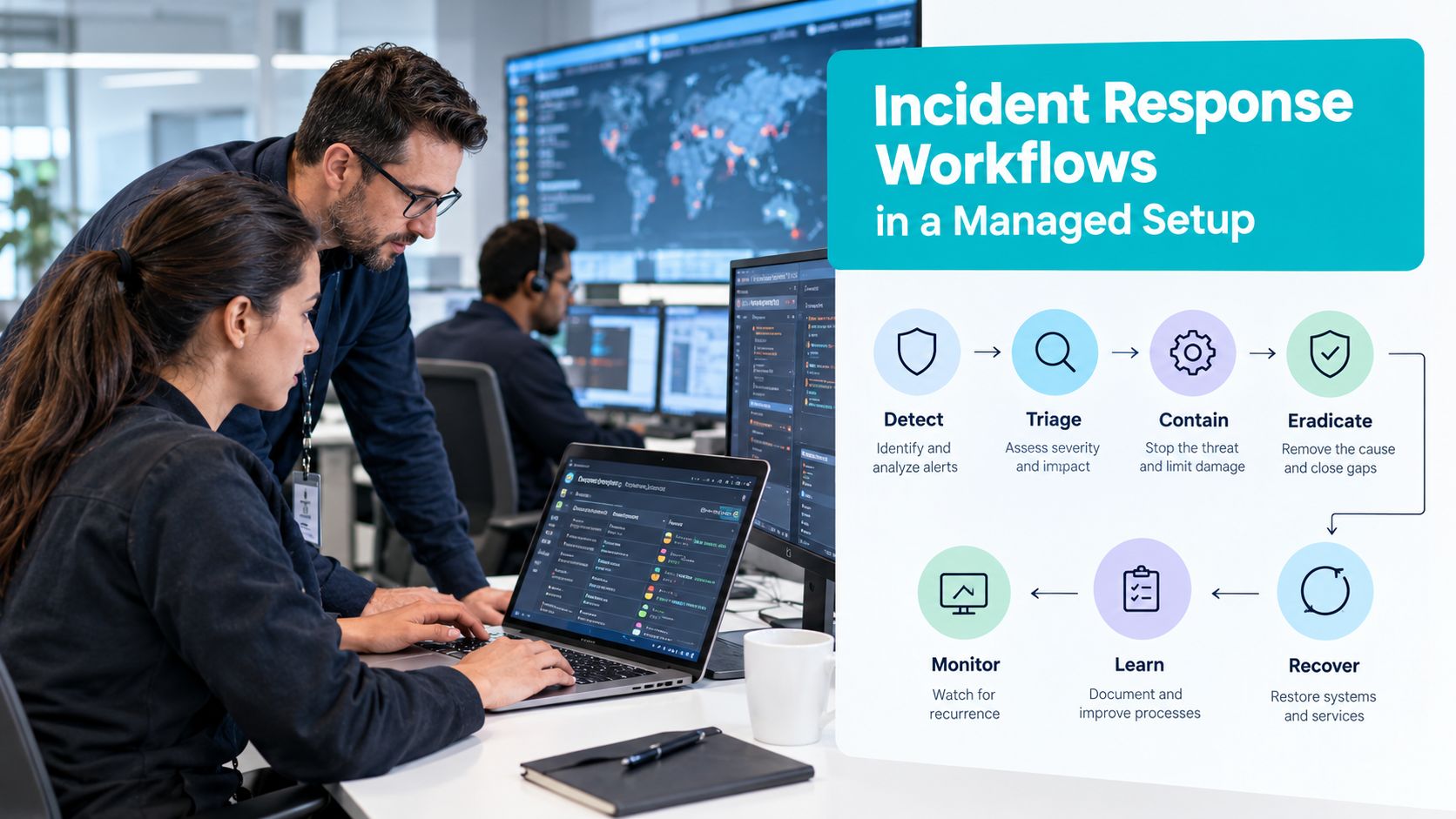
The incident begins with an ordinary-looking anomaly: a firewall permits an outbound connection that doesn't match the server's normal profile. The MSSP's SIEM correlates the flow with authentication and administrative logs, then fires a rule. The analyst opens a ticket, assigns severity against the SLA matrix, and contacts the customer through the out-of-band channel rather than relying only on email.
Detection through containment
The first handoff is evidence preservation. The provider should capture the relevant log records, identify the affected asset, preserve timestamps, and avoid changing the system before the customer decides whether forensic imaging is required. If the evidence window is lost, later analysis becomes an argument about what might have happened.
The MSSP can then propose containment. A temporary ACL on the edge firewall may restrict the suspicious destination or isolate a segment. The customer retains authority over business-impacting actions unless the contract grants emergency change rights. The provider should record the exact rule, expiry time, approver, deployment result, and rollback command.
The affected host may require forensic image capture, credential rotation, or isolation from the management plane. Those actions cross the boundary between network operations and system administration, so the ticket must name the owner for each step.
Operational reality: The most dangerous sentence in an incident room is “someone else is handling it.” The ticket needs a named owner for detection, containment, evidence, and customer decisions.
Post-incident review
A proper PIR contains the timeline, initial indicator, affected controls, containment actions, root cause, unresolved uncertainty, and rule changes. It should also identify whether the provider missed a signal, lacked a log source, or followed a procedure that needs revision. The customer should receive the final report, exported evidence within the contract's limits, and a list of preventive tasks with owners.
Common failure points include delayed evidence preservation and unclear authority over upstream action. During a DDoS event, nobody should be discovering for the first time who can request scrubbing, alter routing, or approve upstream blackholing. The workflow described in what incident response means operationally should align with the MSSP's actual ticket states and escalation contacts.
Compliance, Reporting, and a Pre-Signing Checklist
Compliance evidence comes from routine operations. For PCI DSS, ISO 27001, SOC 2, or HIPAA-related environments, the relevant network records can include segmentation evidence, firewall changes, access logs, vulnerability results, retention settings, and incident records. An MSSP shouldn't promise that its service alone makes an environment compliant. It should produce evidence that supports the controls your organization owns.
Request a monthly firewall change log, vulnerability summary, alert disposition report, and access review. Ask whether the provider can create an auditor-ready evidence package on demand, and define the format before an audit starts.
Before signing, verify:
- Reporting: Obtain a redacted monthly report and confirm every field you expect.
- Retention: Record log sources, retention windows, export format, and deletion rules.
- Access: Review out-of-band controls, named accounts, MFA, session logging, and revocation.
- Change control: Request runbook excerpts, approval paths, emergency authority, and rollback steps.
- Contract scope: Check data residency, subprocessors, attestation boundaries, exclusions, and service credits.
- Exit: Define rule, log, credential, signature, and documentation handover.
Security operations and compliance shouldn't be separate workstreams. If the provider can't show the configuration backup, ticket history, and log evidence, the control may exist technically but remain difficult to defend operationally.
Teams that want hands-off infrastructure operations can review ARPHost's managed services and compare the included monitoring and administration boundaries with their own requirements.
ARPHost, LLC provides managed infrastructure operations across colocation, bare metal servers, VPS hosting, and Proxmox private clouds, with firewall, monitoring, and DDoS considerations tied to the underlying hosting stack. Visit ARPHost, LLC to discuss the control boundaries, evidence requirements, and escalation workflow your environment needs.

Leave a Reply
You must be logged in to post a comment.