

Think of network design services like the architectural blueprints and structural engineering for a skyscraper. You wouldn't just start pouring concrete and stacking floors; you'd have a detailed plan to ensure everything from the foundation to the electrical wiring works together flawlessly. The same goes for your company’s digital infrastructure.
A professional network design prevents the digital equivalent of cracked foundations and overloaded circuits—things like crippling slowdowns, security breaches, and expensive, reactive overhauls down the line.
What Are Network Design Services Anyway?
At its heart, network design is the specialized craft of building a resilient, high-performance, and secure framework for all your IT operations. It’s about much more than just plugging in some routers and switches. It's a deep dive into how your business actually runs, what your teams need to succeed, and then building a network that actively helps you hit those goals.
This is the strategic thinking that makes powerful tools like ARPHost's Dedicated Proxmox Private Clouds and Bare Metal Servers truly shine. You can have the fastest server in the world, but if the network is a mess of poor data flow, high latency, and security holes, that power is completely wasted. A solid design ensures every single piece of your setup, from the core servers to your team's laptops, runs at peak efficiency.
The Exploding Need for Expert Design
The demand for professional network design is growing fast, and for good reason. As businesses move more of their operations online, a shaky network is no longer an option. The U.S. market for these services, valued at USD 21.7 billion in 2026, is on track to blow past USD 43.6 billion by 2032.
This isn't just some abstract trend. It reflects a critical need for infrastructures that can handle modern workloads without buckling. For businesses running on ARPHost's hardware, this means you can tap into enterprise-grade design that supports bare metal servers and private clouds without the massive upfront capital investment. You can get more details on this market growth from psmarketresearch.com.
A proper network design engagement isn't a single action but a multi-stage process. Here’s a breakdown of what you should expect when you hire a professional to map out your network.
Core Components of Network Design Services
This table breaks down what you should get from a professional network design service, helping you understand the real value behind the engagement.
| Service Component | Objective | Key Deliverable |
|---|---|---|
| Initial Assessment & Audit | Identify performance gaps, security risks, and bottlenecks in your current setup. | A detailed report with findings and a strategic baseline for the new design. |
| Architecture & Strategy | Design the logical and physical layout, including hardware, IP schemes, and traffic flow. | A comprehensive network diagram and architecture document (the "blueprint"). |
| Security & Compliance Plan | Integrate firewalls, access controls, and policies to protect data and meet regulations. | A security architecture plan and a list of required hardware/software controls. |
| Redundancy & HA Planning | Build failover mechanisms to ensure continuous operation and minimize downtime. | A high-availability strategy, often including a guide on what is network redundancy. |
Ultimately, these components work together to deliver a network that's not just functional, but a genuine business asset.
A great network design is invisible. Your team just knows that applications run fast, video calls are clear, and data is always accessible and secure. It's the silent foundation of a productive business.
Investing in professional network design is really about future-proofing your operations. A scalable and flexible network lets you adopt new technologies, expand your business, and react to market changes without being hamstrung by your own infrastructure. It’s the difference between a network that just works and one that actively drives growth.
Ready to build a network that scales with your ambition? Explore our Fully Managed IT Services to see how ARPHost can design, implement, and manage a high-performance network for you. Visit https://arphost.com/managed-services/ to get started.
The Four Phases of a Network Design Project
A professional network design project isn't a chaotic scramble; it's a methodical journey that turns your business goals into a high-performance digital backbone. The whole point is to demystify the complexity, breaking it down into four distinct phases that ensure every box is checked—from security and speed to future-proofing your growth.
This process is less of a straight line and more of a focused cycle of discovery, planning, and refinement.
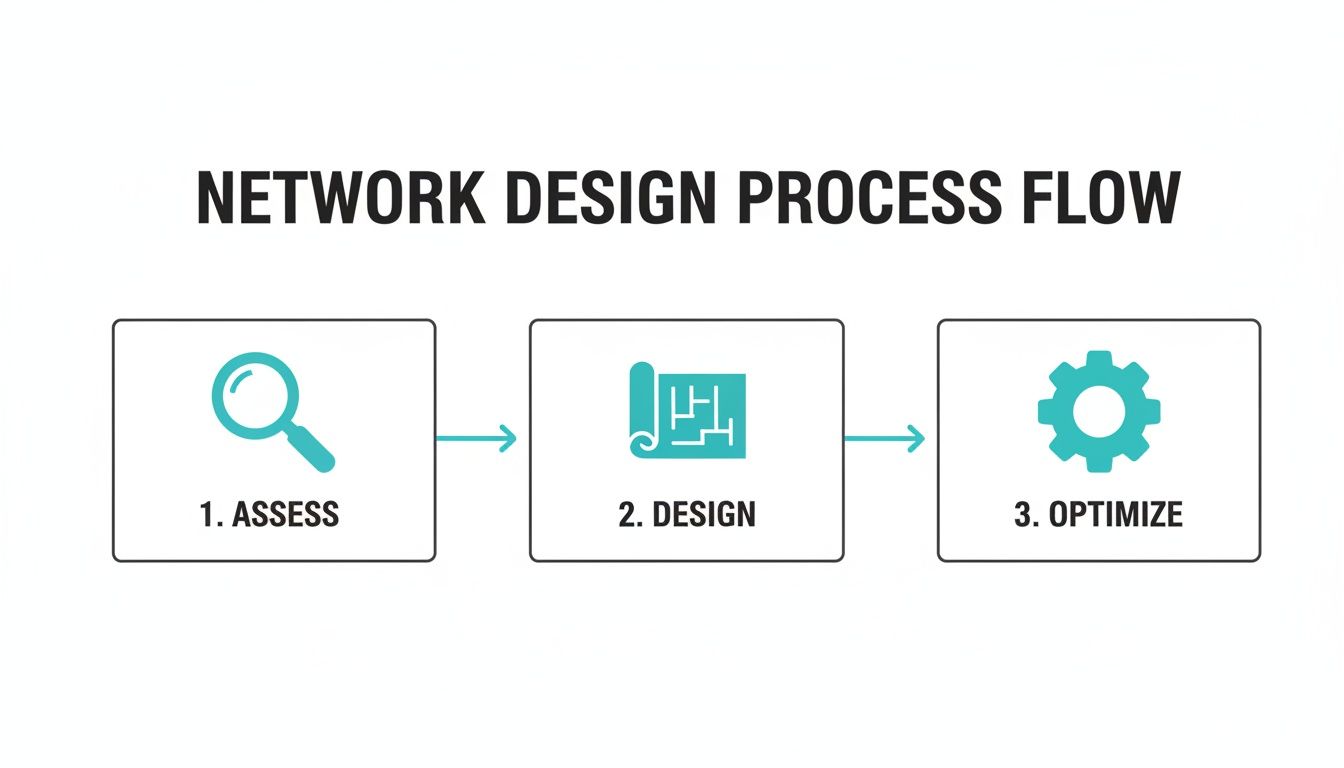
Think of it as building a house. You wouldn't just start throwing up walls. You'd survey the land, draw up blueprints, build the foundation, and then inspect the final structure. Let's walk through each phase.
Phase 1: Assessment and Discovery
This first step is all about understanding what you have right now—the "as-is" state of your world. A network architect will dig deep, conducting a thorough audit of your existing hardware, the applications your team relies on, user workloads, and your current security posture. The goal is to get a complete, honest picture of your challenges and opportunities.
A proper assessment usually involves:
- Business Requirements: Talking to key people in your organization to nail down performance needs, growth plans, and what success looks like for them.
- Infrastructure Audit: Creating a detailed map of your current hardware, software, licenses, and how everything is connected.
- Performance Baselining: Measuring your network’s current speed, latency, and packet loss to find existing bottlenecks. You can't fix what you can't measure.
- Security & Compliance Review: Hunting for vulnerabilities and making sure the new design will meet any industry regulations you're subject to.
This phase wraps up with a comprehensive report that outlines all the findings and provides a clear strategy. This document becomes the bedrock for everything that follows.
Phase 2: Architecture and Design
With a solid understanding of your needs, the architect gets to work on the "to-be" blueprint. This is where the magic happens, translating business goals into a technical plan. Big decisions are made here about the network's logical and physical layout, including what tech and topologies will get the job done.
This is easily the most critical phase. A mistake here will cause headaches that are both expensive and disruptive to fix down the road. It’s where you decide between on-prem, cloud, or a hybrid model that makes sense for your long-term vision.
For many businesses, a hybrid approach hits the sweet spot. You might keep highly sensitive data on-premise for control while using the cloud for apps that need to scale on demand. This is exactly where a solution like ARPHost's Dedicated Proxmox Private Cloud shines, giving you the security of dedicated hardware with the flexibility of a cloud-native environment.
During this phase, specific configurations are meticulously planned out to ensure your network is secure and efficient from the get-go.
Phase 3: Implementation and Migration
Now it's time to bring the blueprint to life. This phase is all about the hands-on work: ordering and setting up hardware, configuring software, and carefully moving services and users from the old network to the new one.
A smooth implementation hinges on meticulous planning to keep downtime and disruption to an absolute minimum. For larger projects, you can find some great pointers in our guide on data center migration best practices.
The key steps usually look like this:
- Hardware Procurement & Staging: Ordering the necessary routers, switches, and firewalls and getting them pre-configured before they even hit your site.
- Physical Installation: Racking and cabling the new equipment in your data center or colocation facility.
- Service Migration: A carefully phased cutover where applications, servers, and users are moved to the new network, almost always scheduled during late nights or weekends.
- Decommissioning: Once the new network is stable and fully operational, the old hardware is safely taken offline and retired.
Phase 4: Testing and Optimization
Once the new network is live, the project isn't over. It enters its final, crucial phase: rigorous testing to confirm the new infrastructure meets every single goal for performance, security, and availability defined back in phase one. This isn't just a quick "flip the switch and walk away" check; it's the start of an ongoing optimization process.
Post-launch activities typically include:
- Performance Validation: Testing application response times and network throughput under real-world load.
- Security Penetration Testing: Proactively trying to break into the new network to make sure the defenses are as strong as they look on paper.
- Failover Testing: Intentionally simulating an outage to verify that all the redundancy and high-availability systems kick in exactly as designed.
- Documentation Handover: Providing you with detailed network diagrams, configuration files, and "how-to" guides for your team.
With ARPHost's fully managed IT services, this optimization never stops. We proactively monitor your network, apply security patches, and fine-tune performance, making sure your infrastructure remains a powerful asset long after the initial build is done.
The Three Pillars of a Bulletproof Network Design
A truly resilient network doesn't just happen by accident. It's meticulously engineered from the ground up, built on a foundation of core technical principles that ensure your digital infrastructure can handle unexpected failures, shut down threats, and grow right alongside your business. If you neglect any one of them, you’re creating a weak link that’s just waiting to cause downtime, data breaches, or performance bottlenecks that will absolutely cripple productivity.

This intentional approach to building robust networks is why the market is exploding. The global network engineering services market, valued at USD 48.38 billion in 2026, is on track to hit a staggering USD 104.16 billion by 2034. The network design slice of that pie is projected to command a massive 43.71% share, proving just how seriously businesses are taking optimized performance and scalability.
Let's break down the three non-negotiable pillars every modern network has to be built on.
H3: Scalability and Performance
Think of scalability as your network’s ability to handle more traffic and more users without breaking a sweat. Performance, on the other hand, is what your users actually feel—how fast an app loads or how quickly a file transfers. A design that nails both is an asset. One that doesn't is a constant drag on your operations.
Imagine your e-commerce site on Black Friday. A scalable network handles the massive traffic spike with ease, giving every customer a fast, smooth experience. An unscalable one buckles under the load, leading to spinning wheels, abandoned carts, and lost revenue. It's that simple.
Key ingredients for a scalable, high-performance design include:
- Smart Bandwidth Allocation: Making sure you have enough capacity for today and for your future growth, so you never hit a traffic jam during peak hours.
- Low Latency: Designing efficient data routes to minimize delays. This is absolutely critical for real-time apps like VoIP calls or video conferences that can't tolerate lag.
- Load Balancing: Spreading traffic across multiple servers or network paths to prevent any one device from becoming a bottleneck. For a deeper dive, check out our guide on how to configure load balancing.
This is where your infrastructure choices really matter. ARPHost's Bare Metal Servers give you dedicated, uncontended resources for raw power, while our Proxmox Private Clouds offer the elasticity to scale your virtual environment up or down on demand without sacrificing that core performance.
H3: Security and Compliance
In an age of non-stop cyber threats, security isn't something you bolt on at the end. It has to be woven into the very fabric of your network from day one. A truly secure architecture doesn't just react to threats; it anticipates them and builds layers of defense to protect your data, your apps, and your people.
This "defense-in-depth" strategy is about creating a hardened perimeter while also securing everything inside. While a basic small business network setup guide can give you the fundamentals, a professional network design takes this to another level with enterprise-grade controls.
A strong security design must include:
- Managed Firewalls: Using advanced hardware like Juniper firewalls to filter out malicious traffic and enforce strict access rules at the edge of your network.
- Network Segmentation: Isolating critical systems (like your customer database) from general user traffic. If a breach does happen, it's contained and can't spread.
- Endpoint Protection: Locking down every single device that connects to your network, from the main servers down to each employee's laptop.
How ARPHost Builds Security In: We take a multi-layered approach. Our Secure Web Hosting Bundles come standard with tools like Imunify360 and CloudLinux OS to isolate accounts and proactively kill malware at the server level. When you combine that with our managed Juniper firewall services, we build a secure foundation that runs from your hosting environment all the way to your network's edge.
H3: Redundancy and High Availability
Redundancy is simply about eliminating single points of failure. It means having backup systems—power, internet, servers—ready to take over instantly if a primary component goes down. The result of good redundancy is high availability (HA): a network that just keeps running, ensuring your business stays online no matter what.
Think of it like an airplane with multiple engines. If one fails mid-flight, the others keep the plane flying safely to its destination. For a network, this means redundant power supplies, duplicate internet connections from different providers, or clustered servers that share the workload.
ARPHost’s High-Availability VPS Hosting plans are a perfect example of this principle in action. They’re built on a solid foundation of KVM virtualization and a distributed CEPH storage cluster. If the physical server housing your VPS has a hardware failure, your virtual machine is automatically and instantly restarted on another healthy machine in the cluster—with zero data loss. That's the power of a design built for true resilience.
By building your network on these three pillars—scalability, security, and redundancy—you're not just creating a functional piece of IT. You're building a strategic advantage.
How Network Design Directly Impacts Your Hosting
It’s easy to treat network design and server hosting like two separate worlds, but in reality, they're completely dependent on each other. A poorly planned network can absolutely hamstring your most powerful hardware, turning a premium bare metal server into a frustrating, sluggish bottleneck.
Get the design right, though, and your entire infrastructure transforms into a cohesive, secure, and high-performance machine. It’s what separates a Proxmox private cloud that’s just a random collection of VMs from one that operates as a truly secure, multi-tenant environment ready for serious workloads. Let's connect the dots between your network blueprint and your server's real-world performance.

From Bottlenecks to Breakthroughs
Imagine you just invested in one of ARPHost’s top-of-the-line bare metal servers for a mission-critical database. You’ve got dedicated CPU cores, a mountain of RAM, and blazing-fast NVMe storage. But what if the network design shoves all that server’s traffic through a single, congested 1Gbps switch that it shares with fifty other non-critical devices? You will never, ever see the performance you paid for.
That’s a textbook network bottleneck. The server has plenty of horsepower, but the "road" leading to it is a single-lane dirt track during rush hour. Professional network design services prevent this disaster by carving out efficient, high-bandwidth data paths built for your specific workloads, ensuring your powerful servers can actually stretch their legs.
Network Design Goals for Different Hosting Environments
The right network architecture is never a one-size-fits-all template. Your priorities will shift dramatically depending on the hosting solution you’re running. This table compares how network design priorities change across various hosting solutions, helping you align your needs with the right infrastructure.
| Hosting Solution | Primary Network Design Goal | Common Challenge | ARPHost Solution |
|---|---|---|---|
| Bare Metal Servers | Maximize Throughput & Low Latency | Uncontended bandwidth, direct access to the public internet without shared bottlenecks. | Provisioned with high-speed ports and a clean network path to eliminate chokepoints. |
| Proxmox Private Cloud | Secure Multi-Tenancy & Isolation | Creating secure virtual networks (VLANs) to isolate different departments or clients. | Full root access allows for custom network configurations and managed services handle complex VLAN and firewall rules. |
| High-Availability VPS | Fault Tolerance & Seamless Failover | Ensuring network paths automatically reroute if underlying hardware fails. | Our hyperconverged HA VPS plans use CEPH storage and a redundant network fabric to guarantee uptime. |
| Secure Web Hosting | Traffic Segregation & Threat Mitigation | Isolating individual websites to prevent cross-site contamination from attacks. | CloudLinux OS and Imunify360 create a caged environment for each account, managed at the network level. |
As you can see, a generic, out-of-the-box network configuration just won’t do the job. Each hosting choice demands a specific architectural approach to get the most out of its natural strengths.
The Role of Network Cloudification
Modern networks are becoming more like cloud services themselves—programmable, flexible, and available on-demand. This idea, often called "network cloudification," is a move away from rigid, long-term contracts and toward dynamic, software-defined connectivity. When done right, one Wipro study found it can lead to a 35% reduction in network operational costs and a stunning 60% improvement in deployment times.
This is a game-changer for businesses running hybrid environments. A properly architected network allows you to seamlessly link your on-premise infrastructure with an ARPHost Proxmox Private Cloud, creating a single, unified network that is both agile and cost-effective.
Why ARPHost Excels Here
We don't just sell servers; we provide the robust network fabric that makes them powerful in the first place. Our entire infrastructure is built on enterprise-grade managed Juniper network devices, giving you a stable and secure foundation from day one. Whether you need the instant failover of our hyperconverged HA VPS plans or the total control of full root access on a Proxmox Private Cloud, our network is designed from the ground up to deliver performance and rock-solid reliability.
At the end of the day, investing in expert network design services is how you squeeze every drop of ROI from your hosting infrastructure. It ensures every dollar you spend on servers, storage, and software delivers its full value, instead of being held back by a network that was treated like an afterthought.
Ready to see how a professionally managed network can elevate your hosting? Request a managed services quote at https://arphost.com/managed-services/ and let our experts build a solution for you.
Choosing the Right Network Design Partner
Picking a provider for your network design isn't like hiring a plumber to fix a leak. You're bringing on a long-term partner who will own the results, for better or worse. This choice is just as important as the hardware you buy. The careful selection of an outsourcing partner is a well-known challenge, and finding the right network firm requires the same sharp eye to tell a true expert from a slick salesperson.
You need a team that gets your business goals, not just your technical wish list. They should operate like an extension of your own IT department, offering advice and support long after the project is signed off. That’s what turns your network into a tool for growth instead of a constant, nagging headache.
Evaluating Technical Expertise and Certifications
A provider's technical chops are your first line of defense against a bad investment. Look for real-world expertise and certifications that match the tech you plan to use. This is how you confirm they have a deep, hands-on understanding of the solutions they’re selling you.
Here are a few key credentials to check for:
- Proxmox Expertise: If you're looking at a private cloud or a VMware to Proxmox 9 migration, your partner absolutely must live and breathe Proxmox VE. Ask them about their work with clustering, high-availability (HA) setups, and specific migration tools.
- Juniper Network Certifications: For any business serious about security and performance, expertise with brands like Juniper is non-negotiable. Certifications prove they have the skills for complex routing, firewall management, and network security.
- VoIP and PBX Administration: Planning to integrate a Virtual PBX phone system? Make sure they have experience with VoIP protocols, FreePBX, and SIP trunking. The last thing you want is garbled calls or a system that doesn't work.
Assessing Experience and Service Depth
Certifications are a great start, but a partner’s track record and the scope of their services tell the rest of the story. You want a team that’s already tackled projects like yours and can support your entire IT infrastructure, not just one piece of it. An integrated approach prevents the classic game of finger-pointing when something goes wrong.
Don't be shy about asking tough questions. Here are a few to get you started:
- Can you show me case studies from businesses similar to mine?
- What’s your process for a complex project, like a full data center migration?
- How far do your managed services go? Do you handle proactive monitoring, patching, and VoIP administration?
- What does your 24/7 support actually look like? Am I talking to a junior agent reading from a script or a real engineer who can solve my problem?
Why ARPHost Excels Here
We bring certified expertise and a full suite of services together under one roof. Our engineers are pros with Proxmox and Juniper, and our fully managed IT services handle everything from your network and firewall to your Virtual PBX. With clear pricing and 24/7 support from actual experts, we're a true partner, not just another vendor.
The rollout of 5G is fueling a huge boom in the network design services market, which is projected to jump from USD 3.45 billion in 2026 to USD 8.76 billion by 2034. This growth is all about demand for smarter designs that can handle edge computing and deliver ultra-low latency—a perfect fit for businesses moving to private clouds. You can explore the research on intelmarketresearch.com to see how this trend is shaping the industry.
Thinking about an infrastructure upgrade with a partner you can trust? Request a managed services quote from ARPHost at https://arphost.com/managed-services/ and let's get started.
Common Questions About Network Design
When it comes to network design services, business owners and IT managers have a lot of practical questions. You're trying to get the best performance and security without breaking the budget, and you need straight answers. Let's cut through the jargon and tackle the most common questions we hear every day.
What Is the Typical Cost of Network Design Services?
This is always the first question, and the honest answer is: it depends entirely on the scope. A simple LAN refresh for a 20-person office might only be a few thousand dollars. But a complex, multi-site hybrid cloud architecture with heavy compliance needs? That could run into the tens of thousands, or more.
The most important number isn't the upfront cost, but the Return on Investment (ROI). A professional design is an investment that prevents much bigger, far more expensive problems.
- Costly Downtime: Just one hour of downtime can cost a small business thousands, and an enterprise can lose hundreds of thousands.
- Security Breaches: With the average data breach costing millions, a secure-by-design network is your single best defense.
- Performance Bottlenecks: Slow apps and choppy video calls kill productivity and frustrate customers, hitting your revenue directly.
At ARPHost, we’re all about value and transparency. Our Dedicated Proxmox Private Clouds, for example, provide a clear and scalable starting point for building a secure environment. The best way to get a real number for your project is to talk to our team about your specific goals.
How Long Does a Network Design Project Usually Take?
Like cost, the timeline scales with complexity. It’s critical to have realistic expectations from the start.
Here’s a general guide you can use for planning:
- Small Network Refresh: If you're just upgrading hardware and improving Wi-Fi in a single office, the whole thing could be done in 1-2 weeks.
- Medium-Sized Business Redesign: A project involving a new firewall, segmented networks for different teams, and integrating something like a Virtual PBX system will likely take 3-6 weeks from the first assessment to the final sign-off.
- Large-Scale Enterprise Project: A major undertaking like a full VMware to Proxmox 9 migration or a multi-site hybrid cloud deployment isn't a quick job. Expect this to span several months.
A project typically moves through the phases we've discussed:
- Assessment: 1–2 weeks
- Architecture & Design: 2–4 weeks
- Implementation & Migration: This is the most variable part. It can range from a few days for a simple cutover to several months for a phased rollout.
ARPHost can help speed things up. We offer rapid provisioning for Bare Metal Servers and have expert-led managed migration services designed to get you on your new infrastructure with minimal disruption.
Can I Redesign My Existing Network?
Absolutely. In fact, most network design services aren't about starting from a blank slate. They’re about auditing, optimizing, and modernizing what you already have. Your network isn't a static monument; it has to evolve as your business does.
A redesign is often the right move if you're:
- Experiencing Poor Performance: Are your apps slow? Are video calls a mess? Do file transfers take forever?
- Facing Security Gaps: You've either had a security scare, a real incident, or you failed a compliance audit.
- Integrating New Technology: You need to support a new VoIP phone system or spin up a private cloud for your developers.
A professional assessment can find bottlenecks and security holes you didn't even know existed. This is where ARPHost's fully managed IT services shine, providing the proactive monitoring and continuous optimization to keep your network—from a single VPS hosting plan to your entire backbone—running perfectly.
What Is the Difference Between Network Design and Network Management?
This is a critical distinction, and it's where a lot of confusion comes from. They are two sides of the same coin but serve very different purposes.
- Network Design: This is the blueprint. It’s the strategic, upfront work of planning the architecture and making key decisions about hardware, software, and topology. It’s a project with a clear beginning and end.
- Network Management: This is the day-to-day operational work. It’s the continuous process of running, securing, and optimizing the network. This includes monitoring traffic, patching vulnerabilities, troubleshooting problems, and managing user access.
Think of it like this: network design is the architect who designs a building. Network management is the property manager who keeps the lights on, the doors locked, and everything running smoothly 24/7.
ARPHost is one of the few providers that excels at both. We can design a custom Proxmox Private Cloud, and then our fully managed IT services team can handle the daily operational load, making sure your network stays secure, fast, and reliable long after the initial project is done.
Ready to build a network that actually helps your business grow, without giving you a management headache? At ARPHost, we provide both the expert design and the proactive management you need. To get started, explore our powerful and affordable VPS options.
Start with our $5.99/month VPS at https://arphost.com/vps-hosting/