


Choosing the right managed services pricing model isn't just a line item on your budget—it’s the foundation of your entire IT partnership.
Get it right, and you've built a predictable, scalable engine for growth. Get it wrong, and you’re stuck with surprise costs, misaligned goals, and an IT provider who simply isn’t invested in your success.
Why Your Managed Services Pricing Model Matters
This is one of the most critical decisions you'll make when bringing in an outside IT team. The pricing structure directly shapes your monthly expenses, the quality of service you actually get, and whether your provider’s incentives line up with your own business goals.
A well-chosen model creates a transparent financial relationship. It lets you budget effectively while ensuring your infrastructure stays secure, optimized, and online when you need it most.
The real goal here is to move beyond a simple vendor transaction and build a strategic partnership. Your provider should be rewarded for preventing problems, not just for billing hours to fix them. This is where the structure of your agreement becomes everything, whether you’re running a flexible ARPHost VPS hosting environment or a high-performance Dedicated Proxmox Private Cloud.
The Shift Toward Value and Flexibility
The industry has been moving away from simple break-fix arrangements for years. According to the 2023 Global MSP Benchmark Survey, there's no single dominant approach anymore.
Instead, a mix of models is gaining ground. A solid 26% of MSPs now use a hybrid of per-user and per-device pricing to give clients more flexibility. This trend points to a bigger shift: pricing that reflects the value delivered, not just the number of machines on a spreadsheet.
Ultimately, the right model ties your provider’s success directly to yours. It supports your specific infrastructure and growth plans with a clear, understandable cost structure. This guide will unpack the most common managed services pricing models to help you find a plan that delivers genuine value.
For a deeper dive into how ARPHost structures its offerings, you can learn more about our fully managed IT services for businesses.
Breaking Down the Core Pricing Models
Picking the right managed services pricing model isn't just about finding the cheapest option; it's about aligning the provider's incentives with your business goals. Each model works differently, fitting certain business sizes, IT setups, and budget styles better than others. Let's break down the four foundational models you'll run into most often.
Per-Device Pricing: A Granular Approach
The per-device model is the classic of managed services, and for good reason—it’s simple and transparent. You pay a flat, recurring fee for each piece of IT hardware the provider manages. Think servers, workstations, firewalls, and network switches.
For instance, an ARPHost managed plan might structure it like this:
- $150/month for each managed bare metal server.
- $75/month for each managed Juniper firewall.
- $50/month for each managed endpoint (desktop/laptop).
The beauty of this model is its predictability. If you have ten servers and two firewalls, the math is straightforward, making it a dream for businesses with a stable hardware inventory. This approach is particularly effective for companies with a high device-to-user ratio—like manufacturing floors or retail stores—or those with significant on-premise infrastructure, such as a colocation setup.
Per-User Pricing: Focusing On People
As the modern workforce went mobile, with every employee juggling a laptop, smartphone, and tablet, the per-user model shot up in popularity. Instead of billing for each gadget, the MSP charges a single flat fee per employee, covering all the tech they use to get their job done.
This massively simplifies billing for organizations where headcount is the main driver of IT demand. It's a fantastic fit for professional services firms, remote-first companies, and any business where your people are your primary asset. The cost scales perfectly with your team's growth, making IT budgeting a breeze as you hire new talent.
Key Insight: The per-user model naturally aligns the provider's service with your team's productivity. The goal shifts from just keeping a list of devices online to ensuring every single person—and all their associated technology—is running at peak performance.
Tiered Pricing: Bundled Service Levels
The tiered model is all about packaging services into easy-to-understand bundles, often labeled something like Bronze, Silver, and Gold. Each tier offers a progressively larger set of services for a corresponding flat monthly fee.
- A Bronze Tier might cover the basics, like proactive monitoring and patch management for essential systems like a Secure Web Hosting Bundle featuring Imunify360.
- The Silver Tier could add endpoint protection, and backup management for more critical VPS Hosting environments.
- A Gold Tier often includes everything from the lower tiers plus strategic consulting, virtual CIO services, and full disaster recovery planning, perfect for a Dedicated Proxmox Private Cloud.
This model gives you clarity and choice. You can pick a package that fits your current needs and budget, with a clear upgrade path as your business scales. The trick is to read the fine print—make sure you're not paying for bells and whistles you don't need or, worse, missing out on critical protections that are only in the next tier up.
The flowchart below can help you quickly map your business priorities—like predictable costs or performance alignment—to the right model.
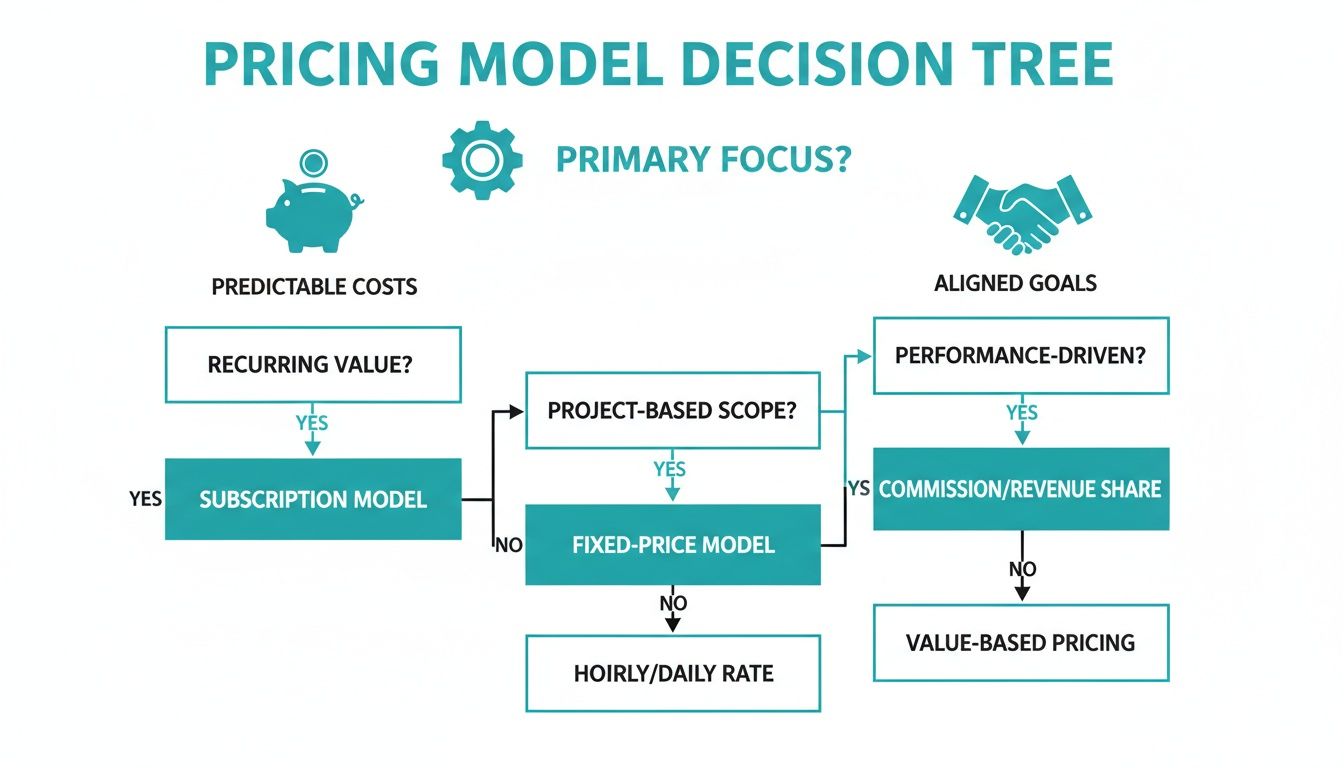
As you can see, if predictable monthly costs are your number one priority, per-device or tiered models are strong contenders. But if you want to ensure your provider's success is tied directly to your own, per-user and value-based models are where it's at.
À La Carte Pricing: The Unbundled Option
Think of the à la carte model as the ultimate pick-and-mix option. It lets you choose individual services as you need them, which is perfect for businesses that already have a solid in-house IT team but need to fill a few specific gaps.
For example, you might just need:
- Managed Juniper Firewall Services to handle network security.
- Managed Backups for a specific cluster of KVM virtual servers.
- VoIP Administration for your company's Virtual PBX phone system.
While this model gives you maximum control, it can get complicated and expensive fast if your needs start to grow. It also puts the responsibility squarely on your shoulders to identify all your IT needs, which can easily leave you with blind spots and critical coverage gaps. It's best used for well-defined, specific projects, not for managing your entire IT stack. If you need to present these kinds of options, a tool like an Elementor Pricing Table can help lay everything out clearly for your stakeholders.
Comparing Common Managed Services Pricing Models
To make things even clearer, we've put together a table that breaks down the four most common pricing models you'll encounter. This should give you a quick, at-a-glance understanding of how they stack up against each other based on key factors like cost predictability, scalability, and the type of business they suit best.
| Pricing Model | How It Works | Best For | Pros | Cons |
|---|---|---|---|---|
| Per-Device | Flat fee per managed device (server, firewall, etc.). | Stable environments with a high device-to-user ratio. | Simple, transparent, and easy to budget for hardware. | Can get expensive if each user has multiple devices. |
| Per-User | Flat fee per employee, covering all their devices. | Growing businesses, remote workforces, professional services. | Aligns with headcount, simplifies billing, scales predictably. | Potentially costly if you have many users with minimal IT needs. |
| Tiered | Pre-defined service bundles at different price points. | Businesses wanting clear options and a defined upgrade path. | Predictable costs, clear service levels, scalable choices. | May include unneeded services; essential items may be in higher tiers. |
| À La Carte | Pay only for specific, individual services selected. | Businesses with in-house IT needing supplemental support. | Maximum flexibility and control over services and costs. | Can become expensive, risk of coverage gaps, complex to manage. |
Getting a handle on these core structures is the first real step toward finding a partner and a plan that truly fits your business. Whether you're just starting out with a single VPS from $5.99/month or need a fully managed private cloud, the right model will set you up with a solid foundation for growth.
Digging Into Advanced Value-Based Strategies
While counting users or devices is a perfectly straightforward way to bill for services, the most forward-thinking managed services pricing models are making a huge shift. Instead of focusing on inputs—what you have—they focus on outcomes—what you get.
This isn't just a small tweak. It completely redefines the relationship with your provider, turning a simple service transaction into a true strategic partnership. Your provider is now financially invested in your success, because their profitability is no longer tied to how many servers they manage, but to how effectively they deliver real results that help your bottom line.
The Value-Based Model
Think of the value-based model as an all-inclusive, flat-fee structure that covers all your IT needs. The price isn't calculated by adding up devices or users; it's based on the total value the IT service brings to your business. This is shaped by factors like your company's size, the complexity of your operations, any regulatory hoops you have to jump through, and your biggest strategic goals.
This model is a fantastic fit for businesses that crave maximum predictability and want a partner who takes complete ownership of their IT environment. You get one single, fixed monthly cost that covers everything from proactive monitoring and security to strategic planning and emergency support. No surprises.
For instance, a company running its core operations on a Dedicated Proxmox Private Cloud doesn't just need servers to be "managed." They need guaranteed performance, ironclad security, and rock-solid uptime. A value-based plan from a provider like ARPHost would wrap all aspects of managing that private cloud into one fee, ensuring it consistently delivers the high performance the business absolutely depends on.
The Outcome-Based Model
Taking the value concept a step further, the outcome-based model directly ties a chunk of your provider's fees to hitting pre-defined key performance indicators (KPIs). This is the ultimate "put your money where your mouth is" arrangement.
Key Takeaway: An outcome-based model directly links your provider's revenue to your success metrics. If they meet or exceed the agreed-upon targets, they get rewarded. If they fall short, their compensation takes a hit.
Imagine seeing this in the real world:
- Uptime Guarantees: Fees are directly linked to maintaining 99.999% uptime for your High-Availability VPS cluster built on CEPH storage.
- Security Incident Reduction: The provider earns a bonus for slashing security incidents by a target of 25% over a quarter using tools like Imunify360.
- Performance Improvements: Payments are tied to decreasing application response times on your managed Bare Metal Servers.
This model doesn't just build trust; it forces deep collaboration and ensures your provider is laser-focused on what actually matters to your operations.
Monitoring-Only Plans
For those with a more hands-on team, the monitoring-only model is a focused and budget-friendly option. Just as the name implies, the provider’s role is strictly limited to keeping an eye on your IT infrastructure. They watch over your systems 24/7 and alert your internal team the moment issues pop up, but they don't step in to fix them.
This plan is tailor-made for organizations that have a capable in-house IT team ready to handle repairs and maintenance but lack the tools or headcount for constant, round-the-clock vigilance. It’s an affordable way to get an early warning system for your critical gear without locking into a full-service contract.
The managed services world is seeing a major shift away from old-school, cost-plus pricing. Instead, businesses are demanding these dynamic, outcome-focused models that deliver a much clearer return on investment. The drive comes from a need for predictable subscription costs and fees tied to tangible benefits, like reduced downtime or efficiency gains. discover more insights about this shift toward value-based pricing in the managed services industry.
Why ARPHost Excels with Value-Driven Strategies
At ARPHost, our fully managed IT services are built from the ground up with these advanced principles in mind. We don't just manage hardware; we deliver outcomes. Our approach combines the predictability of a flat fee with a relentless focus on the performance, security, and reliability you need.
Whether it’s guaranteeing the resilience of our Proxmox-based private clouds (starting at $299/month for high-performance clusters) or providing proactive security management for our Secure Web Hosting Bundles, our goal is to become an extension of your team. We align our success directly with yours by delivering the stability and performance your business needs to thrive, backed by our 24/7 expert support.
Ready to build a true IT partnership? Request a managed services quote at arphost.com/managed-services/ and let's talk about how we can hit your business goals together.
How to Calculate Your Potential IT Costs
Alright, let's move from theory to reality. Understanding the different pricing models is one thing, but seeing how they actually pencil out for your business is what really matters. To help you build a realistic budget, we'll walk through three common business scenarios and apply a couple of different pricing models to each.
This isn't just about hypotheticals. It's a hands-on framework you can use to take stock of your own tech assets and figure out what your monthly commitment might look like.

Scenario 1: The Lean Startup
Imagine a new e-commerce startup. They have a small team of five people and a handful of critical systems. Predictable costs are king, but they absolutely can't skimp on reliability or security.
IT Inventory:
- 1x Secure Web Hosting Bundle (for the website and email) with Imunify360.
- 1x Managed Juniper Firewall
- 5x Users (each with a laptop)
Cost Calculation with Per-Device Pricing:
This model is pretty straightforward—you pay for the core hardware and services being managed.
- Managed Hosting Bundle: $100/month
- Managed Firewall: $75/month
- Total Monthly Cost = $175
Cost Calculation with Per-User Pricing:
Here, the focus shifts to the employees, with the price covering all the tech they use.
- 5 Users @ $60/user/month = $300/month
- Total Monthly Cost = $300
For this startup, the math is clear. The per-device model is a much better fit, saving them over a hundred dollars a month. Their main need is managing a few core infrastructure assets, not supporting a large team with complex device needs.
Scenario 2: The Growing Mid-Sized Business
Now let's look at a marketing agency with 30 employees that's starting to scale up. They're running multiple virtual servers for client projects and internal tools, and their team is always on the move.
IT Inventory:
- 6x High-Availability KVM VPS instances with CEPH storage
- 2x Managed Juniper Firewalls
- 1x Managed Network Switch
- 30x Users (each with a laptop and a smartphone)
Cost Calculation with Per-Device Pricing:
As the number of devices multiplies, so does the bill.
- 6 KVM VPS Instances @ $50/instance = $300/month
- 2 Managed Firewalls @ $75/each = $150/month
- 1 Managed Switch @ $50/month = $50/month
- 30 Endpoints @ $25/each = $750/month
- Total Monthly Cost = $1,250
Cost Calculation with Per-User Pricing:
This approach rolls everything up into a simple per-employee cost.
- 30 Users @ $125/user/month (for comprehensive support) = $3,750/month
- Total Monthly Cost = $3,750
This time, the choice isn't so cut-and-dried. While the per-device model is cheaper on paper, that higher per-user cost likely covers more comprehensive support for each employee's multiple devices—something a fast-paced agency definitely needs. It’s a classic trade-off between raw cost and the value of robust support. If you're wrestling with this kind of decision, our guide on IT cost optimization strategies can help you weigh the pros and cons.
Scenario 3: The Established Enterprise
Our final example is a logistics company with 100 employees. Their entire operation depends on a high-performance private cloud that demands guaranteed uptime, top-tier security, and dedicated resources.
IT Inventory:
- 1x Dedicated Proxmox Private Cloud (a 3-node HA cluster) with full root access.
- A complex Juniper network with managed routers and firewalls.
- 100x Users (a mix of office-based and remote workers)
Cost Calculation with Per-Device/Per-User:
Frankly, trying to calculate this granularly would be a nightmare. It would miss the bigger picture entirely. This company needs a holistic solution, not a line-item bill for every single component.
Cost Calculation with a Value-Based (Flat-Fee) Model:
This is the perfect fit. A single, predictable price covers the entire environment. The provider assesses the complexity, risk, and business-critical nature of the private cloud and delivers a comprehensive package.
- Fully Managed Proxmox Private Cloud Environment: $4,500/month (all-inclusive)
- Total Monthly Cost = $4,500
For an operation like this, a value-based model offers total budget predictability. The fee doesn't just cover hardware; it covers proactive management, security, disaster recovery, and strategic guidance for the entire Proxmox cluster. This aligns the provider’s success directly with the company’s operational stability.
By running these simple calculations, you can get a much clearer idea of how different managed services pricing models will affect your bottom line. The key is to choose the one that aligns not just with your current tech stack, but with your growth plans and business goals.
Choosing the Right Model for Your Business
Okay, you’ve seen the menu of pricing models. Now comes the hard part: making a decision. Choosing the right structure isn’t about hunting for the cheapest option. It’s about finding a framework that actually fits your company's tech needs, budget, and future growth plans.
To nail this down, you need to ask some honest questions—both of yourself and any provider you’re vetting. Getting these answers right will quickly shine a light on which model offers real strategic value, not just a low price tag.
Key Questions to Guide Your Decision
First, take a look in the mirror. Evaluating your own situation will narrow the field faster than anything else.
How Predictable Are My IT Needs? If your infrastructure is stable and your day-to-day requirements are pretty consistent, a per-device or tiered model offers fantastic budget predictability. But if you're in a high-growth startup where things change month-to-month, a more flexible per-user or value-based model will save you a lot of headaches.
Do I Anticipate Rapid Growth in Users or Devices? For companies on a hiring spree, a per-user model makes perfect sense. Your IT costs scale directly with your headcount. On the flip side, if you're planning to add a ton of hardware—say, expanding a server farm—a value-based model for your Dedicated Proxmox Private Cloud would likely be more cost-effective than getting nickel-and-dimed for every new device.
What Level of Proactive Support Is Non-Negotiable? Be honest about what you really want. If the goal is to completely hand off IT management so you can focus on your actual business, then an all-inclusive, value-based model is your best bet. If you just need a safety net or someone to handle the routine stuff, an à la carte or monitoring-only approach is a much smarter spend.
It can also be helpful to see how other companies structure their pricing in the real world. For a good example of this, check out Recepta's pricing page.
Red Flags to Watch For in a Provider
Just as important as asking the right questions is knowing what to run away from. A great pricing model is worthless if the partnership behind it is a mess.
Be cautious of any provider who isn’t upfront about the total cost of ownership. Transparency is the hallmark of a true partner, while ambiguity often hides future expenses and misaligned priorities.
Keep an eye out for these warning signs:
- Vague Service Level Agreements (SLAs): If the SLA is a mushy document that doesn’t clearly define uptime guarantees, response times, and what’s covered versus what costs extra, just walk away.
- Hidden Fees: Go through the contract with a fine-tooth comb. Look for sneaky charges related to onboarding, after-hours support, on-site visits, or project work that you thought was part of the deal.
- Inflexible Contracts: A provider who won’t budge or adjust their agreement to fit what you actually need probably isn't looking for a long-term partnership. The best providers build in customization.
By thinking through your needs and watching for these red flags, you can find a partner whose services line up perfectly with where you’re headed. At ARPHost, our scalable solutions—from our $5.99/month VPS plans to our comprehensive fully managed IT services—are designed to give you exactly that kind of clarity and alignment.
Ready to find a plan that fits your growth? View our Proxmox Private Cloud plans at arphost.com/proxmox-private-clouds/.
How ARPHost’s Solutions Fit Your Budget
Okay, you’ve got a handle on the different managed services pricing models. Now, let’s connect the dots and see how this all applies to the real world—specifically, to our solutions here at ARPHost. We don’t believe in a one-size-fits-all approach. Instead, we’ve built our services to align with the pricing structures that make the most sense, giving you clarity and predictable costs, whether you're running a single server or a whole fleet.
The idea is simple: match the business need to the right pricing model. This cuts out the guesswork and lets you forecast your IT expenses with real confidence.

Scaling This with ARPHost
Different goals call for different tools, and the same goes for pricing. Here’s a quick breakdown of how our most popular services map to the models we’ve covered.
Per-Device Model: Our Secure VPS Hosting plans are a textbook example of this model in action. Starting at just $5.99/month, you pay a flat, predictable fee for each virtual server you launch. This gives you incredibly granular control over your spending, making it perfect for developers or businesses that manage multiple, distinct applications or Instant Applications.
Value-Based Model: For anyone who needs guaranteed performance, tight security, and hands-off management, our Dedicated Proxmox Private Clouds are the answer. This is a value-based play. The all-in price reflects the total package you receive—dedicated hardware, full root access, proactive security, and expert support—all bundled into one clear, predictable fee for your entire environment.
Hybrid & À La Carte Models: This is where our Fully Managed IT Services truly shine. We can build a completely custom hybrid plan that starts with a core service, like monitoring your Bare Metal Servers, and then lets you bolt on specific services as you need them. Need someone to manage your Virtual PBX phone system or configure an advanced Juniper firewall? We layer those on, so you only ever pay for what you actually use.
Why It Works So Well
We’re big believers in straightforward solutions that can grow right alongside your business. Our approach is designed to help you avoid those rigid, one-size-fits-none contracts by offering a flexible set of products that work with different managed services pricing models. This means that as your business changes, your IT partnership—and your budget—can adapt right along with it.
Ready to find a plan that makes sense for your bottom line? You can learn more about our customizable managed services and get a quote that’s built around exactly what you need.
Frequently Asked Questions
What's the Go-To Pricing Model for Managed Services These Days?
Right now, a hybrid approach combining per-user and per-device pricing is the most common, with about 26% of MSPs using it. It strikes a nice balance—you get predictable costs tied to your team size, but it also accounts for shared hardware like servers and firewalls.
That said, simple, all-inclusive flat-fee models are really picking up steam. Businesses love them because they make budgeting a breeze.
How Do I Make Sure I Don't Get Hit with Hidden Costs?
The best way to avoid surprise bills is to demand a crystal-clear Service Level Agreement (SLA). This document shouldn't just list what's included; it needs to be brutally honest about what will cost you extra.
Drill down into the details. What’s the policy for after-hours emergencies? What about big projects like a VMware to Proxmox migration or on-site support visits? A transparent partner like ARPHost lays all this out from the start, so there are no awkward conversations later.
For a Remote Team, Is Per-User or Per-Device Better?
Hands down, a per-user model is the smarter choice for any business with a remote or distributed workforce. Think about it: each of your employees probably uses a laptop, a tablet, and a smartphone to get their work done.
Instead of nickel-and-diming you for every single gadget, the per-user model simplifies everything. You pay one flat fee for each employee, and all the tech and support they need is covered, no matter how many devices they’re juggling.
Ready to find a pricing model that actually fits your business instead of forcing you into a box? ARPHost offers straightforward, flexible solutions designed for your goals.
Explore our Secure VPS Bundles at arphost.com/vps-web-hosting-security-bundles/ and start building the perfect infrastructure today.