

A lot of Colorado Springs owners are in the same spot right now. The business is growing, staff count is creeping up, cloud apps are multiplying, and every week brings a new IT issue that steals time from actual operations. One day it's Wi-Fi instability, the next it's a backup concern, then someone's mailbox gets compromised, and suddenly the owner is acting as accidental IT director.
That's usually the moment when managed it services colorado springs stops sounding like a generic outsourcing term and starts looking like a business decision. Good managed services don't just answer tickets. They standardize systems, reduce preventable downtime, tighten security, and give you a clearer way to scale.
The mistake I see most often is treating IT support as a commodity. It isn't. The right provider becomes part operator, part risk manager, and part technical planner. If your company is trying to adopt automation or AI workflows, your infrastructure decisions need to keep pace with business planning. AI initiatives tend to fail when the underlying systems, access controls, and data handling are still messy.
Why Colorado Springs Businesses Need a Modern IT Strategy
Colorado Springs has a healthy MSP market, and that matters because buyers have real options. Top local firms on Clutch's 2026 listings show strong customer satisfaction, including Corporate Technologies at 4.7 from 12 reviews, Datalink Networks Inc. at 5.0 from 3 reviews, and Integritek Holdings at 4.9 from 4 reviews, according to Clutch's Colorado Springs MSP listings. That tells you something important. Local businesses aren't looking for basic break-fix support anymore. They're rewarding responsiveness, proactive work, and consistent delivery.
What has changed for local businesses
A few years ago, many companies could get by with a local technician, a firewall, antivirus, and a backup appliance nobody tested often enough. That model breaks once your team depends on Microsoft 365, remote access, line-of-business apps, VoIP, cloud storage, and compliance expectations at the same time.
Now IT affects revenue directly. If your phones fail, sales stalls. If your file access drags, staff productivity drops. If your endpoint security is weak, one user click can become an operational crisis.
Good IT strategy isn't about owning more tools. It's about making sure the tools you already pay for are configured, monitored, and recoverable.
Managed services as an operating model
Managed services work best when you treat them as an operating model rather than a support line. That means the provider should be handling a combination of:
- System monitoring so problems are caught before users notice
- Patch and update discipline so servers, endpoints, and edge devices don't drift
- Security controls across endpoints, identities, backups, and network boundaries
- User support that resolves the issue and also documents root causes
- Planning for hardware refreshes, cloud changes, vendor transitions, and disaster recovery
A modern strategy also forces a harder question. Do you want one vendor doing everything, or do you want a more flexible setup where infrastructure, hosting, security, and support are separated in a smarter way? That trade-off matters more than most sales presentations admit.
What owners should optimize for
If you're evaluating managed it services colorado springs providers, don't start with marketing language. Start with your operational pain:
| Business issue | What a modern IT strategy should do |
|---|---|
| Recurring outages | Identify root causes and prevent repeats |
| Security anxiety | Reduce attack surface and improve recovery |
| Slow support | Define response ownership and escalation paths |
| Unclear tech spending | Turn reactive bills into planned operating costs |
| Growth pressure | Add users, systems, and locations without chaos |
Most companies don't need every service fully outsourced. They need the right mix of control, accountability, and resilience.
Core Services and SLAs to Expect from Local Providers
A solid managed service stack is more than a help desk with remote access software. It should cover operations, security, continuity, and business process support in one coordinated model.
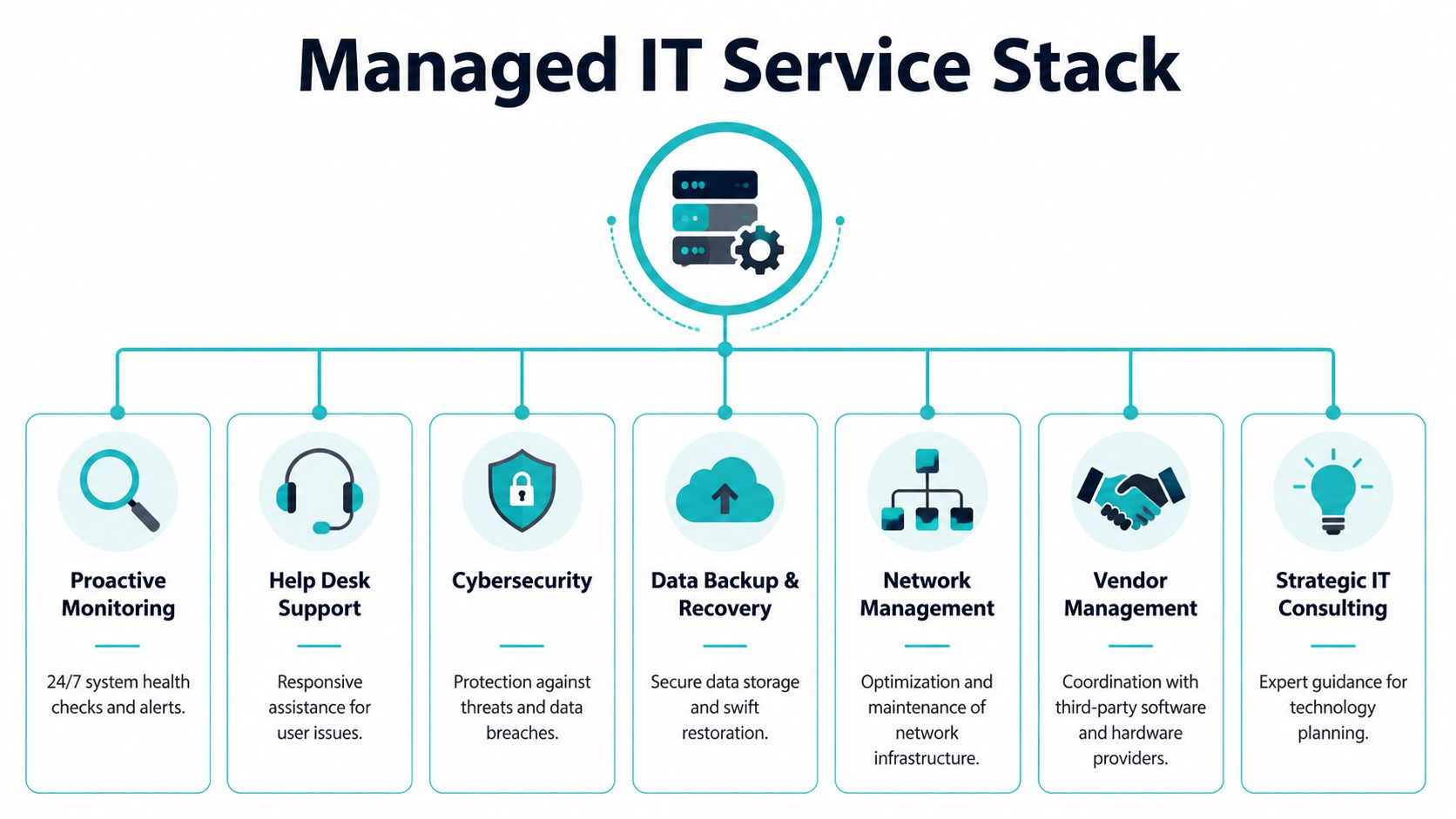
Proactive monitoring is the foundation
The first service to verify is Remote Monitoring and Management, or RMM. In Colorado Springs managed services, RMM tools use agent-based software to continuously scan for vulnerabilities and performance bottlenecks, often patching during off-peak hours to help achieve 99.9% uptime benchmarks. These tools collect metrics like CPU utilization, disk I/O latency, and memory fragmentation, and they can reduce mean time to repair from 4-6 hours in reactive models to under 30 minutes.
If you want a practical primer on how that works in real environments, this overview of RMM software in managed environments is worth reviewing.
Good monitoring doesn't just say a server is "up." It tells the provider when performance is degrading before users open tickets. That's the difference between support that reacts and support that operates.
The core stack most businesses actually need
When I assess an MSP proposal, I expect these service lines to be clearly defined:
Help desk and user support
This covers account lockouts, printer issues, application access problems, workstation errors, and escalation paths. Ask whether support is unlimited or metered, and whether after-hours support is included or conditional.Endpoint and security management
This should include endpoint protection, patch management, policy enforcement, and suspicious activity response. If the proposal only says "cybersecurity" without naming controls, it's too vague.Backup and disaster recovery
Backups must be monitored, retained appropriately, and restored in testing. A backup that hasn't been tested is only a theory.Network operations Firewalls, switches, wireless access points, VPNs, and internet failover need ownership. Many MSP contracts stop at "best effort" once the issue touches an ISP or third-party vendor.
Vendor coordination
This matters more than owners realize. Someone needs to own support calls with Microsoft, your line-of-business vendor, phone provider, and internet carrier.
Practical rule: If a provider can't show you who owns alerts, patches, backups, and escalations, you don't have managed services. You have outsourced confusion.
What good SLAs actually mean
A lot of contracts advertise SLAs, but the details are where service quality shows up.
Look for these distinctions:
| SLA term | What it means | What to ask |
|---|---|---|
| Response time | How quickly they acknowledge the issue | Is it tied to severity? |
| Resolution time | How quickly they fix it | Is there a commitment or just a target? |
| Escalation path | Who takes over when first-line support can't solve it | Is escalation named by role? |
| Monitoring coverage | What systems are watched and when | Are servers, endpoints, backups, and firewalls all included? |
| Maintenance window | When patching or planned work happens | How are users notified? |
Services that sound good but often disappoint
Some MSPs list strategy, security, and consulting in broad terms but deliver mainly ticket resolution. That's why I advise owners to separate "included operational services" from "advisory services."
Ask for examples of what happens monthly. Do they review patch failures, backup status, aging hardware, Microsoft 365 exposure, firewall changes, and recurring ticket patterns? If not, the relationship may stay reactive even under a managed contract.
Understanding Managed IT Pricing and Contract Models
The biggest pricing mistake buyers make is comparing only the monthly number on page one. You need to understand what the pricing model rewards, what it discourages, and which work gets pushed outside the agreement.

What Colorado Springs pricing looks like
Managed IT services pricing in Colorado Springs typically follows tiered structures. Full-service 24/7/365 plans average $100-$150 per workstation. Basic help desk support starts around $75-$125 per user, while premium tiers with advanced security and compliance can range from $250-$400.
That range is wide because not every "managed" agreement includes the same things. Some plans include endpoint protection, patching, monitoring, and backup oversight. Others add compliance support, cloud administration, security stack management, and strategic consulting.
Common contract models
Different providers package that cost in different ways:
Per-user pricing
Best when your staff uses multiple devices and cloud apps. It's easier to budget, but you need to confirm whether servers, network gear, and security tools are extra.Per-device pricing
Works when environments are device-heavy but user counts are stable. It can become expensive if every firewall, workstation, server, and tablet is billable.Tiered bundles
This is common in the local market. Basic, standard, and premium plans make comparison easier, but you need a line-item explanation of what changes between tiers.Break-fix or hourly support
This looks cheaper until repeated incidents pile up. It usually produces the worst budgeting and the weakest preventive maintenance.
What to check before signing
The contract details matter as much as the advertised rate. Review:
| Contract area | Why it matters |
|---|---|
| Onboarding scope | Determines whether cleanup and documentation are included |
| Tool licensing | Confirms which security and monitoring platforms are billable extras |
| Project exclusions | Prevents surprise invoices for migrations and major changes |
| After-hours support | Clarifies whether nights and weekends are included |
| Termination terms | Tells you how hard it is to leave and get your data back |
For a broader look at how providers structure recurring support agreements, this guide to managed services pricing models is a useful companion when you're reviewing proposals.
Your Vetting Checklist and Key Interview Questions
A Colorado Springs provider can sound polished in the sales meeting and still hand your account to a thin support bench after signature. Vetting has to get past the presentation. The local benchmark is already high, with top firms commonly rated in the upper range. Use that as a baseline and press for operational proof.

Start by figuring out whether you're interviewing a true full-service MSP or a provider that works better as part of a hybrid stack. That distinction matters. A company with line-of-business apps, compliance requirements, or an internal technical lead may be better served by keeping core infrastructure under tighter control and buying support around it. If your team is weighing hosted infrastructure options, this comparison of private cloud vs public cloud helps frame the questions you should ask before you commit.
Start with proof of execution
Ask for examples of environments they already manage that look like yours. A 20-person law office, a multi-site medical practice, and a manufacturer with on-prem equipment all create different support loads. Good providers can explain where they fit well and where they do not.
Then review their operating discipline.
Service scope
Get a written list of what they manage: endpoints, servers, Microsoft 365, backup systems, firewalls, wireless, SaaS admin, vendor tickets, and cloud infrastructure. If you are considering a hybrid model, ask which tasks stay with your hosting provider and which move to the MSP.Onboarding process
Look for discovery, admin access review, network mapping, backup validation, standards alignment, and documentation cleanup. If onboarding starts and ends with agent deployment, expect missed risks.Security practice
Ask which tools they use, who reviews alerts, how incidents are escalated, and who has authority to isolate systems. You want named processes, not sales language.Documentation quality Require sample documentation. Redacted is fine. You need to see whether they track assets, credentials, backup jobs, firewall rules, warranty status, and recovery contacts in a format another engineer can use.
Questions that expose weak providers fast
These questions usually separate firms with mature operations from firms that are still improvising.
What exactly happens in the first 30 days?
Strong answers include discovery milestones, risk findings, tool rollout, baseline cleanup, and a review meeting with decision-makers.What are your response targets and your actual escalation path?
Response time by itself is not enough. A provider can acknowledge a ticket in 15 minutes and still leave a business-critical issue sitting for hours.How often do you test restores?
Backup success messages are not the same as a usable recovery plan.Who owns third-party coordination during an outage?
Ask about internet providers, Microsoft, line-of-business vendors, and cloud platforms. Ownership gaps are where long outages happen.Who will support our account after the sale? Sales engineers often disappear once the contract is signed. You need to know whether your day-to-day support comes from a senior team, a pooled help desk, or a junior bench with escalation above them.
Where do you draw the line between included support and project work?
This matters even more in hybrid environments. Routine patching and monitoring are one thing. Migrations, firewall redesign, Azure rework, and major compliance changes are another.
One practical comparison helps here. Marketing leaders often choose between a full agency, an internal team, or a blended model because each option changes cost, control, and accountability. The same decision shows up in IT.
What good answers sound like
Good answers are specific. They name tools, handoff points, escalation roles, and review cadence. They also admit limits. A credible provider will tell you if 24 by 7 coverage is outsourced after hours, if cloud architecture work is billed separately, or if they support certain firewalls better than others.
Watch for one more thing. Ask how they work with client-owned infrastructure. A traditional MSP may push to standardize everything under its stack, which is sometimes the right call. A more flexible provider can support a setup where core workloads live on managed hosting, such as VPS, bare metal, or private cloud, while the business buys only the monitoring, security, or help desk coverage it needs. For a lot of Colorado Springs companies, that answer tells you more than the sales deck does.
The Hybrid Model A Flexible Alternative to Full MSPs
Not every business should sign an all-in-one MSP contract. If your company has an internal technical lead, a development team, specialized software, or a need for root-level control, a hybrid model is often the better fit.

Why some businesses outgrow full-service MSP packaging
Traditional MSP agreements work well when a company wants one vendor to standardize everything. The trade-off is reduced flexibility. You may end up paying per-user or per-device fees for workloads your team could manage more efficiently on dedicated infrastructure.
That's why the hybrid approach deserves more attention in managed it services colorado springs discussions. Instead of outsourcing everything, the business places core workloads on managed hosting infrastructure, such as VPS, bare metal, colocation, or a private virtualization cluster, then adds only the managed services it needs.
A useful analogy comes from another business decision many leaders understand already. Marketing teams often debate agency versus in-house structures because blended models can improve control and cost alignment. The same logic shows up in IT.
Where the cost and control advantage shows up
While some MSPs claim 40% cost reductions over in-house IT, a 2025 Gartner report indicates that SMBs using self-managed cloud infrastructure like KVM VPS or Proxmox private clouds can achieve 25-35% lower TCO than full MSP contracts by pairing them with selective managed add-ons. The cited reason is avoiding per-device fees while retaining root control.
That doesn't mean every company should self-manage infrastructure. It means there is a middle path between "we do everything ourselves" and "we outsource every layer."
| Model | Best fit | Main trade-off |
|---|---|---|
| Full MSP | Limited internal IT capability | Less flexibility |
| Hybrid IT | Internal technical leadership or dev needs | Requires clear ownership boundaries |
| Fully self-managed | Strong internal operations team | Higher internal burden |
What hybrid IT looks like in practice
A workable hybrid setup usually looks like this:
Core infrastructure stays on dedicated hosted platforms
That might mean virtual servers for business apps, bare metal for performance-sensitive databases, or a private virtualization cluster for mixed workloads.Selective managed services cover the operational risk
Monitoring, patching, backup oversight, disaster recovery, and security hardening are added where they create the most value.Internal staff keep control where it matters
Dev teams keep root access, deployment freedom, and architecture choice.
If you're comparing platform strategies, this breakdown of private cloud versus public cloud decisions is a strong starting point.
Here's a short walkthrough of the model in action:
The hybrid model works best when the company knows exactly which systems require control, which systems require outsourcing, and who owns recovery when something fails.
Where this model works and where it doesn't
Hybrid IT works well for software firms, ecommerce teams, multi-site businesses with internal admins, and any company that dislikes vendor lock-in. It works poorly when nobody inside the business can make technical decisions or own application-level changes.
The key is boundary setting. Infrastructure, backup, network edge, and monitoring can be delegated. Application behavior, release cycles, and business workflow design often stay internal. Done right, that split is efficient. Done poorly, it creates finger-pointing.
Real World Scenarios for Colorado Springs Businesses
The easiest way to evaluate service models is to put them in operational terms.
The downtown law firm
A small law firm near downtown has a familiar set of requirements. Staff need stable document access, reliable phones, secure remote work, and recoverable data. They don't need a lab environment or deep infrastructure customization. They need predictable operations and strong protection around user activity.
For that firm, a complete managed model often makes sense. The provider manages endpoints, user support, email security, firewall policy, backup monitoring, and vendor escalation. The owner gets one point of accountability, and the office manager isn't left chasing five vendors during an outage.
The most important design choice here is recovery, not convenience. Proactive MSP models emphasize layered defenses like EDR and immutable backups, and they can reduce the average cost of a data breach by up to 50% compared to reactive response. In virtualized environments such as Proxmox or vSphere, automated failover can support an RTO of less than 15 minutes.
That matters more than fancy dashboards. Legal teams need confidence that a compromised workstation, bad update, or accidental deletion won't halt operations for days.
The Northgate tech startup
Now take a startup north of the city with developers shipping product updates every week. They need isolated environments, admin control, fast provisioning, and room to move workloads around without asking a third-party MSP for every change.
A traditional full-service MSP can frustrate this team fast. Change windows are slower, admin rights are tighter, and custom requirements get treated as exceptions. A hybrid model fits better. Core applications run on dedicated hosted infrastructure, while managed services are layered onto the pieces that carry operational risk, such as monitoring, backups, security hardening, and recovery orchestration.
The difference isn't just technical. It's cultural. Developers want freedom to build. Operations leadership wants assurance that systems are backed up, monitored, and recoverable.
The lesson from both scenarios
Both businesses need competent IT. They just need different forms of it.
- The law firm benefits from consolidation, compliance-minded support, and single-vendor accountability.
- The startup benefits from control, performance, and targeted operational support instead of blanket outsourcing.
- Both need tested recovery plans, clear escalation ownership, and realistic service expectations.
Match the operating model to the business, not to the provider's sales template.
Taking the Next Step to Secure Your IT Future
If you're choosing among managed it services colorado springs providers, the decision gets clearer when you strip it down to four practical questions.
Ask these questions first
What failures hurt the business most right now?
User downtime, email compromise, weak backups, poor Wi-Fi, aging servers, and cloud sprawl don't carry equal risk.How much control does your team need?
If you have internal technical staff or developers, a rigid all-in-one contract may create friction.What should be predictable every month?
Support, monitoring, endpoint protection, and backup operations should not feel financially random.How fast do you need to recover when something breaks?
Recovery requirements should shape your architecture and support model more than feature lists do.
A practical way to move forward
If your environment is messy, start with an assessment. Inventory systems, identify who owns each one, document your backup and recovery path, and review where support currently breaks down. Then choose the operating model that fits.
For some businesses, that will be a traditional MSP. For others, it will be a hybrid arrangement with hosted infrastructure and selective managed services. The right answer depends on your staff, your risk tolerance, and how much flexibility your business needs.
The most important thing is not waiting until the next outage or security incident forces the decision for you.
What good next steps look like
- Get a current-state review of endpoints, servers, cloud apps, network gear, and backup coverage.
- Map business-critical systems so you know what must be restored first.
- Define support ownership before signing any contract.
- Choose a model intentionally, not by default.
A good provider should make your environment easier to operate, easier to secure, and easier to recover. If they can't explain how, keep looking.
If you want a flexible partner for infrastructure and managed operations, ARPHost, LLC is worth a close look. They offer fully managed IT services, VPS hosting, secure web hosting bundles, bare metal servers, colocation, and dedicated Proxmox private clouds for businesses that need stronger control without losing operational support. You can review VPS hosting options, compare Proxmox private cloud plans, or request help with managed services if you're ready to tighten reliability, security, and recovery across your environment.