

Think of managed IT infrastructure services as a professional property manager for your company’s technology. Instead of your own team juggling every server update, network glitch, and security patch, you outsource the day-to-day grind to a specialized provider. This flips the script, turning IT from a reactive cost center into a predictable, performance-driving asset.
From Cost Center to Strategic Asset
Imagine you own a large apartment complex. You could try to fix every leaky faucet, chase down rent, and handle security yourself. Or, you could hire a professional manager to handle it all, freeing you up to focus on acquiring new properties and growing your investment. That’s the core idea behind fully managed IT services for servers and networks.
This shift lets your business break free from the "break-fix" cycle, where your IT team is constantly putting out fires. A managed service provider (MSP) steps in to proactively maintain, secure, and optimize your entire technology stack before problems can even start.
Why Businesses Are Making the Switch
The move to managed services isn't just a fad; it's a direct response to real-world business challenges. The global market for these services hit around USD 117.57 million in 2023 and is on track to reach USD 140.36 billion by 2026. This boom is fueled by increasingly complex hybrid cloud setups and a relentless barrage of cybersecurity threats. Small and mid-sized businesses, in particular, are driving this growth, looking for a smarter way to get enterprise-level IT without hiring a massive in-house team. You can explore additional market growth data to see the full picture of this industry shift.
This model gives you immediate access to serious expertise and powerful tools without the crippling overhead. The core benefits are clear:
- Instant Expertise: Gain a team of certified pros in complex systems like Proxmox VE, Juniper networking, and advanced security, all without the cost and headache of hiring them yourself.
- A Stronger Security Shield: A provider like ARPHost deploys a multi-layered security strategy. We use tools like Imunify360 and apply proactive patch management to defend your infrastructure against constant threats.
- Predictable IT Spending: Say goodbye to surprise capital expenses (CapEx) for emergency hardware repairs. Instead, you get a fixed, manageable monthly operational expense (OpEx).
- Guaranteed Performance: Service Level Agreements (SLAs) aren't just promises; they're guarantees. Your infrastructure is monitored 24/7 by experts who are ready to resolve issues before they can ever impact your business.
By outsourcing the day-to-day management of infrastructure, your internal IT team is freed up to focus on what really matters: strategic projects that drive business growth and innovation.
The Role of a Managed Services Provider
A true managed services partner is more than just a support hotline; they become an extension of your own team. They take full ownership of the health, security, and performance of your critical systems, covering every part of your infrastructure's lifecycle.
For example, a provider might manage a dedicated Proxmox private cloud, making sure your virtual machines are always performant, backed up, and secure. Or, they could handle your secure web hosting bundles, managing everything from malware scans to software updates so your website stays fast and online. This lets your business scale with confidence, knowing a team of professionals is safeguarding your digital foundation.
Managed vs. Unmanaged IT Infrastructure at a Glance
When you're deciding how to run your IT, the choice often boils down to doing it yourself (unmanaged) or partnering with an expert (managed). While an in-house approach gives you direct control, it also comes with significant burdens in terms of cost, time, and expertise. A managed services model offloads that responsibility, allowing you to focus on your core business.
The table below breaks down the key differences to help you see which approach aligns with your goals.
| Aspect | Unmanaged (In-House) | Managed IT Services (Outsourced) |
|---|---|---|
| Expertise & Staffing | Requires hiring, training, and retaining a diverse, expensive internal IT team. | Immediate access to a broad team of certified experts across multiple technologies. |
| Cost Structure | High and unpredictable CapEx (hardware, software) and OpEx (salaries, repairs). | Predictable, fixed monthly OpEx. Converts CapEx to a manageable service fee. |
| Security Management | Responsibility falls entirely on the internal team, who may lack specialized skills. | Proactive, multi-layered security managed by experts using enterprise-grade tools. |
| Monitoring & Uptime | Often reactive ("break-fix"). Monitoring may not be 24/7 unless you staff for it. | Proactive 24/7/365 monitoring with SLAs that guarantee uptime and performance. |
| Focus & Strategy | Internal team is often bogged down with routine maintenance and firefighting. | Frees your internal team to focus on strategic, revenue-generating projects. |
| Scalability | Scaling requires significant investment in new hardware and potentially more staff. | Easily scale resources up or down based on business needs, often on demand. |
Ultimately, the unmanaged model puts all the risk and operational weight on your shoulders. Managed services, on the other hand, provide a partnership that delivers peace of mind, predictable costs, and the expert oversight needed to keep your business running smoothly and securely.
Ready to transform your IT operations? Request a managed services quote to discover how ARPHost can build a custom, secure, and high-performance solution for your business.
Understanding the Core Service Components
A good managed services plan isn’t just about outsourcing your IT helpdesk. It’s a complete package of interconnected services, all working together to keep your business online and performing at its peak. Think of it like a car's engine, brakes, and electrical system—you don't just want one part working; you need them all managed by specialists to ensure a safe, smooth ride.
While each part of a managed IT infrastructure service handles a specific job, it's how they work together that builds a truly unbreakable tech foundation.
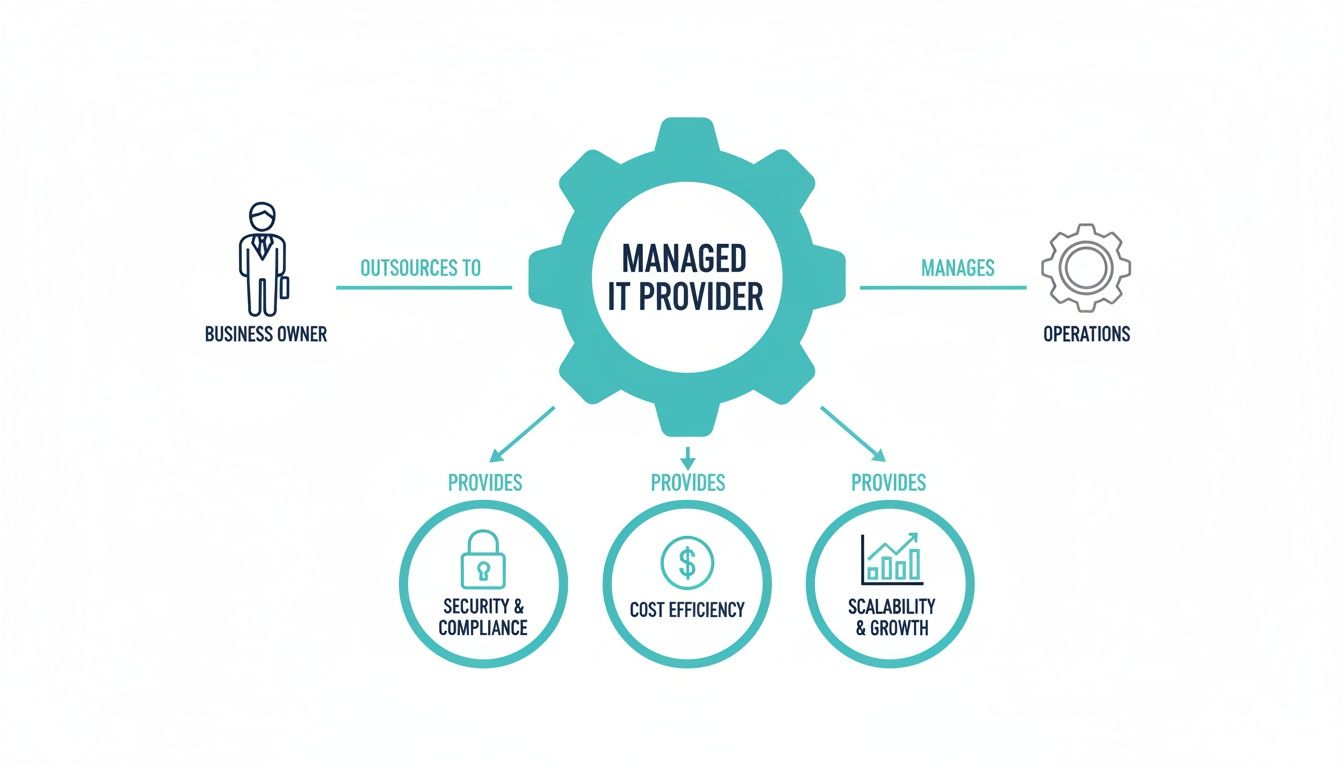
As you can see, handing off these complex operations to a provider like ARPHost frees you up to focus on your business, knowing your security is stronger and your costs are predictable.
Proactive Monitoring and Management
The heart of any solid managed service is 24/7 proactive monitoring. Instead of waiting for a server to go down and your phone to start ringing, our experts use sophisticated tools to keep an eye on your infrastructure around the clock. We’re watching key metrics like CPU load, memory usage, and network latency to catch oddities before they turn into outages.
This constant watchfulness means we can step in and fix things before they ever affect your users. When an alert flags a server's disk space getting dangerously full, our team is already on it. It’s a complete flip from the old, reactive "break-fix" model that has so many in-house IT teams constantly putting out fires. To get this right, you need a solid strategy, which we cover in our guide on effective infrastructure monitoring strategies.
Advanced Security Management
In a world full of digital threats, security can’t be a checklist item—it has to be woven into everything you do. A managed services provider builds a defensive perimeter around your digital assets. This goes way beyond just installing antivirus software. It’s a multi-layered game plan that includes:
- Endpoint Protection: We deploy and manage powerful security tools like Imunify360 on servers and VMs. This actively blocks malware, web attacks, and intrusion attempts as they happen.
- Patch Management: We methodically apply security patches to operating systems and applications, sealing up vulnerabilities the moment fixes are available.
- Firewall Management: We configure and maintain network firewalls, like those on our Juniper hardware, to meticulously control traffic and block unauthorized access to your private network.
For businesses that need an even higher level of security, we can integrate specialized services like Vulnerability Management as a Service, which provides continuous scanning and remediation of any weak points.
Backup and Disaster Recovery
Let’s be honest: what’s your plan if a critical server dies or ransomware locks up your data? A managed disaster recovery (DR) strategy ensures you can get back on your feet fast with minimal—if any—data loss. This is much more than just copying files to a spare drive.
A solid disaster recovery strategy isn't just about having copies of your data; it's about having a tested, actionable plan to restore operations swiftly. This is the difference between a minor hiccup and a business-ending catastrophe.
Providers like ARPHost design and manage these comprehensive backup solutions from the ground up. Our managed Proxmox backup services, for example, create secure, off-site copies of your entire virtual machine setup. If the worst happens, we can rapidly restore your whole environment and keep your business running.
Virtualization and Network Management
Today's IT environments are built on virtualization platforms like Proxmox or VMware. Managing these complex ecosystems—whether it's a single secure VPS or a sprawling private cloud—is a job for specialists. It’s not something you learn on the fly.
Our team at ARPHost lives and breathes virtualization. We handle everything from fine-tuning the performance of your individual VMs to managing the underlying hardware in one of our Dedicated Proxmox Private Clouds. We also manage the entire network fabric connecting it all, optimizing routing and security on enterprise-grade hardware to make sure your data flows fast and stays secure.
The Strategic Business Benefits of Managed Services
Bringing on a managed IT services provider is a lot more than just handing off a few tasks. It's a fundamental business decision that strengthens your bottom line and gives you a real competitive advantage. When you shift the day-to-day grind of IT operations to a dedicated partner, your technology stops being a reactive cost center and starts becoming a powerful engine for growth.
The biggest shift is financial. You're essentially swapping unpredictable, lump-sum capital expenses (CapEx) for a stable, fixed operational expense (OpEx). Instead of getting hit with a massive, unplanned bill when a critical server dies, your IT costs become a predictable monthly line item. That financial stability makes budgeting a whole lot easier and frees up cash to invest back into what your business actually does.
Predictable Costs and Optimized Spending
With a fully managed IT services plan, surprise hardware failures and the emergency repair bills that come with them are no longer your problem. That monthly fee covers everything from routine maintenance to having an expert jump on an incident at 3 AM. It gives you total financial clarity and eliminates the risk of budget-busting expenses that can hamstring a growing company.
This approach also makes sure your resources are always right-sized. You don't have to over-provision expensive hardware "just in case" anymore. A provider like ARPHost lets you start small with a secure web hosting bundle and grow fluidly into a full-blown bare metal server environment as your needs change. You only ever pay for what you actually use.
Access to a Deep Bench of Expertise
Let's be honest: hiring, training, and keeping certified professionals in niche fields like Proxmox, network security, or cloud architecture is incredibly expensive and a huge time sink. Partnering with a managed services provider gives you instant access to an entire team of senior-level engineers for a fraction of what it would cost to hire a single full-time employee.
Imagine having an expert on call 24/7 who knows exactly how to troubleshoot a complex Proxmox cluster or lock down a Juniper firewall. That’s the level of expertise a managed services provider brings to the table, instantly elevating your IT capabilities.
This kind of expert oversight is essential for running complex environments. Whether you need someone to optimize a Dedicated Proxmox Private Cloud or manage a Virtual PBX phone system, you have specialists on hand making sure everything runs at peak performance and security. This frees up your internal team to focus on projects that actually move the business forward.
Fortified Security and Guaranteed Compliance
In today's threat-filled world, solid security isn't just nice to have; it's completely non-negotiable. Cybersecurity has become a massive priority, with a reported 83% of managed service providers seeing an increased demand for security from their clients. This trend is a major reason why 51% of organizations ramped up their MSP usage in the last year alone—they needed help managing escalating threats and meeting tough regulatory demands. You can read more about these managed services trends to get a sense of these shifting priorities.
A good provider implements security best practices by default. At ARPHost, we deploy tools like Imunify360 for active threat defense, meticulously manage firewall rules, and carry out relentless patch management to seal off vulnerabilities. This proactive security posture doesn't just reduce risk; it also helps you meet stringent industry compliance standards like HIPAA or PCI DSS.
Unmatched Scalability and Business Agility
A managed infrastructure is built to grow with you. Need to throw more resources at a marketing campaign? You can scale up your VPS hosting in minutes. Ready to launch a new app? You can spin up a high-availability environment without waiting weeks for hardware to arrive. This kind of agility is what makes managed IT services so powerful for dynamic companies, allowing you to jump on opportunities the moment they appear.
Mini Case Study: Scaling with Confidence
A SaaS company was battling frequent downtime and performance issues on their self-managed servers, which was starting to cost them customers. After they migrated to ARPHost's managed high-availability Proxmox private cloud, they saw a 95% reduction in critical incidents. The stable foundation allowed them to scale their customer base by 300% in just one year without a single infrastructure-related service disruption.
This on-demand scalability, combined with 24/7 expert monitoring and rapid incident response, is the key to achieving maximum uptime and performance for your business.
How to Choose the Right Managed Services Provider
Picking a managed services provider isn't just about offloading tasks; it's about finding a partner you can trust with the keys to your kingdom. This isn't a decision to be made on price alone. You’re handing over a core piece of your business to a team of outsiders, and you need to be sure they’re the real deal.
To find the right fit, you have to dig deeper than a slick sales pitch. This buyer's guide is designed to help you ask the right questions and separate the true experts from the pretenders.

Before you sign any contracts, you need a clear-eyed view of what a provider truly brings to the table. We've put together a checklist of critical criteria to guide your evaluation process. Use these questions to systematically compare your options and find a partner who aligns with your operational needs.
Key Evaluation Criteria for Managed IT Providers
| Evaluation Criteria | Questions to Ask | What to Look For (The Ideal Answer) |
|---|---|---|
| Technical Expertise | Do your engineers hold current certifications for Proxmox VE 9, VMware, or other platforms we use? What is your team’s real-world experience managing hardware like Juniper or Cisco? Can you provide a case study for an infrastructure similar to ours? | "Yes, our senior engineers are certified and have years of hands-on experience. Here’s an example of how we solved a similar challenge for another client." They should offer specifics, not vague assurances. |
| Service Level Agreement (SLA) | What are your exact, guaranteed response and resolution times for different incident priorities? What are the financial penalties or service credits if you miss an SLA? Is your network uptime guarantee backed by real redundancy? | "Our SLA guarantees a 15-minute response for critical issues, backed by service credits. Our network has N+1 redundancy across multiple carriers." The answers should be clear, measurable, and financially backed. |
| Security & Compliance | What specific security tools, like Imunify360 or other Web Application Firewalls (WAFs), are included by default? How do you manage firewall rules and intrusion detection? Can you help us meet compliance standards like HIPAA or PCI DSS? | "We include Imunify360, proactive patching, and managed firewalls. We have a dedicated compliance team that can help you meet your regulatory requirements." They should detail a multi-layered security strategy. |
| Support Model & Accessibility | When I call with a critical issue, who do I talk to? Is it a Tier 1 agent or a senior engineer? What are your support hours, and are they the same for all levels of expertise? | "You get direct 24/7 access to our senior engineers for all critical issues. No script-readers, just problem-solvers." The best providers skip the frustrating tiered support model. |
| Scalability & Growth Path | How do your services scale? Can we start small and grow into a more complex setup without a painful migration? What does that process look like? | "You can start on a small VPS and scale seamlessly to a dedicated private cloud. We handle the migration and ensure there’s no downtime." The provider should offer a clear, logical path for growth. |
Choosing a partner based on these criteria ensures you're not just buying a service, but investing in a reliable extension of your own team. A provider who can confidently answer these questions is one who understands what it takes to run mission-critical infrastructure. For a deeper dive into the numbers, check out our guide on understanding managed services pricing models.
Why ARPHost Excels Here
At ARPHost, we didn't just write this checklist; we built our entire service model around it. Our fully managed IT services for servers and networks are designed to give you clear, confident answers to every one of those questions.
When you call our support line at 3 AM, you’re not talking to a Tier 1 agent reading from a script. You’re connected directly to a senior engineer who has the expertise to begin solving your problem immediately. This 24/7 access to high-level expertise is a core part of our service promise.
We offer transparent, financially-backed SLAs and a clear growth path from a single secure managed VPS starting at $5.99/month to a complex Dedicated Proxmox Private Cloud. Our solutions are built on deep expertise in Proxmox and Juniper environments, backed by proactive security with Imunify360. We don't just manage your infrastructure—we optimize it for performance, security, and growth.
Ready for a partner who meets these standards? Request a managed services quote and speak with one of our engineers today.
The Onboarding and Migration Process Explained
Moving your infrastructure to a managed service provider can feel like a huge undertaking. But a good partner won't just throw you in the deep end. They’ll have a clear, battle-tested process designed to get you from your current setup to a fully managed environment with minimal fuss and zero surprises.
For many businesses, this journey starts with an On-Premise to Cloud Migration. It’s often the first big step toward consolidating your hardware, improving access, and ditching the old server closet for good.

A successful transition is all about collaboration. We work with you, not just for you, to make sure the final setup is a perfect fit for your business. Here’s how we break it down.
Step 1: Discovery and Audit
First things first, we need to know what we’re working with. A dedicated engineer will partner with your team to create a complete map of your existing infrastructure. We catalog every server, application, network switch, and dependency.
The goal here is a top-to-bottom understanding of your environment—from software versions and security gaps to performance bottlenecks. This audit is the foundation for a smooth migration, ensuring nothing critical gets left behind.
Step 2: Collaborative Solution Design
Once we have the full picture, we start designing your new home. This isn’t a one-size-fits-all template; it's a collaborative session where your business goals meet our technical know-how. We'll architect a solution that fits your budget today and scales with you tomorrow.
This is where we might map out a solution like:
- A hybrid cloud that puts your database on high-performance bare metal servers while running your applications in a flexible Dedicated Proxmox Private Cloud.
- A high-availability web stack built on our HA VPS plans for built-in redundancy.
- A secure colocation setup where we manage all the networking and security while you own the hardware.
We document everything, from IP address schemes to backup schedules, giving you a detailed blueprint of exactly what we’re building.
Step 3: Phased Migration and Implementation
With the plan locked in, it’s time to build. To guarantee a seamless switch with zero downtime, we execute the migration in carefully managed phases. We stand up and configure your new environment in parallel with your old one, creating a perfect mirror before we flip the switch.
This is where the real technical magic happens. We’ll test everything from the ground up to ensure a smooth transition.
Expert Tip: For complex moves, like a VMware to Proxmox 9 migration, our engineers handle the entire process. We use a combination of specialized tools and proven methods to convert and move your virtual machines safely, guaranteeing data integrity and application function every step of the way.
Step 4: Rigorous Testing and Validation
Once your data and applications are living in their new environment, we kick off a critical testing phase. We don’t just assume it works; we prove it. We’ll work alongside your team to validate that every app, database, and workflow is running just as it should—or even better.
We hammer on everything from login portals to performance under heavy load. No stone is left unturned.
Step 5: Go-Live and Management Handover
After you give the green light, we schedule the final cutover. This is usually the quickest step, often just a final data sync and a simple DNS change to point your traffic to the new infrastructure. And just like that, you're live.
From that moment on, your infrastructure is officially under our 24/7 proactive management. At ARPHost, our managed migration support isn't an add-on; it’s a core part of our promise to make your transition painless and successful.
Ready to make the move with a partner you can trust? Request a managed services quote, and let our experts build your custom onboarding plan.
Common Questions About Managed IT Services
Even after you see the benefits, switching to managed IT infrastructure services is a big move. It’s only natural for business leaders and IT managers to have questions about what it really looks like day-to-day. Here are some straightforward answers to the questions we hear most often.
How Are Managed IT Services Priced?
The whole point of managed services pricing is predictability. It’s designed to get you away from the chaotic, reactive "break-fix" budget. Most providers use either a fixed monthly fee covering a specific scope of work or a per-device/per-user model. Either way, the goal is the same: turn unpredictable capital costs into a steady, manageable operational expense.
But the real return on investment (ROI) goes way beyond the monthly bill. You calculate it by adding up the cost of downtime you avoided, the productivity your team gains by focusing on core business goals, and the money saved by not having to hire specialized in-house experts. A good managed plan pays for itself by preventing the very problems that can grind a business to a halt.
What Is the Difference Between Managed Services and Colocation?
This comes up a lot, but the distinction is actually pretty simple. Think of it as renting a secure garage versus hiring a full-service mechanic who works in that garage.
Colocation: You rent the physical space, power, cooling, and network connection in a professional data center. You bring your own servers and are entirely responsible for managing them. For businesses that want to own their hardware but need a world-class facility, ARPHost offers secure colocation.
Managed Services: The provider actively manages the hardware and software for you, whether you own the gear or they do. This is the hands-on work: proactive monitoring, patching, security, backups, the whole nine yards.
At ARPHost, we’ve built a clear growth path. You can start with colocation and layer on fully managed IT services as you grow, or jump straight into a fully managed solution from day one.
The core difference is responsibility. Colocation provides the environment; managed services provide the expertise and labor to run the technology within that environment.
Can Managed Services Truly Scale with a Small Business?
Absolutely. In fact, this is one of the model's greatest strengths. A quality provider will have a spectrum of solutions that grow right alongside your business, so you’re never paying for more than you actually need.
This flexibility is a huge deal for small and medium-sized enterprises (SMEs), which are the main force behind the managed services market. That market is projected to grow from USD 132.18 billion in 2025 to USD 146.98 billion in 2026, largely because SMEs need predictable costs and access to expertise they can't justify hiring full-time. A recent study even found that 51% of firms increased their reliance on MSPs to deal with talent shortages and get clearer SLAs. You can read the full research on the growing managed services market to see the trends for yourself.
We designed our ARPHost offerings around this exact growth path:
- Starting Point: A new startup can get off the ground with an affordable secure VPS hosting plan from just $5.99/month.
- Growth Phase: As business picks up, they can easily upgrade to a high-availability VPS cluster for more horsepower and redundancy.
- Maturity: Eventually, they can graduate to a fully dedicated Proxmox private cloud for total control and peak performance.
This lets your infrastructure investment line up perfectly with your revenue and operational needs, from launch all the way to enterprise scale.
How Secure Is My Data with an Outside Provider?
This might sound counterintuitive, but for most businesses, partnering with a professional managed services provider dramatically improves their security. Top-tier providers like ARPHost have access to more advanced tools, specialized security engineers, and stricter protocols than a typical in-house team can afford to maintain.
It’s all about a multi-layered security strategy. This isn't just one piece of software; it's a complete defense system:
- Proactive Threat Defense: We deploy tools like Imunify360 to actively block malware, brute-force attacks, and web exploits before they can do damage.
- Managed Firewalls: Our security experts configure and constantly monitor dedicated hardware and software firewalls to control every packet of network traffic.
- Isolated Backup Solutions: Your data is backed up to secure, separate locations. This means that even if your live systems are hit, your data is safe and ready to be restored.
- Rigorous Patching: A dedicated team works around the clock to ensure every piece of your environment—from the OS to individual applications—is patched to close security holes the moment a fix is available.
This combination of enterprise-grade tools and 24/7 expert oversight creates a security posture that’s incredibly difficult and expensive to build on your own.
Ready to get answers tailored to your specific needs? ARPHost's team of senior engineers is available 24/7 to discuss how our managed IT infrastructure services can help you scale securely and confidently. Request a managed services quote to start the conversation.