

Most advice about managed firewall services starts with the wrong premise, that once you outsource firewall management, your team can stop owning firewall outcomes. That's how organizations end up with a clean contract and a messy incident, because the provider may run the platform while your business still owns the policy, the risk decision, and the compliance answer when auditors ask who approved what.
The market signals explain why this service has moved from convenience to core infrastructure. One estimate values the global managed firewall services market at USD 29.57 billion in 2023 and projects USD 73.54 billion by 2030 at 13.9% CAGR from 2024 to 2030, while another places the market at USD 31.63 billion in 2025 and USD 89.78 billion by 2033 at 13.93% CAGR. Put together, those forecasts show a category that's being pulled into the center of enterprise operations, not kept on the edge of IT budgeting managed firewall services market estimate
Why Managed Firewall Services Are Not a Set-and-Forget Solution
The most dangerous assumption in this space is that outsourcing firewall work also outsources accountability. It doesn't. A provider can monitor logs, push patches, tune rules, and generate reports, but your organization still has to decide what traffic is allowed, what gets exempted, and who can accept the risk of a temporary opening during an incident.
Operational control is not the same as ownership
The operational side is straightforward. Managed firewall services usually cover configuration, monitoring, policy updates, patching, and reporting, which is why they're attractive to teams that don't have staff for round-the-clock firewall administration. The ownership side is harder, because it includes the business decision behind every exception, the escalation path when a rule blocks revenue, and the final call when an application team wants a broad rule that security won't love.
That boundary needs to be explicit before production traffic depends on the service. I've seen change windows go sideways because the vendor assumed the customer would approve the exception, while the customer assumed the vendor would make the call under pressure. In practice, the cleanest deployments use written approval paths for emergency changes, named approvers for policy exceptions, and a short list of conditions that let the provider act without waiting for a meeting.
Practical rule: if an outage or exposure happens, the first question should be “who can change the rule right now,” not “who owns the contract.”
Compliance and response still live with the customer
Managed firewall services can support compliance, but they don't absorb it. If the logs are needed for an audit, if a rule review is required, or if an analyst needs to explain an incident to leadership, the customer still owns the answer. That's why internal governance matters even when the technical operations are outsourced.
A good buying habit is to compare providers on operational clarity, not just feature lists. The right question isn't whether the vendor can run the device, it's whether the operating model leaves you with enough control to approve changes, prove compliance, and respond quickly when the business is on the line.
Core Technical Components of Modern Managed Firewalls
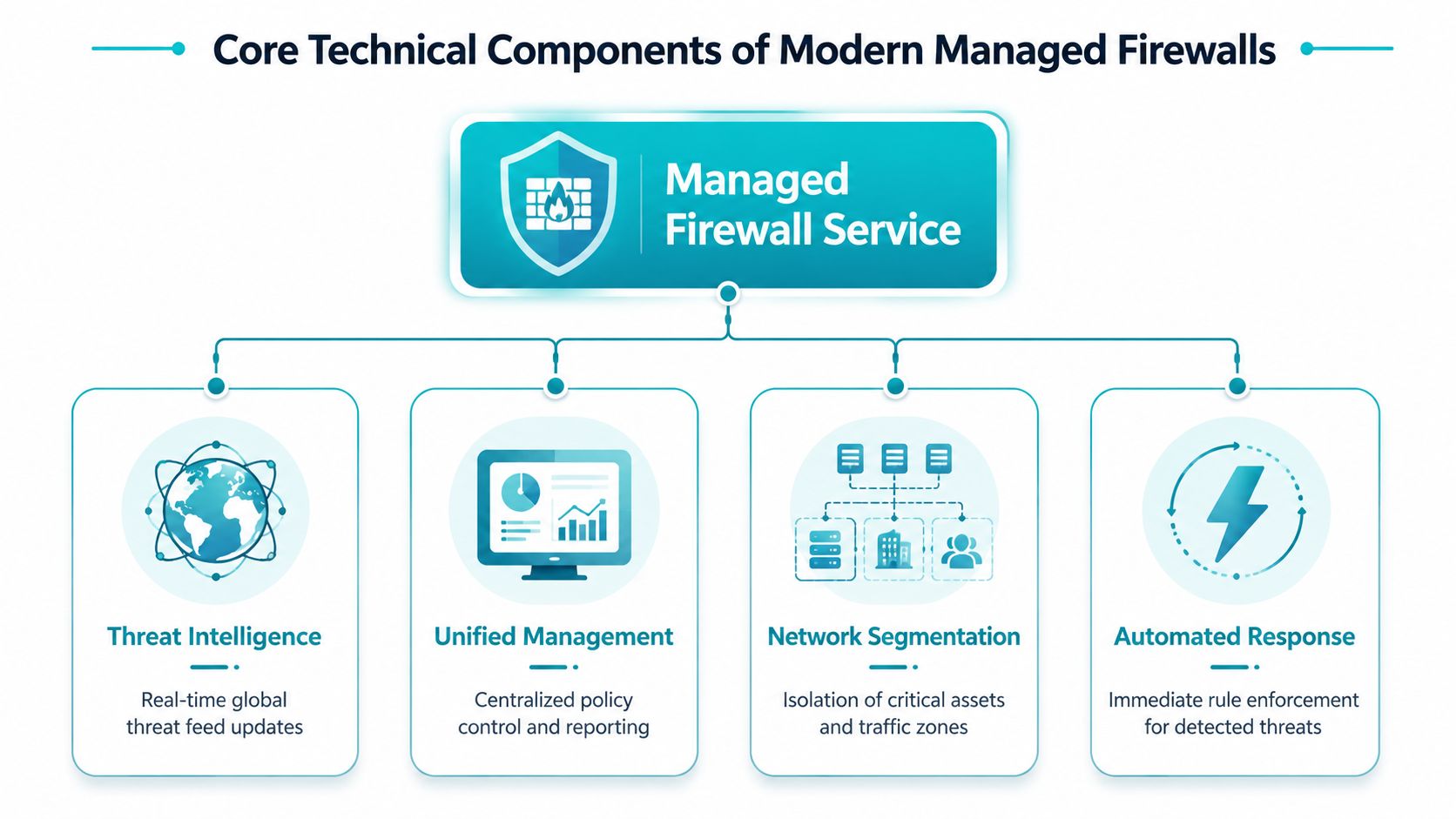
A modern managed firewall is not just a box that blocks ports. It's usually a combination of threat intelligence, unified management, network segmentation, and automated response, with policy, telemetry, and change control stitched together into one operating service.
What the platform is actually doing
The firewall layer itself is often a virtual firewall on shared platforms or dedicated hardware appliances, with service tiers bounded by measurable capacity controls. One managed-firewall specification exposes tiers at 50/200/500 Mbps Layer-7 throughput, 60,000/240,000/500,000 sessions, and 1,000/2,000/4,000 In production, that means you size for session pressure, app mix, and policy sprawl, not just internet speed.
Next-generation firewall features, such as application awareness and deep inspection, only help if they're tuned against real traffic patterns. IPS and IDS functions are most useful when the provider reviews alerts, suppresses noise, and updates signatures without breaking legitimate flows. If the SOC is drowning in false positives, the technical stack is fine but the service is failing.
For teams evaluating Linux-centric stacks, the service model should also fit the rest of the environment, which is why a practical reference like firewalls for Linux can be useful when you're mapping service responsibilities to host-side controls.
Logging, VPN, and segmentation are part of the service envelope
Telemetry is where managed firewalls become operationally real. Equinix documents a high-availability active-passive virtual appliance pair with up to 1 GB of log data per day, 10 GB log storage, and up to 60 days retention per firewall pair, which shows that logging capacity is part of design, not an afterthought Equinix managed-firewall logging envelope. That matters because a busy rule set can generate more event volume than a team expects, and retention can become a compliance issue faster than anyone plans for.
VPN and segmentation are equally practical. Managed firewalls often carry site-to-site tunnels, remote-user access, and segmentation policies that keep admin systems, user VLANs, and production workloads from talking too freely.
Healthy operation looks boring, consistent rule review, predictable logging growth, and clear session headroom. Problems show up as policy exceptions that never close, logs that stop matching the traffic volume, or VPN use that expands without a governance process.
Deployment Models and When Each Makes Sense
Managed firewall services work differently depending on where the traffic lives. I usually separate the choices into three camps, on-premises appliances managed remotely, cloud-native virtual firewalls, and hybrid deployments that straddle both. SASE adds a fourth lens, but it doesn't remove the need to decide where the enforcement point lives.
| Managed Firewall Deployment Model | Best For | Latency Profile | Management Complexity | Typical Use Case |
|---|---|---|---|---|
| On-premises appliance managed remotely | Data-sensitive organizations, plant sites, regulated environments | Usually lowest for local traffic | Moderate, because hardware and policy both need care | Branches, campuses, and legacy data centers |
| Cloud-native virtual firewall | Distributed teams, SaaS-heavy operations, fast-moving cloud estates | Often variable, depends on traffic path and cloud region | Higher integration burden, lighter hardware burden | Cloud workloads, remote access, east-west policy |
| Hybrid architecture | Enterprises in transition, mixed app portfolios, multi-site operations | Mixed, based on where traffic is enforced | Highest, because two control planes must stay aligned | Gradual modernization, merger integration, multi-environment control |
On-premises and hybrid designs
On-premises appliances still make sense when a business needs tight physical control, low local latency, or predictable appliance behavior. Remote management works well here if the provider can reach the devices securely and the customer keeps authority over change windows and edge exceptions. The trade-off is obvious, you keep hardware ownership and get outsourced operations, but you also keep lifecycle complexity.
Hybrid is the common reality for larger firms. Older apps stay close to the data center, while cloud workloads, remote users, and SaaS traffic push policy into new places. In that model, the firewall team spends a lot of time making sure the same security intent doesn't drift between environments.
Cloud-native and SASE
Cloud-native virtual firewalls fit better when traffic is already distributed. They're a cleaner match for SaaS-heavy companies and organizations that care more about policy consistency than about a single perimeter device. The downside is management-plane security, because the more remote the control layer becomes, the more disciplined you need to be about authentication, logging, and segregation of duties.
SASE shifts the conversation from “what sits at the edge” to “where policy follows the user.” That's useful, but it doesn't mean firewalls disappear. It means the firewall becomes one enforcement element inside a broader control model, and teams still need to decide who owns segmentation, VPN policy, and exception handling when applications span private infrastructure and cloud services.
Operational Benefits and Total Cost Analysis
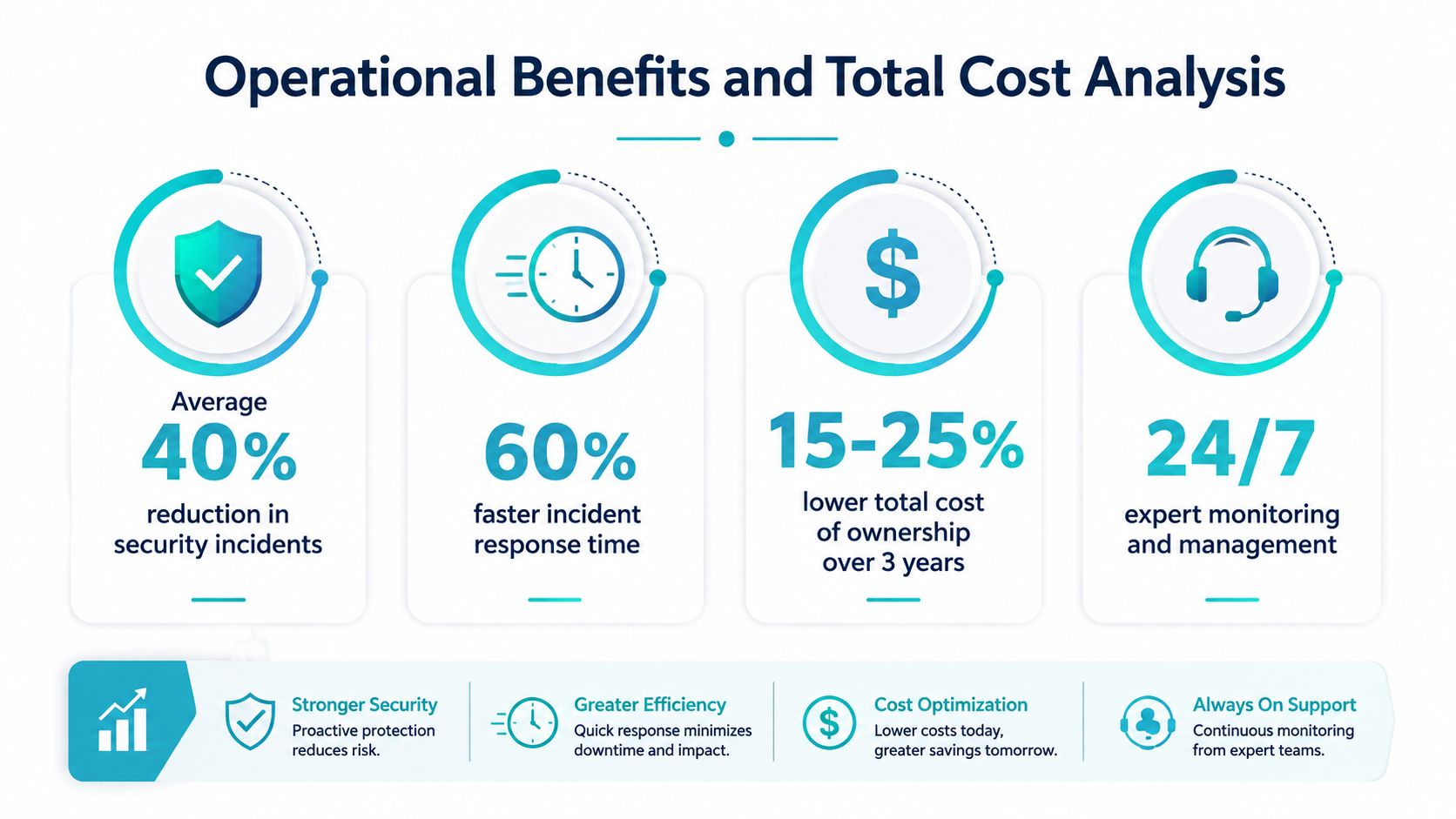
Managed firewall services make financial sense only when you count the work they remove, not just the line item they replace. The value is operational: fewer hours spent on routine monitoring, less pressure on small security teams, and better consistency in change handling. For many businesses, the question isn't whether the firewall is cheaper as a service, it's whether the organization can staff the equivalent control internally without burning out key people.
The hidden costs of doing it in-house
A firewall admin salary is only one part of the in-house model. You also have to pay for training, certification upkeep, tool licensing, alert triage, documentation, and the time lost when the person who knows the rules is on vacation or leaves the company. Those soft costs are often what push managed services over the line for mid-sized teams.
Compliance work adds another layer. When firewall changes are tracked centrally, reviewed consistently, and reported in a usable format, audit prep becomes less of a scramble. That doesn't eliminate the need for internal oversight, but it does reduce the time spent reconstructing why a rule exists in the first place.
What the service buys in practice
Managed firewall services are most valuable when the business needs continuity more than novelty. A good provider gives you continuous monitoring, structured change control, and a team that can notice rule drift before it becomes an incident. That matters in the same way that hiring a good accountant matters, not because the work is exciting, but because the work is too important to be done casually.
For buyers trying to compare commercial models, managed services pricing models is a useful internal reference point when you're mapping scope to budget. If you also need a broader operations partner for servers, backups, and network controls, ARPHost, LLC offers managed infrastructure services that can sit alongside firewall operations in a larger support plan. In some environments, that's easier than stitching together a separate vendor for every layer.
Bottom line: the biggest return comes from consistency. A firewall that gets reviewed, tuned, logged, and escalated on schedule is usually worth more than a cheaper firewall that nobody has time to manage properly.
How to Evaluate Managed Firewall Vendors
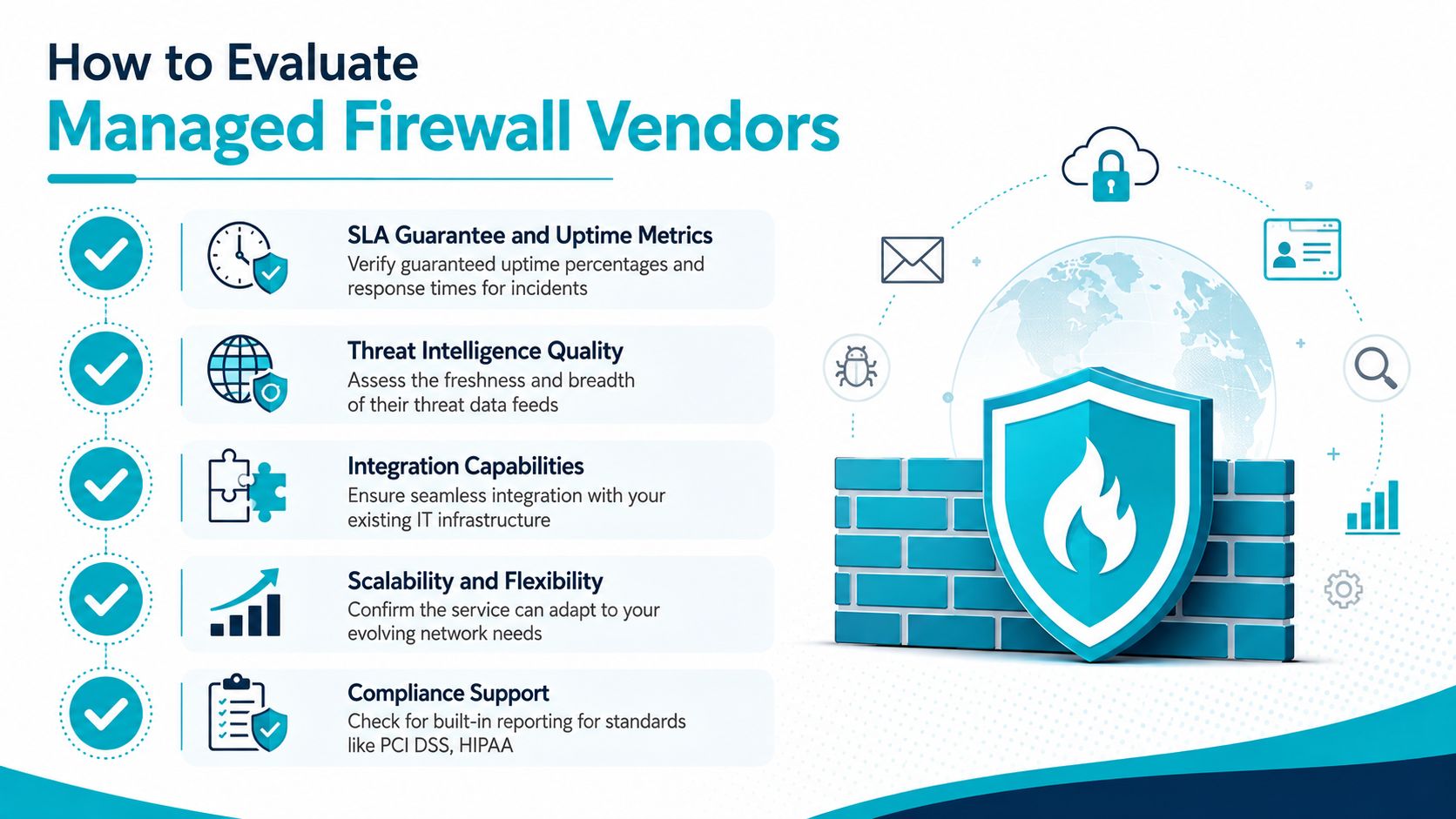
A firewall vendor can look strong in a sales deck and still fail under real operational pressure. The best evaluation process focuses on the SOC, the escalation path, the change workflow, and the reporting output, because those are the places where managed service quality shows up or falls apart.
Questions that expose maturity
Ask who reviews alerts after hours, and ask what happens when the first analyst can't resolve the issue. Ask how changes are approved, who can authorize emergency exceptions, and how rollbacks work if a policy breaks a business app. If the vendor can't describe that process cleanly, the service will probably feel improvised when pressure hits.
SLA language matters more than marketing language. You want to know response timing, escalation thresholds, reporting cadence, and how the provider handles repeated incidents.
Red flags I watch for
A vendor that only talks about uptime and never talks about change control is a risk. So is a provider that sells “full management” but leaves unclear who approves rule exceptions, who owns compliance reporting, and who handles maintenance windows. If you don't get direct answers, you're not buying a managed service, you're buying a ticket queue with security branding.
- Vague escalation paths: If nobody can tell you who gets called when a rule blocks traffic, keep looking.
- Thin reporting: If the reports are just compliance PDFs with no operational insight, they won't help your team.
- Rigid service boundaries: If the vendor refuses to support your actual deployment pattern, they'll slow every future change.
- Weak integration answers: If they can't explain how their service fits your existing identity, logging, or network tooling, the rollout will be painful.
For contract review, it helps to read an actual managed-services agreement before you sign one. The wording in ARPHost's managed IT services agreement is the kind of document that reminds buyers how much depends on scope, responsibilities, and service boundaries.
Implementation Roadmap and Migration Strategy
The cleanest firewall migrations I've seen start with a ruthless inventory, not with a platform swap. One enterprise I worked with had years of accumulated rules, some of them tied to apps nobody used anymore, and the first win was deleting dead policy before the new service ever went live. That reduced risk before a single packet was moved.
Discovery before cutover
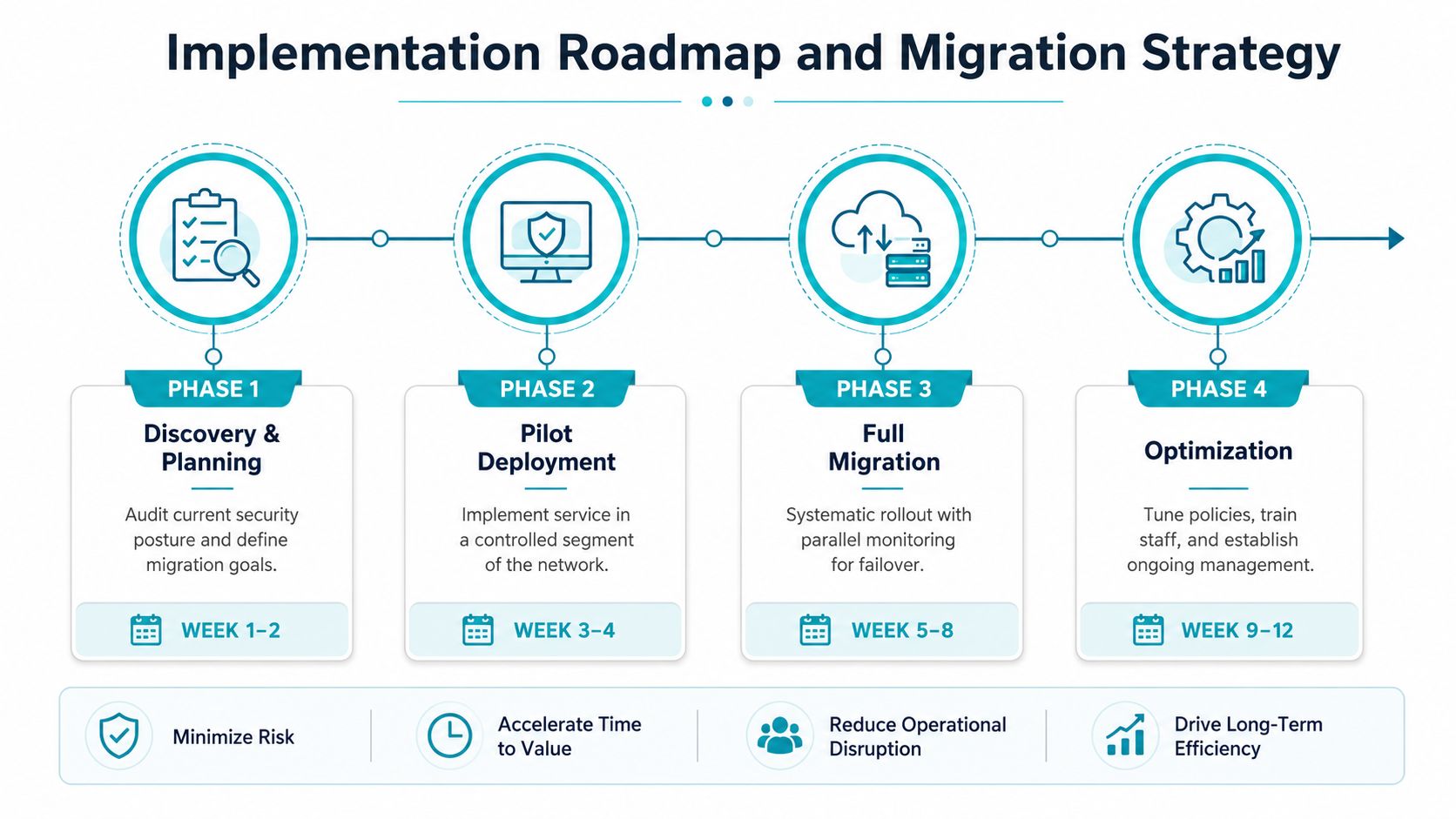
The first phase is to map what the current firewall does. That means identifying rule owners, traffic dependencies, VPNs, exception paths, logging destinations, and anything that exists only because of historical accident. If a rule can't be explained by an application owner, it's a candidate for retirement.
Then define responsibility boundaries in writing. Who approves changes, who is notified during incidents, who can declare an emergency exception, and who restores the previous state if the new policy breaks production? Those answers need to be known before the handoff, not during the outage.
Pilot, rollout, and validation
The safest pattern is a controlled pilot on a small segment of traffic. That gives the provider a chance to verify logging, alerts, and policy translation without exposing the whole business to a new operating model. Once the pilot is stable, you can expand the scope in planned waves while keeping the old path available long enough to compare behavior.
Validation is where hidden issues surface. Application teams need to confirm that required flows still work, security teams need to confirm that alerts are landing where they should, and operations needs to confirm that failover behavior matches the design. After that, tune the policies and schedule recurring reviews so the service doesn't calcify into another pile of old exceptions.
For organizations moving into private cloud or virtualized infrastructure at the same time, it's often easier to pair the firewall transition with the hosting platform transition. ARPHost, LLC can support that kind of rollout with virtual servers, bare metal, and Proxmox-based private cloud options, which helps keep infrastructure and policy changes aligned instead of staggered across too many vendors.
Migration succeeds when the business treats the firewall as an operating process, not a one-time installation. The first month after cutover usually matters more than the cutover day itself.
Frequently Asked Questions About Managed Firewall Services
Are managed firewall services still useful in cloud-first environments? Yes, but the role shifts. The firewall becomes part of a broader control plane for segmentation, VPN policy, and compliance consistency across remote and hybrid traffic, rather than just a perimeter box.
Do managed firewall services fit zero-trust designs? They can, if the provider supports segmentation, identity-aware policy, and clear change controls. Zero trust still needs enforcement points, and the firewall often remains one of them.
What about vendor lock-in? The risk usually comes from opaque policy ownership and unclear reporting exports. Before signing, make sure you know how rules, logs, and responsibility boundaries are transferred if you ever leave.
How should off-premises log storage be handled? Treat log retention as part of the service design, not a side feature. The key questions are where logs live, who can access them, and whether retention meets your audit and investigation needs.
What if the provider has its own security incident? Your contract and operating runbook should spell out notification, scope of impact, and who takes over decision-making. If that isn't documented, the incident gets harder to manage than it needs to be.
Managed firewall services are strongest when they're paired with clear internal ownership, disciplined change control, and a provider that can explain exactly how incidents, audits, and exceptions are handled. If you want help aligning firewall management with hosting, private cloud, or fully managed infrastructure, ARPHost, LLC offers services that can support the network, server, and operations layers around it. Reach out if you want a setup that keeps the technical work off your team without handing away the decisions that still belong to you.