

Cloud invoices usually don't break trust all at once. They do it line by line. Compute looks reasonable, then storage grows, network charges show up, snapshots pile on, and a workload that was supposed to stay flexible turns into a budgeting problem your finance team can't forecast cleanly.
That's where Tampa businesses start looking harder at managed colocation. Not because renting cabinet space is new, but because managed colocation pricing in Tampa often makes more sense when workloads are steady, performance matters, and your team doesn't want the full burden of running a facility or driving to a data center for every hardware issue. You keep control of your infrastructure. The provider handles the physical environment and, in a managed model, takes on the day-to-day operational tasks that usually get ignored until something breaks.
Moving Beyond Unpredictable Cloud Bills
A common trigger for this search is simple. The application stack isn't changing much, traffic is relatively stable, and cloud costs still move around every month. That's fine for bursty development environments or short-lived projects. It's a poor fit for long-running databases, virtualization clusters, licensing-sensitive workloads, and systems that need consistent performance.
Managed colocation gives Tampa companies a middle path. It sits between public cloud abstraction and fully self-operated infrastructure. You place your hardware in a data center environment built for continuous operations, then add a service layer so your internal team doesn't have to own every physical task, alert, reboot request, patch window, or on-site intervention.
Why Tampa buyers start here
The core buying question isn't “What's the cheapest rack space?” It's “What does this environment cost once the operational burden is included?” CTOs usually care about four things:
- Budget stability so finance can plan around infrastructure as a known monthly cost
- Operational coverage for nights, weekends, and incidents that don't wait for business hours
- Performance consistency for workloads that don't benefit from noisy, shared-resource abstraction
- Control over hardware, hypervisors, security tooling, and network design
What a useful price discussion actually looks like
A serious colocation conversation starts with workload shape, not a cabinet photo. Buyers need to know:
- How much power the hardware draws under real load
- Whether bandwidth is modest, sustained, or burst-heavy
- How much remote-hands work the provider will perform
- Which responsibilities stay with your team versus the facility operator
Managed colocation makes financial sense when your workloads are predictable enough to model, but important enough that you can't leave operations to chance.
That's why a straight price-per-U comparison usually fails. A low monthly number can hide expensive support events, weak redundancy, or a quote that excludes the operational work your team assumes is included.
Defining Managed Colocation Services
Managed colocation isn't just “space in a data center plus internet.” That's the old way buyers describe it. In practice, the managed layer changes the product from facility rental into an operating model.
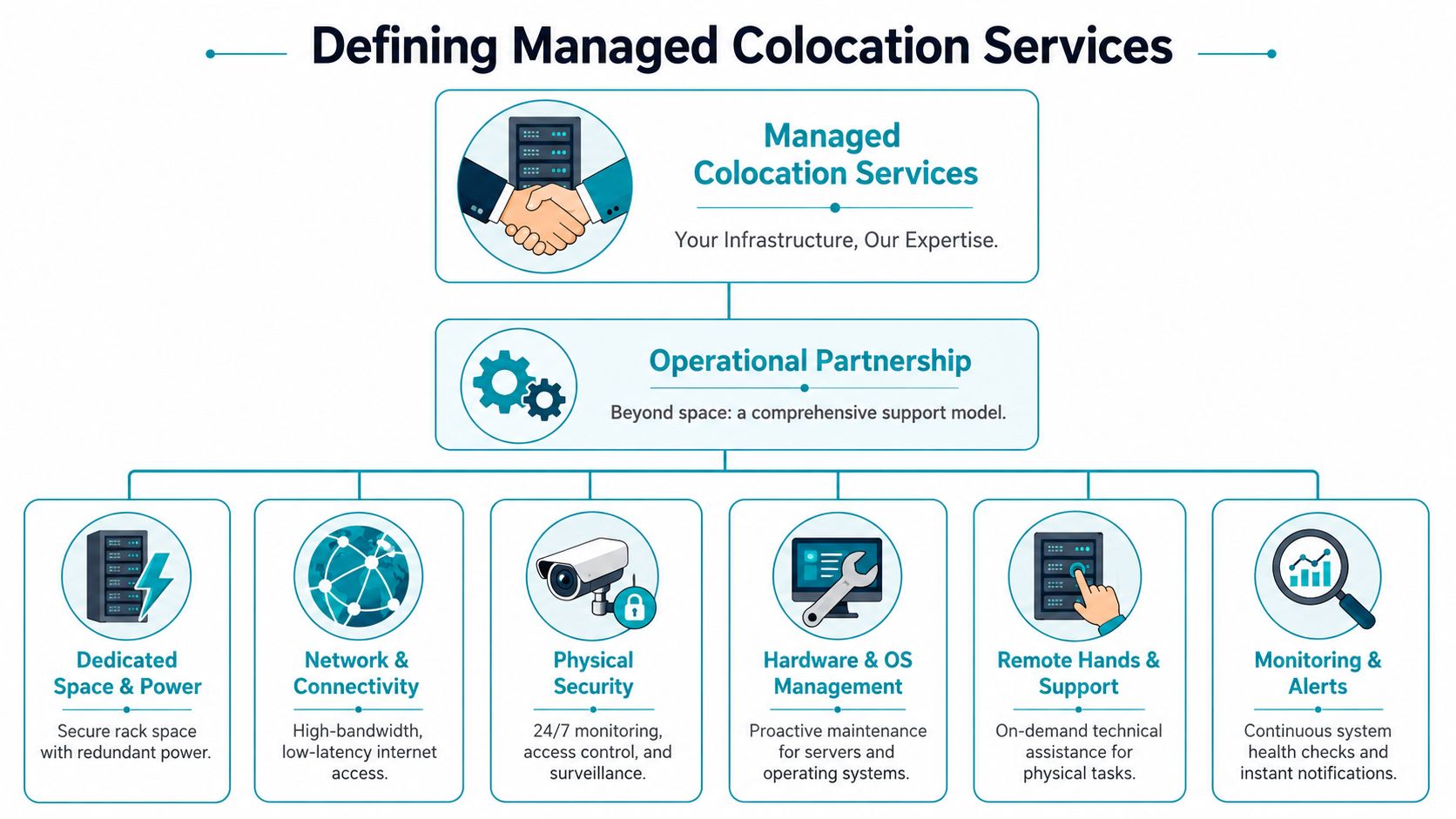
What you're actually buying
At the base level, colocation provides the environment. That usually means secure space, conditioned power, cooling, physical security, and telecom connectivity. The managed version adds people, process, and operational accountability on top of that.
Instead of sending your own staff for every failed drive, cable move, console task, or physical inspection, you're relying on a provider team to execute those tasks within an agreed support scope. That shift matters because most infrastructure problems aren't caused by the rack. They're caused by the work around the rack.
You're not renting real estate. You're deciding who handles the physical side of uptime.
Independent guidance puts the pricing inflection clearly: managed colocation pricing rises when the service moves from pure facility rental to an operational layer, and quotes should be judged by kW commitment, bandwidth model, and included support scope, not just rack space.
The managed layer that changes total cost
The practical difference shows up in daily operations:
- Monitoring and alert response keeps hardware and environment issues from sitting unnoticed.
- Physical intervention covers reboots, reseating cables, checking status lights, swapping approved components, and escort-related tasks.
- Network and connectivity support reduces the friction of troubleshooting edge connectivity, handoff issues, and carrier coordination.
- Facility operations handle the redundant power, cooling, and access controls your business depends on but doesn't want to staff directly.
That's why managed colocation works well for lean infrastructure teams. A two-person IT group can support much more equipment when they're not also responsible for facility access, on-site availability, and physical troubleshooting after hours.
What managed colocation is not
It's not full outsourcing of every infrastructure decision. You still own architecture, operating systems, application design, backup policy, and change control unless the provider contract explicitly expands into those areas.
That distinction matters in procurement. Some buyers assume “managed” includes everything from firewall administration to hypervisor patching. Sometimes it does. Sometimes it doesn't. If the quote doesn't spell out the support boundary, it isn't managed enough to price correctly.
Breaking Down Managed Colocation Pricing Components
Every colocation bill has a structure underneath it. If you can't identify the components, you can't compare quotes properly.
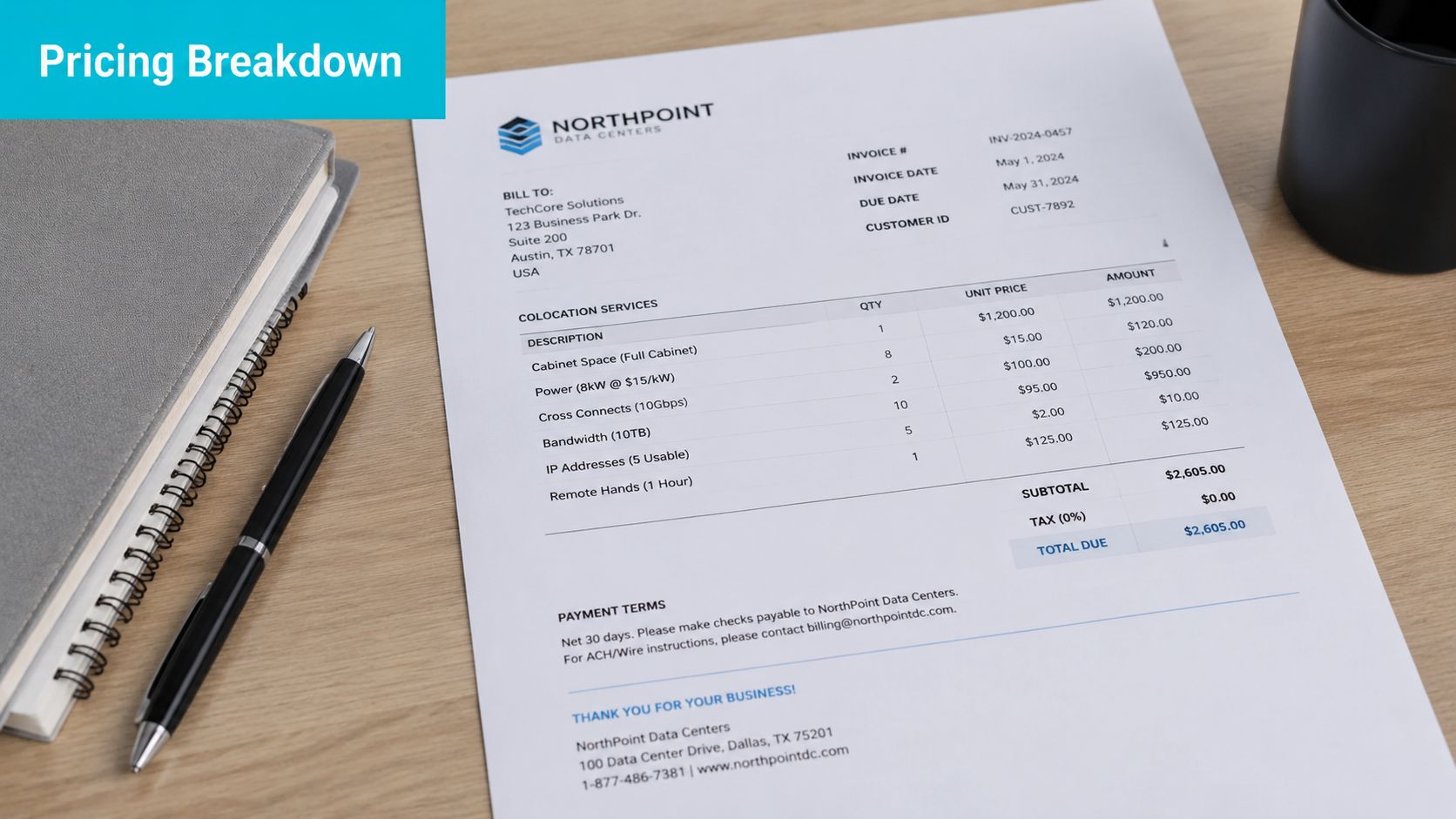
Space is the smallest part of the story
Buyers often start with rack size because it's easy to visualize. A server is 1U. A few nodes fit in a quarter cabinet. A denser deployment needs a half or full cabinet. But cabinet footprint isn't usually the biggest cost driver.
In Tampa, 1U service can start at $99/month, but the technical driver behind the price is often power, not the single rack unit itself, according to ARPHost's Tampa colocation pricing overview.
A physically small server with aggressive CPUs, dense memory, and high-speed storage can cost more to host than a larger but lower-draw system. That's why cheap-by-the-U quotes often look good until the power line gets added.
Power is usually the real bill
Power is where managed colocation pricing Tampa discussions become technical. Providers generally package space, power, and connectivity together, and many quotes are effectively shaped by critical load multiplied by a $/kW model. A high-draw 1U node can therefore cost materially more than an efficient system in the same footprint.
A good quote should tell you:
- Committed power allocation for the rack or partial rack
- Redundancy model if dual power feeds are involved
- Overage treatment when your draw exceeds the committed amount
- Measurement method so you know whether billing follows nameplate assumptions or actual usage
If a provider can't explain how power is billed, the quote isn't complete.
Bandwidth changes the economics fast
Bandwidth pricing gets misunderstood because many teams treat it like a flat internet line item. It isn't. Cost depends on the delivery model and operational expectations.
Look at these variables closely:
- Included connectivity may be enough for basic hosting but not for backup replication, customer traffic, and management access combined
- Metered versus unmetered billing affects whether quiet months offset busy ones
- Cross-connect requirements can add complexity if you need direct carrier or partner connectivity
- Remote access expectations matter if your team will use KVM, backup transport, or replication heavily
A quote that looks low on monthly recurring charges may assume a bandwidth profile your workload won't survive.
Support scope decides whether costs stay predictable
Managed service value is evident. Remote hands, routine checks, troubleshooting assistance, hardware swaps, and after-hours interventions may be bundled, limited, or fully separate. Buyers often discover the difference only after the first incident.
Practical rule: If the quote says “managed,” ask for a written list of the exact physical and operational tasks included each month.
For example, if you're evaluating Tampa options and want a clearer reference point, ARPHost publishes a data center colocation pricing overview that helps frame what should be clarified before you sign.
The hidden-cost pattern I see most often
The most common quoting mistake is this: a team sizes around rack units and ignores peak power draw, support events, shipping logistics, hardware sparing, and migration labor. Then they call colocation “more expensive than expected.”
It wasn't more expensive than expected. The estimate was incomplete.
Why ARPHost Excels for Tampa Colocation
The technical value of a managed colocation provider comes down to whether they reduce operational drag or just resell cabinet space with a support email attached. That difference shows up during migrations, hardware failures, and the first time someone needs real help at an inconvenient hour.
Where the provider matters most
A strong managed colocation partner should be able to support more than the rack itself. They should understand bare metal provisioning, hypervisor requirements, backup design, firewall boundaries, and the practical realities of hybrid infrastructure. That matters if your environment includes Proxmox nodes, dedicated virtualization hosts, storage-heavy workloads, or mixed legacy systems that won't move cleanly to public cloud.
This is also where a carrier-neutral facility matters. Network flexibility gives teams more options around transport, connectivity strategy, and future architecture changes. For Tampa deployments, reviewing a carrier-neutral datacenter model is useful because it aligns with how many growing businesses expand. They don't stay static. They add links, providers, appliances, and replication targets over time.
Operational fit matters more than feature lists
The right provider should function like an extension of your infrastructure team. That means clear escalation paths, competent remote hands, practical guidance around power and density, and the ability to support hybrid patterns instead of forcing a one-size-fits-all design.
ARPHost is one option in that category. Its service mix spans colocation, bare metal, managed IT support, and Proxmox-based environments, which is useful when a business needs a provider that can handle both physical hosting and the surrounding operational work.
What usually works well
For Tampa businesses, the most effective managed colocation deployments usually have three traits:
- Stable core workloads that justify dedicated infrastructure
- Lean internal teams that need provider-side operational help
- A roadmap beyond the first rack so the environment can grow into backup, virtualization, or hybrid hosting without a redesign
What doesn't work is treating managed colocation like a commodity purchase. When buyers optimize only for entry price, they often end up rebuilding the support model after signing.
Example Pricing Scenarios in Tampa
The fastest way to evaluate managed colocation pricing in Tampa is to model a deployment the way finance and operations will actually experience it. Not as a single “rack fee,” but as a blend of recurring facility costs and upfront hardware costs when applicable.
A useful local baseline is that entry-level colocation can start around $75/month, while a more typical quarter-cabinet setup has been quoted at $600/month with 10Gbps connectivity included, and one Tampa comparison also showed about $25,000 upfront for four servers in that scenario.
Scenario one with an SMB Proxmox cluster
A small business with a few steady production applications often lands here. Think line-of-business apps, internal services, a customer portal, and a virtualization layer running on a compact set of hosts.
The business buys four servers up front and places them in a quarter cabinet. The recurring monthly facility cost aligns with the local quarter-cab benchmark above. The reason this model works is operational clarity. Hardware is dedicated, latency is consistent, and the monthly infrastructure bill is easier to forecast than a variable cloud bill for the same always-on footprint.
Typical cost shape:
- Upfront hardware is the major initial expense
- Monthly colocation charge covers the quarter-cabinet environment and included connectivity in the quoted benchmark
- Managed support scope determines whether routine physical tasks are already covered or become separate service events
Scenario two with a larger enterprise footprint
Now consider a business running a denser application stack with stricter resilience requirements. It may need more cabinet space, more power allocation, and a broader operational support envelope. In practice, this buyer won't use entry-level pricing as a planning figure because the deployment characteristics drive the quote upward.
The important lesson isn't a single monthly number. It's that enterprise colocation pricing grows because of density, redundancy expectations, and support scope, not just because the rack is larger. A full cabinet can still be economical if the workload is stable, but only when the quote reflects actual power, connectivity, and service needs.
Tampa managed colocation example monthly costs
| Cost Component | SMB Scenario (Quarter Rack) | Enterprise Scenario (Full Rack) |
|---|---|---|
| Rack footprint | Quarter cabinet | Full cabinet |
| Hardware purchase | One comparison showed about $25,000 upfront for four servers | Higher upfront hardware investment, quoted case depends on platform design |
| Monthly facility baseline | Around $600/month with 10Gbps connectivity included in one Tampa comparison | Custom quote based on power, bandwidth, and management scope |
| Support model | Best fit when remote operational tasks are included clearly | Best fit when management boundaries and escalation paths are contractually defined |
| Main cost driver | Balancing hardware investment against predictable monthly hosting | Power density, redundancy, and operational complexity |
The best SMB colocation projects aren't the cheapest ones. They're the ones sized correctly on day one so they don't need a contract rewrite after the first growth phase.
Managed Colocation Versus Unmanaged and Cloud
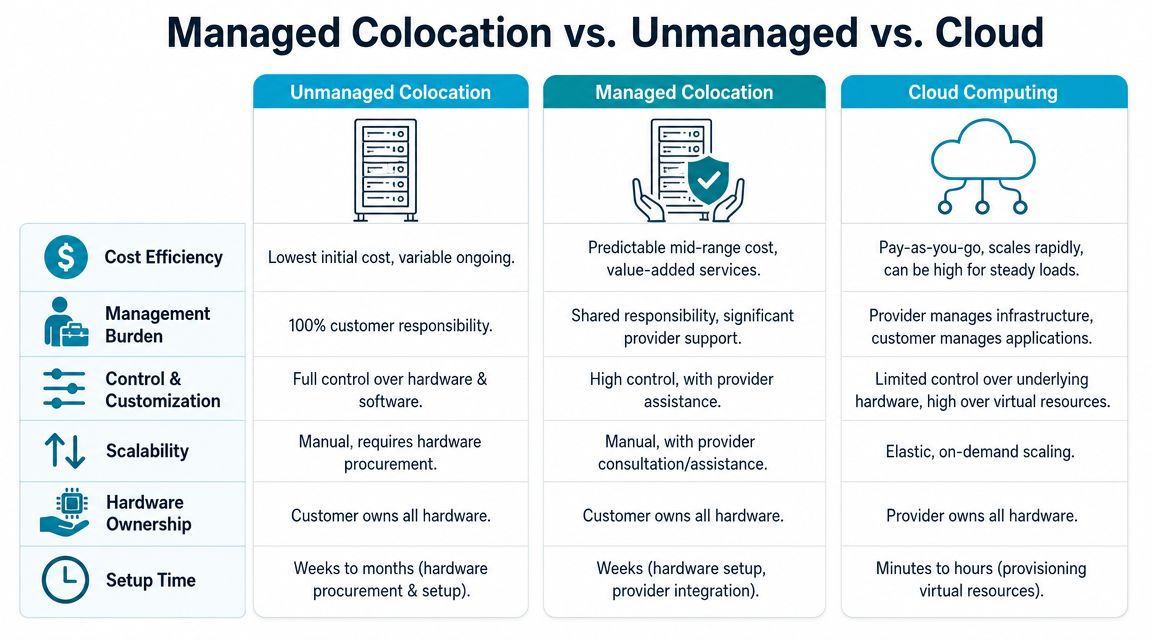
Most infrastructure decisions come down to three models. You can rent space and manage everything yourself. You can push the workload into public cloud. Or you can keep your hardware control while outsourcing the physical and operational burden that doesn't differentiate your business.
Unmanaged colocation
Unmanaged colocation is the lowest-friction facility purchase. You rent the space, deploy your equipment, and retain responsibility for nearly everything else. That can work if you already have strong internal operations, local staff availability, mature runbooks, and enough time to deal with hardware events directly.
The risk is staffing, not cabinet cost. If your team is thin, unmanaged colo tends to push hidden labor back into your own org chart.
Public cloud
Public cloud wins on speed and elasticity. It's still the easiest path for fast experimentation, temporary environments, and workloads that genuinely need burst scaling.
It becomes less attractive when the workload is stable and always on. In Tampa, one comparison says stable workloads can save 20% to 60% versus cloud alternatives when moved to local colocation, while also aligning with needs for predictable costs and continuous operations.
That's the core reason managed colocation keeps getting reevaluated by CTOs. For steady-state systems, cloud flexibility may no longer justify cloud billing.
Managed colocation as the middle ground
Managed colocation is usually the operational compromise that makes sense. You keep hardware control, system design authority, and workload placement flexibility. The provider handles the physical environment and a defined support layer.
That makes it a strong fit for:
- Virtualization clusters that need deterministic performance
- Database-heavy systems with sustained utilization
- Compliance-sensitive workloads where hardware control matters
- Hybrid environments that still need cloud connectivity for selected services
If your team wants a cloud-like operations model without giving up underlying infrastructure control, a managed private environment or managed cloud hosting solution can also fit into that strategy, especially when some workloads belong on dedicated hardware and others don't.
Cloud is excellent for variability. Managed colocation is stronger when the workload has already told you what it wants to be.
Your Checklist for Choosing a Tampa Provider
A Tampa colocation quote is only useful if it answers operational questions before contract signing. Buyers get into trouble when they compare brochure language instead of service boundaries.
Questions that expose the real offer
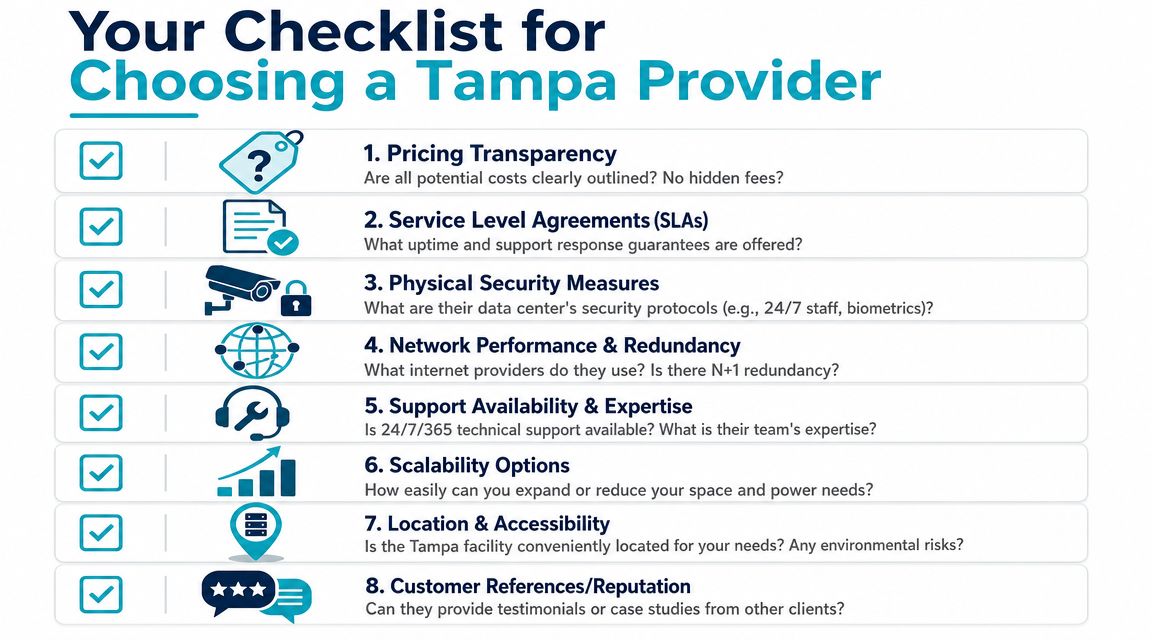
Start with the pricing sheet, then keep going:
- What exactly is included in the monthly charge. Ask whether power, bandwidth, remote hands, monitoring, and after-hours support are bundled or billed separately.
- How is power commitment defined. You need to know whether the quote is based on expected load, allocated load, or actual measured draw.
- What happens during overages or support events. In these situations, “managed” often results in extra line items.
- Which tasks the provider will perform without change-order friction. Reboots, cable checks, media swaps, console access, and hardware replacement coordination should be spelled out.
- How network redundancy is structured. Don't settle for vague statements about uptime. Ask how carrier diversity and failover are handled in practice.
Contract and operations checks
Procurement should also pressure-test the commercial side:
- Term flexibility. Longer terms may improve pricing, but only if your growth assumptions are realistic.
- Expansion path. Make sure you can add power, space, or support without replatforming.
- Support escalation. The best sales process in the world won't help if the after-hours response path is weak.
- Security responsibilities. Know what the provider handles physically and what your team still owns at the OS, hypervisor, and network layers.
Ask for a sample invoice format before signing. If you can't see how the provider presents recurring and non-recurring charges, you can't model TCO cleanly.
A practical negotiation posture
Don't negotiate only on monthly price. Negotiate on scope clarity. It's often better to secure well-defined support inclusions, realistic power commitments, and cleaner overage terms than to shave a small amount off the headline rate and absorb unpredictable costs later.
If you're evaluating managed colocation pricing Tampa options right now, build your short list around providers that can explain the quote operationally, not just commercially.
If you need a quote that maps cleanly to your actual workload, talk with ARPHost, LLC. Give them your server count, power profile, bandwidth expectations, and support requirements, and ask for a written breakdown of what's included so you can compare managed colocation on total cost of ownership instead of rack price alone.