Choosing the right domain registrar is a critical infrastructure decision, not just a line item expense. It's about securing your digital identity with a partner who prioritizes technical control and robust security. A cheap first-year price is irrelevant if it comes with opaque renewal costs, weak security features like missing Two-Factor Authentication (2FA), and support that can't troubleshoot a DNSSEC validation failure. This is a foundational IT decision that impacts everything from website availability to the performance of your private cloud.
Your Domain Is Your Digital Foundation
Think of your domain name as the bedrock of your entire online presence. It's more than a simple web address. Every single service you run—from a simple marketing site on a secure web hosting bundle to a complex, high-availability application cluster running in a Dedicated Proxmox private cloud—is tied directly to this one asset.
The registrar you choose is the gatekeeper. They hold the keys to your brand's accessibility, security, and integrity. This elevates the choice from a simple commodity purchase to a critical infrastructure decision.
A subpar registrar can saddle you with technical debt, expose you to security vulnerabilities, and create operational friction that actively hurts your growth. You wouldn't build a data center on unstable ground, so you shouldn't anchor your mission-critical applications to a registrar with flimsy security or an unreliable DNS network. The stability of your domain directly affects the perceived reliability of your hosted services.
The Strategic Value of a Registrar
The real difference between a basic registrar and a strategic partner comes down to their technical capabilities and support. A partner gives you the tools and safeguards you need to protect your digital assets, not just sell you a name. To get a handle on this, it helps to understand the basics of domain registration. This foundational knowledge is what makes you realize why some features are completely non-negotiable.
Here are a few things that separate a mere vendor from a true partner:
- Robust Security Protocols: This isn't optional. We're talking mandatory 2FA, free DNSSEC to shut down spoofing attempts, and a solid registrar lock to prevent unauthorized transfers.
- Granular DNS Control: You need total control over your DNS records, including the ability to set low Time-to-Live (TTL) values. This is crucial for making quick changes and minimizing downtime during migrations, such as moving from VMware to a Proxmox environment.
- Transparent and Predictable Costs: That super-low introductory price is often a smokescreen. The real cost shows up in the renewal rates, hidden transfer fees, and extra charges for essentials like WHOIS privacy.
A great registrar works silently in the background, providing a stable and secure foundation. A poor one creates constant technical headaches, turning what should be a simple asset into a major liability. Choosing wisely from the start is how you prevent a crisis down the road.
Evaluating Core Security And Technical Features
Forget the flashy intro pricing for a moment. The real measure of a domain registrar is found in its technical guts and security posture. Your domain isn't just a name; it's a critical business asset, and you should protect it with the same seriousness you apply to your production servers running on bare metal or a high-availability VPS. When you're figuring out how to choose a registrar, these features are completely non-negotiable.
First up: account security. If a registrar doesn't enforce Two-Factor Authentication (2FA), walk away. Seriously. 2FA is your first and best line of defense against someone hijacking your account, even if they somehow get your password.
Right alongside that is the registrar lock. This simple feature prevents your domain from being transferred out from under you, whether by accident or by a malicious actor. If someone gets into your account, they could initiate a transfer and steal your entire online identity. A registrar lock stops that cold, requiring you to explicitly unlock the domain before any transfer can proceed. It's a simple but vital safeguard.
Advanced DNS Management Capabilities
This is where a professional-grade registrar really pulls away from the pack. You need more than the basic ability to point your domain to a server. You need full, granular control over all your DNS records—A, CNAME, MX, TXT, SRV, you name it.
Just as important is the ability to set low Time-to-Live (TTL) values. Low TTLs are a lifesaver, allowing your DNS changes to propagate across the internet much faster. This is crucial during server migrations, failovers, or when you're pointing services to a new environment. Without it, you could be waiting hours, or even days, for the internet to catch up.
Another deal-breaker is DNSSEC (Domain Name System Security Extensions). This feature cryptographically signs your DNS data, proving to visitors that they're connecting to your actual website and not a cleverly disguised fake. A good registrar makes this easy, offering one-click DNSSEC activation right from their control panel.
Support For A Wide Range of TLDs
Sure, .com is still king, but smart brand protection often means registering your name across multiple Top-Level Domains (TLDs). This might include country-specific TLDs like .ca or .de, or one of the newer generic TLDs like .io, .app, or .tech.
A registrar with a weak TLD selection forces you to juggle your domains across multiple providers, which is a recipe for administrative headaches and potential security gaps.
When you're vetting potential registrars, their security tools are paramount. To make sure your digital foundation is solid, it's worth digging into different methods for strong website security best practices to shield your site from all sorts of threats. We've also put together our own detailed guide covering the essential layers of protection you need. You can find more on website security best practices in our article.
Ultimately, these are the technical features that ensure your domain stays secure, manageable, and ready to support anything you throw at it.
Decoding Pricing And Hidden Renewal Costs
The domain registration game is notorious for its pricing tricks. You see a flashy $1.99 first-year deal and think you've scored, but that's just the bait. The real cost is hiding in the renewal rates, which can easily jump 5 to 10 times higher after that first year.
This is a classic lock-in strategy. They make it cheap to get in the door but expensive to stay. When you're figuring out how to choose a domain registrar, looking past that initial teaser price is the single most important thing you can do to avoid nasty surprises down the road.
Your goal should be to map out the Total Cost of Ownership (TCO) over at least three to five years. This gives you a much more realistic picture. A registrar selling a domain for $5 with a $25 annual renewal is a far worse deal than one offering it for $12 with a consistent $15 renewal.
Uncovering The Real Costs
It's not just about the renewal rate, either. Hidden fees for what should be standard services can nickel-and-dime you, quickly turning a great deal sour.
Keep an eye out for these common upcharges:
- WHOIS Privacy Protection: This is a must-have service that keeps your personal contact info out of the public WHOIS database. Some registrars include it for free, as they should. Others will charge you $5 to $15 per year for it.
- Domain Transfer Fees: Most registrars don't charge to transfer a domain out, but some make the process intentionally difficult or hit you with vague "administrative fees." Always read the fine print on their transfer policy.
- "Administration" or "ICANN" Fees: These are little charges often tacked on at the very end of the checkout process. They’re small but they add up, padding the final price.
The best registrars bundle essential security features with the domain, rather than selling them as pricey add-ons.
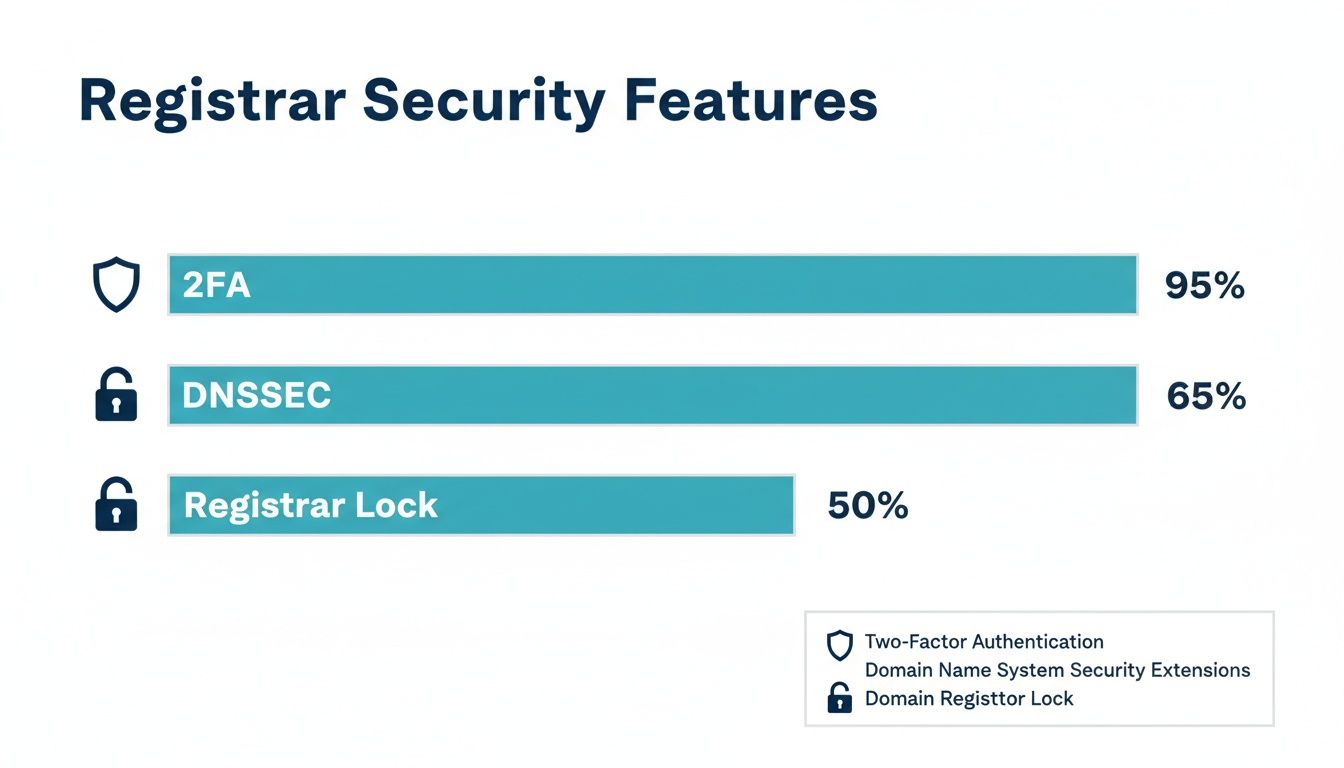
As this data shows, nearly everyone offers 2FA, but more advanced features like DNSSEC are less common. Finding a provider that includes these by default is a huge win for your security posture.
To help you compare apples to apples, use this checklist to track the true long-term costs. It forces you to look beyond the promo price and account for all the extras.
Registrar Cost Comparison Checklist
| Cost Factor | Registrar A | Registrar B | Registrar C (Bundled w/ Hosting) |
|---|---|---|---|
| Initial Registration Price (.com) | |||
| Annual Renewal Price (.com) | |||
| WHOIS Privacy (Annual Cost) | |||
| Transfer-Out Fee | |||
| ICANN/Admin Fee | |||
| Total 3-Year Cost |
Once you fill this out, the registrar offering the best long-term value usually becomes obvious.
The Value of Bundling Services
Honestly, one of the smartest moves you can make is to register your domain with your hosting provider. When you consolidate services under one roof with a provider like ARPHost, life gets a lot simpler.
It streamlines billing into a single invoice and, more importantly, aligns your support. When something goes wrong, you have one expert team to call for both domain and hosting issues—no more finger-pointing between vendors.
Bundling often delivers much better overall value. For instance, a managed VPS hosting plan might include the domain registration, WHOIS privacy, and DNS management at no extra charge. This simplifies your entire setup and completely eliminates those surprise fees.
This integrated approach is a lifesaver for more complex projects. If you’re deploying a secure web hosting bundle or a dedicated Proxmox private cloud, having your domain and servers managed by the same provider ensures everything is configured seamlessly and makes troubleshooting a breeze.
Ready to simplify your infrastructure with transparent pricing? Explore ARPHost's secure web hosting bundles to see how integrated services can benefit your business.
Assessing Support Quality And Transfer Policies
When your site is down and you're losing money by the minute, the quality of your registrar's support is the only thing that matters. All those marketing promises evaporate when you're facing a critical DNS issue. The real question is: can you get a knowledgeable tech on the line immediately, or are you stuck navigating a phone tree only to reach a first-level agent reading from a script?
Before you commit to anyone, you have to test their support. Do they offer actual 24/7 technical support with experts who can troubleshoot complex things like DNSSEC or record propagation delays? Or is it just a customer service line that escalates anything remotely technical?
Here’s a quick test I always recommend: hit them with a pre-sales technical question. Ask something specific about their process for diagnosing DNS resolution failures or what SRV and TXT records you'd need for a Virtual PBX phone system. Their response—or how long it takes to get one—will tell you everything you need to know about the expertise you can expect when a real emergency strikes.
Don't Get Trapped: Dissecting Domain Transfer Policies
A registrar's transfer policy is a clear window into their business philosophy. Are they confident enough in their service to let you leave, or are they trying to lock you in? A transparent, simple transfer process is a great sign. On the other hand, a policy bogged down with fees, delays, and confusing steps is a massive red flag.
Here's exactly what to look for in their transfer-out policy:
- Lock-in Periods: ICANN requires a standard 60-day lock after a new registration or transfer. Anything beyond that is the registrar adding their own handcuffs.
- Transfer-Out Fees: There should be zero cost to transfer your domain away. Any registrar charging a fee for this is basically fining you for leaving their service.
- Procedural Headaches: The process should be dead simple: unlock the domain, request the EPP/authorization code, and you're done. If they make you jump through more hoops, it's intentional friction designed to make you give up.
A difficult transfer process can completely derail critical IT projects. Imagine you've spent weeks planning a migration from a legacy VMware environment to a new Proxmox private cloud, only to be stalled for days because your registrar is dragging its feet. It’s an unnecessary risk and an operational nightmare.
For any business that relies on being online, this isn't some minor detail. When your infrastructure is backed by ARPHost's fully managed IT services, our team can handle the heavy lifting of a migration. But that entire process is so much smoother when your registrar works with you, not against you.
We can ensure any domain-level changes your servers or networks need are handled efficiently, but that all starts with choosing a registrar with fair, customer-first policies. An easy transfer-out process is the hallmark of a company that respects you and your ownership of your digital assets.
The Advantage Of Integrated Domain And Hosting

Juggling separate providers for your domain and hosting might seem manageable, but in reality, it introduces unnecessary complexity right where you can't afford it. Think about it: every time you need to point your domain to a new server or set up email records, you’re logging into two different control panels. That’s two support teams to deal with and two potential points of failure.
This fragmented approach isn't just inefficient; it's risky.
By contrast, an integrated strategy—where your domain and hosting live under one roof—gets rid of all that friction. It brings your billing, support, and technical management into a single, unified system. This is more than just a convenience. It’s about making your entire operation run smoother and faster.
Streamlined Management And Faster Troubleshooting
When one provider handles both your domain and hosting, the technical side of things gets a whole lot simpler. Let's say you're deploying a new app on a high-availability VPS cluster built on KVM with CEPH storage. Instead of logging into your registrar to manually update DNS records and then waiting for changes to propagate, you can manage the entire process from one dashboard.
This unified control pays off in several real-world ways:
- Simplified DNS Configuration: Setting up new services like a Virtual PBX phone system or deploying an application like WordPress becomes a nearly instant, seamless process. The systems are already built to talk to each other.
- One Point of Contact for Support: When something goes wrong, there’s no finger-pointing between your registrar and your host. A single, expert support team can diagnose and solve the problem from end to end, whether it’s a DNS glitch or a server hiccup.
- Enhanced Security Coordination: With a provider like ARPHost, security is integrated across the entire stack. Your domain’s security settings are managed in lockstep with server-level protections like Imunify360, creating a much stronger, more cohesive defense.
The bottom line is that consolidation cuts down on administrative headaches and dramatically reduces the risk of human error. It frees you up to focus on your actual business, not on managing vendors.
The Financial and Operational Impact of Uptime
Choosing an integrated provider is also a smart financial move. Industry data is pretty clear: downtime can cost a small to medium-sized business up to $5,600 per minute. When you bundle services with an ICANN-accredited provider that pairs domain registration with powerful solutions like bare metal server management, you’re investing in proactive monitoring and faster resolutions.
A unified infrastructure isn't just easier to manage; it's fundamentally more resilient—and for any business running critical workloads, that's non-negotiable. With ARPHost's fully managed IT services, we take a proactive stance on uptime, monitoring everything from your network firewall rules to your server patch levels.
Consolidating with ARPHost means a single team of experts is watching over your entire online presence, from the domain name all the way down to the server hardware. It’s the smart way to build a stable, secure, and scalable foundation for whatever you're building next.
Ready to simplify your infrastructure? Get started with our $5.99/month VPS and see the benefits of integrated services firsthand.
Why ARPHost Excels As Your Infrastructure Partner
Choosing ARPHost for your domain isn't just about grabbing a .com. It’s about building your entire digital presence on a single, high-performance foundation from day one. Unlike standalone registrars that just sell you a name and wish you luck, we integrate domain management directly into our ecosystem of powerful infrastructure. This completely eliminates the friction and finger-pointing that comes from juggling different vendors.
When you register a domain with us, it’s instantly ready to connect to our Secure Web Hosting Bundles, which come loaded with Imunify360 and the intuitive Webuzo control panel. No messy DNS changes or waiting games. This tight integration is the same across our entire service stack, whether you're spinning up a scalable KVM VPS Hosting plan or deploying a robust Dedicated Proxmox Private Cloud. You manage everything from one dashboard, supported by one team of experts who know your entire setup.
Think of our 24/7 expert support team as an extension of your own. We handle your domain, your servers, and your applications without the usual "that's not our problem" runaround you get from other providers.
Consolidating your domains and hosting with ARPHost just makes sense. It simplifies your billing, tightens your security, and guarantees your entire digital presence is built on professionally managed infrastructure. It's the most direct path from your domain name to the performance and reliability of your core services.
Ready to build on a better foundation? Explore ARPHost's secure web hosting bundles and let our experts help design a unified solution that just works.
Common Questions About Domain Registrars
People often have the same few questions when they're trying to pick the right domain registrar. Let's clear them up.
Should I Register a Domain With My Hosting Provider?
This is a big one, and my answer is almost always yes. Bundling your domain and hosting with a single provider like ARPHost just makes life easier. You get one control panel to manage everything and a single bill to pay.
More importantly, it completely eliminates the finger-pointing game. When your domain and hosting are separate, any issue can turn into a frustrating loop of "it's not our problem, talk to them." When one company handles both, their support team owns the problem from start to finish.
This is especially true when setting up services like our secure web hosting bundles or virtual PBX systems. With everything under one roof, DNS configuration is handled seamlessly. It’s a direct line to a faster, more reliable setup without the headaches.
What Is a Fair Price for a Domain Name?
Don't get tricked by flashy intro offers. A fair, sustainable price for a standard .com domain usually lands somewhere between $12 and $20 per year—and that includes renewals.
Be very skeptical of those $1.99 first-year deals. They almost always come with a nasty surprise a year later, with renewal rates jumping to $25 or even higher.
A good registrar is transparent. They offer consistent pricing year after year and include critical features like WHOIS privacy at no extra charge. A simple trick is to calculate your total cost over three years; that number will tell you who really offers the best value.
How Does the Domain Transfer Process Work?
Moving a domain from one registrar to another should be a simple, painless affair that takes a few days at most. If a registrar makes it difficult, that's a huge red flag.
The process is pretty standard across the industry:
- Unlock Your Domain: First, you'll log into your current registrar and disable the "registrar lock." This is a security feature that prevents unauthorized transfers.
- Get the Auth Code: Next, you need to request an EPP code, also known as an authorization code. Your current registrar is required to provide this to you.
- Start the Transfer: Give that EPP code to your new registrar. This is what kicks off the official transfer request.
- Approve It: You'll usually get an email asking you to confirm that you approve the transfer. Click the link, and you're almost done.
Any registrar worth your business will make this process straightforward and won't charge you a fee to leave. If they throw up roadblocks or try to charge "transfer-out" fees, it's a clear sign you made the right decision to leave them.
At ARPHost, we’re all about building a solid digital foundation. We simplify things by integrating your domain management directly with our powerful hosting solutions. Whether you need a high-availability VPS plan or fully managed IT services, you get a single point of expert support for your entire infrastructure. Explore our secure VPS bundles and see what it’s like to build on a better foundation.