

You are already past the question of whether cloud belongs in the stack. The core issue is whether Google Cloud still fits the way your team builds, bills, backs up, and recovers workloads today. For many IT teams, that turns into a practical mix of cost control, data path control, and reducing the operational sprawl that comes with a hyperscaler-first design.
That is why google cloud alternatives are rarely simple vendor swaps. They usually come down to workload fit, bandwidth economics, support quality, and how much of the stack your team wants to own. AWS, Microsoft Azure, and Google Cloud together hold most of the cloud infrastructure market, and enterprise cloud spend remains very large, which is why the choice is often about fit rather than sheer platform size (CRN). In practice, the best alternative is not always another hyperscaler. Sometimes it is a managed VPS, a private cloud, or dedicated hardware that delivers the same outcome with less friction and a better total cost of ownership.
The list below keeps the decision practical. It separates broad hyperscaler replacements from developer clouds and performance-oriented hosts, then gets straight into where each one works, where it does not, and when a managed platform can beat self-service cloud on total cost of ownership.
1. ARPHost, LLC
A team that is tired of hyperscaler sprawl often needs a different operating model, not another huge cloud console. ARPHost fits that use case by combining managed VPS hosting, secure web hosting bundles, bare metal servers, Proxmox private clouds, colocation, and managed services through a U.S.-based operation in Tampa, Florida, with a 99.99% uptime SLA and 24/7 U.S.-based support (ARPHost). For organizations moving away from Google Cloud because they want steadier operations and fewer moving parts, that mix can be more useful than a long list of platform services.
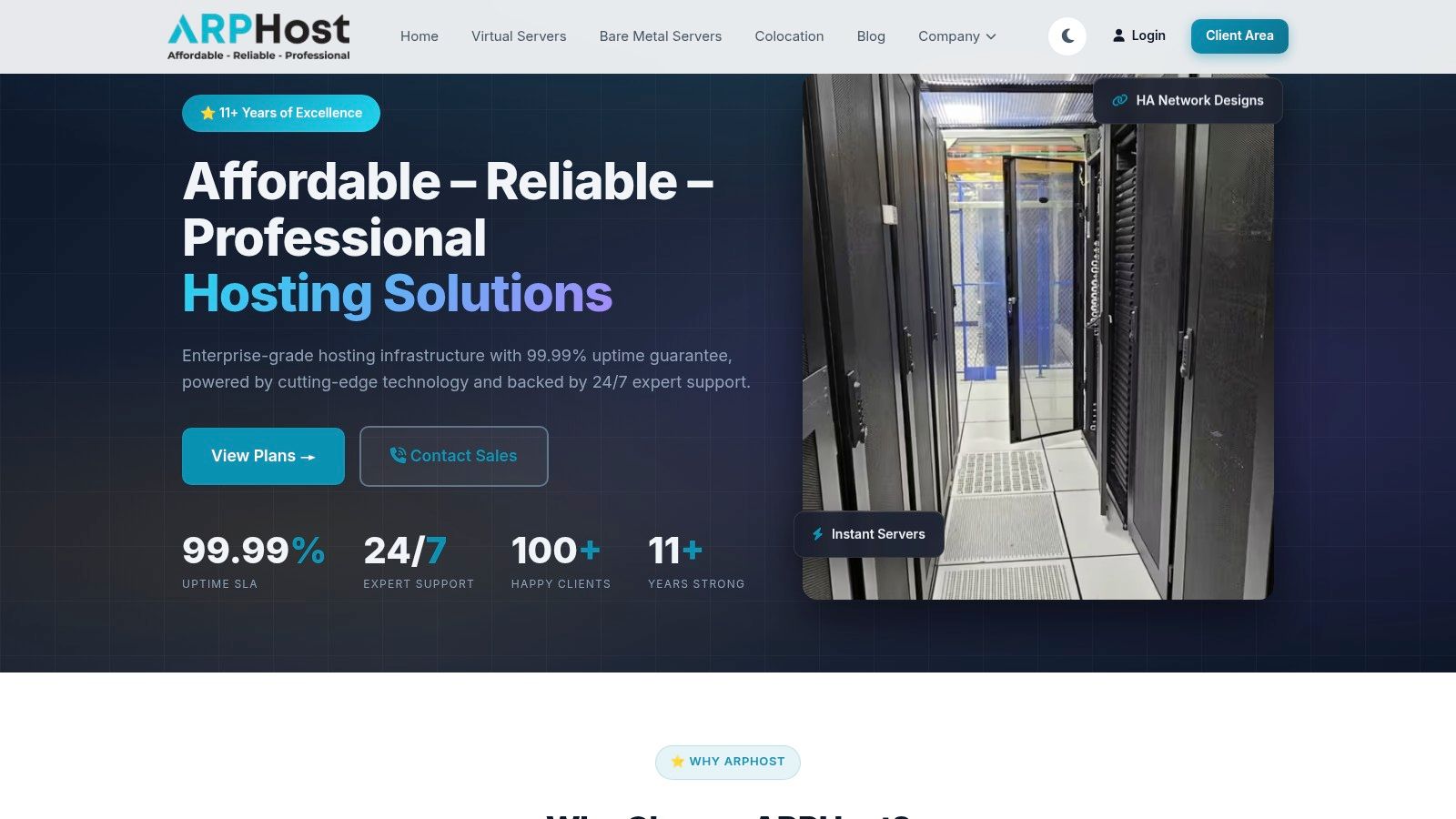
The main advantage is control. ARPHost's portfolio includes NVMe VPS, dedicated bare metal, Proxmox-based private cloud environments, Proxmox Backup as a Service, and instant application deployments, so a GCP workload can move to a simpler operating model instead of being forced into another hyperscaler's design. That fits SMBs, MSPs, and internal IT teams that want the benefits of cloud, self-service provisioning, root access, and backup automation without carrying the operational overhead that often comes with cloud sprawl.
Practical rule: if your workload is bandwidth-heavy, backup-heavy, or managed by a small team, predictable hosting often delivers lower real operating cost than a feature-rich hyperscaler.
ARPHost also stands out on hardware-backed value. The site presents VPS from as low as $4.00/month, a popular $5.99/month VPS, shared hosting from $5.99/month, and bare metal starting at $99/month (ARPHost). For dedicated workloads, the platform can pair well with hardware such as the AMD EPYC 4584PX in Tampa, FL, which suits memory-intensive workloads, large databases, AI or ML inference, and dense virtualization.
For teams comparing cloud vs private cloud economics, ARPHost's guide on private cloud versus public cloud is a useful companion. It helps frame the core question. The issue is not just which platform is cheaper on paper, but which option lets your team spend less time managing infrastructure and more time delivering the service.
ARPHost's IT cost optimization strategies can also help if you are trying to control spend without giving up performance or control.
2. Amazon Web Services
AWS is the default benchmark for google cloud alternatives because it still covers a wider range of enterprise workloads than most providers. That makes it a natural starting point for migration teams that need to compare service depth, regional reach, and operating model before they make a move.
AWS fits best when breadth matters more than simplicity. EC2, managed databases, analytics, Lambda, and a large partner ecosystem reduce the number of gaps you are likely to run into during enterprise migrations. The trade-off is operational complexity. Pricing becomes harder to model once compute, storage, data transfer, and inter-service traffic stack up, and teams can lose visibility quickly if governance is loose.
A practical migration pattern is to use AWS for workloads that need its broad catalog, then control cost from the start. That means disciplined tagging, reservation planning, and a clear review of egress before production traffic lands. If you are already trying to tighten cloud spend, IT cost optimization strategies gives a useful framework for identifying where savings usually come from.
Best fit
- Enterprise breadth: Large application portfolios with many managed-service dependencies.
- Global operations: Teams that need broad regional options and a deep labor pool.
- Complex platforms: Workloads that benefit from a large ecosystem of tools and integrations.
Where it falls short
- Cost clarity: Bills can rise quickly when networking and service-to-service movement increase.
- Small-team simplicity: The platform takes time to learn and govern well.
- Bandwidth-heavy workloads: Transfer economics can outweigh the headline VM price.
AWS is strong, but it rewards organizations that already have the operating discipline to manage it well. If your team needs more predictable costs and less platform overhead, AWS can be more cloud than the workload really requires.
3. Microsoft Azure
Azure is often the first practical alternative for Microsoft-heavy environments. It lines up closely with Microsoft 365, Active Directory, Windows Server, SQL Server, and hybrid identity, so migration planning stays simpler when the current estate already sits inside the Microsoft stack. For teams that need to keep identity, access, and Windows operations under one umbrella, that alignment matters more than a flashy feature list.
Azure also fits the hybrid model better than many general-purpose clouds. If an estate still includes on-prem AD, older Windows workloads, or policy-driven governance requirements, Azure Arc and related tooling can make the transition smoother than a more developer-centric platform. That is why it often becomes the default choice for enterprises with long Microsoft histories and an actual hybrid roadmap.
The trade-off is cost control. Azure can work well, but it does not forgive loose governance. Teams need clear naming, policy controls, and a finance process that separates reserved capacity from pay-as-you-go usage. Without that discipline, spend becomes hard to explain very quickly.
Azure is the right substitute when identity, Windows integration, and hybrid operations matter more than the lowest infrastructure cost.
For teams weighing a managed cloud path against a simpler infrastructure model, the key question is whether deep Microsoft integration is still worth the overhead. A provider like ARPHost can be a cleaner fit for smaller environments, especially when a VPS or private cloud versus public cloud setup replaces infrastructure that does not need the full Microsoft ecosystem.
Azure is less about being the cheapest alternative and more about matching what an organization already runs. That makes it a strong option for Microsoft-centric teams, but it is a weaker fit when the goal is lower operational overhead and tighter control over total cost of ownership.
4. Oracle Cloud Infrastructure
OCI tends to make sense first for workloads that move a lot of data or sit close to Oracle software. Its value is practical rather than flashy. Oracle Cloud is often chosen for lower egress costs, straightforward pricing, and tight database alignment, which makes it a credible Google Cloud alternative for teams that want fewer surprises in the bill.
That pricing angle matters because cloud spend often shows up in movement, not in raw compute. A storage-focused comparison noted that some alternatives cut or remove egress charges, request fees, or minimum-duration penalties, and that shifts the economics for backups, media, and public assets more than instance pricing alone does (Sliplane). OCI fits that pattern. For data-heavy workloads, lower transfer friction can matter more than shaving a small amount off VM cost.
The best fit is usually an environment that already depends on Oracle Database or Autonomous Database. In that case, OCI can reduce migration friction while keeping network and storage costs easier to forecast. The trade-off is ecosystem depth. You will not get the same service variety or partner network you find in AWS or Azure.
For teams deciding whether a workload should stay in public cloud or move to a tighter control model, a private cloud versus public cloud comparison is a useful way to frame the decision. In some cases, the better answer is not another hyperscaler at all, especially when control, predictable performance, and total cost of ownership matter more than broad service catalogs.
OCI works best when the workload requirements are clear and the team does not need to pay for extra services it will never use. That is a narrower target than AWS or Azure, but for the right application, it is a strong one.
5. IBM Cloud
IBM Cloud tends to enter the discussion when a team needs bare metal, OpenShift, or hybrid modernization rather than a broad menu of general-purpose cloud services. That makes it relevant for regulated environments and legacy estates where containerization is a bridge, not a full rewrite. It also appeals to teams that want tighter control over isolation than they would get from a shared cloud layer.
That is why IBM Cloud should be judged by fit, not by headline market share. It competes on enterprise alignment and workload shape, not on being the default answer for every new deployment. Buyers should treat it as a specialized platform for hybrid and enterprise-specific work, not a stand-in for AWS or Azure.
Where it works:
- Regulated workloads: Useful when governance and isolation are central.
- OpenShift-heavy shops: Strong fit for Kubernetes and Red Hat-aligned stacks.
- Bare metal needs: Valuable when performance or tenancy boundaries matter more than convenience.
Where it struggles:
- Smaller ecosystem: Fewer third-party options than the top hyperscalers.
- Platform transitions: Teams need to watch product changes carefully.
- General-purpose cloud: It is often more specialized than teams expect.
If your migration plan includes private cloud thinking, IBM Cloud sits closer to that world than many teams assume. For organizations that want more control over how infrastructure is run, a managed private-cloud model can be the cleaner operational choice. In practical terms, that often means fewer moving parts and clearer responsibility boundaries than self-managing a similar stack on a hyperscaler.
For teams comparing developer clouds against managed hosting, ARPHost's best DigitalOcean alternatives page is a practical comparison point. It helps when you are deciding whether simple cloud VM pricing is enough, or whether a workload would fit better on managed VPS or a private-cloud foundation with tighter control over performance and operations.
The bottom line is straightforward. IBM Cloud fits workloads that are already enterprise-shaped and buyers who care more about control, isolation, and hybrid alignment than broad service depth.
6. DigitalOcean
DigitalOcean is the developer-friendly answer when teams want clarity instead of catalog sprawl. It's a strong google cloud alternative for startups, product teams, and SMBs that just want to launch a service, run a few databases, and keep billing easy to understand. The platform's appeal is less about exotic capabilities and more about speed to value.
Its product philosophy is straightforward. Droplets, managed databases, and managed Kubernetes are easy to use, and the pricing model is much simpler than what many organizations encounter in hyperscaler environments. That simplicity is often the main win. Smaller teams don't always need a deep enterprise platform, they need something they can operate without a dedicated cloud-finops function.
DigitalOcean's fit is strongest for predictable application stacks. If the workload is a web app, API, staging environment, or small production service with moderate complexity, the platform usually does the job cleanly. The limitation shows up when an organization needs a wider enterprise catalog, more regional depth, or heavy hybrid integration.
For teams comparing developer clouds against managed hosting, ARPHost's best DigitalOcean alternatives page is a practical comparison point. It helps when you're deciding whether simple cloud VM pricing is enough, or whether you'd rather move the workload onto managed VPS or a private-cloud foundation with more support behind it.
A useful operating rule is to choose DigitalOcean when you want the lowest cognitive load possible. Choose something else when your workload needs more compliance, more networking options, or more hands-on management.
DigitalOcean is a strong answer for teams that care about getting things done quickly. It's not the deepest platform, but it's one of the easiest to live with.
7. Akamai Cloud Computing
Akamai Cloud Computing, formerly Linode, is a strong middle ground for teams that want straightforward infrastructure without hyperscaler complexity. It's especially useful for developers who value predictable compute, transparent billing, and a clean product catalog. That makes it a practical option when Google Cloud feels too broad and too operationally dense.
The platform's edge is its combination of compute and network heritage. Because it sits under Akamai's broader edge and CDN ecosystem, it can be a better fit for teams that care about delivery and networking as much as raw server creation. That's not the same thing as a full enterprise hyperscaler, and that's the point. You get a narrower, easier-to-manage footprint.
Akamai Cloud works well when the team wants VMs, Kubernetes, object storage, and some higher-memory or GPU options without the surprise factor of layered billing. The trade-off is ecosystem size. It's smaller than AWS or Azure, and teams need to be comfortable with fewer enterprise extras.
Predictable pricing isn't a minor benefit. It changes how teams size projects, approve budgets, and plan long-running services.
That predictability also makes Akamai Cloud appealing for workloads that don't need the entire Google Cloud catalog. If you're hosting a web stack, an internal tool, or a regional application where operational simplicity matters, the platform is easy to justify.
For organizations weighing cloud versus managed infrastructure, the key question is whether the team wants to keep owning more of the stack. If not, a managed provider with VPS or bare metal can be even simpler. If yes, Akamai Cloud gives you a decent balance of clarity and capability.
8. Vultr
Vultr is one of the most common cloud alternatives for teams that want a broader footprint than a simple VPS host, but don't want hyperscaler complexity. It appeals to builders who care about quick provisioning, multiple compute tiers, and a fairly clean path from test to production. For many small and medium workloads, that's enough.
The platform's strength is operational simplicity with enough flexibility to cover a lot of common use cases. You can deploy VMs, bare metal, GPUs, Kubernetes, object storage, and load balancers without dealing with the overhead that often comes with the largest cloud vendors. That makes Vultr especially attractive for application hosting, dev environments, and workloads where time-to-launch matters.
The main caution is networking assumptions. Vultr's IPv6-only entry tier can require extra work if your workload still expects IPv4 from day one. That's not a dealbreaker, but it matters in environments where third-party dependencies, customer access, or legacy integrations still assume traditional dual-stack behavior.
Vultr is also a good reminder that the best cloud choice is workload-specific. If you need a small cloud footprint with decent pricing and fast deployment, it can be a better answer than a hyperscaler. If you need enterprise governance, sprawling managed services, or deep compliance tooling, it starts to feel light.
For teams that are shifting from a public cloud stack to a more controlled infrastructure model, bare metal or managed VPS can be a better long-term operating decision. That's where ARPHost's Tampa-based dedicated and virtual infrastructure can become a cleaner fit than a general-purpose cloud account.
Vultr is best when you want flexibility without getting trapped in a giant platform. It's not the biggest option, but it's often one of the easiest to work with.
9. OVHcloud US
A migration team that wants U.S. regions, public cloud, VPS, dedicated servers, and managed Kubernetes in one provider will usually look at OVHcloud US early. Virginia and Oregon give it useful placement options for latency-sensitive services and workloads with data-residency requirements. That mix makes it a practical Google Cloud alternative for teams that need more control over where infrastructure lives.
OVHcloud US also appeals to buyers who prefer a clearer price structure and a vendor profile that sits outside the dominant U.S. hyperscaler set. Some teams are comfortable with that direction because it reduces dependence on the biggest cloud brands and gives them a different procurement path. The trade-off is straightforward, the service catalog is narrower, and the operating model is less expansive than what you get from the top hyperscalers.
Procurement discipline matters here. Buyers should verify quotes carefully, confirm current SKUs, and check region-level economics before they commit, especially given the company's history, you can browse the Ovh data breach for context. A cloud that looks attractive in a proposal can still become awkward if the pricing or product mix does not match the workload.
The real question is operational control, not just cloud branding. A provider can look economical on paper and still create friction if the service catalog or support model does not match how your team works.
For organizations comparing OVHcloud US with a managed private-cloud provider, the decision usually comes down to how much responsibility they want to keep in-house. If the goal is to stay in public cloud with a smaller footprint and predictable regional placement, OVHcloud can be a good fit. If the goal is to reduce day-to-day management and keep infrastructure simpler to run, a provider like ARPHost may fit better.
OVHcloud US shows why a sensible alternative does not have to be the most familiar one. Regional choice, transparent infrastructure, and enough services to cover common deployments can matter more than a long list of managed features.
10. Hetzner Cloud
Hetzner Cloud is the classic value choice for teams that prioritize price-to-performance and a straightforward catalog. It's one of the easiest alternatives to recommend when the workload is cost-sensitive and doesn't need the full complexity of a hyperscaler. That simplicity is a feature, not a limitation, for a lot of small teams.
Its strengths line up well with standard web services, internal tools, and development workloads. The product catalog is easy to understand, ordering is straightforward, and the broader dedicated server and private cloud options make it useful when you want to grow beyond basic VM hosting. For teams that are comfortable managing more of their stack, it can be a very efficient platform.
The main caution is to verify current pricing and traffic inclusions before committing. Like any value-oriented cloud, the economics can shift by location and SKU, and the right decision depends on where your users are and how much bandwidth the workload consumes.
Hetzner's appeal is strongest when you know your workload isn't exotic. If it's a business app, staging environment, backup target, or a moderately loaded production service, the platform often delivers excellent value. If you need a deep enterprise service catalog or extensive managed PaaS support, it's not the first place I'd send you.
For teams that want the same practical benefits with U.S.-based support and managed infrastructure, ARPHost's VPS and bare metal offerings are worth comparing directly. Sometimes the better answer is not “cheapest cloud,” but “most support for the workload I have.”
Hetzner is a strong fit for disciplined teams that can keep things simple. It gives you a lot of usable infrastructure without a lot of ceremony.
Top 10 Google Cloud Alternatives, Side-by-Side Comparison
| Provider | Core features | Performance & reliability ★ | Security & backups ✨ | Price & value 💰 | Best for 👥 |
|---|---|---|---|---|---|
| ARPHost, LLC 🏆 | Shared, NVMe VPS, bare‑metal, Proxmox private cloud, colocation, managed services | ★★★★☆, NVMe, Tier‑1 uplinks, 99.99% SLA, N+1 power | ✨ Multi‑layer DDoS, Imunify360, daily backups, Proxmox BaaS | 💰 From $4/mo (VPS); shared $5.99; bare metal from $99/mo | 👥 SMBs, e-commerce, DevOps, Tampa colocation |
| Amazon Web Services (AWS) | Vast IaaS/PaaS portfolio (EC2, RDS, Lambda, S3, etc.) | ★★★★★, global regions & AZs, mature SLAs | ✨ Strong compliance, managed security services, backups | 💰 Usage‑based; complex but many cost‑optimiz. options | 👥 Enterprises, scale‑out apps, global deployments |
| Microsoft Azure | Compute, hybrid tools, identity, M365 integration | ★★★★★, strong US presence, hybrid support | ✨ Tight AD/Windows integration, governance tools | 💰 Pay‑as‑you‑go + reservations; FinOps needed | 👥 Microsoft‑centric enterprises, regulated apps |
| Oracle Cloud Infrastructure (OCI) | High‑perf compute, block storage, DB services | ★★★★☆, optimized networking, low egress | ✨ Oracle DB optimizations, transparent pricing | 💰 Competitive egress; TCO win for DB/bandwidth | 👥 DB‑heavy workloads, lift‑and‑shift migrations |
| IBM Cloud | Bare‑metal, OpenShift, hybrid modernization | ★★★★, bare metal & enterprise features | ✨ OpenShift/Red Hat focus, regulated workloads | 💰 Enterprise pricing; advisory support available | 👥 Regulated industries, legacy/hybrid modernization |
| DigitalOcean | Droplets, managed DB, Kubernetes, simple UI | ★★★★, predictable performance, quick setup | ✨ Simple backups, 99.99% Droplet SLA | 💰 Clear, predictable pricing, good for SMBs | 👥 Startups, small teams, developers |
| Akamai Cloud (formerly Linode) | VMs, managed K8s, object storage, CDN edge | ★★★★, plan‑based performance, Akamai edge | ✨ Predictable plans + CDN integration | 💰 Plan‑based, easy budgeting | 👥 Developers wanting edge + predictable costs |
| Vultr | VMs, bare metal, GPUs, hourly billing | ★★★★, fast provisioning, regional presence | ✨ DDoS protection, quick scale options | 💰 Competitive price‑to‑performance | 👥 SMBs, apps needing quick scale and low cost |
| OVHcloud US | OpenStack public cloud, VPS, dedicated, Kubernetes | ★★★★, region/local zone options | ✨ Transparent infra footprint; check security history | 💰 Transparent region pricing; strong bandwidth deals | 👥 Teams seeking cost‑effective US regions |
| Hetzner Cloud | VMs, dedicated servers, private cloud (value‑oriented) | ★★★★, strong price‑to‑performance | ✨ Simple tooling, community support; backups available | 💰 Very competitive pricing (check current SKUs) | 👥 Cost‑sensitive workloads, developers |
Choosing Your Path From Hyperscale to Hybrid Control
The strongest google cloud alternatives are the ones that fit the workload, the team, and the amount of operational control you want to keep. AWS and Azure remain the most established hyperscale replacements in many markets, while Oracle, IBM, DigitalOcean, Akamai, Vultr, OVHcloud, and Hetzner tend to fit narrower needs better than broad general-purpose use. That is the practical split reflected in recent provider comparisons and market coverage. The core decision is usually about fit, not feature count.
For many buyers, the choice comes down to hyperscaler versus managed infrastructure. Hyperscalers make sense when you need broad service coverage, global reach, and tight native integration. Managed hosts and private clouds make sense when you care more about predictable billing, lower operational overhead, and a closer match between spend and actual usage. ARPHost fits that second path well, with VPS hosting from $5.99/month, dedicated bare metal, secure web hosting bundles, Proxmox private clouds, colocation, and managed services that are easier to administer than a large cloud account.
Workload shape matters more than brand. Bandwidth-heavy or backup-heavy environments often cost less and run with less friction on simpler infrastructure. Database-heavy, latency-sensitive, or Microsoft and Oracle aligned workloads can still justify a larger platform. The right answer depends on how much operational work your team can realistically own.
ARPHost's value is control with support. U.S.-based technicians, NVMe-backed infrastructure, private-cloud options, and a straightforward migration path from cloud sprawl to a managed stack all matter when your team still wants root access, backup choices, and room to scale. For a lot of IT teams, that balance is the alternative that holds up in production.
ARPHost, LLC is the kind of infrastructure option many teams consider after cloud complexity starts to outweigh its benefits. If you need VPS hosting, bare metal, Proxmox private clouds, colocation, or managed services for Google Cloud replacement projects, start at ARPHost, LLC and compare your workload against a simpler, more controlled model.