

In 2026, 92.4% of Shopping Cart Inspect reviews found malicious, suspicious, or concerning issues, so ecommerce site security requires layered defense, not a single security product. Protect the full path with TLS, a web application firewall, PCI DSS controls, secure code, and continuous monitoring.
The practical starting point is to force encrypted transport, put a WAF in front of every public application endpoint, isolate payment services, patch the application stack, and verify that alerts and backups work before an incident. A certificate alone won't stop injected JavaScript, credential stuffing, a compromised plugin, or a stolen administrator session.
For an Nginx server on Ubuntu 22.04 or 24.04, begin by validating the live TLS endpoint and then inspect the web server configuration:
openssl s_client -connect shop.example.com:443 -servername shop.example.com </dev/null 2>/dev/null | openssl x509 -noout -subject -issuer -dates
sudo nginx -t
sudo systemctl reload nginx
The commands only confirm certificate validity and configuration syntax. Production protection comes from the controls around them, including segmentation, authenticated administration, logging, rate limiting, tested restoration, and disciplined change management.
Table of Contents
- The Ecommerce Security Threat Landscape in 2026
- Understanding PCI DSS Requirements for Ecommerce
- Implementing TLS and Payment Security Controls
- Deploying Web Application Firewall Protection
- Building DDoS Mitigation and Server Hardening
- Setting Up Backups and Immutable Storage
- Creating an Actionable Security Checklist
- Production Observations from Multi-Tenant Infrastructure
The Ecommerce Security Threat Landscape in 2026
SecurityMetrics reported that 92.4% of Shopping Cart Inspect reviews found malicious, suspicious, or concerning issues on researched ecommerce sites in 2026. The same review data found similar issues in 67% of payment page reviews. Those findings place the highest-risk area where customers enter data, not only inside a private backend. SecurityMetrics' ecommerce security findings support a production reality that infrastructure teams see repeatedly: the storefront, checkout form, third-party scripts, APIs, and payment page are all part of the attack surface.

Why the checkout is not a single security boundary
An attacker may start with a vulnerable plugin, reach an exposed API, reuse a stolen session, and inject code into a payment page. A network firewall won't necessarily understand that an apparently valid HTTP request is attempting SQL injection or cross-site scripting. A secure payment processor won't protect a storefront that has been modified to redirect customers or load an untrusted script.
The attack chain usually crosses several control layers:
- Application flaws: Unsafe input handling, broken authorization, vulnerable dependencies, and insecure checkout logic expose customer and payment workflows.
- Network weaknesses: Public administration interfaces, flat internal networks, and permissive firewall rules make lateral movement easier.
- Delayed maintenance: Old frameworks, plugins, operating systems, and container images leave known paths open.
- Client-side exposure: Marketing tags, analytics scripts, and checkout integrations can change what runs in a customer's browser.
Production rule: Treat every script that runs on a payment page as part of the payment environment. Third-party code needs ownership, review, version control, and removal criteria.
Bot activity makes detection harder. Kaspersky reported that malicious bot activity rose 124% between July 2025 and June 2026, while AI and LLM crawler traffic rose 82.3%. Bots and AI agents represented about 26.5% of observed traffic, and 65.3% of popular websites failed to detect any of 10 simulated bots in the same dataset. Kaspersky's retail and ecommerce bot research reframes the problem. Basic blocking can damage legitimate shoppers while missing credential stuffing, card testing, inventory abuse, and aggressive AI crawlers.
The effective design combines secure coding, a WAF, bot-aware rate limits, script governance, centralized logs, and continuous review. A perimeter device helps, but it can't compensate for weak authorization inside a checkout API or an unmonitored payment page.
Understanding PCI DSS Requirements for Ecommerce
PCI DSS isn't a checkout-page checklist. Its ecommerce guidance applies across servers, applications, routers, firewalls, and logging infrastructure, along with encryption in transit, vendor patching, secure coding, and an active process for handling new vulnerabilities. PCI Security Standards Council ecommerce guidance describes the broader control problem clearly: a payment environment fails when several ordinary weaknesses combine.
Map the cardholder data environment
Start by documenting where payment data can appear:
- Browser and storefront: Identify checkout pages, embedded payment forms, JavaScript tags, cookies, and browser-to-server requests.
- Application tier: Record APIs, queues, background workers, database connections, and administrative paths that can influence an order.
- Payment services: Separate hosted payment pages, tokenization services, gateways, and internal payment processors from general application workloads.
- Operations layer: Include hypervisors, backups, log collectors, deployment systems, and administrator workstations.
The map should name the owner of each component, its patch process, its authentication method, and the logs it produces. Outsourcing card entry doesn't eliminate the need to secure the storefront that directs customers to the processor.
Apply controls across the stack
Enforce TLS for public and internal service communication where payment data or session credentials travel. Segment payment services from the public web tier with firewall policy that allows only required application flows. Keep the operating system, web server, framework, plugins, database, and vendor integrations current, and record exceptions with an expiry date.
Centralize Nginx, application, WAF, authentication, database, and payment integration logs. A single request identifier makes it possible to correlate a suspicious login with a cart mutation and a database query. Store logs outside the application host so an attacker who gains web access can't erase the evidence.
The compliance document should describe what runs in production. A passed questionnaire can't compensate for an unknown plugin, an unpatched framework, or a payment page that changed without review. Teams that need infrastructure designed around segmentation and evidence retention can review ARPHost's PCI-compliant hosting, then validate the exact scope with their assessor and payment provider.
Implementing TLS and Payment Security Controls
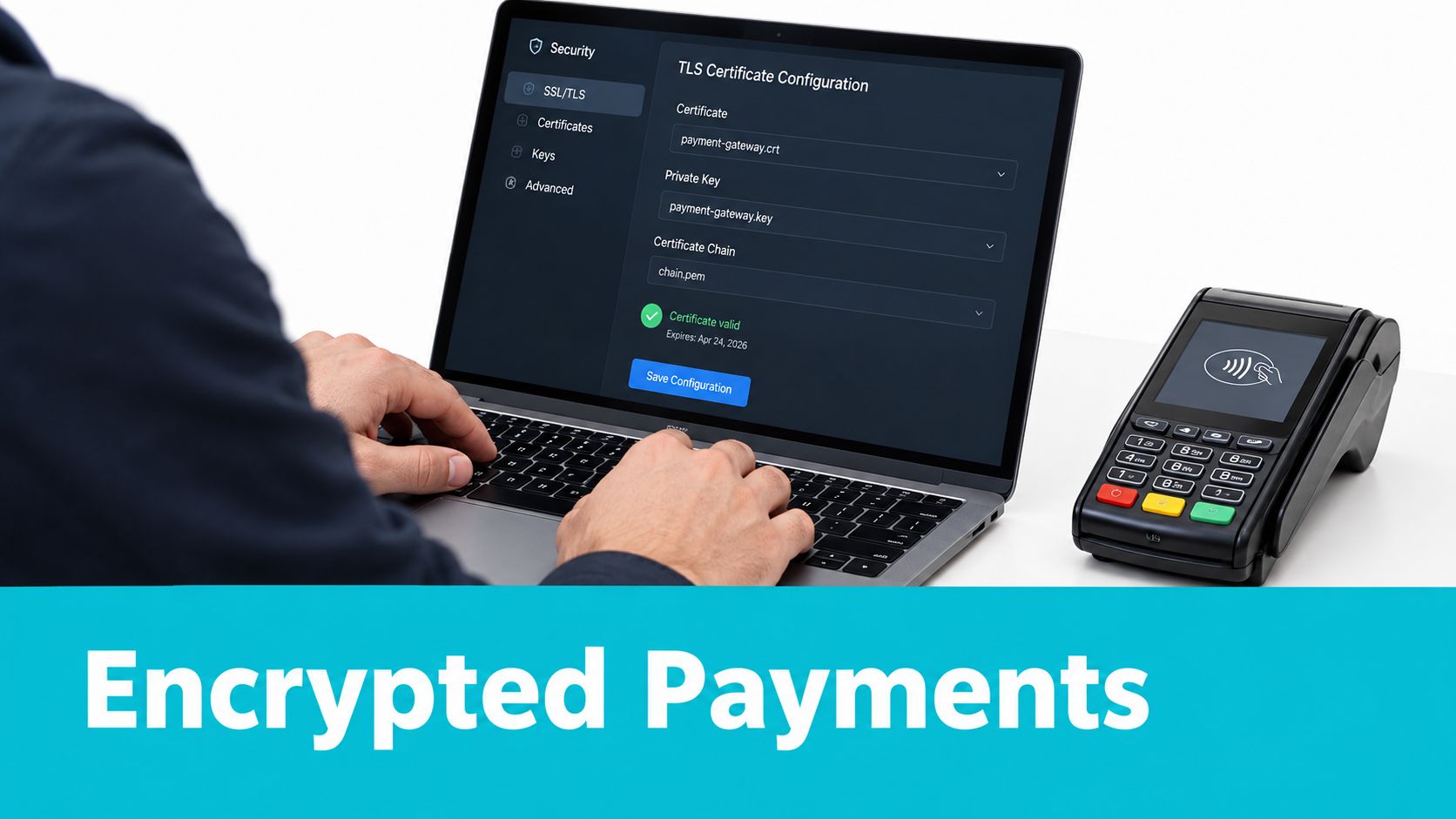
TLS protects data while it moves. It doesn't validate application authorization, prevent malicious JavaScript, or secure a compromised administrator account. The deployment goal is consistent encryption from the customer's browser to the edge, across load balancers, and between application services that handle sessions or payment state.
Configure and verify the web tier
For Nginx 1.24 on Ubuntu 22.04 or 24.04, use TLS 1.2 and TLS 1.3, redirect HTTP, and add HSTS only after every required subdomain and asset is HTTPS-ready:
server {
    listen 80;
    server_name shop.example.com;
    return 301
}

server {
    listen 443 ssl http2;
    server_name shop.example.com;

    ssl_certificate /etc/letsencrypt/live/shop.example.com/fullchain.pem;
    ssl_certificate_key /etc/letsencrypt/live/shop.example.com/privkey.pem;
    ssl_protocols TLSv1.2 TLSv1.3;
    ssl_session_cache shared:TLS:10m;
    ssl_session_timeout 10m;
    add_header Strict-Transport-Security "max-age=31536000" always;
}
Use your certificate automation to renew before expiry, and test both the renewal hook and the reload hook. Verify the result with:
sudo nginx -t
sudo systemctl reload nginx
curl -sSI  | grep -Ei 'HTTP/|strict-transport-security|location'
openssl s_client -connect shop.example.com:443 -tls1_2 </dev/null 2>/dev/null | grep -E 'Protocol|Cipher'
The common failures are mixed content, a certificate renewed on disk but not loaded by the process, unsupported legacy clients, and a load balancer that terminates TLS while the backend receives unencrypted traffic. ARPHost's SSL certificate configuration guide is useful for the hosting-specific workflow, but your application still needs an end-to-end transport review.
Keep payment data out of application code
Prefer hosted payment pages or tokenization when the business and payment provider support them. Your application should receive a token and transaction result, not retain raw card data in request bodies, logs, queues, error traces, or database columns. Redact authorization headers, payment tokens, and personal data before logs leave the application.
When a certificate or TLS change fails, rollback means restoring the previous known-good certificate references and configuration, testing with nginx -t, and reloading the service. Don't disable certificate validation or fall back to plaintext to recover a checkout.
Deploying Web Application Firewall Protection
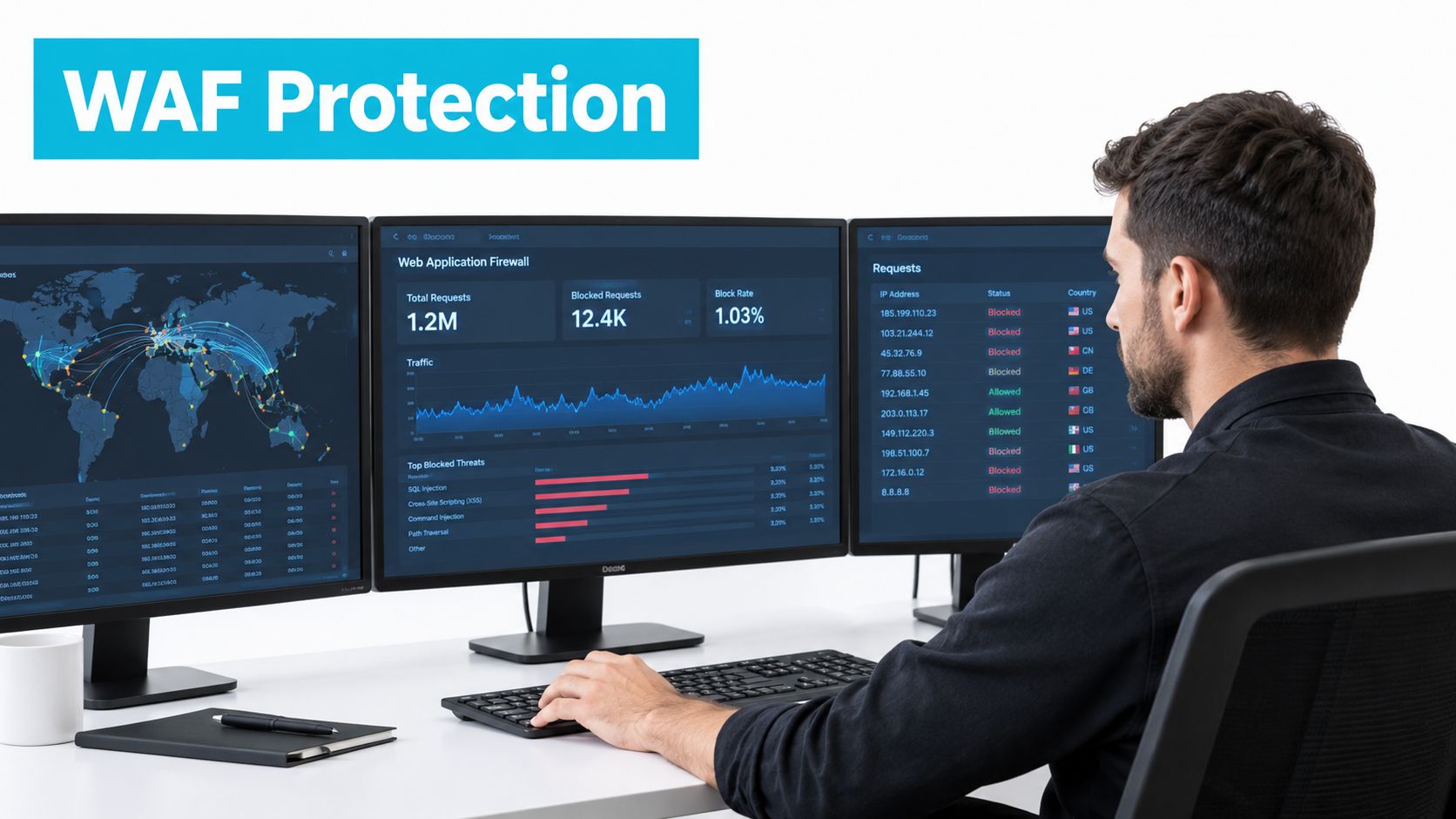
A traditional network firewall filters network flows. A web application firewall, or WAF, understands HTTP and HTTPS requests and can identify application-layer patterns such as SQL injection and cross-site scripting. PCI DSS v4.0 Requirement 6.4.2 makes a WAF or equivalent protection mandatory for ecommerce merchants in card-data environments. Cisco's WAF explanation describes why the control belongs in front of the application runtime.
Put the WAF at the correct point
The request path should look like this:
Customer browser
      |
      v
Edge rate limits and DDoS filtering
      |
      v
WAF, managed rules, custom rules, bot signals
      |
      v
Load balancer or reverse proxy
      |
      v
Web and API services
      |
      v
Application, queue, database, payment service
Deploy the managed rules in logging or detection mode first. Capture legitimate checkout requests, product searches, API calls, and administrative workflows. Then block high-confidence signatures and add narrow custom rules for login, cart, checkout, password reset, and payment endpoints.
A rule that blocks every unusual request will create an outage during a product launch. A rule that never blocks anything is only a dashboard. Tune exclusions by route and parameter, not by disabling an entire attack category. Keep a change record for every exception, including the reason, owner, test result, and review date.
Verify behavior before an incident
Use a test environment to send harmless requests that trigger known SQL injection and XSS signatures, then confirm the WAF blocks or logs them before they reach the application. Check the origin access log to verify that blocked requests don't appear as successful application requests.
Protect the WAF itself. Restrict administrative access, export logs to a separate system, alert on repeated authentication failures and sudden request bursts, and test the failure mode if the WAF is unavailable. ARPHost's website security best practices provides adjacent operational guidance, while Cloudflare-managed rules or another equivalent service can handle edge enforcement when your team doesn't operate that layer directly.
Building DDoS Mitigation and Server Hardening
Availability and security overlap, but they aren't the same control. Upstream volumetric filtering can absorb traffic before it saturates your circuit, while a WAF and application rate limits handle abusive HTTP behavior. If the origin server is already overloaded, adding more application workers often makes the incident worse by consuming the remaining CPU, memory, and database connections.
Harden the host before exposing it
For a Debian 12 or Ubuntu 24.04 ecommerce host, start with a minimal installation and remove services the workload doesn't need. Apply security updates through the operating system's supported mechanism, restrict SSH to an administrative path, disable password authentication where key-based access is ready, and require MFA for the control plane.
A practical baseline includes:
- Least privilege: Run Nginx, PHP-FPM, workers, and database services under separate accounts where the application supports it.
- Service reduction: Disable unused daemons, packages, development tools, and public dashboards.
- Filesystem controls: Make application code read-only to the runtime where deployments permit it, and separate uploads from executable paths.
- Integrity monitoring: Alert on changes to web roots, payment templates, configuration files, and scheduled tasks.
- Segmentation: Place databases, queues, backups, and payment services on private networks with explicit allow rules.
For SSH, an /etc/ssh/sshd_config.d/10-ecommerce-hardening.conf drop-in can contain:
PasswordAuthentication no
KbdInteractiveAuthentication no
PermitRootLogin no
PubkeyAuthentication yes
AllowGroups infrastructure
Validate before reloading, and keep an existing administrative session open while testing a new one:
sudo sshd -t
sudo systemctl reload ssh
sudo ss -lntup
Use rate limits without blocking buyers
Rate-limit login, password reset, cart mutation, coupon, and payment authorization endpoints more aggressively than product pages. Key limits by a combination of account, session, device signal, and source reputation where possible. A single source address is a poor identity model for mobile networks, offices, and shared carrier infrastructure.
What this looks like in production: On multi-tenant infrastructure, one noisy workload can exhaust shared connection pools even when its own CPU use looks ordinary. Per-tenant limits, separate database resources, and clear origin metrics expose that behavior before it becomes a platform-wide outage.
Test DDoS runbooks with your upstream provider. The escalation path should identify who can enable scrubbing, who can isolate an origin, and who can approve a temporary rate-limit change.
Setting Up Backups and Immutable Storage
A backup that the production administrator can delete with the same credentials isn't a strong recovery boundary. Ecommerce recovery needs separate credentials, encrypted storage, documented retention, and a restore test that proves the database, uploaded media, application code, queues, and configuration can work together.
Separate backup infrastructure from production
For virtual machines and Proxmox clusters, image-level backups simplify recovery of the operating system and application environment. Proxmox Backup Server or a managed Proxmox Backup service can provide deduplication, encryption, verification, and controlled restore workflows. Keep backup access outside the normal application administrator role, and make deletion or retention changes require a separate approval path.
The backup design should include:
- Application consistency: Quiesce or coordinate database writes before capturing critical database backups.
- Encryption: Encrypt data at rest and protect the key material separately from the backup repository.
- Isolation: Put backup repositories on separate hosts, networks, or credentials from production.
- Immutability: Use retention locking or storage policies that prevent an attacker from rewriting recent recovery points.
- Geographic resilience: Maintain a recovery copy away from the primary facility when regional disruption matters, including hurricane and grid risk for Florida operations.
Verify restoration, not just job completion
A green backup job only says that a job reported success. Schedule a restore test into an isolated network and verify application startup, database integrity, login behavior, product data, order state, media, and payment configuration. Never connect a restored test system to live payment processing.
Record the restore duration, missing dependencies, operator steps, and any credential rotation required after recovery. Monitor repository capacity, failed jobs, verification errors, and unexpected deletion attempts. Keep an offline or separately controlled copy for the most important databases and secrets.
A rollback during a failed application deployment should restore the last known-good application release and database snapshot only when schema compatibility has been checked. Database rollback can destroy legitimate orders created after the snapshot, so use forward repair or point-in-time recovery when it preserves transaction history.
Creating an Actionable Security Checklist
The useful checklist is ordered by attack prevention and recovery value, not by how easy the control is to document. A small team should first secure administration, transport, patching, WAF coverage, logs, and restoration. A larger DevOps team can add automated API authorization tests, dependency gates, script inventories, and deployment attestations.

Prioritize controls by operational value
| Control Category | Implementation Complexity | Risk Reduction Impact | Typical Timeline |
|---|---|---|---|
| TLS enforcement and certificate renewal | Low to medium | High | Immediate project |
| WAF deployment and rule tuning | Medium | High | Short implementation cycle |
| Administrator MFA and phishing-resistant access | Low to medium | High | Immediate project |
| Patch and dependency management | Medium | High | Ongoing process |
| Centralized logging and alerting | Medium | High | Short implementation cycle |
| Network segmentation | Medium to high | High | Planned infrastructure change |
| Immutable backups and restore testing | Medium | High | Short implementation cycle |
| Commerce API authorization testing | High | High | Recurring engineering work |
| Third-party script governance | Medium | Medium to high | Ongoing review |
| File integrity and deployment verification | Medium | Medium to high | Pipeline project |
The timeline descriptions are planning categories, not guarantees. Complexity rises when the store has legacy plugins, undocumented integrations, or shared hosting boundaries.
Run the checklist against the actual hosting model
For a VPS, verify tenant isolation, firewall policy, SSH access, resource limits, snapshots, and the provider's backup boundary. Don't assume a snapshot is immutable or that a host-level backup includes application-consistent database state.
For bare metal, include firmware, out-of-band management, disk encryption strategy, spare capacity, physical access, and recovery media. Dedicated hardware suits high-throughput databases and private virtualization, but the operator owns more of the patching and hardware lifecycle.
For colocation, document remote hands, power paths, network failover, physical access records, replacement parts, and the process for isolating a compromised server. A rack with excellent physical controls can still expose a payment application through an unpatched public endpoint.
Add identity and request validation
NIST defines MFA as two or more categories of proof and recommends enabling it wherever available. For elevated-privilege users, phishing-resistant authenticators such as FIDO authenticators with WebAuthn provide stronger protection than password-only access or SMS alone. NIST MFA guidance provides the baseline.
For state-changing ecommerce requests, validate CSRF protections on the backend. OWASP recommends server-generated, unique, secret, unpredictable tokens for state-changing requests when the framework doesn't provide protection. OWASP's CSRF prevention guidance is especially relevant to account changes, password updates, checkout actions, and AJAX endpoints.
Production Observations from Multi-Tenant Infrastructure
The most common failure isn't the absence of a security product. It's a control that exists but isn't connected to the next control. TLS is enabled, but an old HTTP origin remains reachable. A WAF is installed, but the team bypasses it during a launch and forgets to restore the route. Backups run, but nobody has restored the database and media together.
What secure deployments do differently
Secure ecommerce deployments make ownership visible. Someone reviews WAF exceptions, someone receives authentication alerts, someone tests restoration, and someone can revoke a compromised integration without waiting for a developer who is unavailable. The system records those actions outside the web application.
The same discipline applies to third-party scripts. Teams maintain an inventory of script owners, permitted domains, release changes, and payment-page presence. They remove abandoned tags instead of allowing browser code to accumulate indefinitely.
| Failure pattern | Why it persists | Corrective action |
|---|---|---|
| WAF rules left in detection mode | Teams fear checkout false positives | Test real flows, then block narrow high-confidence rules |
| Admin access protected only by passwords | Convenience overrides risk | Require MFA and phishing-resistant methods for privileged users |
| Backups marked successful but never restored | Monitoring checks jobs, not recovery | Run isolated restore tests and record the result |
| Shared application and database network | Initial deployment was faster | Segment services and permit only required flows |
| Logs stored only on the origin | The application owns its evidence | Forward logs to separate storage with restricted deletion |
| Emergency firewall exceptions remain permanent | No expiry or review owner exists | Add an owner, reason, and automatic review date |
What this looks like in production: Multi-tenant platforms expose operational shortcuts quickly. A customer may have a hardened application while a neighboring workload creates noisy traffic, fills a shared filesystem, or consumes connection capacity. Isolation, quotas, monitoring, and clear escalation matter as much as the storefront configuration.
Small businesses often don't need to operate every security layer themselves, but they do need to define the boundary. Managed hosting can cover patching, monitoring, backups, and edge controls. A self-managed VPS offers more control but requires an operator who can respond to kernel, web server, application, and incident work. Bare metal and private clouds provide stronger workload isolation and predictable resources, while increasing responsibility for design and lifecycle management.
ARPHost, LLC offers colocation, bare metal servers, VPS hosting, Proxmox private clouds, secure web hosting, and managed IT operations. Its Tampa infrastructure is relevant when a team needs local remote hands, regional recovery planning, or a managed boundary around patching, monitoring, DDoS controls, and backups. Choose the operating model that matches the team's ability to maintain the controls, not the one with the longest feature list.
If your ecommerce stack needs a practical security review, ARPHost, LLC can help evaluate hosting, segmentation, managed operations, backups, and edge protection. Visit ARPHost to discuss an infrastructure design that keeps payment workflows isolated, monitored, and recoverable.

Leave a Reply
You must be logged in to post a comment.