

Most buyers ask the wrong question about dual Xeon server hosting. They ask how many cores they get. The harder question is whether those extra cores still make financial and operational sense in 2026, once you factor in power draw, licensing, storage design, and the kind of workload you run.
That's why dual Xeon hardware hasn't disappeared. It has narrowed into a specific role. If you need dense virtualization, a lot of RAM in one chassis, and enough threads to pack multiple services onto a single host, a dual-socket system can still be a practical fit. If you need better efficiency, faster per-core performance, or a cleaner path for newer applications, a modern single-socket platform often wins.
Is Dual Xeon Hosting Still Relevant in 2026
Does a dual Xeon server still earn its rack space in 2026, or are you better off with a newer single-socket platform?
It still has a place, but it is a specialized choice, not a default one. The reason is simple. Two sockets still give buyers a practical way to pack more total cores and more memory capacity into one physical host, which is why dual-CPU systems remain common in virtualization clusters, internal infrastructure nodes, and consolidation-heavy deployments.
Market listings still reflect that role. Providers package dual Xeon systems with high core counts, large RAM allocations, and enough NVMe capacity to support VM-heavy use cases, rather than small dedicated workloads. The trade-off is cost. Dual-socket hardware usually carries a meaningful premium over single-CPU dedicated servers, so the buying decision should be based on workload density and consolidation value, not on core count alone.
Where dual Xeon still makes sense
Dual Xeon hosting remains relevant when the primary goal is to run more work on one box.
That usually means Proxmox clusters, mixed VM and container hosts, internal business platforms, test labs, and smaller multi-tenant environments where thread count and RAM headroom matter more than top-end per-core speed. In those cases, older but still capable dual-socket platforms can make financial sense, especially if the software stack scales across many vCPUs and does not depend on the newest CPU features.
A practical example is a Dual Intel Xeon E5-2690 V3 server. This class of machine is still useful for buyers who want a dense self-managed node at a lower entry cost than newer enterprise platforms.
Where it stops making sense
Dual Xeon becomes harder to justify when the workload depends on fast individual cores, lower power draw, or newer platform capabilities such as higher memory bandwidth and stronger performance per socket.
That is the key 2026 decision. Dual Xeon hosting is still relevant when consolidation density is the priority and the price is right. If the goal is lower total cost of ownership over time, a modern single-socket AMD EPYC server often comes out ahead once power, licensing, and performance per core are part of the calculation.
The Dual Xeon Architecture Explained
A dual Xeon server is a dual-socket motherboard with two physical processors installed. Each CPU has its own cores, threads, and memory pathways. The operating system sees one server, but under the hood it's coordinating work across two processor packages.
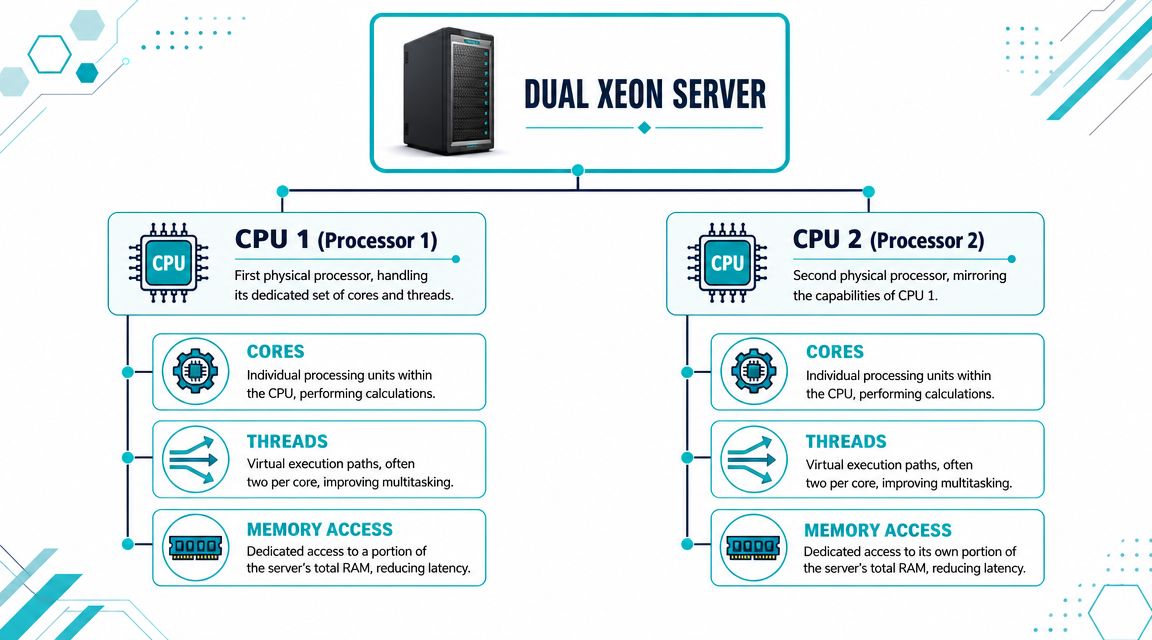
What the second CPU actually gives you
The biggest gain is parallel capacity. Instead of relying on one processor to handle all VM scheduling, container workloads, background tasks, and storage activity, the system can distribute that work across two CPU packages.
In practical hosting terms, that means more room for:
- More virtual machines on a single node
- Larger memory footprints for hypervisors and databases
- More simultaneous services without saturating one processor package
- Better consolidation for MSP-style and multi-tenant environments
A concrete market example shows how this looks in packaged hosting today. A listed Dual Intel Xeon E5 system is sold with 28 cores, 56 threads, 64 GB DDR4 ECC RAM, and 10 Gbps connectivity, showing that dual-socket systems are now bundled as standard dedicated products rather than custom enterprise builds, as seen in this dual Xeon E5 offering.
Why NUMA matters
The part many buyers miss is NUMA, or non-uniform memory access.
In a dual-socket server, each CPU has faster access to the memory attached closer to it. If a VM runs mostly on CPU 1 but constantly pulls memory from CPU 2's side of the system, latency goes up. It's still one server, but it's not one uniform pool in the way people assume.
That doesn't make dual Xeon a bad platform. It means the hypervisor has to be configured intelligently.
Practical rule: Dual-socket systems reward clean VM sizing. Oversized, badly pinned, or poorly balanced workloads can lose some of the benefit you paid for.
What experienced admins do with it
In production, teams usually get the most from dual Xeon by treating it as a density platform, not a frequency platform. They use it for many moderate workloads, not for a handful of applications that demand the fastest possible single-thread response.
That distinction explains why dual Xeon systems continue to show up in virtualization-heavy hosting. Two CPUs on one board can be a very efficient way to put more memory, more threads, and more tenant capacity into one chassis, provided the workload matches the architecture.
Ideal Workloads for Dual Xeon Servers
The easiest way to judge dual Xeon server hosting is to stop thinking in terms of “powerful” versus “outdated” and think in terms of fit. Some workloads map cleanly to dual-socket hardware. Others don't.
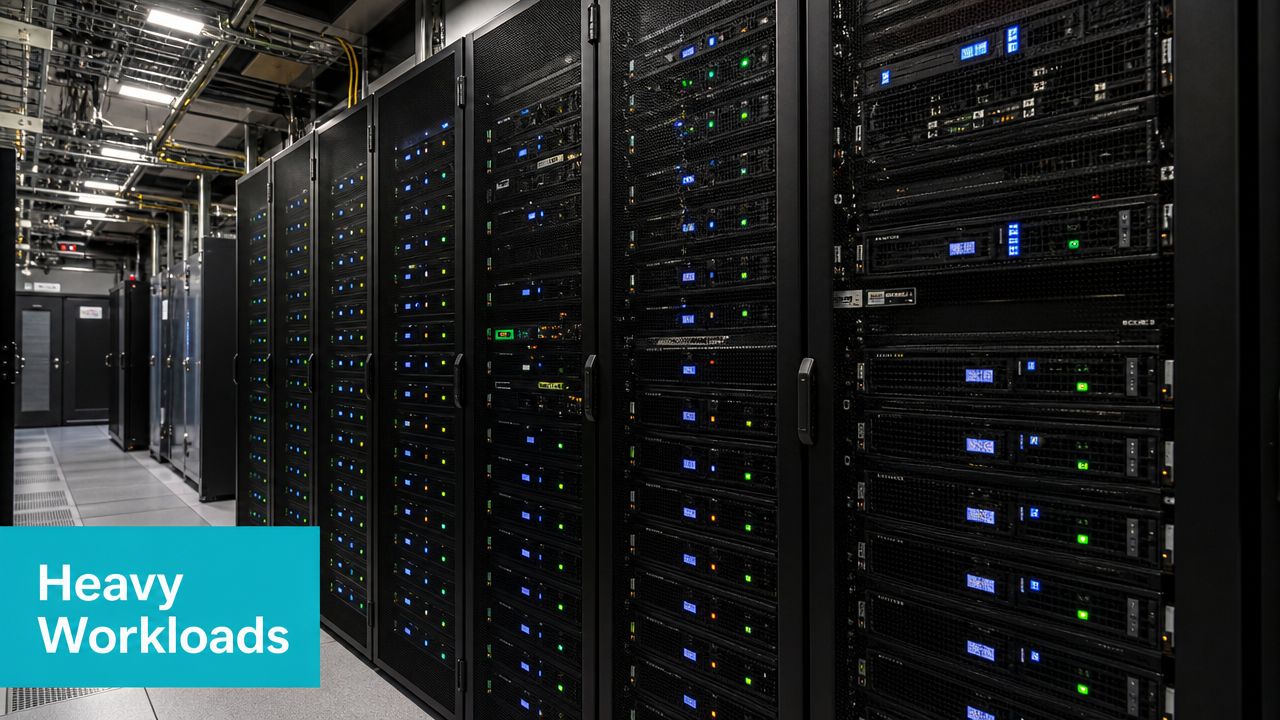
Dense virtualization and private cloud nodes
This is the classic use case.
Dual Xeon platforms are often paired with high-RAM and redundant-storage layouts because they're built for dense virtualization. One published example uses a pair of Intel Xeon E5-2630 v3 processors, 256GB RAM, 20TB of SAN-backed storage in RAID 50, and a 1Gbps uplink, which is exactly the kind of design you see when the goal is VM density and resilience rather than peak per-core frequency.
That matters for:
- Proxmox hosts running many KVM guests
- Internal private clouds that consolidate file, app, and utility servers
- Shared or multi-tenant platforms where many moderate loads coexist
- Development clusters with a lot of parallel CI, test, and staging tasks
If you're evaluating this for real infrastructure planning, it also helps to think beyond CPU and RAM. Requirements like latency tolerance, recovery expectations, and storage behavior matter just as much as core count. For virtualization hosts, those non-functional constraints often decide the hardware more than the application itself.
Game hosting and multi-service stacks
Dual Xeon can also work well for multiple game server instances, especially when you're hosting several communities or combining game services with voice, web panels, databases, and backup jobs on the same machine.
This isn't always about one game needing two CPUs. It's often about many supporting services sharing one host without starving each other. The same logic applies to agencies, MSPs, and internal IT teams that want one box to handle web services, mail relays, utility apps, and monitoring with room for growth.
A short walkthrough of bare metal and rack planning helps show why these servers still attract infrastructure builders:
Database and media workloads with caveats
Databases are a mixed case. Dual Xeon is often useful for many concurrent database-backed services, especially when memory capacity matters. It's less compelling for a single latency-sensitive database that benefits more from newer cores and memory subsystems.
Media transcoding is similar. A dual Xeon box can handle a lot of parallel CPU work, especially for batch processing or mixed service hosting. But if your plan depends on the fastest turnaround per task, you should compare it directly against a newer platform before committing.
Why this class of server still sells
A server like a dual E5-2690 V3 class machine remains practical because it gives operators a lot of scheduling room in one chassis. That's useful when your business benefits from consolidation more than cutting-edge per-core speed.
Dual Xeon vs Modern Single-Socket AMD EPYC
This is the comparison that matters now. Not dual Xeon versus basic shared hosting. Not dual Xeon versus an undersized VPS. The decision is older dual-socket density versus newer single-socket efficiency.
Older dual-socket Xeon platforms can still deliver a lot of threads, but they do so with a tradeoff. Independent hardware coverage highlighted in XDA's discussion of dual-CPU servers notes that older dual-socket Xeon systems can offer high thread counts while delivering materially worse performance-per-watt than newer server CPUs. That matters to SMBs because total cost of ownership depends on more than the invoice for the server itself.
Side-by-side platform view
| Metric | Dual Intel Xeon E5-2690 V3 | AMD EPYC 4584PX | AMD Ryzen 9600X |
|---|---|---|---|
| CPU layout | Dual socket, older Xeon platform | Single socket, newer EPYC platform | Single socket, newer high-clock desktop-class platform |
| Core strategy | High aggregate core and thread count for consolidation | Fewer sockets with newer architecture and high memory capacity | Lower core count, stronger fit for lighter or speed-sensitive workloads |
| Memory profile | DDR4-era platform, good fit for larger VM footprints | DDR5-era platform with strong headroom for memory-intensive tasks | DDR5-era platform, usually better for smaller single-tenant stacks |
| Best fit | Dense virtualization, mixed multi-service hosting, lab and legacy consolidation | Large databases, AI/ML inference, high-density virtualization, newer production stacks | Dev environments, app servers, tools that prefer clock speed over thread count |
| Main caution | Lower efficiency and weaker per-core behavior than newer CPUs | Higher platform class, may be unnecessary for smaller footprints | Not designed for heavy consolidation in the same way as dual Xeon or EPYC |
What dual Xeon still does well
Dual Xeon wins when the workload is highly parallel and you care more about how many moderate workloads can coexist than about how fast one core can finish one task.
That makes it sensible for:
- Virtualization clusters with many small or mid-sized guests
- Mixed infrastructure nodes running web, mail, backup, and utility services
- Labs and staging environments
- Budget-conscious consolidation where root access on one host matters
In those scenarios, raw thread count still has value. You can pack in more VMs, more sidecar services, and more background work without immediately hitting scheduler pressure.
Where EPYC usually pulls ahead
Modern single-socket EPYC platforms generally win when buyers need a better balance of efficiency, memory technology, and per-core behavior. A newer platform can often do more useful work per watt and per rack unit while keeping management simpler.
That matters for workloads like:
- Busy transactional databases
- Newer application stacks with heavier single-thread pressure
- Inference and memory-heavy data services
- Production environments where long-term energy and cooling costs matter
There's also a softer operational benefit. One socket means fewer NUMA complications, fewer cross-socket scheduling issues, and a cleaner performance profile for teams that don't want to spend time tuning placement and affinity.
If your environment is mostly “many things at once,” dual Xeon can still be rational. If it's “this specific app must be fast and efficient,” newer single-socket hardware usually gives you a better answer.
Where Ryzen fits
Ryzen belongs in this comparison because many businesses don't need server-class dual-socket density. For dev stacks, web applications, small databases, and single-tenant workloads, a modern high-clock single-socket system can feel snappier and simpler.
That's often the better decision when the server hosts a narrow workload rather than an infrastructure bundle.
The practical buying rule
Choose dual Xeon when you're optimizing for consolidation value.
Choose EPYC when you're optimizing for modern efficiency and broader production headroom.
Choose Ryzen when you're optimizing for lighter, faster, simpler single-tenant execution.
That's the decision most buyers should make first, before they compare monthly plan names.
Calculating the Total Cost of Ownership
What does a dual Xeon server really cost after the invoice, the software stack, and a year of operations are factored in?
The monthly hosting fee is only the starting point. In 2026, the primary decision is whether a dual-socket system lowers total spend through consolidation, or whether a newer single-socket platform delivers the same work with less power draw, less tuning, and better licensing efficiency.
A dual Xeon node can still make financial sense. The mistake is pricing it like a simple hardware upgrade instead of a consolidation tool. If one box replaces several smaller hosts, reduces rack footprint, and keeps enough memory and PCIe capacity in one place, the higher monthly rate may be justified. If it only replaces one modern single-socket server, the math often gets worse.
For budgeting, use a framework that includes recurring operating costs, not just the server line item. This dedicated server hosting cost guide is a useful reference for building that model.
Costs that are easy to miss
A dual-socket server introduces costs that are easy to overlook in an initial budget review.
- Power and cooling: Older dual Xeon platforms usually draw more power per unit of useful work than current single-socket EPYC systems. That matters more in long-lived deployments than in short test cycles.
- Software licensing: Products licensed by core count, CPU count, or host size can erase the value of higher thread density. This shows up quickly with commercial databases, virtualization add-ons, and some backup platforms.
- Operational time: Dual-socket hosts can need more attention around NUMA layout, VM placement, interrupt balancing, and performance debugging under mixed load.
- Refresh risk: A cheap older platform can become expensive if it hits efficiency, storage, or support limits earlier than expected and forces another migration sooner.
Those costs are not theoretical. They show up in tickets, in slower troubleshooting, and in renewal decisions.
A practical TCO filter
Use a simple test before signing a contract.
| TCO question | If the answer is yes | Likely direction |
|---|---|---|
| Do you need to consolidate many VMs or mixed internal services onto one host? | Fewer physical nodes may lower overall spend | Dual Xeon can fit |
| Are electricity, cooling, or datacenter efficiency part of the buying decision? | Operating cost will matter over time | Newer single-socket often fits better |
| Does your software bill increase with more cores or sockets? | Density may cost more than it saves | Single-socket often wins |
| Do you need large memory capacity and high thread count in one server without building a larger cluster? | Consolidation still has value | Dual Xeon remains a valid option |
The cheapest plan on paper often produces the higher operating cost.
For many IT teams, the right question is simple: does this dual Xeon box replace enough hardware, licensing, and administrative overhead to beat a modern single-socket alternative over the full service life? That is the comparison ARPHost pushes clients to make, because raw core count alone is no longer a reliable buying shortcut in 2026.
Managing Your Dual Xeon Environment with Proxmox
A dual Xeon box becomes much more useful when it's treated as a virtualization platform instead of a single-purpose dedicated server. For many teams, Proxmox VE is the cleanest way to do that because it gives you KVM, LXC, snapshots, storage flexibility, clustering options, and straightforward administration without locking you into a heavyweight licensing model.
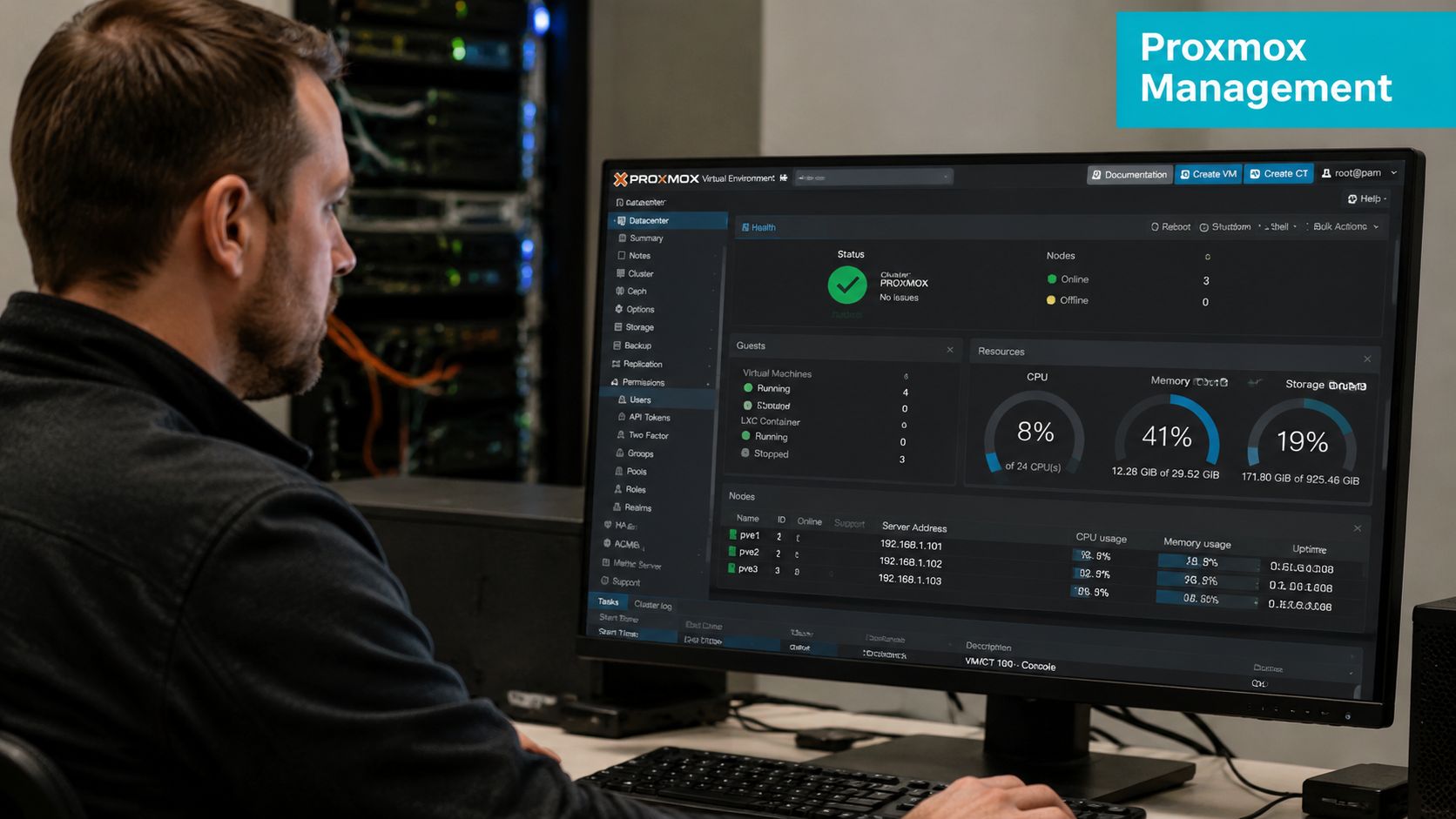
A practical deployment pattern
On a dual Xeon host, the usual path looks like this:
- Install Proxmox VE directly on the bare metal server.
- Separate system storage from VM storage where possible.
- Build VM groups by workload type, such as web, database, utility, and management.
- Size memory and vCPU allocations conservatively at first.
- Watch NUMA behavior and rebalance noisy guests before the node gets crowded.
For dense environments, this approach works well because Proxmox makes it easy to split workloads between KVM virtual machines and LXC containers. Heavy isolation or custom kernels go into VMs. Lightweight services, reverse proxies, utility apps, and internal tools often fit better in containers.
What tends to work well
Dual Xeon plus Proxmox is especially useful for:
- Private cloud foundations for SMBs and MSPs
- VMware exit projects where teams want a more flexible open platform
- Lab and staging clusters with full root access
- Backup and disaster recovery nodes that need to host many services economically
A lot of operational pain comes from overcommitting too early. Don't load the node as if every guest will stay quiet forever. Leave room for backup windows, patch cycles, and the few VMs that become noisier than expected after they go live.
High availability and managed paths
If you're moving beyond a single host, clustering and failover design become more important than CPU choice alone. That's where a Proxmox-focused platform or managed build can save time. One option in that category is Proxmox high availability hosting, which is useful when the goal is a resilient virtual environment rather than a standalone bare metal box.
Don't judge a dual Xeon node by idle behavior. Judge it during backup windows, patch windows, and simultaneous VM bursts.
Teams that want the hardware but not the operational burden usually split into two camps. Some rent bare metal and build Proxmox themselves. Others use a managed private cloud service so migrations, monitoring, and storage design are handled with them rather than by them. ARPHost, LLC offers both bare metal and Proxmox-based private cloud options, which is practical for teams deciding between full control and a managed rollout.
Checklist for Choosing a Dual Xeon Provider
A dual Xeon server can be a solid fit. A badly delivered one becomes a support ticket generator. Provider quality matters more here because older dual-socket hardware has less margin for poor storage, weak networking, or sloppy provisioning.
What to check before you buy
Hardware clarity
Ask for the exact CPU family, RAM type, storage class, and whether the platform uses ECC memory and enterprise drives. “Xeon server” by itself tells you almost nothing.Virtualization fit
If you plan to run Proxmox, ask whether the host is being sold for dense virtualization or just as a generic dedicated server. Those aren't the same thing.Network and remote access
Confirm uplink class, remote management options, rescue access, and how the provider handles reinstallation and recovery.Storage design
Find out whether storage is local NVMe, RAID-backed, SAN-backed, or hybrid. Storage layout matters as much as CPU choice for VM-heavy systems.Support boundaries
Know where unmanaged ends. Some providers give you a powered-on server and stop there. Others will help with hypervisor issues, monitoring, migrations, and failure response.
Questions worth asking directly
| Question | Why it matters |
|---|---|
| Is this platform intended for virtualization density or single-app hosting? | It reveals whether the provider understands the workload |
| What storage design is attached to this server? | VM performance and resilience depend on it |
| What happens if a node needs recovery or replacement? | Response process matters more than marketing copy |
| Can you help with migration and ongoing management? | Dual-socket systems reward competent operations |
The right provider won't just quote cores. They'll explain tradeoffs, tell you when dual Xeon fits, and tell you when a newer single-socket platform is the better call.
If you're deciding between dual Xeon density and newer single-socket efficiency, ARPHost, LLC offers a practical mix of bare metal, Proxmox-focused infrastructure, VPS hosting, and managed services so you can match the platform to the workload instead of forcing every project onto the same hardware shape.