
Choosing a domain registrar feels like a simple task, but it’s one of those foundational IT decisions that has a surprisingly long-term impact on your performance, security, and day-to-day operations. For IT professionals, the best choice isn't about chasing the cheapest initial price tag; it's about finding a partner that offers transparent costs, powerful DNS, robust security, and seamless integration with your hosting stack.
Choosing Your Domain Registrar: A Technical Guide
Your domain registrar is much more than a digital storefront for buying a name. Think of it as a critical partner in your infrastructure. Commodity registrars love to lure you in with low introductory prices, but they often make their money back through steep renewal rates and hidden fees for essentials like WHOIS privacy. A strategic partner, on the other hand, gives you predictable costs and includes the services you actually need to run a secure and efficient operation.
For any serious IT professional or business, the evaluation has to go way beyond that first-year registration fee. A proper domain registrar comparison means looking at the total cost of ownership (TCO), the quality of the DNS management tools, and the strength of the security features.
Key Evaluation Criteria for a Domain Registrar Comparison
A solid technical framework helps you see the difference between a basic vendor and a strategic infrastructure partner.
- Total Cost of Ownership (TCO): Always look past the first-year discount. Do the math for a 3-5 year period, factoring in renewal hikes and any add-ons you'll need, like WHOIS privacy.
- DNS Management & Performance: How fast and reliable is their DNS service? For real performance and automation, you need advanced features like low TTLs, an Anycast network, and, ideally, API access.
- Security Features: These are non-negotiable. Your registrar must offer two-factor authentication (2FA), registrar locks to prevent hijacking, and DNSSEC to ensure DNS integrity.
- Integration and Support: Does the registrar play well with your hosting environment? A consolidated provider simplifies everything, giving you a single point of contact when you need to troubleshoot complex issues across your stack.
Why ARPHost Excels Here
Consolidating your domain with your hosting provider, like we do here at ARPHost, creates huge operational wins. This approach puts your domain, hosting, and security under one roof with a single point of contact for expert 24/7 support. It makes DNS configuration a breeze, since your domain resolves on the same high-performance network as your Secure Web Hosting Bundles, which cuts down latency and removes potential points of failure. It's a key benefit when evaluating a "secure managed VPS hosting" solution.
Quick-Start Registrar Evaluation Framework
To make this even clearer, here’s a quick framework that breaks down the key differences you'll encounter when evaluating a potential registrar. It highlights what separates a simple commodity vendor from a true infrastructure partner.
| Evaluation Criteria | Commodity Registrar | Strategic Partner (like ARPHost) | Why It Matters for IT Pros |
|---|---|---|---|
| Pricing Model | Low initial price, high renewal rates. | Transparent, predictable pricing. | Avoids budget surprises and lowers TCO. |
| WHOIS Privacy | Often an expensive add-on. | Included as a standard feature. | Protects PII from spammers and threats. |
| DNS Services | Basic, slow, and feature-limited. | High-performance DNS with advanced tools. | Ensures faster website speed and reliability. |
| Security | Basic; 2FA may be optional. | Robust; 2FA, domain lock, and DNSSEC. | Prevents domain hijacking and spoofing attacks. |
| Support | Limited to basic issues; slow response. | 24/7 expert support for the entire stack. | Provides faster resolutions and expert guidance. |
Ultimately, the choice comes down to what you value most. If you're just parking a domain for a side project, a commodity registrar might be fine. But for any business-critical website or application, partnering with a registrar that prioritizes performance, security, and expert support is the only move that makes long-term sense.
Analyzing Total Cost Of Ownership Beyond The First Year
The oldest trick in the domain registrar's playbook is the deceptively cheap introductory offer. We've all seen them—domains for just a few dollars for the first year. But this classic "bait-and-switch" is designed to lure you in before the real costs hit you at renewal time.
A seasoned IT pro knows that the sticker price is just noise. The only number that matters is the Total Cost of Ownership (TCO). TCO cuts through the marketing fluff and calculates the real expense of owning a domain over several years, factoring in the initial registration, all renewals, and the "optional" add-ons that are anything but.
Uncovering Hidden Fees In Your Domain Bill
To get an honest TCO, you have to play detective and hunt down every potential fee. These costs are often buried in the fine print and can quickly turn a supposedly "cheap" domain into a long-term budget drain.
Here are the usual suspects to factor into your calculation:
- Renewal Rate Hikes: This is the big one. It's not uncommon to see renewal rates jump by 100% to 500% after the first year.
- WHOIS Privacy Protection: An essential security feature that stops spammers and bad actors from harvesting your contact info. Some registrars nickel-and-dime you for this annually; a true partner includes it for free.
- Domain Transfer Fees: If you ever try to leave, some registrars will hit you with exit fees or wrap you in so much red tape that it's easier to just pay up.
- Premium DNS Services: Basic DNS can be slow and flaky. Many registrars will upsell "premium" DNS for better performance, a feature that should be standard with any quality hosting package.
This is the core difference between a commodity registrar obsessed with initial price and a strategic partner focused on long-term value.
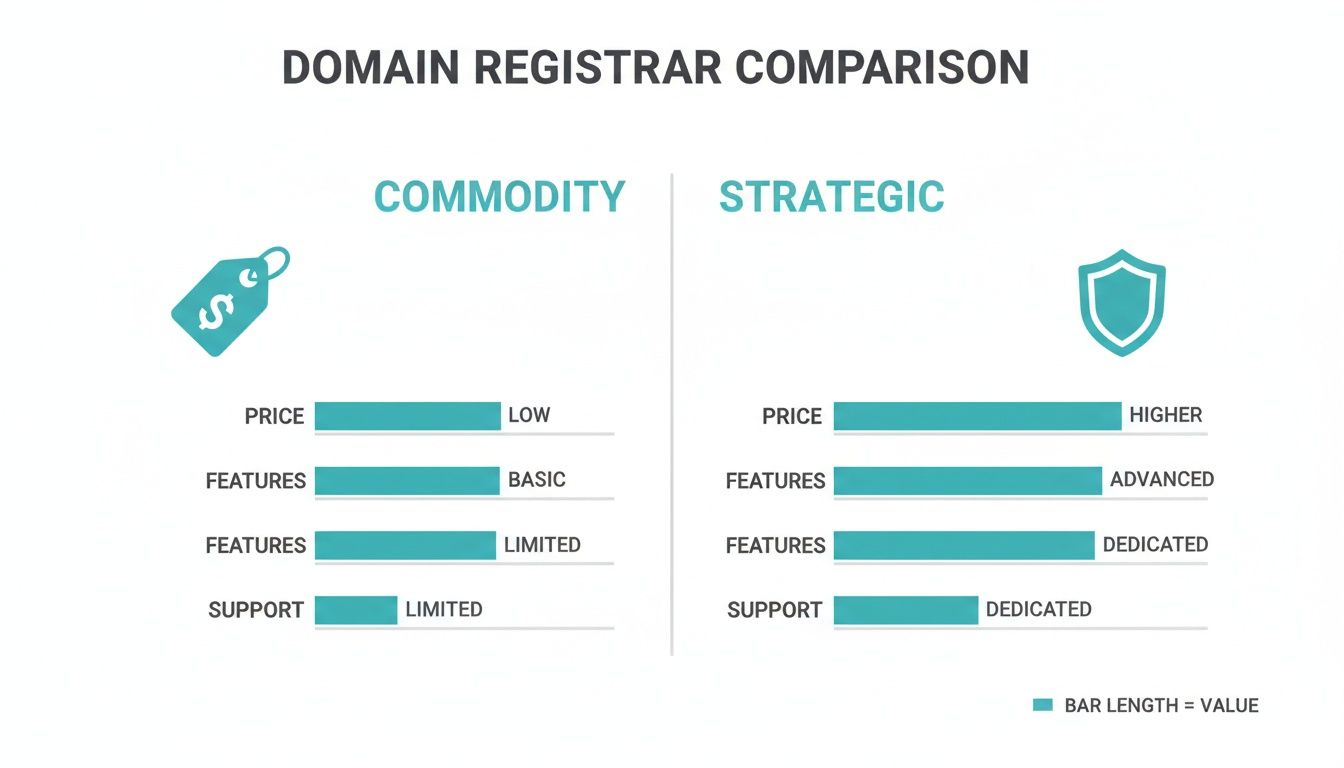
As you can see, a strategic approach bundles critical features like privacy and solid support from the start. A commodity provider treats them as upsells, adding to your TCO year after year.
To make this crystal clear, let's look at the math. The table below shows the real 5-Year TCO for a standard .com domain across several registrars, including renewal hikes and privacy fees.
5-Year Total Cost Of Ownership (TCO) Comparison
| Registrar | Year 1 Cost (incl. privacy) | Year 2-5 Renewal Cost (per year) | 5-Year Total Cost | Notes |
|---|---|---|---|---|
| GoDaddy | $12.17 | $22.17 | $100.85 | High renewal cost. |
| Namecheap | $10.28 | $15.88 | $73.80 | Privacy is free. Renewal is higher. |
| Porkbun | $10.37 | $10.37 | $51.85 | Consistent pricing. Free privacy. |
| ARPHost | $14.95 | $14.95 | $74.75 | Consistent pricing. Free privacy. |
While some registrars appear cheaper in year one, their renewal hikes quickly inflate the long-term cost. Providers with consistent, transparent pricing offer far better value over the lifespan of your domain.
Scaling This with ARPHost
Choosing a provider that bundles domain registration with hosting, like ARPHost, changes the entire TCO calculation. Instead of juggling separate bills for your domain, privacy, and premium DNS, everything is rolled into one predictable cost.
By consolidating your domain with your hosting, you eliminate multiple billing cycles and reduce administrative overhead. This integrated approach ensures your domain's DNS resolves on the same high-performance network as your server, optimizing speed and simplifying management.
For example, our Secure Web Hosting Bundles are built to provide a single, cohesive solution. They pair high-performance hosting with essentials like Imunify360 security and the Webuzo control panel, giving you one optimized environment for your entire digital footprint. This is a practical solution for businesses seeking fully managed IT services for their web presence.
This model makes budgeting clean and predictable, freeing you from the surprise fees that are so common with standalone registrars. When you choose an integrated solution, you're not just buying a temporary discount—you're investing in long-term stability and value.
DNS Performance and Management: The Deal-Breaker
Sure, cheap registration prices and easy transfers matter. But if your domain’s DNS is slow or unreliable, nothing else does. Your website will feel sluggish or go down completely, torpedoing user experience and tanking your search rankings. This is where the real technical comparison begins—separating basic registrars from true infrastructure partners.
Most budget registrars throw in "free" DNS that's slow, has zero redundancy, and offers bare-bones management. For any business-critical website or application, relying on this is a disaster waiting to happen.
Standard DNS vs. Premium DNS
Not all DNS services are created equal, and what’s included with your registration can vary wildly. A standard offering might be fine for a personal blog, but business operations demand a lot more.
Standard DNS: This usually runs on a Unicast network. That means every request, whether from London or Los Angeles, hits the same server location. The result? High latency for international visitors and a single point of failure if that location goes offline. Management is often restricted to basic A, CNAME, and MX records.
Premium DNS: This is where an Anycast network comes in. Visitor requests are automatically routed to the closest server in a global network, dramatically cutting latency and speeding up load times worldwide. It also enables lower Time-to-Live (TTL) values, so your DNS changes go live faster. We break this down further in our guide on what DNS propagation is and how it works.
A key differentiator is whether these premium features are included or sold as a pricey add-on.
For any business running web apps, VoIP, or e-commerce, premium DNS isn’t a luxury—it’s a requirement. Latency kills conversions and productivity, and an Anycast network is your best weapon against it. This is especially true for services hosted on virtual private clouds where performance is paramount.
Why Advanced Records and Automation Matter
Modern applications and security practices go way beyond simple A records. Your registrar’s DNS editor needs to support advanced record types that are essential for operations and security.
For example, to configure your domain with ARPHost's Virtual PBX phone system, you'll need precise SRV records. A simple DNS editor might not support this.
_sip._udp.yourdomain.com. 86400 IN SRV 10 0 5060 pbx.arphost.com.
This SRV record directs SIP traffic to the ARPHost PBX server, a critical step for VoIP functionality. For DevOps teams and Managed Service Providers (MSPs), API access is a complete game-changer. An API lets you automate DNS changes, integrating domain management right into your deployment pipelines and infrastructure-as-code (IaC) workflows.
The ARPHost Advantage: An Integrated Ecosystem
At ARPHost, we don’t see DNS as an upsell. We see it as a core component of your hosting infrastructure. When you bring your domain and services to us, you’re not just getting server space—you’re plugging into a unified, high-performance ecosystem.
Your domain's DNS resolves on the exact same secure, low-latency network as your High-Availability VPS. This setup completely eliminates the performance bottlenecks you get when your DNS and hosting are with different providers.
It also makes management and security dead simple. You manage DNS records for your domain right next to your server, all from a single control panel and backed by our 24/7 expert support. There’s no finger-pointing between a registrar and a hosting provider. Just one team, one platform, and one commitment to your entire infrastructure’s performance.
Comparing Critical Security And Privacy Protections

When you're comparing domain registrars, security isn't just another line item on a feature list. It's the bedrock of your entire digital identity. A single weak point at the registrar level can lead to catastrophic failure, from a simple service disruption to a full-blown domain hijacking.
The problem is, not every registrar sees it that way. Some treat security as a core responsibility, baking robust protections into their standard service. Others nickel-and-dime you, relegating critical features to pricey add-ons or ignoring them altogether. This is where a sharp, technical eye becomes non-negotiable.
The Non-Negotiable Security Features
If you're serious about protecting your domain, there are three features that are absolutely essential. Think of these as the minimum bar for any registrar worth your time.
- Two-Factor Authentication (2FA): This is your first and best defense against a stolen password. By requiring a second verification step—usually a code from your phone—2FA makes it exponentially harder for an attacker to brute-force their way into your account.
- Registrar Lock (Domain Lock): It’s a simple toggle, but it’s incredibly powerful. When enabled, a registrar lock automatically rejects any attempt to transfer your domain away. No one can move it until you log in and explicitly unlock it yourself.
- DNSSEC (Domain Name System Security Extensions): This one is more technical, but just as critical. DNSSEC adds a layer of cryptographic verification to your DNS records. It guarantees that when someone types in your domain, they're sent to your actual server, not a malicious fake set up to intercept traffic or phish for credentials.
These aren't just nice-to-haves. They're the digital equivalent of a bank vault's multi-ton door, time-locked mechanisms, and armed guards. Without them, your domain—arguably your most valuable digital asset—is sitting in a room with an unlocked door.
Of course, domain security is just one piece of a much larger puzzle. It's crucial to also follow essential website security best practices to protect your entire operation from top to bottom.
The WHOIS Privacy Shell Game
Every time you register a domain, your name, address, email, and phone number are submitted to a public database called WHOIS. Without privacy protection, this information is open for anyone to see, turning you into an instant target for spammers, data scrapers, and phishing scams.
This is a key area where registrars show their true colors.
- The Upsell: Many commodity registrars treat WHOIS privacy as a profit center. They'll happily charge you an extra $10-$15 per year, per domain, just to hide information that should be private by default.
- The Standard: In contrast, a true partner-oriented registrar will bundle WHOIS privacy for free. They recognize it not as an add-on, but as a fundamental security measure every customer deserves. A registrar that gives you privacy for free is making a clear statement about their commitment to your security over their bottom line.
ARPHost’s Integrated Security Approach
At ARPHost, we've built our platform on the principle that security shouldn't be an à la carte menu. It needs to be a unified, cohesive ecosystem. This is the core idea behind our philosophy of building security in layers, where every component reinforces the others.
Every domain registered or transferred to us comes standard with free WHOIS privacy, registrar lock, and 2FA. There are no upsells for these essentials.
But we take it a crucial step further. When you pair your domain with one of our Secure Web Hosting Bundles, you’re not just securing the registration; you’re fortifying the server it points to. These bundles run on a hardened stack powered by Imunify360 and CloudLinux OS, which provides proactive threat detection, automatic malware removal, and virtualized file systems to isolate accounts. Within the Webuzo control panel, you can manage security settings with a few clicks, demonstrating a real-world example of managed security in action.
This unified approach means your domain registration and your website data are protected under a single, secure roof, managed by one team of experts who are on call 24/7.
Assessing Transfer Policies, APIs, and Technical Support
Pricing and flashy features only tell you half the story. The real measure of a registrar is hidden in the operational details—the nitty-gritty of transfers, automation, and what happens when you actually need help. These "behind-the-scenes" mechanics are what separate a simple vendor from a true infrastructure partner. They either make your life easier or create infuriating bottlenecks.
A smooth domain transfer is table stakes for any agile IT team. But some registrars make leaving a nightmare. They'll impose arbitrary 60-day transfer locks that go beyond ICANN rules, create confusing verification steps, or just drag their feet on support requests. This isn't an accident; it's a "vendor lock-in" strategy designed to trap your digital assets.
Evaluating Transfer Policies and API Access
A registrar that’s confident in its service makes transfers dead simple. The process should be straightforward: unlock the domain, grab your authorization code (the EPP code), and start the transfer. Anything more complex is a massive red flag.
For any technical team, a solid API isn't a "nice-to-have"—it's a requirement for real automation. A well-documented API lets you manage your entire domain portfolio programmatically, which is where the real efficiency gains are.
You should be looking for key API functions like:
- Domain Registration and Renewal: Automate the entire domain lifecycle from start to finish.
- DNS Record Management: Integrate DNS updates directly into your CI/CD pipelines.
- WHOIS Updates: Programmatically manage contact info and privacy settings.
- Transfer Status Checks: Monitor the progress of domains moving in or out.
Without an API, your team is stuck clicking through a web portal. It's slow, manual, and a recipe for human error. Beyond just registration, knowing the process for future changes, like changing the domain name of a WordPress site, is critical for your long-term flexibility.
The Critical Role of Expert Technical Support
When a critical DNS record goes sideways or a domain transfer gets stuck, the last thing you need is a chatbot or a first-line agent reading from a script. This is where you find out what a registrar’s support is really made of. Many commodity registrars outsource support or cap it at basic account questions, leaving you to fend for yourself on anything technical.
A registrar’s support team should feel like an extension of your own. When the same experts manage both your domain and your hosting, you get cohesive, knowledgeable help without the classic finger-pointing between different providers.
That integrated approach is exactly how we operate at ARPHost. Our 24/7 expert support team manages your entire stack, from a domain's DNS records all the way down to your Bare Metal Servers or a Dedicated Proxmox Private Cloud. When there's an issue, you have a single point of contact who already understands your complete setup, which means faster and more effective solutions.
It cuts out the diagnostic guesswork and gets you back online. And if you need to move your whole operation, our team can guide you. You can learn more in our guide on how to migrate a website to a new host.
Making the Right Call for Your Digital Foundation
Picking a domain registrar isn't just about snagging the cheapest price; it's a foundational decision that impacts your entire online operation. A proper domain registrar comparison quickly shows that the real cost isn't on the sticker. It’s measured in performance, security, and whether you get real help when something inevitably breaks.
The right choice is more than just a transaction. It's about finding an infrastructure partner, not just a commodity vendor. We've spent this guide breaking down the factors that separate the good from the bad.
A Clear Framework for Your Decision
Ultimately, the best choice boils down to four pillars: transparent total cost of ownership (TCO), advanced DNS, solid security, and expert support you can actually reach. A cheap intro price is worthless if your DNS is slow, renewal fees triple, or you're stuck arguing with a chatbot during a crisis.
The biggest strategic win comes from consolidation. When you manage your domain and hosting under one roof, you simplify everything from billing to security. You get a single, accountable partner, which means no more finger-pointing between your registrar and host—just faster resolutions.
This integrated model means your domain, security, and hosting all work together. You have one team to call, one bill to pay, and one platform built for cohesion.
Why ARPHost is the Strategic Partner for Your Business
We built ARPHost to be the exact partner this framework demands. We don't just sell services; we deliver an integrated ecosystem designed for performance, security, and real long-term value.
Here's how we hit every critical point:
- Transparent Total Cost of Ownership: Our pricing is clear and predictable. A domain with us costs the same in year one as it does in year five. Essential features like WHOIS privacy are always included for free, no surprises.
- Advanced DNS and Performance: Your domain's DNS runs on the same high-performance network as our hosting. This co-location slashes latency and makes your website or application noticeably faster.
- Comprehensive Security: We provide free WHOIS privacy, registrar locks, and 2FA as standard. By pairing your domain with our Secure Web Hosting Bundles, you add powerful layers of protection like Imunify360 and CloudLinux OS, hardening your entire setup.
- Unified Expert Support: Our 24/7 support team is made up of technical experts who manage the whole stack, from your domain records to your Bare Metal Servers. You get hands-on help from pros who understand your complete infrastructure.
This approach is about more than just convenience. It's about building a scalable, secure, and high-performance base for your business. Whether you're running a simple site or managing a complex Dedicated Proxmox Private Cloud, our platform is built to grow right alongside you.
Choosing ARPHost isn't just about registering a domain. It’s an investment in a long-term partnership that cuts down on management headaches, strengthens security, and drives performance across your entire digital presence.
Ready to build a stronger foundation? Start by exploring our powerful and affordable High-Availability VPS hosting plans, starting at just $5.99/month. Or, if your needs require end-to-end oversight, request a quote for our fully managed IT services and let our experts handle the heavy lifting.
Frequently Asked Questions
When you're deep in the weeds comparing domain registrars, a few critical questions always pop up. Let's tackle them head-on, so you can make a choice that actually works for your business, not just your budget.
Is It Better To Keep My Domain And Hosting Separate?
It might seem clever to separate your domain and hosting, but in practice, it just creates headaches. You’re left juggling two sets of bills, two support teams, and two security panels. When something inevitably breaks, get ready for the blame game as each provider points the finger at the other.
Keeping everything under one roof with a provider like ARPHost just makes sense. DNS changes are straightforward, you benefit from a single security umbrella, and you have one expert team to call. This unified approach is the key to keeping your site running smoothly and getting problems fixed fast.
What Is The Real Cost Of Free WHOIS Privacy?
That "free" WHOIS privacy is rarely free. Many registrars use it as a hook, only to slam you with sky-high renewal rates or nickel-and-dime you for other services that should be standard. The real value isn't in a flashy introductory offer, but in pricing that’s transparent from day one.
Always calculate the total cost of ownership (TCO) over a 3-5 year period, not just the year-one discount. That’s where the true expense reveals itself.
At ARPHost, we include WHOIS privacy as a standard feature. Our pricing is straightforward and predictable, so you get the protection you need without getting ambushed by renewal fees down the road.
How Difficult Is It To Transfer A Domain To A New Registrar?
The answer depends entirely on who you’re trying to leave. A good registrar makes it simple: you unlock the domain, grab your authorization (EPP) code, and you’re on your way. The process should take minutes.
Unfortunately, some registrars turn this into a nightmare. They use confusing verification steps, impose arbitrary waiting periods, or just plain ignore support requests, all in a bid to keep you locked in. Before you commit, make sure you choose a provider with a crystal-clear transfer policy and a support team that actually responds, like ARPHost. It ensures you can move your assets without a fight if you ever need to.
Why Is Advanced DNS Management Important For Business?
The basic DNS you get with a cheap domain registration is often an afterthought—it's slow, lacks redundancy, and gives you minimal control. This directly impacts your site’s speed and how professional you look to your visitors. A slow site is a dead site.
Advanced DNS management is a different beast entirely. It uses tech like Anycast routing to slash latency for your global audience and supports modern security standards like DNSSEC. For any business where uptime and speed are non-negotiable, it’s a must-have. That’s why ARPHost’s hosting plans integrate high-performance DNS from the start, ensuring your site is always fast, secure, and reliable.
At ARPHost, we see your domain for what it is: the foundation of your entire digital operation. By consolidating it with our hosting services, you get a single, high-performance, and secure platform backed by 24/7 expert support that actually picks up the phone.
Ready to see how a unified approach can strengthen your online presence? Explore our Secure Web Hosting Bundles and fortify your online presence today.