

The site is slow, users are reporting timeouts, and the monitoring dashboard shows an unusual rise in connections. CPU may still look normal because the bottleneck is upstream, in the access circuit, firewall, connection table, or application workers. Before changing server settings, sample the traffic and check whether the host is receiving a SYN flood:
sudo tcpdump -ni eth0 'tcp[tcpflags] & tcp-syn != 0' -c 100
ss -ant state syn-recv | wc -l
ss -s
ip -s link show dev eth0
If SYN-RECV is high and interface counters are abnormal, enable Linux SYN cookies as a temporary pressure-relief measure:
sudo sysctl -w net.ipv4.tcp_syncookies=1
That won't protect a saturated uplink or an exhausted upstream firewall. The durable fix is to match DDoS protection solutions to the attack profile, then place mitigation before the device or service that is running out of capacity.
Table of Contents
- The DDoS Decision You Need to Make
- What Modern DDoS Traffic Looks Like
- Comparing On-Prem, Cloud Scrubbing, Hybrid, and Managed Services
- Building a Layered Design That Actually Works
- Matching the Right Architecture to SMB and Enterprise Workloads
- How to Evaluate Any DDoS Protection Provider
- DDoS Protection Questions Buyers Actually Ask
The DDoS Decision You Need to Make
The on-call rotation is awake, the traffic graph has spiked, and customers are reporting failures. The immediate choice is whether to divert traffic, tighten a rule, or let existing controls absorb the event. That choice depends less on a vendor's headline capacity than on the attack profile reaching your service.
A large volumetric flood can fill the access circuit before an appliance inspects the packets. A smaller HTTP campaign can exhaust database connections, load-balancer state, or PHP workers while bandwidth remains modest. The useful question is not which product advertises the largest number. It is which architecture protects the resource the attack is consuming.
Start with the attack profile
Assess two things:
- Attack profile: Is the event a packet flood, a connection-state attack, a slow application-layer campaign, or a mixture?
- Operational control: Who detects it, changes policy, validates legitimate traffic, communicates with the customer, and rolls mitigation back?
Short events demand rapid detection and enforcement. Long campaigns test staffing, tuning, and the ability to keep legitimate traffic flowing. ENISA's threat assessment reports that 84% of attacks lasted less than 10 minutes, while the longest attack recorded in Q2 2019 lasted 509 hours, more than 21 days. Those figures appear in ENISA's DDoS threat assessment.
An appliance can react quickly and gives operators direct control, but it cannot protect a full access link. Cloud scrubbing can absorb traffic upstream, yet diversion, route convergence, tunnels, and clean-traffic return add operational steps. Slow application-layer attacks create a different problem: filtering must distinguish abusive requests from valid sessions without adding unacceptable latency.
Practical rule: Buy for the attack that prevents customers from connecting, not the attack that produces the most impressive capacity number.
Four architectures, four compromises
An on-premises appliance suits repeated smaller floods and connection-state attacks when the local network has enough capacity and staff can tune controls during an incident. It keeps inspection near the workload, but its ceiling is the surrounding network path.
Cloud scrubbing is the stronger fit for large volumetric attacks. It filters upstream and offers specialist operations, while BGP or DNS diversion, tunnels, and clean-traffic return become part of the recovery process.
Hybrid protection handles routine filtering near the edge and invokes upstream scrubbing when local capacity is exceeded. It balances control and scale, but requires the team to operate routing and policy changes reliably.
A fully managed service transfers detection, escalation, tuning, and reporting to an operations team. You give up some per-event control, but that trade makes sense when no staffed network operations center is available around the clock.
The decision for the next 30 days is concrete: do you need capacity, expertise, fast failover, or all three? Test the architecture against the attack profile and the operational response it requires.
What Modern DDoS Traffic Looks Like
A customer can lose access while the attack remains small on a bandwidth chart. The traffic may instead exhaust a connection table, load balancer, API quota, or application-worker pool. Size protection around the resource the attack can consume, not only the link capacity.
The first half of 2025 recorded 15,260 attacks, an 84.37% decrease from the same period in 2024. More than 97% were classified as unique-style attacks, and nearly 73% stayed below 0.5 Gbps. The largest observed event exceeded 813.39 Gbps and 71 million packets per second, according to the DigiCert UltraDDoS 2025 biannual report.
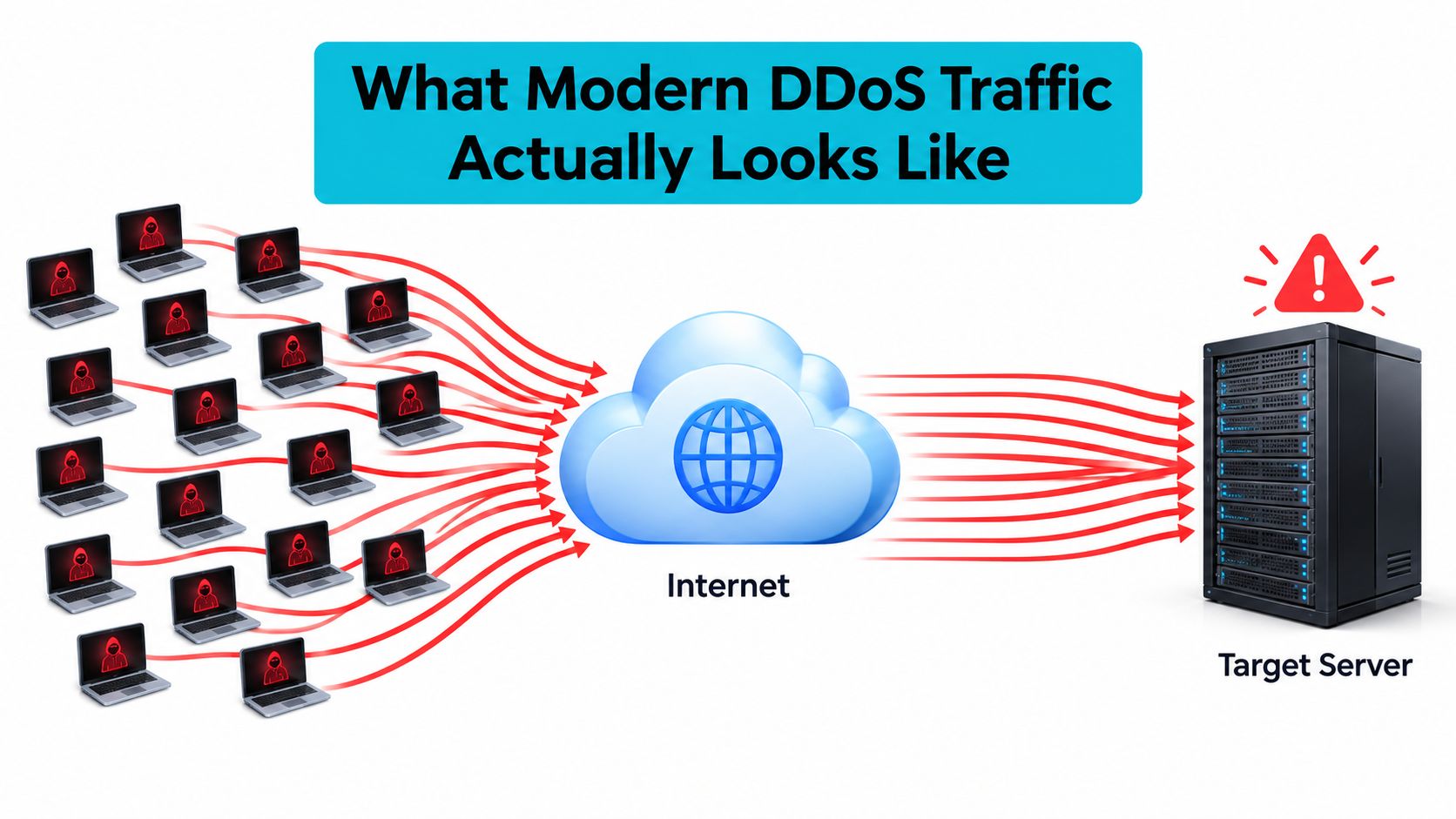
Small attacks can create large outages
A repeated low-bandwidth event can disrupt service when it targets an expensive endpoint. Login, search, checkout, and API requests may consume far more backend capacity than their traffic volume suggests. The web server can remain responsive while the database reaches its connection limit or the application queue stops accepting work.
SYN floods show why packet rate and state matter. The server returns SYN-ACK and retains state while waiting for the final ACK. Enough incomplete handshakes consume connection-table entries and memory, blocking legitimate clients. On Linux, the symptom appears in the SYN-RECV count, even when CPU usage looks normal.
Slow application-layer attacks require different controls. HTTP floods, Slowloris traffic, botnet requests, and API abuse can pass basic network checks while consuming workers and database time. The application-layer DDoS analysis describes the operational challenge of combining rate limits, WAF rules, CAPTCHA, and behavioral analytics while tracking false positives, latency, conversion impact, and recovery time.
Multi-vector traffic changes the design
Attackers can combine methods during one incident. A defensive design therefore needs packet filtering, connection-state validation, rate controls, and application awareness, with thresholds that match the workload rather than a single advertised capacity figure.
In production, evaluate four resources:
- Packets: Can the edge handle SYN, ACK, fragmented, or reflection traffic?
- Connections: Can stateful controls reject spoofed or out-of-state flows?
- Requests: Can expensive endpoints remain available to genuine users?
- Operations: Can staff change and verify policy while the event is active?
Use this DDoS attack detection guide to distinguish a network flood from an application failure before choosing capacity.
Comparing On-Prem, Cloud Scrubbing, Hybrid, and Managed Services
Choose the architecture from the attack profile, not from the provider's largest capacity figure. Small repeated floods, slow application-layer attacks, and large volumetric events place pressure on different resources. The design must also make clear where inspection occurs and who can change the response.
An on-premises appliance works well for smaller recurring attacks and policies that require close control. Positioned between the network edge and protected systems, it can apply stateful inspection, rate limits, and application rules with direct visibility into local traffic. Its hard limit is the circuit and upstream path. If either becomes saturated, the appliance cannot restore packets that never reach it.
Cloud scrubbing is built for large volumetric attacks. The attacked prefix is redirected to an upstream mitigation center, commonly through BGP. Propagation can take minutes, and the customer often needs an address block acceptable to transit networks, commonly at least a /24. Clean traffic returns through GRE or dedicated connectivity, as described in this BGP and DDoS protection comparison. The trade-off is added path complexity, processing overhead, and less direct control during the event.
A hybrid design keeps normal traffic on an always-on local path while reserving cloud diversion for attacks that exceed local filtering capacity. It handles small repeated events without routing changes and provides an escalation path for larger floods. That flexibility depends on accurate thresholds, tested routing, and a clear diversion decision.
Fully managed protection combines mitigation technology with continuous detection and response. It suits teams that need an operator to validate an event, tune controls, communicate status, and preserve evidence. The customer gives up some control over individual mitigation decisions, so escalation boundaries and approval requirements must be documented in advance.
DDoS protection architectures at a glance
| Architecture | Capacity ceiling | Diversion method | Inspection latency | TTFM typical | Customer control | Best fit |
|---|---|---|---|---|---|---|
| On-premises appliance | Limited by local circuit and appliance resources | None, traffic stays inline | Low, local inspection | Fast when staffed | High | Repeated smaller attacks and staffed routed networks |
| Cloud scrubbing | Upstream provider capacity | BGP, DNS, or provider automation | Adds path and processing overhead | Depends on detection and diversion | Moderate | Large floods and distributed public services |
| Hybrid | Local capacity plus upstream scrubbing | Always-on edge, BGP or other escalation path | Low during baseline, higher after diversion | Fast for local events, slower for escalated events | High to moderate | Mixed attack profiles requiring local control and escalation |
| Fully managed service | Provider-defined capacity and network reach | Provider-managed diversion or inline controls | Depends on service path | Provider-defined response | Delegated | SMBs and teams without continuous security operations |
TTFM means time to first mitigation. Treat it as a contractual measurement, not a decorative acronym. Confirm whether the clock starts at provider detection, customer notification, or the first filtering action.
ARPHost, LLC describes network-level mitigation, firewalls, inline controls, and managed options across its infrastructure services. Its cloud DDoS protection service fits customers that need upstream capacity without building an independent scrubbing path.
A service that requires a routing change for every short burst may have sufficient technical capacity yet remain operationally unsuitable.
Building a Layered Design That Actually Works
A useful design places each control before the resource it protects:
Internet
   |
Upstream filtering and scrubbing
   |
Edge firewall and rate limiting
   |
Stateful TCP inspection
   |
Load balancer or reverse proxy
   |
WAF and application controls
   |
Web, API, database, and mail workloads
The ordering is not cosmetic. A firewall rule that runs after the access circuit has saturated can't restore service. Filtering must happen upstream for link-filling traffic, stateful controls must protect connection tables, and request-aware controls must protect expensive application paths.

Verify the network and TCP layers
Start with a short packet sample and interface counters:
sudo tcpdump -ni eth0 'tcp[tcpflags] & tcp-syn != 0' -c 100
ip -s link show dev eth0
ss -ant state syn-recv | wc -l
ss -lnt
A high SYN-RECV count during an outage points toward handshake exhaustion. A rising interface error or drop count suggests the host or virtual interface is under pressure. If the host counters look normal while customers still time out, inspect the upstream firewall, load balancer, and circuit rather than increasing the web server backlog.
For Linux systems, check SYN cookies:
sysctl net.ipv4.tcp_syncookies
Enable them temporarily if appropriate:
sudo sysctl -w net.ipv4.tcp_syncookies=1
To persist the setting on a system using standard sysctl loading:
sudo sh -c 'printf "net.ipv4.tcp_syncookies=1n" > /etc/sysctl.d/99-network-hardening.conf'
sudo sysctl --system
SYN cookies reduce backlog pressure by avoiding normal state retention until the handshake completes. Raising backlog values alone isn't a complete solution when the interface or upstream firewall is already saturated.
Set thresholds from clean traffic
A universal packet-per-second threshold is a shortcut to false positives. Record normal SYN, SYN-ACK, DNS, and HTTP behavior by service and time of day, then compare the event against that baseline.
sar -n DEV 1 10
nstat -az | egrep 'TcpInSegs|TcpOutSegs|TcpExtSyncookiesSent'
ss -s
sudo journalctl -k --since '-10 min' | egrep -i 'syn|conntrack|drop'
Use the layered security guidance from ARPHost when separating network filtering, host hardening, and application controls. Rate limits should be narrow around expensive operations, while ordinary page views and established sessions should remain unaffected.
In multi-tenant infrastructure, the recurring production problem isn't a lack of controls. It's an emergency rule that blocks neighboring tenants, a threshold learned during an attack, or a change nobody can explain during rollback.
Keep emergency changes reversible. Save the previous rule set, record the exact activation time, and define the signal that ends mitigation. A clean recovery is part of protection, not an afterthought.
Matching the Right Architecture to SMB and Enterprise Workloads
The right design depends on who operates it and what the infrastructure exposes. A single WordPress site, a cluster of VPS instances, and a routed private cloud don't have the same failure boundary.
For a small business running shared hosting, WordPress, or one VPS, fully managed protection or cloud scrubbing usually makes more sense than a self-operated appliance. The operator may understand the application well but still lack someone available to validate traffic, tune rules, and coordinate upstream changes during an incident.
A mid-market company with several VPS instances or a private cloud generally benefits from hybrid protection. Always-on edge filtering handles routine noise and smaller bursts, while upstream diversion handles events that exceed local capacity. The important part is rehearsing the handoff before the outage.
Workload fit matters more than company size
| Workload | Primary risk | Suitable architecture | Operational requirement |
|---|---|---|---|
| Shared hosting and WordPress | Request floods, login abuse, noisy neighbors | Managed edge and application controls | Provider-managed tuning and tenant isolation |
| Single VPS | SYN floods, exposed services, application exhaustion | Managed or cloud-assisted protection | Clear host and provider escalation |
| Multiple VPS instances | Shared uplink and uneven tenant behavior | Hybrid edge plus upstream scrubbing | Per-service baselines and routing playbooks |
| Proxmox private cloud | Concentrated impact across virtual machines | Hybrid or upstream protection with local controls | Segmented policies and tested failover |
| Colocation and routed networks | Link saturation and broad prefix exposure | On-premises appliance plus upstream scrubbing | Customer routing expertise and provider escalation |
| Bare metal databases and APIs | Connection exhaustion and expensive requests | Stateful edge controls plus application-aware mitigation | Endpoint-specific limits and observability |
ARPHost operates colocation, bare metal, VPS, Proxmox private cloud, secure web hosting, and managed IT services from Tampa, Florida. Its documented service approach includes multi-layer DDoS protection, firewalling, monitoring, and managed infrastructure options. For dedicated virtualization, high-core-count compute, or private-cloud workloads, ARPHost bare metal servers can provide the hardware boundary needed for local controls, while upstream protection remains necessary for attacks that exceed the facility or circuit path.
ENISA's analysis of publicly reported EU public-administration incidents from 2024 identified 586 incidents. Almost 64% were DDoS attacks, and DDoS represented more than 95% of incidents attributed to hacktivist groups, according to ENISA's cyber-threats overview. That context matters for public-facing services, but the operational lesson applies to businesses too: availability attacks consume staff time even when they don't cause lasting system damage.
Tampa can also be relevant when South or Central American users need a practical regional path, when a colocation customer needs local remote hands, or when disaster planning includes hurricane and grid resilience. Those factors should be verified with the provider's facility and network documentation, not assumed from a city name.
How to Evaluate Any DDoS Protection Provider
A provider's advertised capacity says little about whether it can protect your service. Evaluate performance against the attack profiles that affect your customers: repeated small floods, slow application-layer requests, and large volumetric events. Ask how detection and mitigation behave at the edge, through upstream scrubbing, and inside the application path.
NIST recommends measuring effectiveness, efficiency, business impact, availability, throughput, connection rate, total attack traffic, and performance before, during, and after an event. Its guidance also addresses configuration complexity and delay added during packet processing, as described in the NIST DDoS measurement guidance.
Questions worth putting in the contract
- Detection: What event starts the time-to-detect measurement?
- Mitigation: What event starts the time-to-first-mitigation measurement?
- Legitimate traffic: How is the percentage of valid traffic retained?
- Latency: What processing delay does protection add before, during, and after mitigation?
- False positives: How are customers, crawlers, accessibility tools, and mobile users distinguished from attack traffic?
- Capacity: What packet-per-second, connection-rate, and application-layer limits apply?
- Recovery: How is recovery time measured after traffic returns to normal?
- Evidence: Which logs, flow records, samples, and post-incident reports will you receive?
- Escalation: Who can approve emergency routing or policy changes, and how is that person reached?
A useful SLA should define availability or mitigation commitments, a measurable TTFM ceiling, service credits, and escalation responsibilities. Capacity claims do not replace a test plan.
Ask ARPHost to document how its service handles each attack profile, what remains under customer control, and which conditions trigger upstream intervention. Confirm regional latency, facility resilience, and on-site support separately when those factors affect recovery.
DDoS Protection Questions Buyers Actually Ask
Why isn't DDoS protection priced as one flat amount?
The cost depends on the protected architecture, traffic profile, number of services, diversion method, application controls, monitoring, and required operational support. A single public figure can't describe the difference between protecting one VPS and operating a routed private cloud with upstream failover.
Why does time to mitigate vary?
An always-on edge control can act without a routing or DNS change. BGP and DNS diversion introduce additional detection, propagation, tunnel, or caching steps. Managed services may respond quickly, but the actual result depends on the provider's detection logic, staffing, and escalation process.
How can I distinguish a slow application attack from a traffic spike?
Check request paths, authentication state, response latency, worker utilization, database connections, and client behavior. Application-layer attacks imitate normal traffic, so a healthy interface combined with exhausted workers or a concentrated rise on expensive endpoints deserves application-level investigation, not only a larger network circuit.
When should I stop tuning rules myself?
Escalate when the access circuit, upstream firewall, shared load balancer, or provider routing is the limiting resource. If the event requires sustained monitoring, coordinated diversion, or application decisions that could block legitimate customers, a managed incident-response path is safer than repeated emergency edits.
To review current protection options across colocation, bare metal, VPS, and managed infrastructure, visit ARPHost, LLC. Its engineers can help map your public services to the appropriate combination of edge filtering, upstream mitigation, host controls, and operational escalation.
ARPHost, LLC provides colocation, bare metal, VPS, Proxmox private clouds, secure web hosting, and managed infrastructure with multi-layer DDoS protection and firewall controls. Visit ARPHost, LLC to discuss an attack-profile-based design and establish the monitoring, escalation, and recovery procedures before the next incident.

Leave a Reply
You must be logged in to post a comment.