

Figuring out colocation pricing can feel like you're trying to hit a moving target. The final bill boils down to four key ingredients: the physical space your gear occupies, the power it drinks, the network bandwidth it uses, and the level of hands-on support you need from the data center staff. This can mean a bill of a few hundred dollars a month for a single server, or it can climb into the tens of thousands for high-density private cages.
Understanding Colocation Pricing Models
When you get a colocation quote, you're essentially paying for a slice of a high-tech fortress—its space, power, cooling, and security. To make sense of it all, providers typically use one of three main pricing models. Think of it like choosing a storage unit: do you pay for a small locker, a whole room, or just for the electricity your freezer uses inside it?
Each model fits a different need, from a startup just getting its footing to a large enterprise running power-hungry hardware. Let's break them down so you can see which one makes the most sense for your budget and your tech.
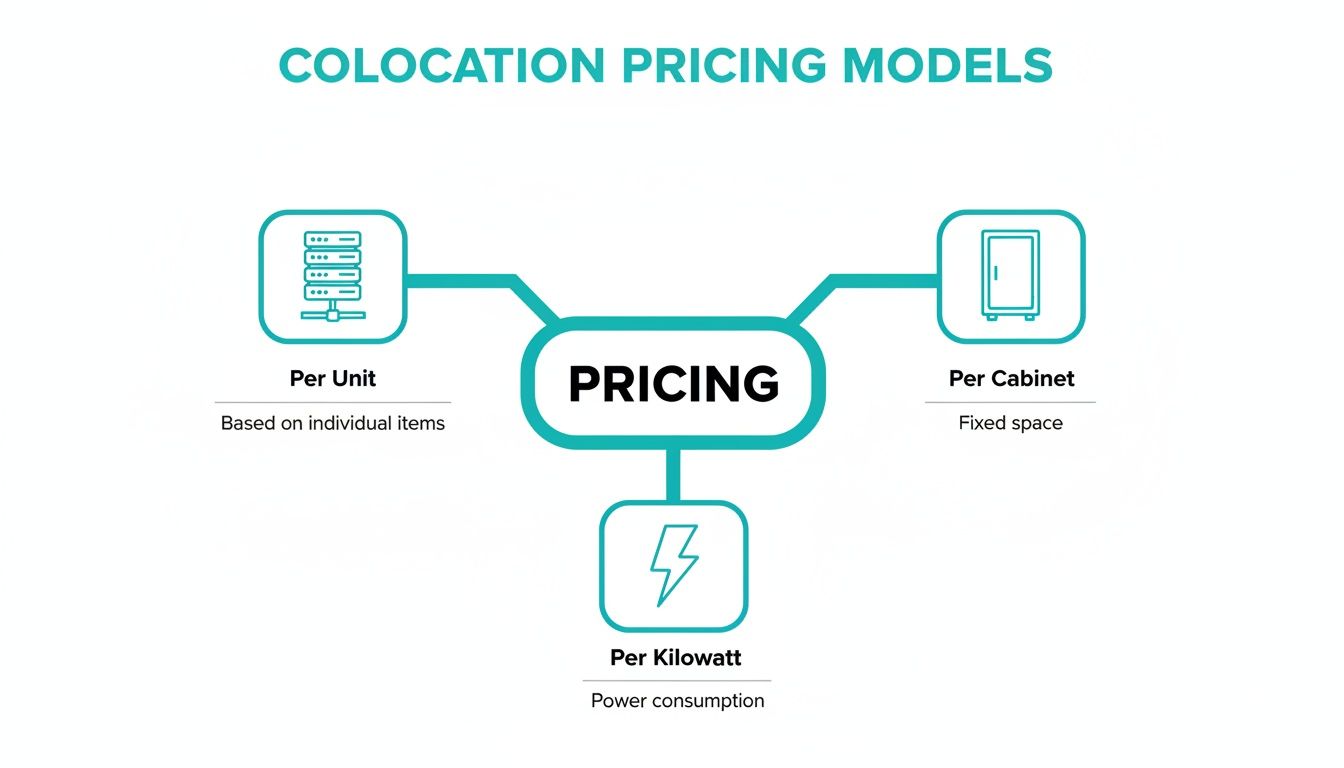
Per Unit (RU) Pricing
The Per Unit (RU) model is the perfect entry point. Think of it as renting a single, secure shelf in a massive, climate-controlled warehouse. You're paying for a standardized slot measured in "U," where one U is 1.75 inches of vertical rack height. It’s ideal for businesses that need to professionally house just one or two servers.
This approach gives you all the benefits of enterprise-grade security and reliability without having to commit to a full cabinet. It's the logical next step when you've outgrown the server closet in your office. If you're new to this world, our guide on what is colocation hosting covers all the fundamentals.
Per Cabinet Pricing
Stepping up, the Per Cabinet model is like renting a whole private locker instead of just a shelf. You get exclusive use of an entire 42U or 48U cabinet, giving you the space to build out a more substantial stack of servers, networking gear, and storage arrays.
This model gives you more density and control, making it a great fit for companies running a multi-server environment. The cost is predictable—a flat monthly fee for the space, which usually comes bundled with a specific power circuit, like a 20A or 30A drop. It’s a straightforward way to secure a dedicated footprint that can grow with you.
Per Kilowatt (kW) Pricing
Finally, we have the Per Kilowatt (kW) model, which works a lot like your home electricity bill. Instead of paying primarily for space, your cost is tied directly to the actual power your hardware consumes. This is the go-to model for high-density deployments where a few servers can draw a massive amount of energy.
We’re talking about AI training clusters, high-performance computing (HPC) rigs, and large-scale virtualization environments like ARPHost's Dedicated Proxmox private clouds. This model is quickly becoming the new standard as server hardware gets more powerful. In fact, recent data shows the average price for wholesale colocation in key North American markets hit $195.94 per kW per month in late 2025. That's a 6.5% jump year-over-year, largely driven by the power demands of AI infrastructure.
To help you decide, here's a quick comparison of the three main models.
Colocation Pricing Models at a Glance
| Pricing Model | Best For | Typical Use Case | Cost Structure |
|---|---|---|---|
| Per Unit (RU) | Small businesses, startups, single-server deployments | Hosting a single web server or a small firewall | Fixed monthly fee per rack unit (U) occupied. |
| Per Cabinet | Growing businesses, multi-server environments | Housing a mix of servers, switches, and storage arrays | Predictable monthly fee for a full cabinet with bundled power. |
| Per Kilowatt (kW) | Enterprises, high-density computing | Running AI/ML clusters, HPC workloads, or large private clouds | Variable cost based on metered power consumption. |
Ultimately, the right choice depends entirely on your hardware's footprint and its power appetite. A small business with one server will find Per RU pricing far more economical, while a tech company running GPU-heavy workloads will get more value from a Per kW model.
For organizations running powerful Bare metal servers or Dedicated Proxmox Private Clouds, the per-kW model offers the most scalable and cost-effective pricing structure. It ensures you only pay for the energy your high-performance equipment actually uses. ARPHost specializes in building these power-dense environments for demanding workloads.
The Primary Cost Drivers You Cannot Ignore
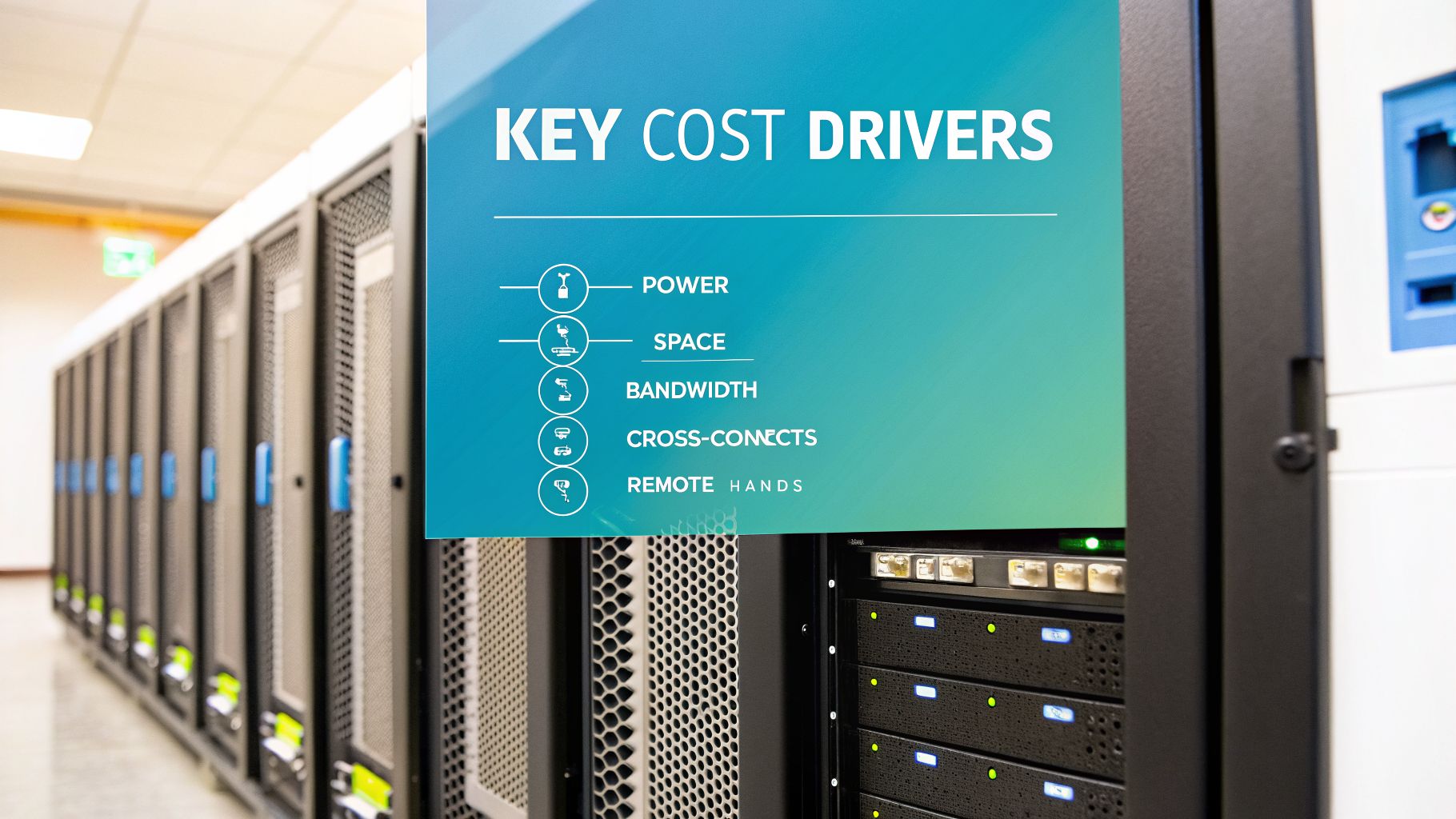
While pricing models like "per U" or "per cabinet" give you a starting point, they don't tell the whole story. The final number on your invoice is really determined by five major cost drivers—think of them as the dials you can turn to balance performance, resilience, and your budget.
Getting these wrong can lead to some nasty surprises. Let’s break down each driver so you know exactly what you’re paying for and can build a predictable, scalable infrastructure.
1. Power Consumption and Redundancy
Power isn't just a line item; it's often the single largest variable in your colocation bill. It’s not just about how much juice your servers draw, but how that power is protected from failure.
- A-Feed (Single Power Source): This is your standard, single-circuit power feed. It's the most economical choice, but it’s also a single point of failure. If that circuit goes down for maintenance or an outage, so does your gear.
- A+B Feed (Redundant Power): Here, you get two completely independent power circuits running to your cabinet. If the 'A' feed fails, your equipment’s dual power supplies instantly failover to the 'B' feed without interruption. This is a must-have for any mission-critical application where downtime is not an option.
Opting for an A+B feed adds cost, but it's a fundamental piece of any serious high-availability strategy, especially when building resilient architectures like an ARPHost Dedicated Proxmox Private Cloud for production workloads.
2. Physical Space and Rack Density
The physical footprint of your equipment is a straightforward cost. Whether you rent a few Rack Units (RU), a full cabinet, or a private cage, more space equals a higher monthly fee.
But the real game-changer is rack density—how much power and cooling can be supplied to that space. A standard cabinet might be rated for 5-7 kW. A high-density cabinet, on the other hand, can handle the intense demands of a Proxmox Private Cloud or a stack of Bare Metal Servers, delivering 15-20 kW or even more.
While denser cabinets cost more upfront, they let you pack more compute power into a smaller footprint, which is often more efficient in the long run.
Expert Insight: Don't just plan for today. Think about your hardware needs 6 to 12 months from now. It’s often cheaper to get a full cabinet with some room to grow than it is to add a second, smaller deployment later.
3. Bandwidth and Connectivity
Your connection to the rest of the world is another key factor. Providers typically bill for bandwidth in one of two ways:
- Metered Bandwidth: You get a high-speed port (like 1Gbps or 10Gbps) and only pay for what you use, usually calculated with the 95th percentile method. This works great for workloads with steady, predictable traffic.
- Unmetered Bandwidth: You pay a flat rate for a dedicated connection (e.g., 100Mbps or 1Gbps) and can push as much data as you want up to that limit. This is perfect for spiky, unpredictable traffic from things like busy web servers or content delivery.
4. Cross-Connects and Interconnectivity
A cross-connect is simply a physical cable that links your cabinet to something else in the data center. These direct links are essential for building high-performance, low-latency architectures. You'll need cross-connects to:
- Connect directly to a specific internet carrier for optimized routing.
- Create a private link to a cloud provider like AWS or Azure.
- Link up with a partner or customer who is also in the same facility.
Each cross-connect has a one-time setup fee and a recurring monthly charge. A big part of what you're paying for is the assurance that these crucial connections are protected by the facility's top-tier data center physical security.
5. Remote Hands and Managed Services
"Remote Hands" is the on-site technical support provided by the data center staff. They can handle everything from a simple server reboot to racking and stacking new hardware for you.
Support is typically offered in two flavors:
- On-Demand: You pay by the hour (usually with a one-hour minimum) whenever you need something done.
- Bundled Hours: You pre-purchase a block of hours each month at a discounted rate.
For businesses that want to be completely hands-off, ARPHost takes this a step further with fully managed IT services. We don't just react to tickets; our team proactively manages your entire stack—OS patching, security hardening, network configuration, and disaster recovery. This turns your colocation space from a rental into a fully managed extension of your team, freeing you to focus on your actual business.
Ready to see how these factors apply to your specific needs? Contact our solutions experts for a transparent colocation quote at arphost.com/colocation/.
Before we even get into colocation pricing, let's talk about the alternative: building your own data center. For most businesses, this idea falls somewhere between wishful thinking and a financial nightmare. The meteoric rise of colocation makes perfect sense once you start running the numbers on a DIY approach.
Ever sketched out what it would take? You start with buying land, navigating zoning laws, and then the actual construction. But that's just the ground floor. From there, the costs explode. You're talking about redundant power grids with massive UPS systems and diesel generators, industrial-scale cooling, and physical security that would make a bank vault jealous.
The Staggering Financial Barrier
The price tag to get in the game is astronomical and only climbing. Data center construction costs have gone vertical, now averaging around $1,000 per square foot—that's a nearly 50% jump in just one year. A standard facility will easily set you back $10 to $12 million per megawatt. If you're building for high-density AI workloads, you can double that to $20 million per megawatt or more.
And that’s just to cut the ribbon. The real pain comes from the ongoing operational expenses (OpEx):
- Staffing: You need a 24/7 team of certified engineers, security guards, and facility managers. They aren't cheap, and they're hard to find.
- Maintenance: That complex power and cooling gear needs constant love and care to prevent an outage that could cost you millions.
- Compliance: Get ready for a revolving door of auditors for SOC 2, HIPAA, or PCI-DSS. Each audit cycle drains time and money.
- Utilities: Your power bill will be colossal. Without the bulk purchasing power of a major provider, you're paying premium rates for every kilowatt.
For a growing company, sinking millions into a concrete bunker and diverting your best people to manage it is a strategic dead end. It starves the parts of your business that actually make money—product development, sales, and customer support.
The Logical Path Forward with Colocation
This is exactly the problem colocation solves. It gives you keys to an enterprise-grade facility without the multi-million-dollar buy-in and the operational migraine. You get all the good stuff—resilience, top-tier security, and insane connectivity—for a predictable monthly fee.
Suddenly, a crippling capital expenditure becomes a manageable operating expense. It means you can rack up your Bare metal servers or spin up a Dedicated Proxmox Private Cloud in a Tier III or Tier IV environment—a feat that would be completely out of reach financially if you tried to build it yourself. For a closer look at the tech involved, check out our technical guide to colocation and hosting infrastructure.
In the end, colocation isn't just an "alternative" anymore. For the vast majority of businesses, it's the only path that makes sense. It's scalable, financially sound, and lets you get back to work. Partnering with a provider like ARPHost lets you sidestep the risk and focus on what you do best.
Negotiating Your Contract and Avoiding Hidden Fees
A colocation contract isn't just a rental agreement. It's a minefield of fine print that can either protect your budget or blow it to pieces with unexpected costs. This is where you need to be sharp—getting the negotiation right is your best defense against inflated invoices and nasty surprises.
Many providers reel you in with a lean base rate, knowing they can claw back profits on ancillary charges later. The usual suspects? Exorbitant remote hands fees for a simple five-minute task, confusing bandwidth overage penalties, and even mandatory security escort costs just for your team to visit your own gear. A low initial quote can easily double if you aren't paying close to attention.
The Provider Vetting Checklist
Before you even think about signing, go in armed with the right questions. A provider’s willingness to be transparent here speaks volumes about how they do business.
- Power: How do you bill for power? Is it a fixed rate per kilowatt, or is it a pass-through cost? What’s the price per kWh?
- Bandwidth: Do you use 95th percentile billing, or something else? I need to know the exact overage charges.
- Remote Hands: What’s the hourly rate? Is there a minimum charge, like billing a full hour for a five-minute reboot?
- Cross-Connects: What are the non-recurring setup fees and monthly recurring charges for both copper and fiber runs?
- Setup Fees: Are there one-time installation fees? Are they negotiable? (Hint: They almost always are).
- Contract Terms: What’s the penalty for early termination? And what are the standard price hikes when the contract renews?
To really make an impact, you need to walk into that meeting prepared. Learn how to negotiate vendor quotes effectively and you'll hold all the cards.
Actionable Negotiation Tactics
Once you have this information, the power dynamic shifts. You’re no longer just accepting a price; you’re co-creating a deal that works for both sides.
- Bundle Remote Hands: Instead of getting hit with sky-high on-demand rates, ask for a bundled package. Propose including 5-10 remote hands hours per month at a steep discount. This gives you predictable costs for routine maintenance.
- Clarify Bandwidth Billing: If you anticipate occasional traffic spikes, insist on a 95th percentile billing model. This method forgives brief traffic bursts, saving you from getting hammered by punitive overage fees that punish growth.
- Waive Setup Fees: This one’s a classic. For longer contract terms, like 24 or 36 months, it's completely reasonable to ask the provider to waive all initial setup fees. They secure a long-term customer, and you slash your upfront costs.
Why ARPHost Excels Here
At ARPHost, we think transparent pricing is just good business. We build our colocation and managed services quotes to be all-inclusive, so you aren’t blindsided by hidden fees. Our fully managed IT services are designed to stop unexpected costs before they happen. Our expert engineers handle everything from patch management to network security, so you don't get emergency remote hands bills for problems that should have been prevented.
By treating the contract like a collaborative document, not an ultimatum, you can forge a fair agreement that actually supports your business. A good partner will work with you.
Ready to see what a transparent partnership feels like? Request a managed services quote at arphost.com/managed-services/ and let us build a plan that fits your budget—no surprises included.
The ARPHost Advantage with Managed Colocation
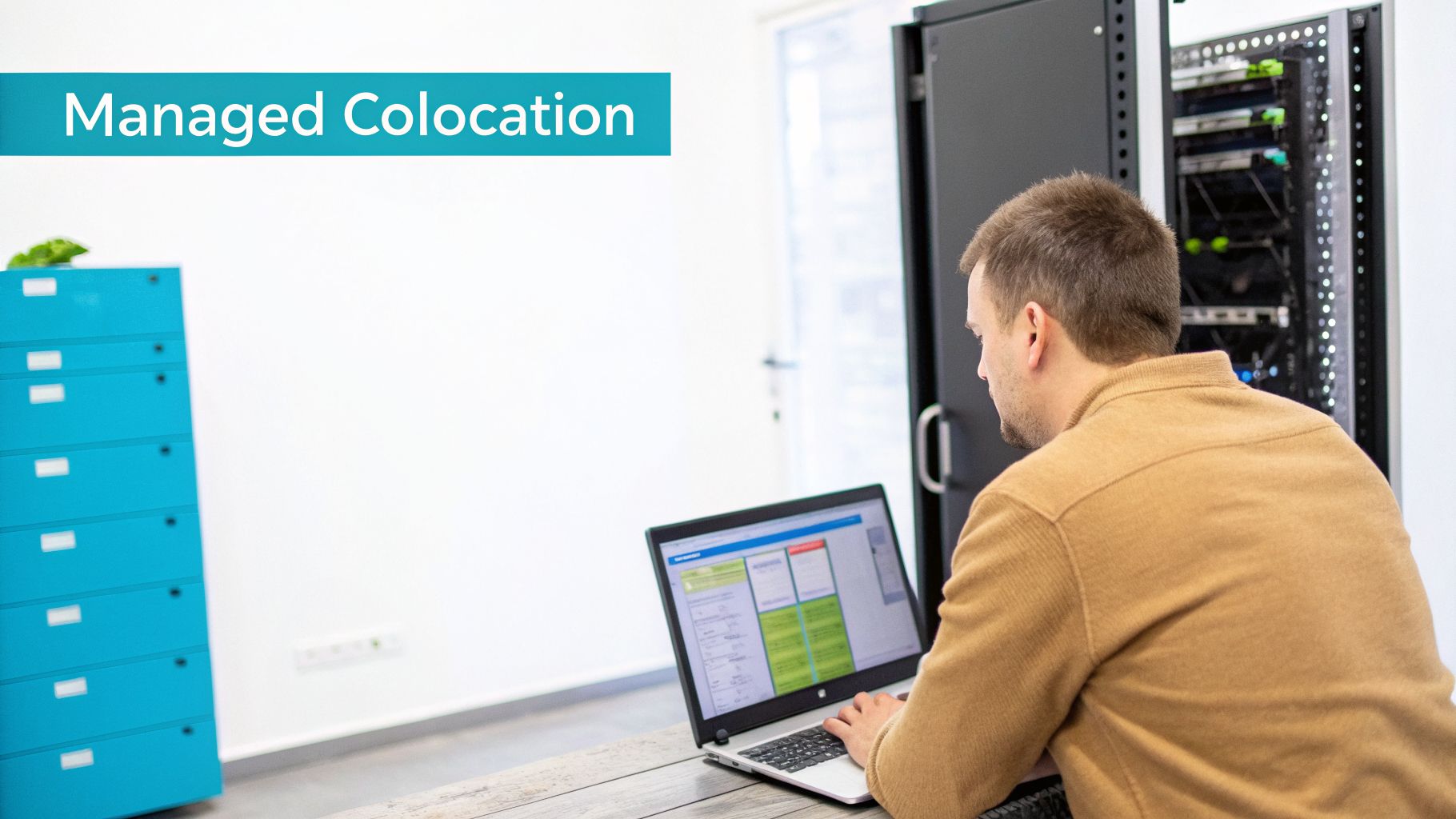
Once you’ve sorted out the basics of space and power, the real work begins. Standard colocation gives you a secure spot for your hardware, but it also leaves your team on the hook for every server crash, OS patch, and late-night emergency. This is where ARPHost's fully managed colocation completely changes the game.
With a typical provider, you're just renting real estate. With ARPHost, you're gaining an infrastructure partner. Our certified engineers become a 24/7 extension of your own team, turning a simple rack rental into a resilient, fully supported environment. We take care of the tedious, time-consuming grunt work so you can get back to building your business.
From Reactive Fixes to Proactive Management
The unmanaged colocation experience is a constant cycle of firefighting. A drive fails, an OS vulnerability is announced, a service goes down—and your team has to drop everything to fix it. Our managed services flip that script, shifting the focus to proactive administration that stops problems before they ever start.
This isn't just a convenience; it's a fundamental change in how your infrastructure runs. Our managed services suite includes:
- Proactive Monitoring: We're your eyes on the server around the clock, spotting performance bottlenecks, security risks, and hardware hiccups before they can trigger an outage.
- Patch Management: Our team takes full ownership of OS updates and security patches. We handle the testing and deployment, closing vulnerabilities so you don't have to.
- Managed Backups: We don't just set up backups; we manage and verify them. Your critical data is protected and ready for a rapid restore when you need it most.
- Network and Firewall Administration: Forget wrestling with firewall rules. We manage your network devices, hardening your security posture and ensuring traffic flows exactly as it should.
This hands-on approach is a strategic advantage, slashing your operational overhead and dramatically reducing business risk.
The True Cost of Unmanaged Colocation
The global colocation market is booming, expected to hit USD 164.11 billion by 2031 as more companies look to shed the high cost of building their own data centers. But just renting space can create a whole new set of expenses if you're not ready for the hands-on management burden. You can read more about the colocation market's robust expansion and pricing trends to see where the industry is heading.
When you look at the day-to-day responsibilities, the value of a managed partner becomes crystal clear. The table below shows what your team is responsible for in a standard unmanaged setup versus the peace of mind you get with ARPHost.
Unmanaged vs. ARPHost Managed Colocation
| Task | Unmanaged Colocation (Your Responsibility) | ARPHost Managed Colocation (Our Responsibility) |
|---|---|---|
| Server Patching | Your team tracks, tests, and applies all OS and security updates. | Our engineers handle the entire patch management lifecycle for you. |
| Hardware Diagnostics | Your staff diagnoses failures and coordinates with remote hands. | We proactively monitor hardware and manage all replacements ourselves. |
| Security Monitoring | You're on your own to configure, monitor, and respond to alerts. | We provide continuous security monitoring and active incident response. |
| Backup Management | Your team has to set up, test, and manually verify every backup job. | We manage a complete, verified disaster recovery strategy for you. |
| Emergency Response | A 3 AM server crash means a frantic call to wake up one of your people. | A 3 AM server crash means our on-call engineers are already fixing it. |
This comparison highlights the operational gap. With unmanaged colocation, you’re always on call. With ARPHost, we are.
With ARPHost, you can start with a single managed server and seamlessly scale into a Dedicated Proxmox Private Cloud or a hybrid environment with our Bare metal servers. All your infrastructure remains under one expert management team, ensuring consistent support and simplified billing as you grow.
Choosing managed colocation isn’t about outsourcing tasks—it’s about embedding expertise and reliability directly into your operations. You’re not just buying power and ping; you’re investing in operational excellence and the freedom to focus on what matters.
Ready to see how a managed partnership can transform your infrastructure? Request a custom managed services quote to discover the ARPHost difference.
Finding Your Ideal Infrastructure Partner
Picking a colocation provider isn't just another line item on a spreadsheet; it’s a partnership. You're entrusting them with the hardware that runs your business. Now that you understand the ins and outs of data center colocation pricing, from the core models to the sneaky cost drivers, it’s time to find a partner who actually gets what you need.
The best ones offer more than just a rack and a power outlet. They give you a solid foundation to build on, with real expertise and transparent billing. As you start weighing your options, look past the initial price tag and focus on the real value. A slightly higher monthly bill for fully managed services can easily save you thousands by preventing a single hour of downtime or letting you skip a new sysadmin hire.
Final Provider Vetting Checklist
Use this checklist to cut through the marketing fluff and find a provider that will act like a true extension of your team.
- Support Quality: Do they have 24/7 support from certified engineers who can actually solve a problem? Or are you just talking to a call center that opens tickets? Test them. See how fast they respond and if they know their stuff before you sign anything.
- Scalability Options: How easily can you grow from a single server to a full cabinet or even a Dedicated Proxmox Private Cloud? A good partner offers a clear growth path, not a series of painful migrations.
- Power and Cooling: What’s the power density per cabinet? Do they have modern cooling that can handle today’s high-performance gear without breaking a sweat? Don’t get stuck in a facility that can’t keep up.
- Pricing Transparency: Is the quote crystal clear? Ask them directly about potential extra costs for remote hands, cross-connects, and those notorious contract renewal price hikes.
Why ARPHost Excels Here
We built ARPHost to be the partner we always wanted. That means honest, transparent pricing combined with a full suite of solutions that scale with you, from our affordable Secure web hosting bundles to enterprise-ready Bare metal servers. Our 24/7 expert support isn't an upsell—it's the core of our promise to help you succeed.
Making the Confident Choice
At the end of the day, the right infrastructure partner is the one who makes your life simpler and lets you sleep at night. They turn unpredictable expenses into a clear, manageable cost and swap your operational headaches for proactive, expert management. When you choose wisely, you’re not just securing a rack; you’re locking in a reliable foundation for your business’s future. To see what separates the best from the rest, dive into our detailed comparison of the best colocation providers.
Ready to find a partner who is genuinely invested in your success? Contact our solutions experts at ARPHost for a no-obligation quote that’s tailored to your exact technical needs and budget. Let's build your ideal infrastructure together.
Your Colocation Pricing Questions, Answered
Alright, you've wrapped your head around the different pricing models and what drives costs up. But let's get down to brass tacks. We get these practical questions all the time from IT managers, so here are some straight answers.
What's a Realistic Starting Budget for a Small Business?
If you’re moving a single server (a 1U or 2U box) out of the office closet, you can realistically get started for $100 to $250 per month. That's not a bare-bones price, either. It should cover a small power draw (1-2 amps), a metered internet port (typically 100Mbps or 1Gbps), and at least one static IP address.
Think of it as the perfect entry point into an enterprise-grade facility. It’s a huge leap in reliability from an on-prem setup and aligns with the starting costs for our flexible VPS Hosting plans, giving you a clear growth path.
How Much Will Bandwidth Actually Run Me?
Bandwidth costs can really swing depending on your needs. Most providers will give you a fast port (1Gbps or 10Gbps) and bill you for what you use, which is known as metered billing. Using the 95th percentile method, this usually costs between $0.50 and $2.00 per Mbps.
Alternatively, you can buy a dedicated chunk of unmetered bandwidth. For example, a 100Mbps unmetered connection might set you back $150-$300 per month. We help you figure out which model saves you the most money and monitor your usage to make sure you're on the right plan, so you don't get hit with surprise overage fees.
Can I Easily Upgrade My Space and Power Later?
You absolutely should be able to, but this is where your choice of provider really matters. A good partner plans for your growth from day one. You need to be able to go from a few rack units to a full cabinet or add a second power circuit without taking your services offline.
This is a cornerstone of how we operate. We’ve helped clients scale from a single server to a full-blown Dedicated Proxmox Private Cloud all within the same facility. And with our fully managed IT services, our team handles the new hardware deployment and migration, making growth completely hands-off for you.
Partner with ARPHost for transparent pricing and infrastructure that grows with you. Explore our scalable solutions by visiting https://arphost.com/colocation/ today.