

Colocation pricing in Tampa begins at $99 per month for 1U, featuring included bandwidth and fully redundant managed network infrastructure, which encompasses IPv4/IPv6, IPMI, and 25Mbps of bandwidth.
If you're trying to compare providers right now, a key consideration isn't just monthly rack rent. It's what gets bundled, what gets billed later, and whether the power and network design match how your servers operate.
Most Tampa buyers hit the same wall. They ask a simple question, “How much does colocation cost in Tampa, FL?” and get dragged into a sales process before anyone will say a number. That makes it hard to budget, harder to compare quotes, and almost impossible to spot the hidden line items that turn an acceptable monthly bill into a bad long term contract.
This market is competitive enough that you shouldn't accept vague pricing. Tampa has multiple colocation operators and meaningful facility depth, which gives buyers room to negotiate on more than cabinet space alone, including power structure, carrier choice, and service terms, as shown by Tampa market listings from OCOLO. That matters because the cheapest looking quote often stops being cheap once cross-connects, remote hands, bandwidth, and power headroom start showing up on separate invoices.
Transparent Tampa Colocation Pricing You Can Budget For
A Tampa IT manager trying to budget colo usually runs into the same problem fast. The quote starts with a simple rack rate, then power, bandwidth, remote hands, IP access, and setup charges show up later. By the time the contract is clean enough to compare, the original number is meaningless.
Published pricing fixes that.
For small footprints in Tampa, ARPHost posts clear monthly rates that give buyers a real starting point:
| ARPHost Tampa Plans (2026) | Monthly Price |
|---|---|
| 1U Server | $99/mo |
| 2U Server | $179/mo |
| 4U Server | $289/mo |
You can review the full Tampa colocation pricing breakdown and compare it against any quote that lands on your desk. That matters because a 1U firewall, backup node, or single application server should be easy to price. If it takes three sales calls to get a usable number, the billing model is probably going to stay opaque after deployment too.
What the monthly price includes
The practical value is not just the rack unit price. It is what gets bundled into it.
Bandwidth included: 25 Mbps committed bandwidth on 95th percentile billing
Network ports: redundant 10 Gbps uplink ports
Management access: IPMI or other out-of-band access
Addressing: /29 IPv4 block and /64 IPv6 block
Onsite support: remote hands assistance
That structure is easier to budget for because the common operational extras are already accounted for. IT managers can model monthly run rate without guessing which line items will appear after install.
I have seen plenty of Tampa quotes that looked competitive until the provider priced cross-connects, remote hands minimums, IP allocations, or bandwidth commits separately. A low rack rate is not useful if the actual bill shows up on page two.
Practical rule: A colo quote is only usable when space, power assumptions, network access, and support are stated clearly enough to map to your actual hardware.
There is also a published market reference for larger, steady workloads. Lawton Information Services lists a quarter-cabinet plan at $600 per month with 10 Gbps connectivity included at no extra charge, plus an estimated $25,000 upfront hardware purchase for four servers That example is useful because it correctly presents the buying decision. Stable, always-on systems often favor colocation economics. Variable workloads often do better in cloud.
For Tampa buyers, the primary differentiator is quote clarity. ARPHost's all-inclusive small-footprint model removes a lot of the pricing friction that turns routine colo purchases into procurement problems.
Deconstructing Colocation Costs Power Bandwidth and Space
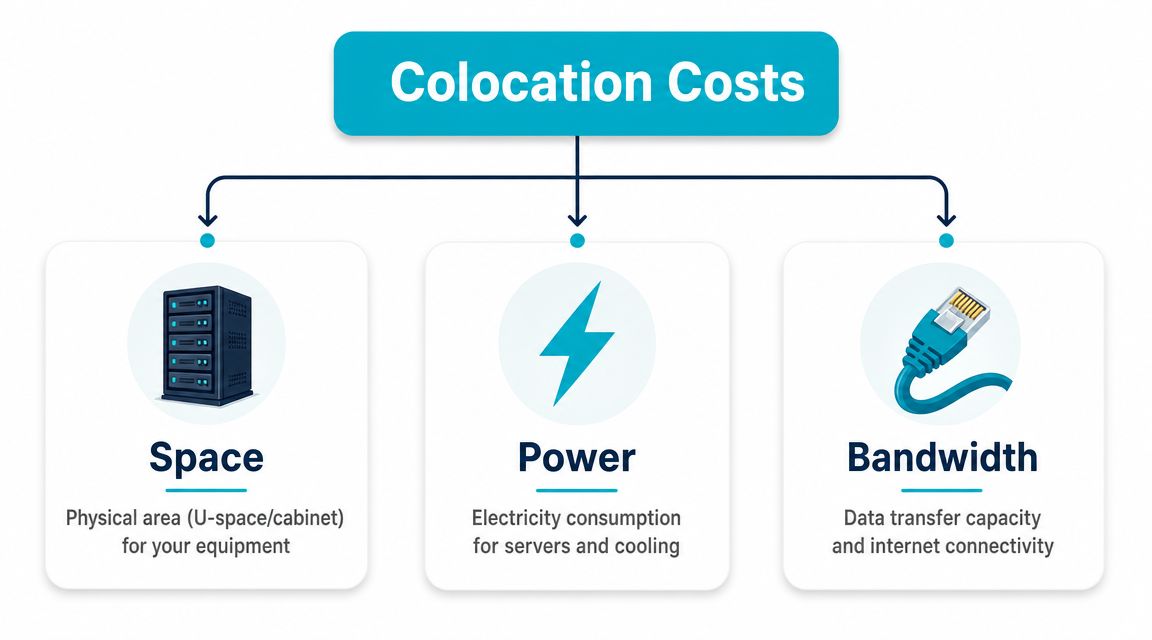
The monthly number on a quote is only useful if you know what drives it. In practice, colocation costs come from three buckets: space, power, and bandwidth. Buyers usually focus on space because it's easy to visualize, but that isn't what normally pushes a quote up over time.
Space is the easiest line item
Rack space is the simplest part of the bill. You're paying for a 1U, 2U, 4U footprint, a partial cabinet, or a full cabinet. That's why buyers tend to compare only the monthly rack rate. It feels like the obvious benchmark.
That shortcut causes bad decisions. A lower space rate can hide a more expensive power structure or a network package that forces you into separate carrier contracts later.
Power usually decides the real cost
The harder question is power. That's the line item that changes the economics as deployments get denser. A light 1U appliance has one profile. A compute-heavy box with multiple power supplies, sustained CPU load, and higher thermal output has another. Once you move into larger footprints, the quote should show whether the provider is pricing for business continuity style deployments or for sustained higher-density production workloads.
A Tampa-focused pricing guide from CoreSite points to a central issue: most content says colocation is priced on space, power, and connectivity, but misses that power is often the true pricing lever, especially when a facility is designed for different workload densities. That's why a quote should be benchmarked by power commitment, amperage, and any burst conditions, not just by cabinet rent.
If you're budgeting a small deployment and want a cleaner planning process, a bundled model can help. A published resource like ARPHost data center colocation pricing is easier to work with because the small per-U plans package the essentials instead of pushing every operational need into custom line items.
How 95th percentile billing works
Bandwidth is where many buyers get confused, especially if they're used to cloud egress billing. In this case, 25 Mbps committed bandwidth is included and billed using 95th percentile methodology rather than per-GB charging.
Here's the practical version:
Traffic is sampled regularly
The highest 5% of usage samples are discarded
Billing reflects your typical sustained usage, not short spikes
That approach is favorable for bursty workloads. If your traffic jumps during backups, software updates, reporting windows, or customer sync events, those brief peaks don't automatically become the number you're billed on.
Short spikes are normal. A billing model that ignores the top 5% of samples is usually friendlier than per-GB overages when your traffic isn't perfectly flat.
What doesn't work is comparing a 95th percentile commit to a throttled low-cost transit plan as if they're interchangeable. They aren't. One is built for operational flexibility. The other is often built to enforce a ceiling.
How a Tampa Business Cut Colocation Costs with ARPHost
A common Tampa failure pattern starts with a quote that looks acceptable and ends with a stack of add-ons nobody modeled correctly.
One recent local comparison involved a client paying about $2,800 per month to another provider for what had been sold as a 208V 20-amp A+B redundant power feed. On paper, that sounded workable. The trouble was everything around the headline number.
What the old bill was really buying
The provider did not include internet connectivity in a practical way. The client had to source separate bandwidth providers and absorb cross-connect costs on top of the base colocation charge. Those cross-connect fees were typically $100 to $200 per connection per month, and they stacked on top of transit costs. The estimated base for space and power sat around $1,800 to $1,900, with another $600 to $900 in bandwidth and cross-connect related costs depending on commit levels.
The result was a bill that looked structured but wasn't predictable.
The dangerous quote isn't always the expensive one. It's the one that hides dependency costs outside the contract.
The bigger issue was reliability
Then the power path failed.
The customer learned the “redundant” feed wasn't redundant. What had been presented as A+B was a single source split at the PDU. That means one upstream problem could still take down the full deployment. For an IT manager, that's worse than just overpaying. It means you paid extra for redundancy you didn't receive.
That detail matters when you're reviewing Tampa colocation quotes. If the provider can't clearly walk you through the power path, don't assume the language on the proposal means what it sounds like.
What changed in the replacement design
The revised deployment consolidated the moving parts into a single provider model with genuine redundant power, included bandwidth on redundant uplinks, switching and network infrastructure already in place. The savings came from removing extra vendor layers, not from stripping out reliability.
That kind of design works better for teams that don't want to manage separate transit relationships, track recurring cross-connect fees, and troubleshoot around unclear facility responsibilities. It also shortens procurement because the network side is already built.
If your environment is growing beyond a few units, this is usually the point where you also decide whether to stay with straight colocation, move some workloads to bare metal, or split steady-state infrastructure into a private virtualization stack. For teams that need that mix, providers such as ARPHost also offer adjacent options like bare metal servers, Proxmox private clouds, and managed services, which can simplify hybrid designs when not every workload belongs in the same hosting model.
Three Hidden Fees to Avoid in Tampa Colocation Quotes
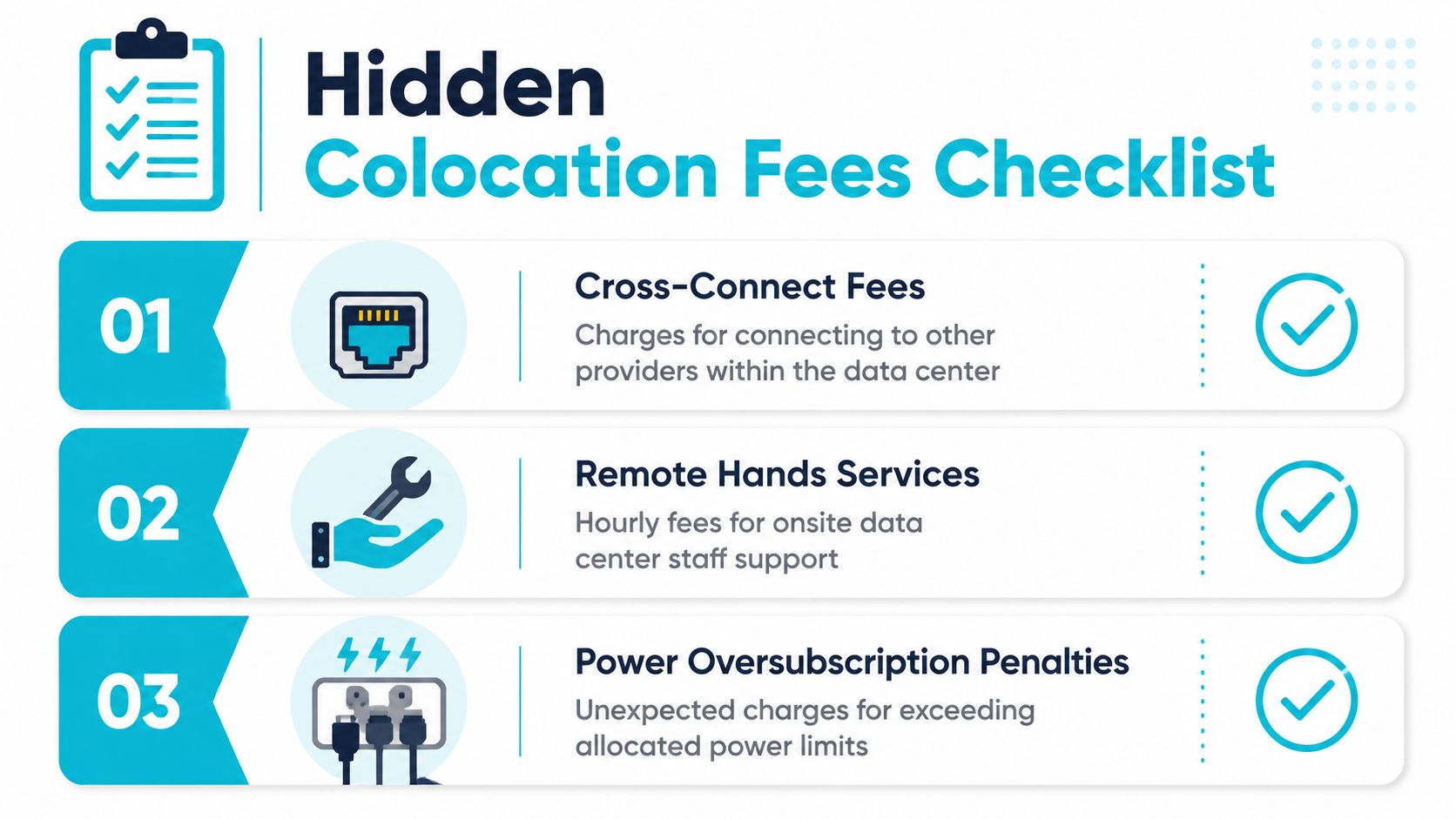
A lot of bad colocation contracts look reasonable on page one. The trouble starts in the service order, the addendum, or the billing policy. When people compare colocation pricing tampa, these are the three line items I tell them to inspect before they compare monthly totals.
Contract escalations can wreck a good budget
Some providers build annual increases into long-term agreements. The wording often looks harmless until you model it across the contract term. The problem isn't just the increase itself. It's that many buyers never incorporate it into total cost planning.
Look for language tied to CPI or a minimum annual increase. If the contract escalates faster than your infrastructure needs, you can end up renewing hardware decisions around a pricing model that no longer makes sense.
A few checks help:
Read the general terms: Price increases are often not listed on the main pricing schedule.
Model the full term: Compare year one cost against year two and year three, not just the entry price.
Ask about renewal language: Some contracts are manageable in the initial term and much worse at renewal.
Bandwidth overages depend on the billing method
Bandwidth surprises usually come from one of two places. The first is a buyer who didn't ask how usage is measured above the commit. The second is a provider that presents a commit rate without explaining the overage model clearly.
The content gap in this market is real. Public colocation guides often discuss generic pricing components but don't answer the practical question of how much of the invoice is driven by power headroom versus cabinet rent, or how burst pricing changes the network bill in real deployments, as discussed in QuoteColo's market comparison of 40U pricing and regional variation. That matters because a low sticker price can stop looking attractive once connectivity and failover design are added.
Cross-connect fees multiply fast
This is the fee that catches a lot of businesses off guard. If your provider doesn't include practical internet connectivity, you'll need cross-connects to carriers inside the facility. Each physical connection can carry a recurring monthly charge, and redundancy typically means more than one.
That changes the economics fast. A competitive cabinet rate can become a mediocre deal once each carrier connection carries its own fee and its own management overhead.
Ask these questions directly:
Is bandwidth on-net and included, or do I need separate transit contracts?
What recurring cross-connect charges apply per carrier connection?
Will I need multiple providers just to reach the redundancy level you advertise?
If the proposal separates colocation from the network you actually need to operate, treat the network cost as part of the base quote, not as an optional add-on.
What works better is an all-inclusive structure where small deployments already include bandwidth, switching, remote access, and onsite support. It reduces billing friction and makes provider comparisons far more honest.
The Strategic Advantage of a Local Tampa Data Center
A Tampa IT manager usually finds the value of a local facility at 2:00 a.m, not during contract review. A breaker trips, a firewall needs hands on it, or a carrier handoff starts dropping packets. At that point, the difference between a provider with local engineering staff and a provider that routes every request through a national ticket queue stops being theoretical.

Tampa has enough colocation supply to give buyers real choice. That matters because provider selection is no longer about finding any available rack space. It is about choosing the facility that fits your latency target, support expectations, disaster recovery plan, and budget model. In this market, local access can reduce both downtime risk and billing surprises.
The pricing piece is easy to underestimate. National providers often look competitive on the first quote, then add remote hands minimums, cross-connect charges, after-hours support fees, and renewal increases that were easy to miss on page six. A local provider with a clean, all-inclusive structure is easier to budget and easier to manage. That is one reason many Florida businesses prefer a facility relationship where the monthly bill matches the original design discussion.
Geography also works in Tampa's favor. It is a practical location for serving users across Florida, the Gulf Coast, and nearby international routes where low-latency regional access still matters. For disaster recovery, Tampa also gives companies based elsewhere in Florida a separate operating location without pushing infrastructure too far from the team that has to maintain it.
Carrier neutrality matters here too. A facility should give you options for upstream connectivity and room to change network design later, not lock you into one bundled path because that is how the building is sold. ARPHost addresses that with its carrier-neutral data center services in Tampa, which gives IT teams flexibility on network design while keeping the commercial model straightforward.
Facility design matters more than marketing terms
Ignore vague sales language and ask for the operating details that affect uptime, maintenance windows, and recovery time:
Tier III data center
99.99% uptime SLA
Full N+1 redundant power infrastructure
N+1 redundant cooling
Carrier diversity with Cogent, Hurricane Electric, and GTT
Operating since 2015
Those points are useful because they can be verified. They also tell you what kind of environment you are buying, which is more important than generic claims about enterprise quality.
The video below gives helpful context on how to think about colocation strategy beyond sticker price.
National provider versus local Tampa provider
A national contract can make sense for companies standardizing infrastructure across several cities. There is nothing wrong with that model. The trade-off is that support, pricing clarity, and exception handling often become harder once the account is pushed through multiple internal teams.
A local Tampa provider is usually a better fit when your team wants direct answers, predictable monthly billing, and fast coordination during changes or incidents. That is where ARPHost's all-inclusive approach stands out. Instead of forcing IT managers to assemble the full monthly cost from cabinet rent, bandwidth, remote hands, and support line items, the service is packaged in a way that reflects how the environment will be run.
The practical test is simple. Ask the provider to explain the power path, the network handoff, who performs onsite work, what is included in the base rate, and what triggers extra charges. If the answers are clear and consistent, you are dealing with an operator that understands how infrastructure is bought and supported in practice.
Your Provider Selection Checklist and Next Steps
At this stage, the right move isn't to collect more marketing PDFs. It's to pressure test the shortlist with technical and contractual questions that expose weak designs early.
Tampa has enough facility depth that buyers can make real placement decisions based on compliance, power, carrier access, and SLA fit, not just monthly rent. A local directory lists 28 facilities from 22 operators, and enterprise buyers are told to benchmark offers by kW commitment, carrier mix, and SLA terms because multiple facilities advertise compliance-oriented controls in this market, as noted on Hivelocity's Tampa colocation page. That is the right buying lens.
Questions every buyer should ask
Use this checklist before signing anything:
Show me the actual power design
Ask the provider to explain the A path and B path clearly. If they can't map it, don't assume the redundancy claim is real.How is bandwidth billed above the included commit
You want the billing method in writing, not a verbal summary. If they use 95th percentile, ask how samples are taken and what triggers overage billing.Are there annual price escalations or renewal increases
This belongs in your TCO model from day one.What is included in the base monthly rate
Specifically ask about remote hands, IPMI access, switching, routing, cabling, IP allocations, and onsite support.Will I need paid cross-connects for normal internet connectivity
If yes, price them into the quote immediately.What SLA applies to uptime and support response
Uptime language without support clarity leaves a gap during real incidents.
Matching footprint to deployment type
Use the rack size to narrow the conversation:
1U deployments: good for firewalls, compact application servers, monitoring appliances, or backup boxes
2U deployments: a better fit when storage, expansion cards, or denser compute push you beyond 1U
4U deployments: often the practical ceiling for specialty gear before you should evaluate a partial rack or managed cabinet
The best quote is the one that matches your actual power draw, network behavior, and support model. The cheapest rack unit price by itself doesn't tell you that.
When to ask for a custom quote
Per-U pricing works well for smaller footprints. Once you need a full rack, a cage, higher sustained power density, or more custom network design, stop trying to force the deployment into a standard template. Call and get the engineering answers first.
If you want a public benchmark to start with, review Tampa colocation pricing and plan details. For custom rack, cage, or high-power deployments, the better path is a direct engineering conversation so the quote reflects real draw, redundancy needs, and bandwidth expectations instead of a generic sales package.
If you're comparing Tampa colocation options and want the straight version without buried line items, review the published plans from ARPHost, LLC and then call 970-999-6032 for custom rack, cage, or high-power deployments. The useful next step is simple: put your current quote, power requirement, and bandwidth pattern side by side with an all-inclusive alternative and see which one still makes sense after every line item is exposed.