

Choosing your IT infrastructure is like deciding between building a custom home in a gated community versus leasing a fully-serviced luxury apartment.
Colocation is the custom home—you bring your own server hardware to a high-tech facility that provides the land, security, power, and utilities. Hosting is the luxury apartment—you lease a ready-to-use server environment managed entirely by a provider, where convenience and service are prioritized over ownership.
Deciphering Your Infrastructure Options
The choice between colocation and hosting is a foundational engineering decision. It dictates your level of root access and hardware control, your IT budget structure (CapEx vs. OpEx), and who gets paged at 3 a.m. when a RAID controller fails. Getting this right is the first step toward building a resilient, scalable, and cost-effective tech stack that supports your business objectives.
At its core, the decision boils down to a simple trade-off: hardware ownership vs. managed service.
The Ownership Model: Colocation
Colocation is the definitive path for businesses that already own server hardware or have highly specific configuration requirements—such as custom GPU arrays or proprietary appliances—that off-the-shelf solutions cannot accommodate. You are essentially leasing secure rack space, complete with redundant power and high-speed network connectivity, inside an enterprise-grade data center.
Key Takeaway: With colocation, it’s your hardware in our facility. You maintain total control over your hardware and software stack while leveraging robust infrastructure for security and uptime—all without the massive capital expenditure of building and certifying your own data center.
This model is ideal for organizations with strict compliance mandates (like HIPAA or PCI DSS) or those running legacy applications on specific, non-virtualizable hardware.
The Service Model: Managed Hosting
Managed hosting is a broad category where the provider owns, manages, and maintains all the hardware. This covers everything from affordable VPS Hosting to powerful Bare Metal Servers and fully isolated Dedicated Proxmox Private Clouds.
You pay a predictable monthly fee for a production-ready environment. This completely offloads the burden of hardware lifecycle management, firmware updates, security patching, and system monitoring from your internal team.
This approach delivers agility and a significantly lower barrier to entry. It’s an excellent choice for startups, SMBs, and any business that prefers to focus its engineering resources on its core applications rather than on managing physical infrastructure. You can scale resources up or down with a few API calls or clicks in a control panel, adapting to changing demands in minutes, not months.
Colocation Vs Hosting At A Glance
To frame the decision more clearly, let’s put the two models side-by-side. This table breaks down the fundamental differences at a high level.
| Aspect | Colocation | Managed Hosting (VPS, Bare Metal) |
|---|---|---|
| Hardware Ownership | You own and provide all servers and equipment. | The hosting provider owns and maintains the hardware. |
| Initial Cost | High (Capital Expenditure for servers). | Low (Minimal to no upfront costs). |
| Management | You are responsible for all hardware and software. | Provider manages hardware; optional management for OS/apps. |
| Control & Customization | Total control over hardware and software. | High control, but within provider-defined hardware options. |
The right choice depends entirely on your technical requirements, budget model, and how much hands-on infrastructure management your team is equipped to handle. One isn’t universally better—it’s about finding the optimal fit for your business.
Understanding Colocation: Your Hardware In Our Facility
Think of colocation as gaining programmatic access to a fortress-like data center without the astronomical cost and compliance overhead of building one yourself. Instead of housing servers in an office closet with inadequate cooling, you physically place your own hardware into a secure, purpose-built facility engineered for 99.999% uptime and resilience. It’s the go-to path for businesses that already own their equipment or have custom configuration needs that standardized hosting cannot meet.
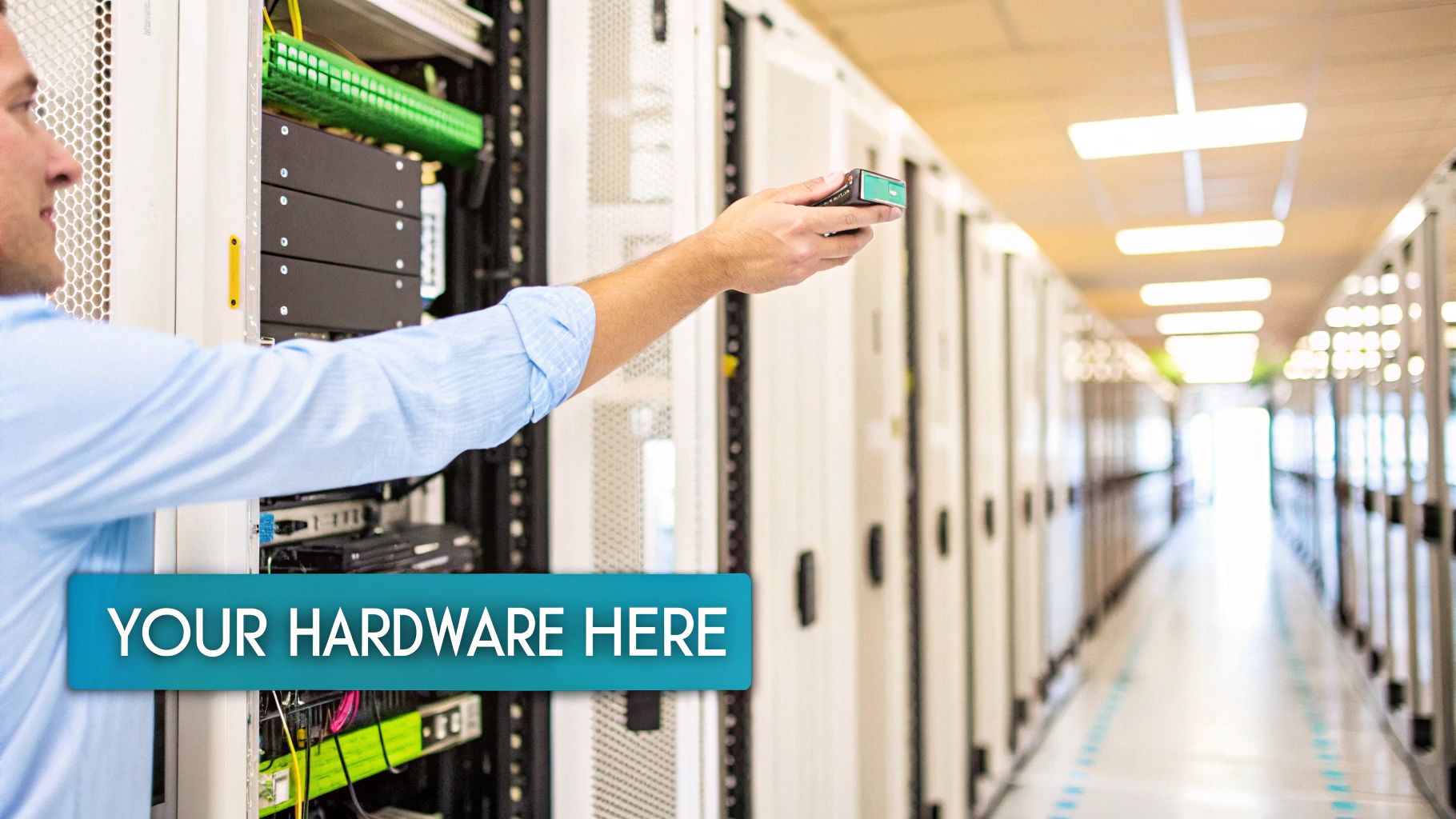
You’re not just renting a shelf; you get secure rack space, redundant A+B power feeds, advanced climate control, and multiple layers of physical security. This hands-on approach is essential for organizations facing strict compliance mandates like HIPAA or PCI DSS, where direct ownership and auditable control over the physical hardware are non-negotiable.
Deconstructing The Colocation Environment
When you opt for colocation, you’re tapping into an entire ecosystem built for peak performance and security. Understanding the infrastructure of modern data centers reveals the technical value you receive. The core components of a solid colocation service always include:
- Secure Rack Space: You lease a specific amount of vertical cabinet space, measured in rack units (U). One “U” is 1.75 inches high, letting you precisely provision space for a single 1U server or a full 42U cabinet for a complex deployment.
- Redundant Power: Facilities provide A+B power circuits from separate Power Distribution Units (PDUs), often fed by independent UPS systems and backup generators. This design eliminates power as a single point of failure.
- Advanced Climate Control: Industrial-grade HVAC systems with hot/cold aisle containment maintain precise temperature and humidity levels. This prevents thermal throttling and extends the operational lifespan of your hardware.
- Multi-Layered Physical Security: Your assets are protected by 24/7 on-site security staff, biometric access controls, video surveillance, and individually locked server cages. It’s a physically secure environment designed to meet compliance standards like SOC 2.
The primary benefit of colocation is gaining access to this certified, hardened infrastructure—an operational standard most businesses could never achieve cost-effectively on their own.
The Colocation Cost Structure
Colocation pricing is transparent and breaks down into an initial Capital Expense (CapEx) to procure your hardware, followed by a predictable, recurring Operational Expense (OpEx) for the data center services.
Key Takeaway: The monthly fee is typically based on three primary factors: the amount of rack space you use (per U or per cabinet), your power commitment (billed per-amp or per-kilowatt), and your network bandwidth consumption.
This model keeps costs transparent and simplifies budgeting once your hardware is deployed. The data center colocation market is projected to grow from USD 104.2 billion in 2025 to USD 204.4 billion by 2030 as more companies offload facility management to focus on their core business.
Why ARPHost Excels Here
While many providers offer space and power, ARPHost delivers a true infrastructure partnership. We understand your hardware is mission-critical, and our hands-on support ensures it’s always looked after by certified experts. We offer flexible colocation and hosting plans that scale with you, from a single server to multiple full racks.
Our experienced technicians can serve as your “remote hands,” performing tasks from initial racking and stacking to troubleshooting and component swaps. This hybrid approach combines the total control of ownership with the peace of mind of a managed service. For a deeper dive into what colocation involves, check out our guide on what colocation hosting is.
Exploring The Spectrum Of Managed Hosting Solutions
If colocation is about owning the hardware, managed hosting is about owning the outcome. This service-first model shifts you away from large upfront capital expenditures and hands-on maintenance to a flexible, OpEx-based solution. This approach is a game-changer for businesses that want to focus engineering talent on their applications, not on the underlying physical infrastructure.
Managed hosting solutions cover a wide spectrum, with each option fine-tuned for different performance, security, and scalability requirements. Understanding this spectrum allows you to find the perfect balance between cost, control, and convenience for any workload.
High-Availability VPS Hosting: The Agile Foundation
At the most accessible end of the spectrum is Virtual Private Server (VPS) hosting. A powerful physical server is logically partitioned using a hypervisor, and you get your own private, isolated slice with dedicated resources—CPU cores, RAM, and storage. It’s the perfect launchpad for developers, startups, and small businesses that have outgrown shared hosting but don’t yet require a full dedicated machine.
ARPHost’s High-Availability VPS Hosting elevates this model by using KVM virtualization for true hardware-level isolation, ensuring your performance is never impacted by “noisy neighbors.” Our hyperconverged infrastructure is built on a resilient CEPH storage backend, providing built-in data redundancy that protects against single points of failure. It’s an ideal environment for production websites, CI/CD pipelines, or business applications that demand high uptime.
Key Takeaway: High-Availability VPS is where affordability meets enterprise-grade reliability. You get an isolated, dependable, and instantly scalable environment, providing a powerful foundation for modern applications. For enhanced security, our Secure Web Hosting Bundles add Imunify360, CloudLinux OS, and the Webuzo control panel for a hardened, easy-to-manage solution.
Bare Metal Servers: Bridging The Gap
Moving up the ladder, we find Bare Metal Servers. This option is the perfect middle ground between the agility of virtualization and the raw, uncontended power of colocation. With bare metal, you lease an entire physical machine. There’s no hypervisor layer; your applications get direct, exclusive access to 100% of the server’s CPU, RAM, and I/O resources.
This is the definitive solution for workloads that are resource-intensive or highly sensitive to latency, such as:
- High-transaction databases (e.g., SQL Server, PostgreSQL) that require maximum IOPS.
- Big data processing and analytics (e.g., Hadoop, Spark).
- CPU-bound tasks like video encoding or scientific computing.
- High-performance game servers.
Bare metal provides the dedicated hardware of colocation without the capital expense of purchasing the server. It’s a smart, OpEx-friendly way to achieve maximum performance and security isolation. For more on outsourcing IT management, see this a comprehensive guide to Managed IT Services.
Dedicated Proxmox Private Clouds: The Pinnacle Of Control
At the top of the managed hosting spectrum are Dedicated Proxmox Private Clouds. This is the ultimate solution for organizations requiring absolute control, peak performance, and complete tenant isolation. You get a fully dedicated, hyperconverged cluster of servers, firewalls, and storage that is exclusively yours—the power of a private data center, delivered as a managed service.
Built on the powerful Proxmox VE 9 platform, our private clouds provide a complete virtualization management suite with full root access. You are free to create and manage virtual machines (KVM) and containers (LXC) with total autonomy. This is perfect for enterprises with strict compliance needs, MSPs managing multiple client environments, or businesses running complex applications in a completely segregated infrastructure. And with ARPHost’s managed services, we handle everything from initial deployment and proactive monitoring to backups and security hardening. See how our managed IT services for small business can offload your infrastructure management.
Comparing Control, Cost, And Scalability
Choosing between colocation and hosting isn’t a simple decision—it’s a series of critical trade-offs. To make the right call, you must evaluate these models across the factors that most impact your business: control, cost, and scalability.
Each path offers a distinct value proposition. This isn’t about finding a one-size-fits-all “best” option; it’s about aligning an infrastructure model with your team’s technical capabilities, your financial strategy, and your growth trajectory.
The Dynamics Of Control And Management
Control is the primary differentiator. With colocation, you have complete and total autonomy. Since you own the server hardware, you dictate every technical detail—from the CPU model and memory configuration down to the RAID level and network card firmware. This granular control is non-negotiable for companies with custom hardware needs or those bound by strict compliance frameworks that mandate physical ownership.
However, this control comes with total responsibility. Hardware lifecycle management, out-of-band access, and responding to component failures fall squarely on your team’s shoulders.
Managed hosting flips this dynamic. When you opt for an ARPHost High-Availability VPS or Bare Metal Server, you trade absolute hardware control for operational efficiency. We are responsible for the physical infrastructure, ensuring optimal performance and reliability. This frees your team to focus on higher-value tasks—your applications and data—instead of managing physical assets.
This shift from managing hardware to managing business outcomes is a strategic advantage. It allows smaller teams to leverage enterprise-grade infrastructure without needing dedicated hardware specialists on staff.
Analyzing The Financial Commitment
The financial models for colocation and hosting are fundamentally different, catering to opposite ends of the IT budgeting spectrum.
Colocation is a Capital Expenditure (CapEx) intensive model. The largest cost is the upfront procurement of server hardware, which can run into thousands of dollars per unit. After this investment, your ongoing costs for rack space, power, and bandwidth become a predictable Operational Expenditure (OpEx). For stable, long-term workloads, this can be more cost-effective over a 3-5 year horizon.
Managed hosting, in contrast, is a pure OpEx model. There are no significant upfront costs. You pay a predictable monthly fee for access to enterprise-grade hardware, making it incredibly easy for startups and SMBs to deploy powerful infrastructure without depleting capital. For organizations looking to optimize their budget, exploring IT cost optimization strategies can reveal how to best manage these recurring expenses.
Evaluating Scalability And Agility
How quickly can your infrastructure adapt to business growth? This is where the differences between colocation and hosting become stark.
- Scaling Colocation: To add capacity, you must procure a new server, configure it, and ship it to the data center for installation. The entire process can take weeks and involves significant logistical overhead. This model works for predictable, planned growth.
- Scaling Hosting: With managed hosting, scaling is often just an API call or a few clicks away. An ARPHost VPS experiencing a traffic surge can have its CPU, RAM, and storage resources increased in minutes. Deploying an entirely new Bare Metal Server can be done in hours. This agility is a competitive advantage for businesses with dynamic traffic patterns or those in rapid growth phases.
Detailed Feature And Cost Comparison
This table provides a side-by-side breakdown of the key technical and financial differences between colocation and ARPHost’s managed bare metal and VPS solutions.
| Criteria | Colocation | ARPHost Bare Metal Server | ARPHost High-Availability VPS |
|---|---|---|---|
| Initial Cost | High (CapEx) | None (OpEx) | None (OpEx) |
| Control Level | Full hardware/software | Full OS/software control | Full OS/software control |
| Management | You manage everything | ARPHost manages hardware | ARPHost manages hardware/platform |
| Scalability Speed | Slow (days/weeks) | Fast (hours) | Instant (minutes) |
| Best For | Custom hardware, compliance | High-performance workloads | Agile development, SMBs |
Ultimately, the choice between colocation and hosting comes down to what you value more: the absolute control of owning your hardware or the operational agility and efficiency of a fully managed, service-based infrastructure.
A Framework For Choosing Your Infrastructure Path
Understanding the theory behind colocation and hosting is one thing; applying it to make the right business decision is another. The best choice comes from asking direct questions about your team’s technical skills, your financial model, and your business’s growth trajectory.
This isn’t about finding the “best” option—it’s about matching an infrastructure strategy to your operational reality. Let’s walk through the key decision points to select a solution that performs today and scales with you tomorrow.
Assessing Your Team’s Expertise And Resources
First, conduct an honest internal assessment: Does your team possess the deep, hands-on expertise to manage physical server hardware, including out-of-band management, firmware updates, and component-level troubleshooting?
If the answer is a confident “yes,” colocation is an excellent option. It provides your experts with the absolute control needed to build and operate a perfectly tailored environment.
However, if your team is smaller, focused on software development, or you simply need them dedicated to revenue-generating activities, a managed hosting solution is the smarter strategic move. ARPHost’s Fully Managed IT Services can take the entire burden of hardware management, proactive monitoring, and security patching off your plate. This frees your team to innovate instead of managing infrastructure.
This decision tree helps visualize the trade-offs between control, cost, and scalability.
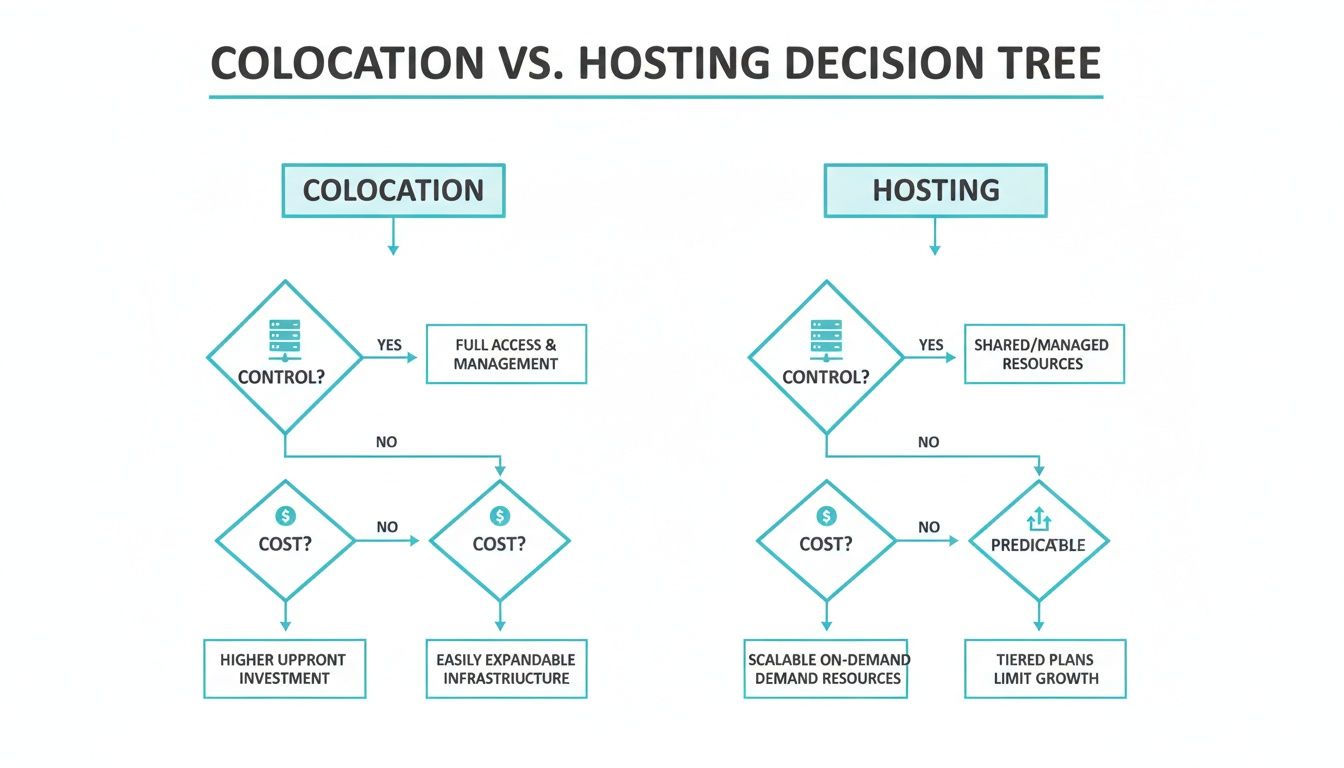
As you can see, the need for total hardware control points you toward colocation. A preference for predictable costs and the ability to scale up quickly? That’s squarely in the hosting camp.
Evaluating Your Hardware And Budget Model
Next, consider your assets and financial strategy. Do you already own a significant amount of specialized server hardware? If you’ve made a substantial capital investment, colocation allows you to maximize its value by moving it to a top-tier facility with enterprise-grade security and connectivity.
Conversely, if you’re starting fresh or want to avoid a large upfront capital outlay, the managed hosting model is the clear choice. Hosting operates on a predictable Operational Expenditure (OpEx) model, converting a large capital expense into a manageable monthly fee. This is ideal for startups and growing businesses that need to preserve cash flow for other priorities.
Consider these two real-world scenarios:
- A financial services firm with custom FPGA-based servers for high-frequency trading: For them, colocation is the only logical choice. It protects their hardware investment and delivers specific performance characteristics that cannot be virtualized.
- A fast-growing SaaS startup: An agile, OpEx-based solution like ARPHost’s High-Availability VPS Hosting is a perfect fit. They can scale resources instantly as user demand grows, without sinking capital into depreciating hardware assets.
Scaling This With ARPHost
A key benefit of partnering with a flexible provider like ARPHost is that your initial choice doesn’t lock you in permanently. Our infrastructure ecosystem is designed to support your business as it evolves, allowing you to transition between solutions as your needs change.
You might start lean with one of our Secure Web Hosting Bundles, an all-in-one solution secured by Imunify360 and managed with the user-friendly Webuzo control panel. As your application gains traction and requires more performance, you can seamlessly migrate to a powerful Bare Metal Server for dedicated resources.
From there, you could graduate to a Dedicated Proxmox Private Cloud for ultimate control and isolation, or even adopt a hybrid model that uses Colocation for specialized legacy hardware alongside a managed private cloud. This flexible pathway ensures your infrastructure always right-sizes to your business needs.
Ready to find your starting point? Explore our Secure VPS Bundles at arphost.com/vps-web-hosting-security-bundles/ and launch a powerful, protected environment today.
Your Migration And Deployment Checklist
Selecting your infrastructure model is the first step; executing a flawless transition is the second. A well-planned migration minimizes downtime, ensures data integrity, and validates that your new environment is performant from day one.
Whether you’re physically moving servers into a colocation facility or migrating applications to a managed platform, a structured, step-by-step approach is critical. Success hinges on meticulous preparation—from auditing your current environment to defining a clear rollback strategy.
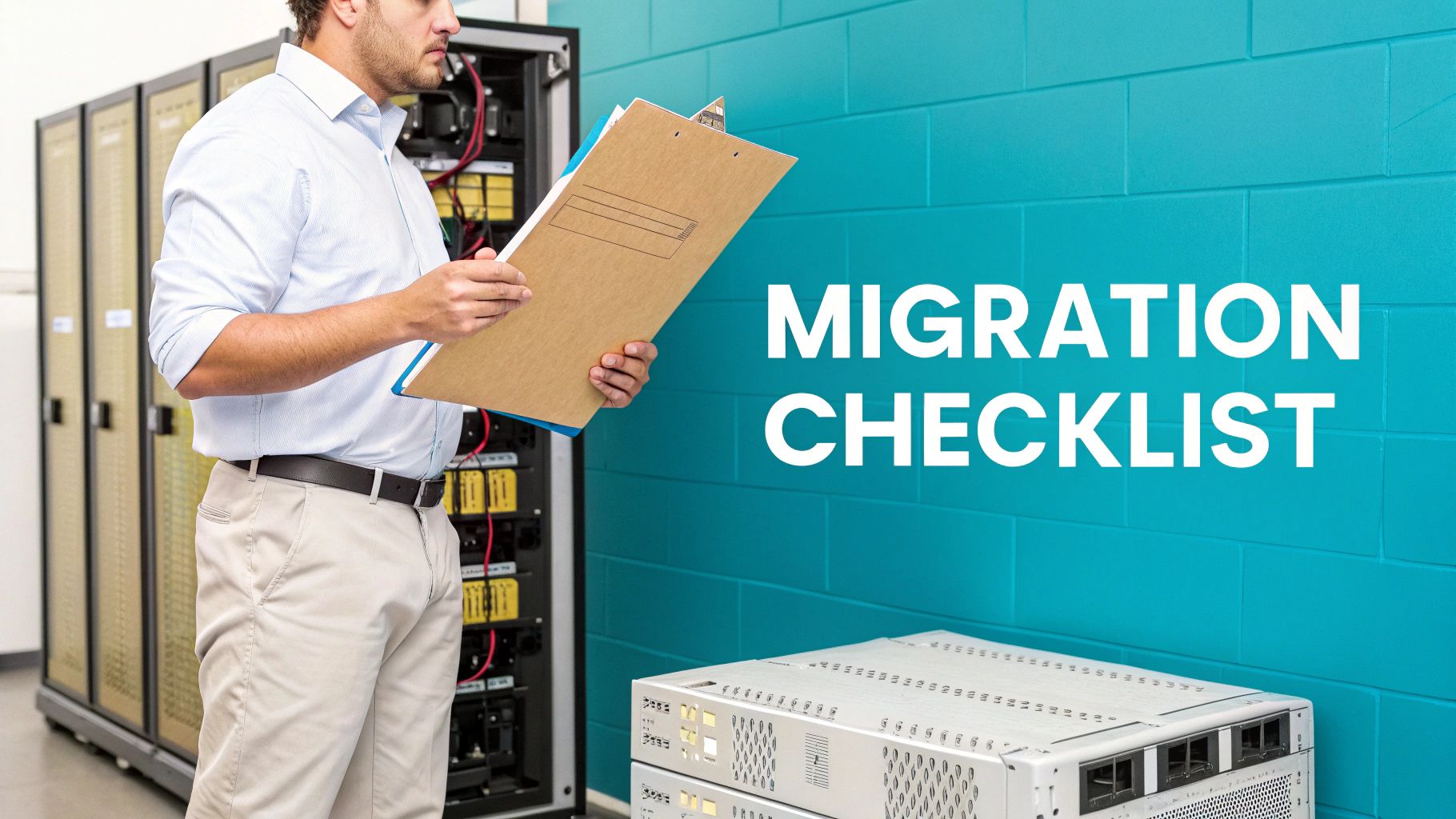
The Colocation Migration Checklist
Moving physical hardware is a logistics-heavy operation focused on the equipment itself and coordination with data center staff.
- Hardware & Asset Audit: Create a detailed inventory of every server, switch, and PDU to be moved. Document serial numbers, configurations, and rack unit (U) height for each asset.
- Rack Elevation Planning: Diagram your target rack layout in advance. This plan should optimize airflow (hot aisle/cold aisle) and balance power loads across A and B circuits to prevent overloads.
- Logistics Coordination: Schedule delivery with the data center’s receiving team. Confirm the process for site access, security clearance, and available tools (e.g., server lifts).
- Pre-Cabling & Labeling: Label both ends of every power and network cable before unplugging anything. This simple step can save hours of troubleshooting during re-racking.
- Installation & Testing: Once racked, methodically connect power and network cables according to your diagram. Power on devices sequentially, verifying network connectivity and remote access (e.g., IPMI/iDRAC) before concluding the installation.
The Managed Hosting Migration Checklist
Migrating to a hosted service like a VPS or private cloud shifts the focus from physical logistics to data and software configuration.
- Establish a Performance Baseline: Before migration, benchmark your application’s performance (e.g., response time, throughput) in its current environment. This data will be crucial for post-migration validation.
- Data Migration & Synchronization: Use tools like
rsyncfor file-level transfers or native database replication to move your data. A common strategy is to perform a large initial sync followed by smaller, incremental updates to minimize the final cutover window. For example, to sync a web directory:# Perform initial sync, preserving permissions and ownership rsync -avz -e "ssh" /path/to/local/webroot/ user@new_server_ip:/path/to/remote/webroot/ - Application Configuration & Testing: Replicate your application stack in the new environment. Use a staging URL to conduct thorough testing and ensure all dependencies and configurations are correct.
- DNS & Traffic Cutover: Plan your DNS switch carefully. Lower the Time-to-Live (TTL) on relevant DNS records 24-48 hours in advance. This ensures that when you update the IP address, the change propagates quickly across the internet.
- Post-Migration Validation: After the cutover, monitor application logs for errors, verify all services are running, and compare performance against your initial baseline.
Key Takeaway: For complex moves, such as migrating a VMware environment to Proxmox VE, expert assistance is invaluable. A poorly executed migration can result in extended downtime and data loss, turning a strategic upgrade into a costly failure.
ARPHost’s managed migration support is designed to de-risk this process. Our experts specialize in complex projects, including migrating workloads to our Dedicated Proxmox Private Clouds, ensuring your deployment is smooth, secure, and successful.
Ready to plan a risk-free transition? Request a managed services quote at arphost.com/managed-services/ to discuss your migration project with our team.
Frequently Asked Questions About Colocation And Hosting
As you finalize your decision, several key questions often arise. Here are answers to the most common queries we receive from IT professionals, helping you lock in your infrastructure strategy with confidence.
Can I Get Help Managing My Colocated Servers?
Absolutely. While colocation is traditionally an unmanaged service, you’re never completely on your own. Most data centers offer “remote hands” services.
Think of it as having an on-site technician who acts as your extension inside the facility. They can handle tasks ranging from a simple server reboot and checking a cable connection to more complex operations like swapping a failed hard drive or memory module. At ARPHost, our 24/7 remote hands support provides a crucial safety net, giving you expert help right when you need it without the cost of dispatching your own engineers.
How Does Billing Work For Colocation Versus A VPS?
The billing models are fundamentally different and align with distinct financial strategies.
- Colocation: Billing is component-based, typically with three main parts: physical rack space (per “U” or per cabinet), committed power draw (billed in amps or kW), and internet bandwidth usage. After the initial hardware CapEx, this becomes a predictable monthly OpEx.
- VPS Hosting: This is a straightforward, all-inclusive monthly subscription. The fee covers your allocated server resources (vCPU, RAM, storage), as well as the underlying power, cooling, and hardware maintenance. It’s a pure OpEx model—like our High-Availability VPS plans starting at just $5.99/month—that simplifies budgeting and eliminates surprise costs.
What Is The Main Security Difference Between Colocation And Hosting?
The primary difference lies in the division of responsibility—the “shared responsibility model.”
With colocation, the provider is responsible for securing the physical environment. This includes multi-layered physical access controls: biometric scanners, 24/7 video surveillance, and on-site security personnel. Your responsibility begins at your server’s chassis; you are responsible for securing the operating system, applications, and data.
With a managed solution like ARPHost’s Secure Web Hosting Bundles, we are responsible for security at multiple layers. We provide the hardened data center and we actively protect your server with tools like Imunify360 for malware scanning, CloudLinux OS for tenant isolation, and proactive OS patch management. It’s a defense-in-depth strategy that protects you from the physical rack all the way up to your application code.
Ready to build a reliable and scalable infrastructure without the complexity? ARPHost provides a full spectrum of solutions, from agile VPS hosting to secure colocation, all backed by 24/7 expert support. Start with our $5.99/month VPS at arphost.com/vps-hosting/ and launch your next project today.