


For any startup, turning a killer idea into a real, growing business on a shoestring budget is the name of the game. The cloud isn't just a technical choice; it's the strategic foundation that allows you to sidestep the crippling upfront costs of hardware and adopt a pay-as-you-go model. This frees up capital for what really matters: building your product, finding customers, and scaling efficiently.
Why Cloud Hosting Is Your Startup's Competitive Edge
Every founder knows the classic dilemma: a world-changing idea meets a world-limiting bank account. In the pre-cloud era, launching a tech product meant buying, configuring, and maintaining your own expensive servers. This was a massive capital expense (CapEx) that could drain your war chest before you ever made your first sale, creating a huge barrier to entry that favored big companies with deep pockets.
Cloud hosting flips that script entirely. It turns those scary, upfront server costs into a predictable, manageable monthly operational expense (OpEx). Instead of buying a server rack, you rent the exact computing power you need, right when you need it.
This fundamental shift gives you a set of advantages that define modern, agile companies:
- Financial Agility: By avoiding huge hardware bills, you can pour your limited funds into building a better product, marketing it, and hiring the right people.
- Speed to Market: Forget waiting weeks for servers to arrive. With one-click installers like ARPHost's instant applications available through the Webuzo control panel, you can deploy a fully configured environment for WordPress or Magento in minutes, not months.
- Effortless Scalability: When your user base explodes, your infrastructure can grow with it. A few clicks in your control panel can add more RAM, CPU, or storage, ensuring your app doesn’t crash under the weight of your own success.
- Built-in Reliability: Reputable cloud providers build their data centers with layers of redundancy (power, network, cooling) to ensure high availability. Replicating that kind of uptime on your own would be prohibitively expensive for a single startup.
The New Standard for Business Growth
Moving to the cloud isn't a niche strategy anymore—it's the default playbook for successful businesses. Industry data projects that by 2026, a staggering 94% of enterprises will rely on cloud services, with startups leading the charge to gain an edge. It's a proven ecosystem where nimble teams can launch fast, with an estimated 72% of all workloads running in the cloud by 2025. This isn't just a trend; it's the engine for modern growth. You can explore more on these cloud computing statistics to see the full picture.
For a startup, cloud hosting isn’t just an IT decision; it's a core business strategy. It provides the technical foundation to compete with incumbents by enabling faster innovation, operational resilience, and capital efficiency from day one.
At ARPHost, we've built our hosting solutions to solve these exact problems. Whether you're launching an MVP on a budget-friendly Secure Web Hosting Bundle or preparing to scale with a Dedicated Proxmox Private Cloud, our platforms provide the power and flexibility to grow. You get the agility of the cloud backed by dedicated hardware and 24/7 expert support—the ideal foundation for your ambitious journey.
Ready to build your foundation? Start with our high-performance VPS hosting plans from just $5.99/month at arphost.com/vps-hosting/.
Decoding Your Cloud Architecture Options
Picking the right cloud model for your startup can feel like a huge decision, but it all comes down to a trade-off between cost, control, and performance. To make sense of it, let's use a simple analogy: real estate. Choosing your infrastructure is like picking a place for your business to live and grow.
The Public Cloud, think AWS or Azure, is like renting a spot in a massive, bustling apartment complex. It’s affordable and packed with shared amenities. But you’re sharing the building with tons of other tenants. This can lead to "noisy neighbor" issues that hit your performance, and you have zero say over the building's rules or hardware.
For a startup, the right cloud choice is the bedrock that connects big ambitions with the reality of limited capital.
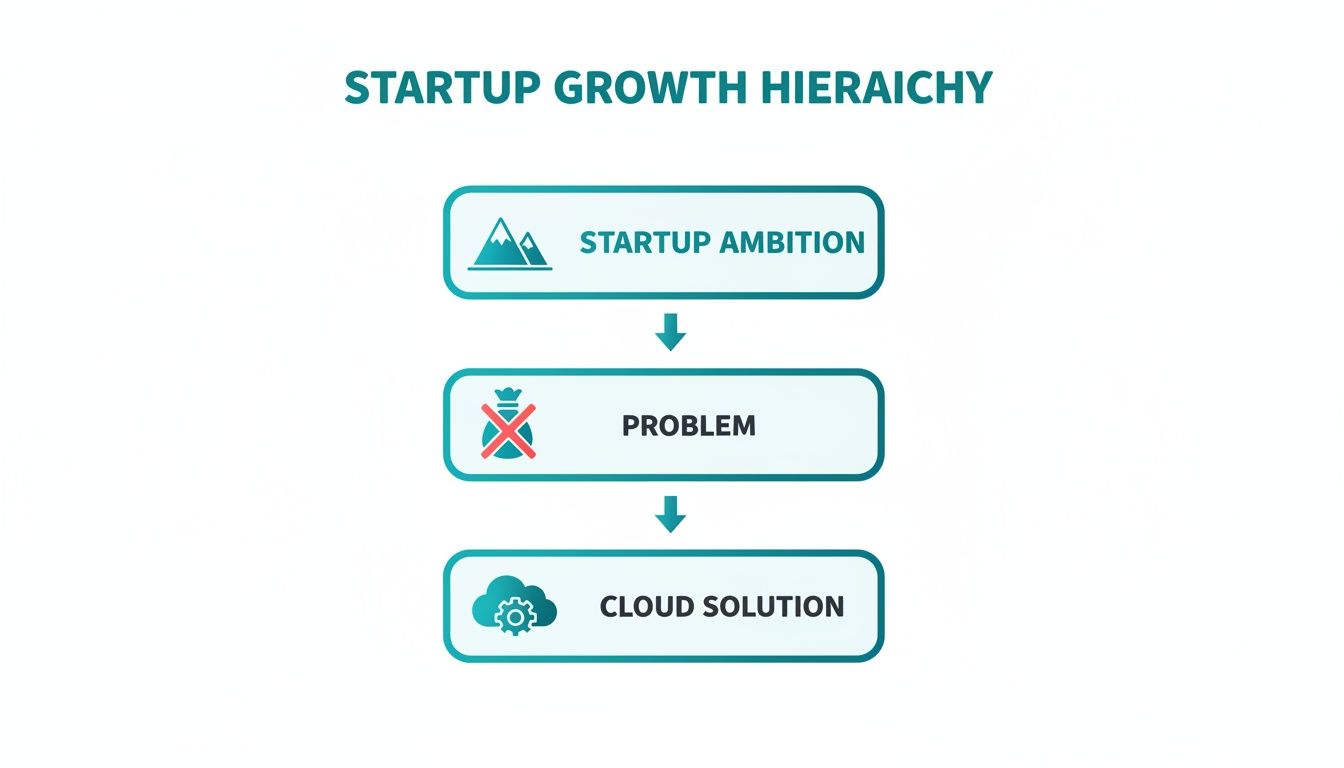
As you can see, the cloud isn’t just about servers; it’s the solution that makes sustainable growth possible when ambition is high but cash is tight.
Private, Hybrid, And Proxmox Clouds
A traditional Private Cloud is the equivalent of building your own custom-designed headquarters. You get absolute control, unmatched security, and guaranteed performance. This is perfect for startups handling sensitive data or needing rock-solid resource allocation. The catch? The massive upfront cost and complexity have always put it out of reach for most.
Then there’s the Hybrid Cloud, which aims for the best of both worlds. It’s like owning that secure custom home (your private cloud) but also leasing a flexible downtown office (the public cloud) for specific projects. It gives you great flexibility, but juggling both can add a serious layer of management complexity.
This is where a game-changing option comes in: the Dedicated Proxmox Private Cloud. Think of it as the "affordable custom headquarters" in the cloud world. You get the dedicated hardware, full root access, and iron-clad security of a private cloud, but without the astronomical price tag. We’re talking a high-performance cluster starting at just $299/month. You get a dedicated environment built on platforms like Proxmox, giving you the power to manage your own virtual machines (VMs) and containers without sharing resources.
Comparing Your Architectural Options
To make the right call, you have to map each model to what your startup actually needs in terms of cost, control, and future growth. The perfect architecture for an early-stage MVP is going to look completely different from what a scale-up needs to handle enterprise data.
This table breaks down the core differences to help you see where your startup fits.
Cloud Hosting Models Compared For Startups
| Hosting Model | Best For | Cost Structure | Control & Customization | Key Advantage |
|---|---|---|---|---|
| Public Cloud | MVPs, non-sensitive workloads, and unpredictable traffic spikes. | Pay-as-you-go, but can become expensive at scale. | Low control over underlying hardware and environment. | Maximum flexibility and lowest initial barrier to entry. |
| Private Cloud | Sensitive data (e.g., finance, healthcare), and performance-critical applications. | High upfront and ongoing management costs. | Complete control over hardware, security, and software. | Unmatched security, performance, and customization. |
| Hybrid Cloud | Businesses needing both public cloud flexibility and private cloud security. | Complex; a mix of CapEx and variable OpEx. | High control, but requires complex orchestration. | Balances security and scalability for diverse workloads. |
| ARPHost Proxmox Private Cloud | Startups needing private cloud benefits on a budget; ideal for scaling securely. | Predictable monthly fee (OpEx); lower TCO than public clouds at scale. | Full root access to dedicated hardware and Proxmox VE. | Enterprise-grade control and performance at startup-friendly pricing. |
Ultimately, choosing your cloud architecture is a foundational decision. For a much deeper dive into the specifics, check out our guide on the differences between private cloud vs. public cloud. The best cloud hosting for startups is one that gives you a clear runway for growth, letting you start small and scale with confidence—without getting forced into a corner or having to re-architect everything down the line.
Managed Vs. Unmanaged Hosting: The DIY Or DFY Choice
Once you've settled on your cloud architecture, you hit the next major fork in the road: who’s going to manage this thing? This decision is huge. It dictates where your team spends its time, what your real operational costs look like, and how fast you can react when things go sideways.
The question is simple: are your engineers building your product or babysitting a server?
There’s no single right answer. It all comes down to your team’s skills, your budget, and what you’re trying to achieve. Let’s break down what each path really means.
The Unmanaged Path: DIY Infrastructure
Going unmanaged means you get the keys to the kingdom. You’re handed the raw server resources—whether it's a Bare Metal Server or a VPS—and from there, you’re on your own. For a startup stacked with deep DevOps talent, this level of total control can be tempting.
But with great power comes great responsibility. Your team is on the hook for absolutely everything.
- Security Hardening: You’re the one setting up firewalls (like UFW or firewalld), hunting for intrusions, and locking down the OS.
- Software Updates & Patching: Your team has to constantly scan for new vulnerabilities (
apt update && apt upgradeoryum update) and apply critical patches to the OS and all server software. - 24/7 Troubleshooting: When the server crashes at 3 AM or a performance bottleneck grinds your app to a halt, it’s your phone that rings.
- Backup & Recovery: You have to design, test, and manage a bulletproof backup strategy—and know exactly how to execute a restore when disaster strikes.
This route demands a skilled team that can afford to drop everything to put out infrastructure fires, pulling them away from building the product that actually makes you money.
The Managed Advantage: Your On-Demand Expert Team
Managed hosting is the "Done For You" alternative. You offload all those complex, time-sucking tasks to your hosting provider. Think of it as having an expert IT department on retainer for a fraction of what it would cost to hire one in-house. This is the go-to model for lean startups that need every engineer focused on one thing: the core product.
With managed services, you turn unpredictable firefighting into a predictable monthly cost. Your team gets to keep 100% of its focus on innovation and shipping features—the lifeblood of any startup.
ARPHost's Fully Managed IT Services are built to be an extension of your own team. We handle the proactive monitoring, security, and performance tuning so you never have to think about it. It’s not about just fixing things when they break; it's about making sure they don't break in the first place. You can see a detailed breakdown in our guide on managed vs. unmanaged VPS hosting.
Why ARPHost Excels Here: Managed Hosting ROI
Partnering with ARPHost for managed hosting gives you a serious leg up on the competition. Here’s how our services solve real-world problems for startups:
- Proactive Security: Our Secure Web Hosting Bundles come standard with Imunify360 and CloudLinux OS. They automatically protect, detect, and clean malware while isolating tenants to stop one bad actor from affecting everyone else.
- 24/7 Expert Support: Our U.S.-based team is always on deck to handle anything from routine updates to full-blown emergencies. Your infrastructure stays stable and performant, day or night.
- Worry-Free Maintenance: We manage all OS patching, security updates, and performance monitoring. We also manage your network stack, including Juniper firewalls and switches, and can even administer your Virtual PBX phone system. This frees your developers from the operational grind and lets them get back to coding.
This approach delivers a much higher ROI because it maximizes your team’s productivity. Instead of fighting with server configs, your developers are shipping features, squashing bugs in your app, and driving real business growth.
Ready to offload server management and get back to building what matters? Request a quote for our Fully Managed IT Services and let us handle the heavy lifting.
Choosing Your Infrastructure Foundation
Once you've settled on your architecture and management style, it's time to pick the engine that will actually power your startup. This is the foundation—the hardware and virtualization combo running your application. Getting this right is crucial for balancing today's budget with tomorrow's growth, and each option lines up perfectly with a specific stage of a startup's journey.
Your main choices boil down to a Virtual Private Server (VPS), a Bare Metal Server, or a full-blown Private Cloud. Let's walk through when and why you'd pick each one, mapping them to how a typical startup grows.
VPS Hosting: The Agile Starting Point
For most startups, a Virtual Private Server (VPS) is the perfect launchpad. Think of it as your own dedicated slice of a much bigger, more powerful physical server. You get your own isolated operating system, RAM, and CPU resources, giving you the sweet spot between flimsy shared hosting and the cost of a dedicated server.
ARPHost's High-Availability VPS plans run on KVM (Kernel-based Virtual Machine) virtualization, which creates true hardware-level isolation. That means your performance won't get dragged down by "noisy neighbors" on the same machine.
- Best for: MVPs, web applications, development/staging environments, and e-commerce sites.
- Key Advantage: You can get online in minutes for a low cost and scale up with a few clicks when traffic starts rolling in.
This is where most startups begin. An ARPHost KVM VPS starting at just $5.99/month packs more than enough punch to launch your product and handle your first wave of users without draining your bank account.
Bare Metal Servers: For Raw Power
As your startup finds its footing and grows, you might hit a point where the virtualization layer itself becomes a bottleneck. Some jobs just need all the power they can get. We're talking about resource-hungry workloads like AI/ML model training, big data analytics, game servers, or databases under heavy fire.
This is where Bare Metal Servers come in. You get an entire physical server, all to yourself. There’s no hypervisor skimming resources off the top, so your application gets 100% of the CPU, RAM, and disk I/O. The result is pure, predictable performance and low latency, which is non-negotiable for those demanding tasks. You might move a single, overworked database to a bare metal server to unblock your entire application.
The Ultimate Goal: A Proxmox Private Cloud
For startups that are scaling fast and need enterprise-grade control, a Dedicated Proxmox Private Cloud is the end game. This setup gives you the best of both worlds: the raw power of bare metal combined with the flexibility of your own private, virtualized environment. You get a cluster of dedicated servers running Proxmox VE 9, letting you create and manage your own VMs and containers like a pro.
Here’s a glimpse of the control panel you'd get with an ARPHost Proxmox Private Cloud.
This single dashboard gives you a complete, at-a-glance view of your entire cluster's health, from CPU load to storage space, so you can stay ahead of any issues. A Proxmox cluster lets you consolidate workloads, set up high availability, and manage your infrastructure with the efficiency of a big cloud provider—but with the security and cost control of your own hardware.
This shift to cloud-native platforms is happening fast. By 2026, a staggering 95% of new digital workloads will be built on them, a huge jump from just 30% in 2021. For a startup, that's a massive competitive edge. It's also why 87% of businesses are already using hybrid and multi-cloud strategies for better flexibility. You can review more details about these cloud computing trends to see where the market is headed.
Why ARPHost Excels Here
ARPHost offers a seamless growth path from a single VPS all the way to a multi-node Proxmox cluster. We only use dedicated, enterprise-grade hardware—never oversold consumer-grade parts. Our expert team also provides managed migration support to move you from your old setup, including tricky VMware to Proxmox 9 migrations, ensuring a smooth transition as your startup takes off.
Whether you're starting lean or gearing up for massive scale, the right foundation is here.
Explore your next step. View our Dedicated Proxmox Private Cloud plans at arphost.com/proxmox-private-clouds/ today.
Essential Security And Backup Strategies
For a startup, a data breach isn't just a bad day—it's an extinction-level event. Losing customer data or your own intellectual property can destroy your reputation and sink the company before you’ve even found your footing. This is why building a fortress around your infrastructure isn't just an expense; it’s a non-negotiable insurance policy for your future.
Effective security is never about a single tool. It's about a layered defense that protects everything from the network edge right down to your application code. You need to think like an attacker and close every possible door. And while you're focused on your own stack, it's wise to stay informed about more general security concerns to ensure a well-rounded strategy.

Proactive Threat Defense With Managed Security
Your first line of defense is at the network perimeter. A managed firewall is your digital gatekeeper, inspecting all incoming and outgoing traffic before it ever touches your servers. At ARPHost, our managed network services run on enterprise-grade Juniper hardware, giving you a robust front line against malicious actors from day one.
But firewalls are only the beginning. The operating system and applications themselves are huge targets. This is where automated security suites become a game-changer for a lean startup.
For a startup, every hour spent on manual security tasks is an hour not spent building your product. Automated, managed security tools give you enterprise-grade protection without the enterprise-level headcount.
Our Secure Web Hosting Bundles are built around this idea, integrating two powerful tools to automate your defense:
- Imunify360: Think of this as an all-in-one security guard for your web applications. It uses a multi-layered approach with a web application firewall (WAF), malware scanning, intrusion detection, and proactive defense to block attacks in real-time.
- CloudLinux OS: This hardened operating system creates isolated Lightweight Virtual Environments (LVEs) for each user account. If one account on a server is somehow compromised, the infection is contained and can't spread to your other projects or consume all server resources.
Bulletproof Your Data With The 3-2-1 Backup Rule
Even with the world's best security, you have to plan for the worst-case scenario. A robust backup strategy is your ultimate safety net, whether you're facing hardware failure, an accidental "delete" command, or a ransomware attack. The industry-standard approach here is the 3-2-1 backup rule.
- Three Copies: Keep at least three complete copies of your critical data.
- Two Media Types: Store those copies on at least two different types of storage (e.g., local server disk and a separate cloud object store).
- One Off-Site Copy: Make sure at least one of those copies is stored in a completely different physical location.
This strategy ensures that a single point of failure—like a fire in the data center or a ransomware variant that encrypts your live server—can't wipe you out completely. That off-site copy is your lifeline. To go deeper on this, check out our guide on modern immutable backup solutions.
Why ARPHost Excels Here
We make implementing the 3-2-1 rule dead simple with our Proxmox Backup as a Service. We create encrypted, immutable backups of your servers and store them in a secure, off-site location, checking all the boxes for you.
Here’s a quick overview of how you'd configure a backup job in the Proxmox interface:
# This is a conceptual CLI example for a Proxmox Backup Server job
# Defines a backup job named 'daily-vm-backups'
# Runs daily at 2:00 AM
# Includes all guest VMs
# Excludes a specific temporary VM (vmid 105)

backup:
  - id: daily-vm-backups
    schedule: "daily at 02:00"
    vms: all
    exclude: 105
    enabled: 1
The key word here is "immutable." It means the backups cannot be altered or deleted, even by an attacker who gains root access to your live systems. This makes it your ultimate defense against ransomware. With our managed services, we handle the entire process, so you can be confident your data is always protected and ready for a rapid restore when you need it most.
Putting It All Together: Startup Configurations And Use Cases
Theory is great, but a practical blueprint is what gets you launched. Let's take all the concepts we've covered and map them to real-world startup scenarios. The right infrastructure from day one can be the difference between burning cash and building a powerful foundation for growth.
Below are three common startup stages and the ideal ARPHost configuration for each. This isn't just about where you are now; it's a clear growth path from launch to scale. As you grow, your setup will need to adapt, and you can get a deeper look at those strategies in this guide on scaling startups.
Scenario 1: The Bootstrapped SaaS MVP
You're a small, sharp team with a killer idea and a shoestring budget. Your only goals are getting a minimum viable product (MVP) to market fast, keeping costs rock-bottom, and being secure from the start. You don't have time to be a sysadmin.
- Recommended Solution: ARPHost Secure Web Hosting Bundle or a High-Availability KVM VPS.
- Key Features: These plans hit that perfect sweet spot between cost and power. You get instant deployment with the Webuzo control panel, automated protection with Imunify360, and the resource isolation of CloudLinux OS.
- Starting Cost: Kicks off at just $5.99/month.
- Why It Works: This is your secure, low-cost launchpad. It handles the essentials so you can focus on your product, and it’s ready to scale up the second your user base starts to climb.
Scenario 2: The Data-Intensive AI Startup
Your startup is all about heavy data processing, training machine learning models, or running complex analytics. You need raw, unthrottled performance and low-latency I/O that a shared or virtualized environment just can't guarantee. Every millisecond counts.
- Recommended Solution: ARPHost Bare Metal Server.
- Key Features: You get 100% dedicated access to the server's CPU, RAM, and storage. There's no hypervisor overhead, no "noisy neighbors"—just pure hardware performance.
- Starting Cost: Highly competitive pricing for true enterprise-grade hardware.
- Why It Works: It delivers the brute force needed for demanding workloads. When your needs evolve, it can be seamlessly integrated as a powerful node in a future Proxmox private cloud cluster.
Scenario 3: The Established Scale-Up
You've hit product-market fit and the growth curve is steep. Now, you're focused on rapid scaling, tightening security for sensitive customer data, and getting a handle on costs before the public cloud bills get out of control.
- Recommended Solution: ARPHost Dedicated Proxmox Private Cloud.
- Key Features: Starting at just $299/month, you get a dedicated cluster with full root access to Proxmox VE 9. This lets you build and manage your own high-availability VMs and containers with total control.
- Why It Works: It gives you the power and security of a private cloud but with a predictable operating expense (OpEx). You get a much lower total cost of ownership (TCO) at scale, building a resilient, high-performance business without the billing surprises.
No matter where you are on your journey, ARPHost provides the dedicated hardware and 24/7 expert support to be your long-term infrastructure partner.
Ready to build your ideal infrastructure? Explore our Secure VPS Bundles at arphost.com/vps-web-hosting-security-bundles/.
Your Top Questions, Answered
When founders talk to us about cloud hosting, the same questions always come up. Let's get right to it—here are the straight answers on cost, migration, and what it really takes to get your infrastructure right.
How Much Should A Startup Budget For Cloud Hosting?
Your cloud budget should grow with you, not ahead of you. The biggest mistake we see is over-provisioning—paying for power you don’t need yet. When you're just launching an MVP, a simple and affordable solution like ARPHost's KVM VPS starting at $5.99/month is plenty.
As you gain traction, your costs will naturally follow. This is a key part of scaling startups effectively. A growing app might shift its database to a beefier Bare Metal Server for performance, and eventually, it makes sense to consolidate onto a Dedicated Proxmox Private Cloud (starting at $299/month) for ultimate control and long-term savings. The best part? Unlike the confusing, metered billing of the big public clouds, our pricing is transparent and predictable. You'll always know what you're paying.
Can I Migrate My Existing Application To ARPHost?
Yes, and we’ll handle it for you. Migrating an existing app, database, or your entire server setup is a core part of our fully managed IT services. We make sure the transition is smooth, with as little downtime as humanly possible.
We’ve seen it all, and we specialize in the tricky stuff, like a full VMware to Proxmox 9 migration. Our team takes care of the technical heavy lifting so your developers can keep their focus where it belongs: on your product. We’ll get your environment cloned and running perfectly on our platform.
What Makes Your High-Availability VPS Different?
A standard VPS lives on a single physical machine. If that hardware goes down, so does your app. It's a single point of failure that no production workload can afford. Our High-Availability (HA) VPS plans are built to eliminate that risk entirely.
Our HA VPS architecture is built on a robust KVM-based platform with a distributed CEPH storage backend. If the physical node your VPS is running on fails, our system automatically and instantly restarts your virtual server on another healthy node in the cluster, ensuring maximum uptime for your business-critical applications.
In short, if a server fails, your VPS just reboots on another one and keeps on running. It’s the uptime assurance you need for serious business.
Do I Need In-House IT Staff To Use Your Services?
Not at all. While our unmanaged plans are a great fit for teams with serious DevOps chops, our fully managed IT services are designed to be your expert IT department, available on demand.
This isn't just basic support. We're talking proactive server monitoring, patch management, advanced security with Imunify360, Juniper network device administration, and even Virtual PBX phone system management. We manage the infrastructure so your team can put 100% of its time into building and growing the business.
With ARPHost, you’re not just renting a server; you're gaining an infrastructure partner who's invested in your success. Ready to simplify your IT and get back to building? Request a quote for our fully managed services at arphost.com/managed-services/.