

When you move to the cloud, you're not just changing where your servers live—you're redrawing the entire security map. The biggest technical challenges we see are data breaches, persistent misconfigurations, shaky identity and access controls, supply chain attacks, and the endless maze of regulatory compliance.
These aren't just technical buzzwords; they represent real threats that can lead to serious financial loss and bring your operations to a grinding halt. That's why having a proactive, managed security plan isn't just a good idea—it's essential for any business running mission-critical workloads. This guide provides actionable steps and best practices to transform these challenges into a hardened, resilient infrastructure, leveraging the power of ARPHost's managed solutions.
Understanding the Core Cloud Security Challenges
Shifting to the cloud gives you incredible agility, but it also means the old "castle and moat" security model is dead. Your data and applications are no longer tucked safely behind a corporate firewall; they're distributed across various services, creating a much larger attack surface.
The numbers don't lie. A staggering 83% of organizations have dealt with at least one cloud security incident recently. For businesses using public clouds, the problem is often self-inflicted—an average of 43 misconfigurations per account are just sitting there, waiting to be exploited. It’s a huge, flashing warning sign for IT professionals.
Getting a handle on these threats is the first step toward building an infrastructure that can withstand an attack. For a deeper dive, check out our guide on the primary security risks of the cloud.
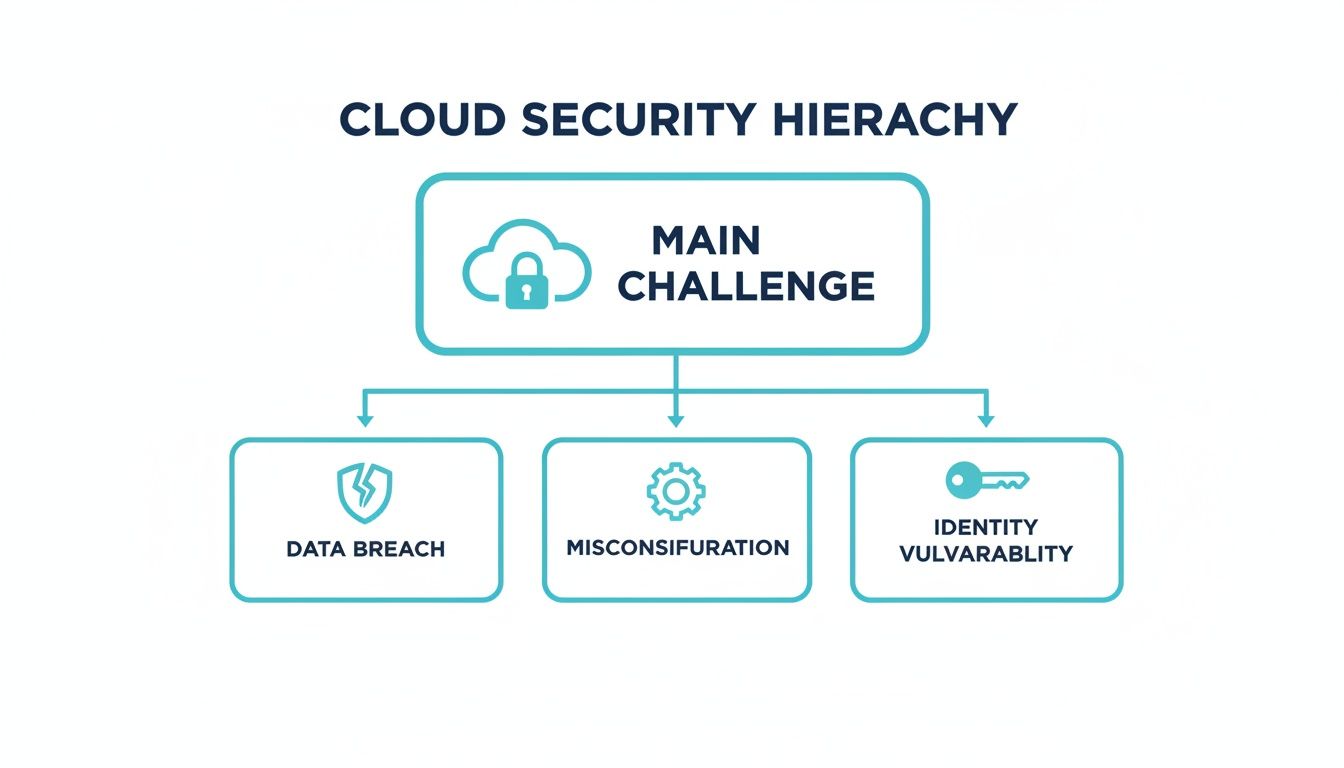
As you can see, one core problem often branches out, creating multiple points of failure that all need to be buttoned up at the same time.
Key Threats and Their Business Impact
Every one of these security challenges carries its own unique flavor of risk, from direct financial hits to the kind of reputational damage that takes years to repair. Even the migration process itself is a critical moment of vulnerability. If you're planning a move, a good SharePoint migration security guide can be an invaluable resource for locking things down.
To make this crystal clear, here’s a quick summary of the top cloud security challenges, what they can do to your business, and how ARPHost’s managed solutions are designed to stop them in their tracks.
Top Cloud Security Challenges and Their Solutions
| Security Challenge | Business Impact | ARPHost Solution |
|---|---|---|
| Data Breaches | Financial loss, regulatory fines, customer churn, and brand damage. | Dedicated Proxmox Private Clouds offer complete resource isolation, while managed backups with immutable storage provide a last line of defense. |
| Cloud Misconfigurations | Unintentional backdoors for attackers, leading to unauthorized access and data exposure. | Fully Managed IT Services include proactive monitoring and configuration hardening to prevent common errors from day one. |
| Identity & Access Risks | Compromised credentials leading to account takeovers and privilege escalation. | Managed security services help implement strong Identity and Access Management (IAM) policies, including least-privilege access on your servers. |
| Shared Environment Risks | "Noisy neighbor" issues where another tenant's breach could affect your resources. | Bare Metal Servers and Private Clouds provide single-tenant environments, completely eliminating shared infrastructure risks. |
Ultimately, a strong defense is about having the right architecture from the start and the right team to watch over it. By isolating your resources and proactively managing configurations, you can close the doors that attackers are constantly trying to pry open.
How Misconfigurations Create Hidden Backdoors
Think of a cloud misconfiguration like leaving your front door not just unlocked, but wide open. It’s not some sophisticated, targeted attack that gets you; it's a simple oversight that invites trouble. This is easily one of the most common cloud computing and security challenges out there, and it usually boils down to human error, overly complex settings, or just a lack of solid governance.
An attacker doesn't need to be a coding genius to exploit these gaps. They run automated tools that constantly scan the internet for the low-hanging fruit—things like a publicly exposed S3 bucket or a database still using its default password. Once they find one, they have a direct backdoor into your sensitive data.
The scale of this problem is massive. A staggering 68% of organizations cite cloud misconfigurations as their top security threat. To put that in perspective, this single issue was behind 23% of all cloud incidents in recent years. It’s a clear sign that these simple mistakes are leading to major breaches. You can dive deeper into these common vulnerabilities of cloud computing in our other articles.
Common Misconfigurations and Their Impact
These aren't just abstract risks; they are specific, totally preventable mistakes with devastating consequences. A single misconfigured firewall rule or an overly generous user account can instantly erase all your other security efforts.
Here are a few real-world examples that create dangerous backdoors:
- Publicly Accessible Storage: Leaving a cloud storage bucket (think S3 or Azure Blob) completely open to the internet. This is a classic blunder that has exposed everything from sensitive customer data to intellectual property.
- Overly Permissive IAM Roles: Giving users or applications far more access than they actually need. If an account with admin-level privileges gets compromised, an attacker suddenly holds the keys to your entire kingdom.
- Unrestricted Outbound Traffic: Allowing servers to connect to any destination on the internet without restrictions. This is how malware "phones home" to its command center or how an attacker quietly exfiltrates stolen data.
- Default Credentials and Weak Passwords: Failing to change the default username and password on a new database or management console. This is one of the easiest vulnerabilities for an attacker to find and exploit.
Building a strong Secure Software Development Life Cycle (SDLC) is foundational to catching and preventing these kinds of misconfigurations before they ever make it into a live environment.
A single misconfigured security group rule can expose a critical database to the entire internet. Automated scanners can find this vulnerability in minutes, turning a simple oversight into a catastrophic data breach.
From Misconfiguration to Proactive Prevention
The only real way to solve this is to stop cleaning up messes and start preventing them. This means creating secure-by-default configurations, automating your security checks, and using managed services that enforce best practices from the start.
This is exactly the principle our Secure Web Hosting Bundles at ARPHost are built on. We don't just hand you a server and wish you luck; we give you a hardened environment designed to eliminate common misconfigurations before they can ever become a problem.
This screenshot shows how our bundles integrate critical security layers like Imunify360, CloudLinux OS, and the Webuzo control panel right out of the box.
These tools work in concert to build a secure foundation. Imunify360 gives you proactive malware scanning and a web application firewall, while CloudLinux OS isolates tenants from each other, stopping one compromised account from taking down the whole server. It’s an integrated approach that closes the gaps that manual setups often leave wide open.
Why ARPHost Excels at Preventing Misconfigurations
Stopping misconfigurations requires a mix of the right technology and deep expertise. ARPHost delivers on both by baking security directly into our managed hosting solutions.
- Hardened Server Templates: Our VPS hosting plans (starting at just $5.99/month) are deployed from pre-configured templates that already follow security best practices. This slashes the risk of errors during the initial setup.
- Proactive Monitoring and Management: With our Fully Managed IT Services, our team actively watches your infrastructure for configuration drift and potential weak spots. We handle the patches and security updates so you don't have to.
- Integrated Security Tooling: Solutions like our Secure VPS Bundles come with industry-leading tools like Imunify360 already built in. This isn't some optional add-on; it's a core part of our security promise to you.
When you choose a managed provider like ARPHost, you're not just buying infrastructure—you're getting a security partner. We take on the complex, error-prone work of server hardening so you can focus on what you do best: running your business.
Ready to lock down your infrastructure? Explore our Secure VPS Bundles and build on a foundation of security.
Securing Identities in a Zero Trust World
Forget the old idea of a secure network perimeter—that castle-and-moat approach is dead in the cloud. Your infrastructure isn't a fortress anymore; it's a sprawling collection of services and data spread across the internet. In this new world, identity is the new perimeter. The most common way attackers get in isn't by smashing through a firewall. They just walk in the front door with stolen credentials.
This is a massive shift, and it makes Identity and Access Management (IAM) the absolute cornerstone of your cloud security strategy. A single weak password, an overly generous user role, or a lack of monitoring can expose everything. If an attacker nabs just one user account with too many permissions, they could own your entire infrastructure.

This is precisely where the Zero Trust model comes in. It’s a security framework built on one simple, powerful principle: never trust, always verify. It starts from the assumption that threats are already inside your network, so no user or device gets a free pass by default.
Putting Zero Trust Into Practice with Smart IAM
Adopting a Zero Trust mindset means ditching the old habit of granting broad access. Instead, you move to a granular, verification-first approach. It’s not a product you buy off the shelf; it's a strategy you live and breathe through disciplined policies and the right tools.
Here’s how to put its core principles to work:
- Enforce the Principle of Least Privilege (PoLP): This is the golden rule. Give users, apps, and services the absolute bare minimum access they need to do their job—and nothing more. If someone only needs to read logs, they should never have the power to delete a virtual machine. Simple as that.
- Make Multi-Factor Authentication (MFA) Mandatory: A password alone is just not enough anymore. Forcing MFA adds a critical second layer of defense, like a code from a mobile app or a physical key. This makes it exponentially harder for an attacker to get in, even if they manage to steal a password.
- Run Regular Permission Audits: People change roles, and projects end. Access needs change, too. You have to regularly review who has access to what. These audits are your best tool for catching and revoking stale permissions, orphaned accounts from former employees, and roles that have quietly become way too powerful.
These practices are non-negotiable for any cloud environment, but they become absolutely mission-critical when you're running something as powerful as one of ARPHost's Dedicated Proxmox Private Clouds.
Locking Down Root Access on Your Proxmox Private Cloud
A private cloud gives you the keys to the kingdom: full root access and your own dedicated hardware. That means incredible performance and control, but with great power comes great responsibility. A poorly managed root account is a catastrophic single point of failure, a common weak spot in cloud computing and security challenges that requires a disciplined defense.
Here’s a practical, step-by-step example for creating a secure sudo user on a new Proxmox host, a best practice we implement for all our managed clients:
- SSH into your Proxmox server as
root. - Create a new user account:
adduser your_admin_userFollow the prompts to set a strong password and user details.
- Grant sudo privileges to the new user:
usermod -aG sudo your_admin_user - Verify the user's sudo access:
su - your_admin_user
sudo whoami
If it returns
root, you have successfully configured the user. Now, you should disable direct root login via SSH for enhanced security.
A Zero Trust framework isn't about blocking people out; it's about making sure every single access request is legitimate, authenticated, and authorized before it's granted. It's this continuous verification that keeps your most critical assets safe.
This is where ARPHost turns raw power into a secure asset, not a liability. Our fully managed IT services team works directly with you to build and enforce strict IAM policies right on your private cloud. We’ll configure fine-grained role-based access controls (RBAC), set up non-root sudo users for daily admin tasks, and integrate logging to keep a close eye on all privileged activity.
This hands-on management lets your team use the full potential of your dedicated environment without accidentally opening the door to risk. We help you apply Zero Trust principles in a practical way, securing your infrastructure at its very foundation.
Ready to pair the power of a private cloud with expert security management? Request a quote for our managed services and let our team build a bulletproof access strategy for you.
Building a Fortress Against Data Breaches
A data breach is the ultimate digital nightmare for any business. It's not just about the eye-watering fines and recovery costs; it's about the erosion of something far more valuable: customer trust. To truly tackle the core cloud computing and security challenges, you have to think like an attacker—understand how they get in, what they do once inside, and how to build a defense that stops them at every turn.
Attackers rarely come knocking on the front door. Instead, they’re patient, looking for the digital equivalent of an unlocked window—a misconfiguration, a stolen password, or a piece of unpatched software. Once they find that small crack, they slip inside and start moving laterally, escalating their privileges and quietly mapping your network until they find what they're after: your customer data or intellectual property.
This isn't just a hypothetical problem; the threat is growing exponentially in the cloud. We've seen a 75% year-over-year jump in cloud-based intrusions, fueled by a massive rise in ransomware and phishing. By 2023, a staggering 72% of businesses globally had been hit by ransomware. Even more concerning, attackers successfully breached public cloud data in 77% of those incidents, a huge leap from previous years. These stats, pulled from recent cybersecurity research, paint a clear picture: a layered, proactive defense isn't just a good idea, it's essential. For a deeper dive into these numbers, you can discover additional cybersecurity statistics on Nu.edu.

This kind of modern security thinking is exactly what’s needed to counter sophisticated threats that easily bypass old-school perimeter defenses.
Proactive Defense Through Isolation and Segmentation
The best way to stop a breach in its tracks is to make it incredibly difficult for an attacker to move around if they do manage to get in. This is where network segmentation and resource isolation become your most powerful weapons. Instead of a flat, open network where every server can chat with every other server, you build secure, isolated zones.
This is a fundamental principle where ARPHost's Dedicated Proxmox Private Clouds give you a massive security advantage over a typical multi-tenant public cloud.
- Physical and Network Isolation: In a private cloud, your compute and storage resources are physically yours and yours alone. You aren't sharing hardware or network fabric, which completely eliminates the risk of a "noisy neighbor" incident where another tenant's breach spills over and impacts your environment.
- Granular Network Control: You get the keys to the kingdom. With full control over your virtual network, you can implement strict firewall rules and segment your workloads—for instance, walling off your public-facing web servers from the critical internal databases they talk to. This is easily configured using Proxmox VE's built-in firewall or through managed Juniper network devices.
By creating these digital bulkheads, you contain any potential intrusion to a small, manageable corner of your network, drastically reducing the blast radius of an attack.
The Last Line of Defense: Immutable Backups
Even with the best defenses, you have to plan for the worst-case scenario, especially with ransomware constantly evolving. Your backup strategy is your final and most important line of defense. The problem is, modern ransomware is smart; it's designed to hunt down and encrypt or delete your backups first, making them useless right when you need them most.
Immutable backups are your ultimate failsafe. An immutable backup cannot be altered, encrypted, or deleted by anyone—not even an administrator with root privileges—for a set period. This makes it a ransomware-proof copy of your critical data.
ARPHost’s managed backup solutions are built on this very principle. We create secure, offsite, immutable copies of your data, guaranteeing that you always have a clean, uncorrupted version ready to restore, no matter what happens to your live environment. This turns a potentially business-ending catastrophe into a manageable recovery event. For more details, you can check out our complete overview of cloud computing security risks.
Why ARPHost Excels Here: A Defense-in-Depth Strategy
At ARPHost, we don’t just plug single holes; we build a layered, defense-in-depth strategy that protects your infrastructure from every angle.
- Isolated Architecture: Our Proxmox Private Clouds and Bare Metal Servers provide the fundamental hardware and network isolation needed to stop threats from spreading laterally.
- Managed Security: We implement and manage advanced firewalls, configure intrusion detection systems, and apply proactive patch management to seal vulnerabilities before they can ever be exploited.
- Resilient Disaster Recovery: Our managed backup solutions, featuring immutable storage, provide a guaranteed recovery point, protecting you from both data loss and ransomware extortion.
This combination of an isolated environment, proactive security management, and a rock-solid recovery plan creates a true fortress around your data.
Ready for a truly secure cloud foundation? View our Proxmox Private Cloud plans starting at $299/month and build your infrastructure on dedicated, isolated hardware.
Navigating Supply Chain and Shared Environment Risks
Your cloud security is only as strong as its weakest link. The tricky part? Sometimes, that link isn't even under your roof. Two of the most subtle yet dangerous cloud computing and security challenges come from outside your own configurations: supply chain vulnerabilities and the built-in risks of shared, multi-tenant environments.
In a standard public cloud, you're sharing physical hardware with countless other customers. It’s like living in an apartment building. You can install the best locks on your own door, but you have zero control over what your neighbors are doing. A security flaw or a resource-hogging "noisy neighbor" next door can absolutely affect your performance and safety.
This shared model is the polar opposite of the complete isolation you get with dedicated infrastructure—the only real way to take multi-tenancy risks completely off the table.
The Power of True Resource Isolation
How do you guarantee other tenants can't affect you? Simple: have no other tenants. This is the core security principle behind single-tenant solutions, which carve out a private, dedicated environment just for your workloads.
- ARPHost Bare Metal Servers: You get the entire physical server. No sharing, no compromises. This means raw, uncontended performance and total hardware isolation, giving you maximum control over your security.
- Dedicated Proxmox Private Clouds: Build your own private cloud on top of dedicated hardware. It’s the best of both worlds—the security of resource isolation combined with the flexibility of virtualization. You create a secure bubble for all your applications.
By moving to a single-tenant model, the risk of a "noisy neighbor" disappears. Your resources are yours and yours alone.
Defending Against Supply Chain Attacks
A supply chain attack is a far more insidious threat. It happens when an attacker slips malicious code into a trusted piece of third-party software—a WordPress plugin, a code library, or a vendor’s update server—and uses it as a Trojan horse to get inside your system. You could have a perfectly hardened server, but one compromised dependency can bring it all down.
A supply chain attack bypasses your direct defenses by sneaking a vulnerability through a channel you already trust. This is why proactive patch management and software vetting aren't just best practices; they're critical security functions.
Let's be realistic: vetting every single software component and keeping it all patched is a monumental, full-time job. It demands a disciplined process for tracking vulnerability disclosures, testing patches, and deploying them before they can be exploited. This is where managed services become a total game-changer.
How ARPHost Shields You from Hidden Threats
For most teams, manually tracking every potential vulnerability in your software stack is flat-out impossible. ARPHost's Fully Managed IT Services are designed to offload this critical burden, providing a proactive defense against threats you might not even see coming.
Our expert team handles the entire patch management lifecycle for you. We’re constantly monitoring for new vulnerabilities in operating systems and common applications, testing patches in a safe environment, and then deploying them to your servers to close security gaps fast. This constant vigilance protects you from both direct attacks and sophisticated supply chain threats. We even offer managed VoIP administration for your Virtual PBX phone systems, ensuring every part of your IT stack, from servers to phones, is secure.
With a managed approach, your infrastructure stays secure and up-to-date, letting you get back to focusing on your business. We'll handle the complex, time-consuming work of fighting off the threats.
Ready to secure your infrastructure with expert management? Request a managed services quote and let ARPHost protect you from every angle.
Mastering Cloud Compliance and Regulations
Let's be honest: navigating the alphabet soup of compliance standards like HIPAA, PCI DSS, and GDPR can feel like one of the most draining cloud computing and security challenges out there. It’s a minefield of legalese and technical requirements.
There's a dangerous myth floating around that if your cloud provider is certified, you're automatically in the clear. That couldn't be further from the truth. Compliance is a partnership. Your provider gives you a secure foundation, but it's how you build on it—how you configure your environment and manage your data—that ultimately decides whether you pass an audit.
It all boils down to proof. Can you show an auditor you have the right controls in place? Can you prove you're enforcing them, day in and day out? The provider’s certification is just the starting line, not the finish.
Your Essential Cloud Compliance Checklist
To satisfy tough regulatory demands, you need a documented, repeatable process. While the fine print varies between standards, a solid compliance program always rests on a few universal pillars designed to protect sensitive data.
Here are the non-negotiable controls you absolutely must have in place:
- End-to-End Data Encryption: This is non-negotiable. All sensitive data has to be encrypted, both at rest (sitting on a disk) and in transit (moving across the network). It’s a foundational requirement for just about every major regulation.
- Detailed Access Logging: You must keep detailed, unchangeable logs of who touched what data, and when. These audit trails are your best friend during a forensic investigation and are the only way to prove that only authorized people are accessing sensitive information.
- Regular Security Audits: Compliance is a moving target, not a one-and-done task. You have to conduct regular internal and third-party audits to hunt for vulnerabilities, make sure your security controls are actually working, and ensure configurations haven't drifted out of spec.
These three pillars take abstract rules and turn them into concrete, defensible actions for your business.
Compliance isn't just about checking boxes to satisfy a regulator. It's about building a security-first culture where every single configuration change and access request is viewed through the lens of protecting your data. Get it wrong, and you're looking at crippling fines and a total loss of customer trust.
How ARPHost Becomes Your Compliance Partner
Getting compliance right requires two things: the right infrastructure and the right expertise. At ARPHost, we bring both to the table. Our infrastructure is built inside SSAE 18 SOC 2 Type II certified data centers, giving you a physically secure and audited foundation right out of the gate. That's a critical first step for meeting standards like HIPAA and PCI DSS.
But we go a step further. Our Fully Managed IT Services team becomes your hands-on compliance partner. We help you implement, document, and maintain the very technical controls that auditors scrutinize. From configuring managed firewalls and setting up encrypted backups to locking down access controls on your dedicated Proxmox private clouds, we do the heavy lifting.
This partnership lets you focus on running your business, knowing your environment is built and maintained to meet the strictest regulatory demands.
Ready to build an infrastructure that's compliant by design? Explore our secure Proxmox Private Cloud plans and team up with experts who get what modern regulations require.
Your Cloud Security Questions Answered
We’ve covered a lot of ground on cloud security, from common threats to architectural defenses. It's only natural that a few questions are still bouncing around. Let's tackle some of the most common ones head-on to clear things up and help you figure out the best path forward.
How Does a Private Cloud Improve Security Over a Public Cloud?
Think of it like owning a standalone house versus renting an apartment. A private cloud, like the dedicated Proxmox environments we build at ARPHost, gives you complete resource isolation. You have your own dedicated hardware, your own network, your own four walls.
In a public cloud, you’re sharing the underlying infrastructure with countless other tenants. This creates what we call "noisy neighbor" problems and, more critically, opens the door to cross-tenant breaches. A private cloud completely eliminates that risk. You get total control to build a hardened, isolated fortress tailored exactly to your security needs, without worrying about who’s living next door.
What Is the First Step an SMB Should Take to Secure Its Cloud Environment?
Before you do anything else, lock down your identity and access management (IAM). This is ground zero for cloud security.
Start by enforcing a strict 'least privilege' policy. This simple concept means people only get access to the absolute minimum they need to do their jobs—and not a single permission more. The very next step should be to turn on multi-factor authentication (MFA) for every single user and service. No exceptions.
A good managed service provider can audit your current permissions and get these foundational policies configured correctly from day one. It's one of the fastest ways to close the most common entry point attackers use. For an affordable starting point, check out our high-availability VPS hosting plans from $5.99/month, which provide a secure KVM-based platform to build upon.
How Do Managed IT Services Reduce the Risk of a Data Breach?
Managed IT services, like those from ARPHost, aren't just a safety net; they're an active defense system. We bring proactive, expert oversight to your entire infrastructure, shifting the security burden from your team to ours.
This isn't a "set it and forget it" deal. It's a comprehensive, ongoing strategy that includes:
- 24/7 Monitoring: We're always watching for suspicious activity and potential threats, long after your team has logged off.
- Proactive Patch Management: We find and fix software vulnerabilities before cybercriminals have a chance to exploit them.
- Expert Configuration: We ensure your firewalls, access controls, and security policies are implemented correctly and stay that way.
- Disaster Recovery: We manage secure, immutable backups, ensuring that if the worst happens—like a ransomware attack—you can get back up and running fast.
Ultimately, managed services mean you have a dedicated team of specialists whose only job is to keep your defenses sharp and effective around the clock.
At ARPHost, we don't just sell you infrastructure and wish you luck. We build a partnership in security. Our fully managed IT services are designed to tackle every angle of cloud security, from hardening your initial setup to constant monitoring and bulletproof disaster recovery.
Request a managed services quote today and see how our expert team can build a secure, resilient, and compliant environment for your business.