

Ever been to a major international airport? You’ve got dozens of airlines all competing under one roof, giving you the freedom to pick the best flight based on price, schedule, or loyalty points. A carrier-neutral datacenter is the digital version of that airport—it’s an independent facility where your business can connect to a huge marketplace of telecom carriers, ISPs, and cloud providers.
That freedom of choice is the bedrock of any modern, resilient, and cost-effective infrastructure. Instead of being locked into a single provider's network, you gain the flexibility to build a best-in-class, multi-homed environment that can withstand outages and scale on demand.
What Is a Carrier Neutral Datacenter?
A carrier-neutral datacenter is a colocation facility that provides direct access to multiple telecommunication carriers and network service providers. Unlike a carrier-specific facility owned by a single telecom giant like AT&T or Verizon, a neutral facility isn’t playing favorites. Instead, it fosters a competitive ecosystem where you, the customer, get to call the shots and choose the network services that make the most sense for your business.
This model is absolutely essential for modern IT, whether you're managing a rack of bare metal servers or deploying a sophisticated Dedicated Proxmox private cloud. You're no longer stuck with one carrier's pricing, performance quirks, or coverage gaps. You can mix and match providers based on cost, speed, latency, and where they can reach. That has a direct impact on your company's agility and, just as importantly, your budget.
The Power of Choice and Competition
The real magic of a carrier-neutral datacenter is the marketplace it creates. When multiple carriers are all vying for your business in the same building, it naturally pushes bandwidth costs down and drives service quality up. If you're unhappy with a provider or a better deal comes along, you can switch or add a new one without the monumental pain of physically moving your gear.
For any business that depends on rock-solid connectivity, this is a total game-changer. The benefits speak for themselves:
- Reduced Costs: You can negotiate much better rates when providers have to compete for your business.
- Enhanced Resilience: Build true network redundancy by using multiple, diverse carriers. If one goes down, you have others ready to pick up the slack.
- Future-Proof Scalability: Need more bandwidth or a new connection? You can add them on demand as your business grows.
The Standard for Modern Infrastructure
Carrier-neutral multi-tenant data centers (MTDCs) have quickly become the gold standard. They’ve captured the biggest slice of the market simply by delivering the flexibility and reliability that modern businesses need to survive and thrive. Inside these facilities, you can create direct physical links, known as cross-connects, to any provider you choose. This slashes latency and boosts security because your traffic never has to touch the public internet.
This competitive advantage is a huge reason the global data center market is booming, with some projections showing it could hit USD 646.16 billion by 2030. You can dig into more global data center trends to see why this model is dominating the industry.
This entire setup is the backbone of effective colocation, a service where you place your own servers inside a professional data center. To get a better handle on this foundational service, check out our guide on what colocation hosting is and how it works.
The Engine Room: Interconnection, Peering, and Cross-Connects
To really get why a carrier-neutral datacenter is such a big deal, you have to look under the hood—into its engine room. This is where the magic happens, built on three core concepts: interconnection, peering, and cross-connects. These aren’t just technical jargon; they are the gears that give you the flexibility, performance, and cost-savings modern businesses run on.
Think of interconnection as a private superhighway built right inside the datacenter. It’s a dedicated, physical link connecting your network directly to your cloud providers, ISPs, and partners. The key difference? It completely bypasses the congested, unpredictable public internet. The result is a connection that's faster, far more secure, and incredibly reliable.
This direct connectivity is what makes a carrier-neutral facility the central nervous system for modern IT. The whole model is built around giving you choice, which sparks competition, and ultimately builds resilience into your infrastructure.
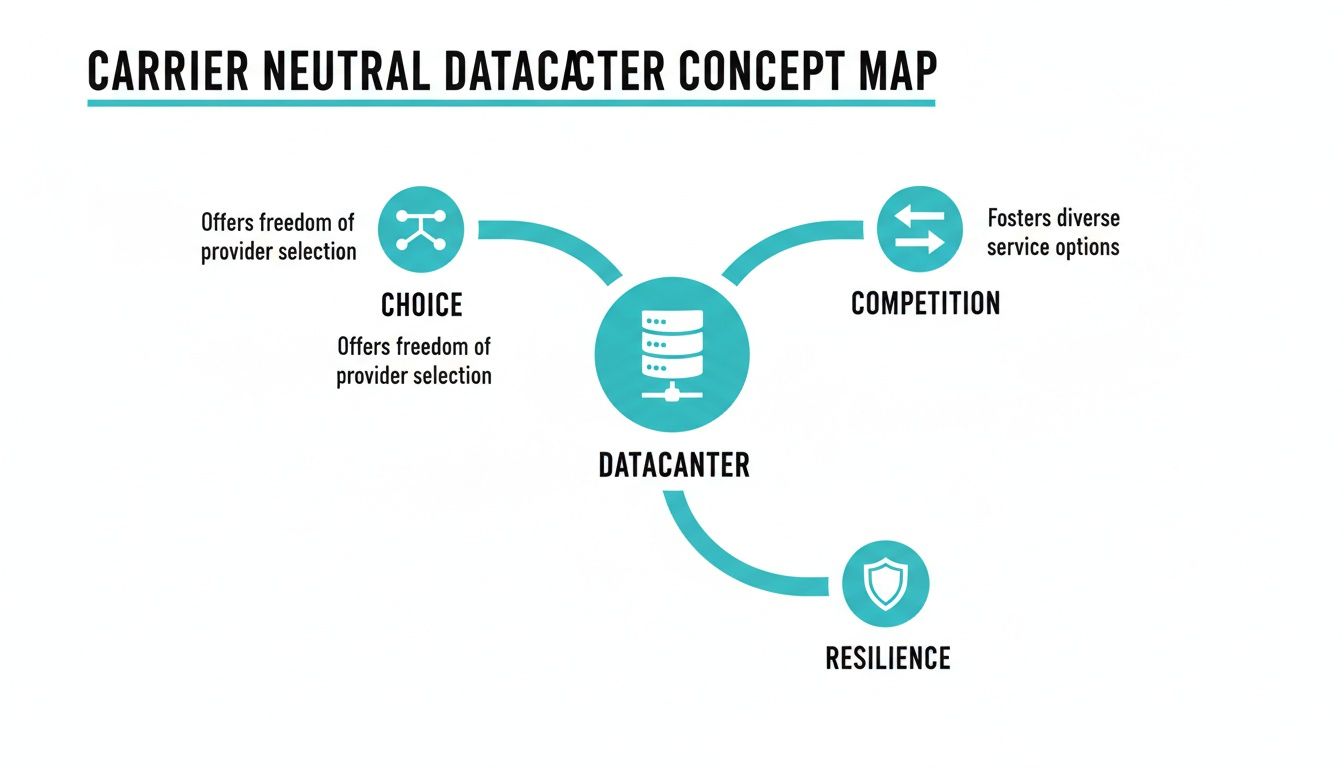
As you can see, these pillars feed into each other. The freedom to choose your carriers forces them to compete on price and performance, which in turn makes your entire setup stronger and more reliable.
Peering for Performance and Cost Savings
Peering takes the idea of interconnection one step further. It’s essentially a handshake agreement between two or more networks to exchange traffic directly, for free. By cutting out the middlemen (the traditional internet transit providers), data finds a much shorter, more efficient path.
This creates two massive advantages:
- Lower Latency: With fewer hops, data gets where it's going faster. This is a game-changer for application performance, especially for real-time services like VoIP and streaming.
- Reduced Costs: You stop paying expensive transit fees for any traffic exchanged between peered networks. Over time, these savings add up significantly.
Carrier-neutral datacenters are the perfect meeting places for this to happen. They function as major peering hubs where hundreds of networks can connect and swap traffic directly.
Cross-Connects: The Physical Link
So, how does all this digital handshaking actually happen? It comes down to a simple, physical cable called a cross-connect. It's the tangible link—usually a fiber optic or copper cable—that runs from your server rack directly to the network equipment of whichever carrier you choose, all under the same roof.
A cross-connect is what makes the entire carrier-neutral model work. It turns the abstract idea of network choice into a physical reality, giving you a direct plug into a competitive marketplace of providers.
This direct line is the secret sauce for a high-speed, low-latency environment that’s critical for demanding workloads. For ARPHost clients running high-performance hardware, this ensures applications perform at their absolute peak. When you need raw power and unrestricted traffic, options like our unmetered dedicated servers thrive in this environment, taking full advantage of the high-capacity, direct-to-carrier networking.
It's no surprise this model is booming. Market research from DataIntelo projects the carrier-neutral data center market will grow at a strong 11.3% CAGR through 2033, fueled by the relentless demand for scalable, interconnected computing.
The Real-World Business Advantages of Carrier Neutrality
Technical concepts like interconnection and peering can sound abstract, but their real value shows up on the balance sheet and in your customer's experience. Moving your gear into a carrier neutral datacenter isn’t just a tech upgrade; it’s a strategic business decision that directly impacts your costs, performance, and ability to adapt. Let’s break down the four game-changing advantages this model delivers.
Significant Cost Savings
The first and most obvious win is the impact on your network spending. By bringing dozens of carriers under one roof, a neutral facility creates a natural marketplace right where your servers live. This competition forces providers to sharpen their pencils and offer better pricing for bandwidth to earn your business.
It’s the ultimate defense against vendor lock-in and those surprise price hikes when a contract is up for renewal. On top of that, direct peering lets you sidestep expensive internet transit providers for a huge chunk of your traffic, directly cutting operational costs. This is a massive advantage for businesses pushing a lot of data, like those running media-heavy websites or large-scale apps on a secure web hosting bundle.
Superior Application Performance
In a carrier neutral datacenter, speed isn't just a feature—it’s baked into the very architecture. Direct cross-connects create the shortest, most efficient path between your servers and your network carriers. This slashes latency, which is absolutely critical for real-time applications, e-commerce checkouts, and VoIP systems like ARPHost’s Virtual PBX phone systems.
Lower latency translates into faster page loads for customers, quicker database responses, and a far smoother user experience. For any business where milliseconds matter, this performance boost is a serious competitive edge.
Unbeatable Resilience and Uptime
Real business continuity is all about eliminating single points of failure. A carrier neutral datacenter is the perfect place to build a resilient, multi-homed network architecture with several different carriers. If one of your providers has an outage or someone accidentally cuts a fiber line, your traffic can be automatically rerouted through a secondary or even tertiary carrier with zero downtime.
This kind of redundancy is next to impossible to achieve in a single-carrier facility. It provides a solid foundation for your disaster recovery strategy, ensuring your most important systems—from bare metal servers to Proxmox private clouds—stay online no matter what.
Future-Proof Flexibility and Scalability
Your business isn't static, and your infrastructure shouldn't be either. A carrier neutral datacenter gives you the agility to adapt without a painful and expensive physical migration. Need to connect to a new cloud provider? Want to switch carriers for a better deal? Scaling your bandwidth for a big launch? It's as simple as ordering a new cross-connect.
This flexibility is essential for dynamic growth. The global shift toward this model is undeniable, and the data backs it up. In booming digital economies, carrier-neutral facilities have grabbed massive market share, with one report showing their revenue growth hit a CAGR of 22.2%—more than double that of their carrier-operated counterparts.
Why ARPHost Excels Here
At ARPHost, we don’t just use any datacenters; we exclusively partner with top-tier, carrier neutral facilities for our colocation and hosting services. This deliberate choice means our clients get direct access to a rich ecosystem of network providers. Our fully managed IT services team will help you design and implement a multi-carrier strategy from the ground up, optimizing for cost, performance, and resilience to make sure your infrastructure runs at its peak.
Your Checklist for Choosing the Right Colocation Partner
Picking a colocation provider is a huge decision. It’s not just about renting space and power; it’s about finding a partner whose infrastructure directly impacts your performance, reliability, and bottom line. A top-tier carrier neutral datacenter should feel like a thriving ecosystem, not just four walls and a power outlet. This checklist covers the absolute non-negotiables—the same tough standards we at ARPHost use when we vet our own datacenter partners.
Network Ecosystem and Carrier Diversity
The whole point of a carrier-neutral facility is choice. But a long list of carrier logos on a website means nothing. You have to dig deeper to make sure you're getting genuine diversity and not a hidden single point of failure.
Get straight to the point and ask potential partners these questions:
- How many tier-1 carriers are actually on-net and serving customers right now? A list of 50 carriers is useless if only two are actively provisioned and ready to go.
- Can you show me a current carrier list and prove there are diverse physical fiber entry points into the building? This is critical. You need to confirm that a single backhoe digging up the street won't sever multiple "diverse" carriers that all come in through the same conduit.
- What are the real costs and average setup times for cross-connects? Shady providers love to hide fees here. Opaque pricing or month-long delays can completely wipe out the cost savings you were hoping for.
A rich, truly diverse network ecosystem is what lets you build resilient connectivity for everything from a single secure web hosting bundle to a complex Dedicated Proxmox private cloud.
Physical and Digital Security Measures
Your hardware is one of your most valuable assets. The facility you trust to protect it needs to have iron-clad security protocols—both physical and digital—that are verified by independent auditors, not just their own marketing team.
One of the first things to look for is a commitment to internationally recognized standards. Achieving ISO 27001 certification, for example, shows they take information security management seriously.
Your security checklist must include:
- Multi-Factor Access Control: Don't settle for less than three layers. Think biometric scanners, keycard access, and a manned security desk that actually checks IDs.
- Comprehensive Surveillance: We're talking 24/7/365 video monitoring covering every critical area—cages, racks, and all the way out to the property line.
- Compliance and Audits: Ask for their latest reports. A SOC 2 Type II certification is a great sign, as it audits their controls over a period of time, not just on one good day.
Power and Cooling Redundancy
Uptime is everything. The datacenter's power and cooling systems have to be built to handle equipment failures and even city-wide power outages without your gear ever skipping a beat.
It's important to understand the jargon here. N+1 redundancy means they have one extra component (like a generator or AC unit) for backup. 2N means the entire system is fully mirrored. For mission-critical workloads, 2N is the gold standard you should be looking for.
Make sure the provider backs up their promises with a strong Service Level Agreement (SLA) that guarantees enterprise-grade uptime.
On-Site Support and Remote Hands
Sooner or later, you'll need someone on-site to push a button or swap a drive. The quality of a provider’s "remote hands" service can be the difference between a five-minute fix and a five-hour outage. Vet their support team’s expertise, their availability, and what their response time guarantees are within the SLA.
ARPHost’s colocation services are built exclusively on partnerships with facilities that meet these tough criteria. Our team has been through this process countless times, and we can help you cut through the noise to find the perfect home for your infrastructure.
Ready to find an enterprise-grade home for your infrastructure? Discuss your colocation requirements with an ARPHost expert today.
Unifying Your Hybrid Cloud with Carrier Neutral Colocation
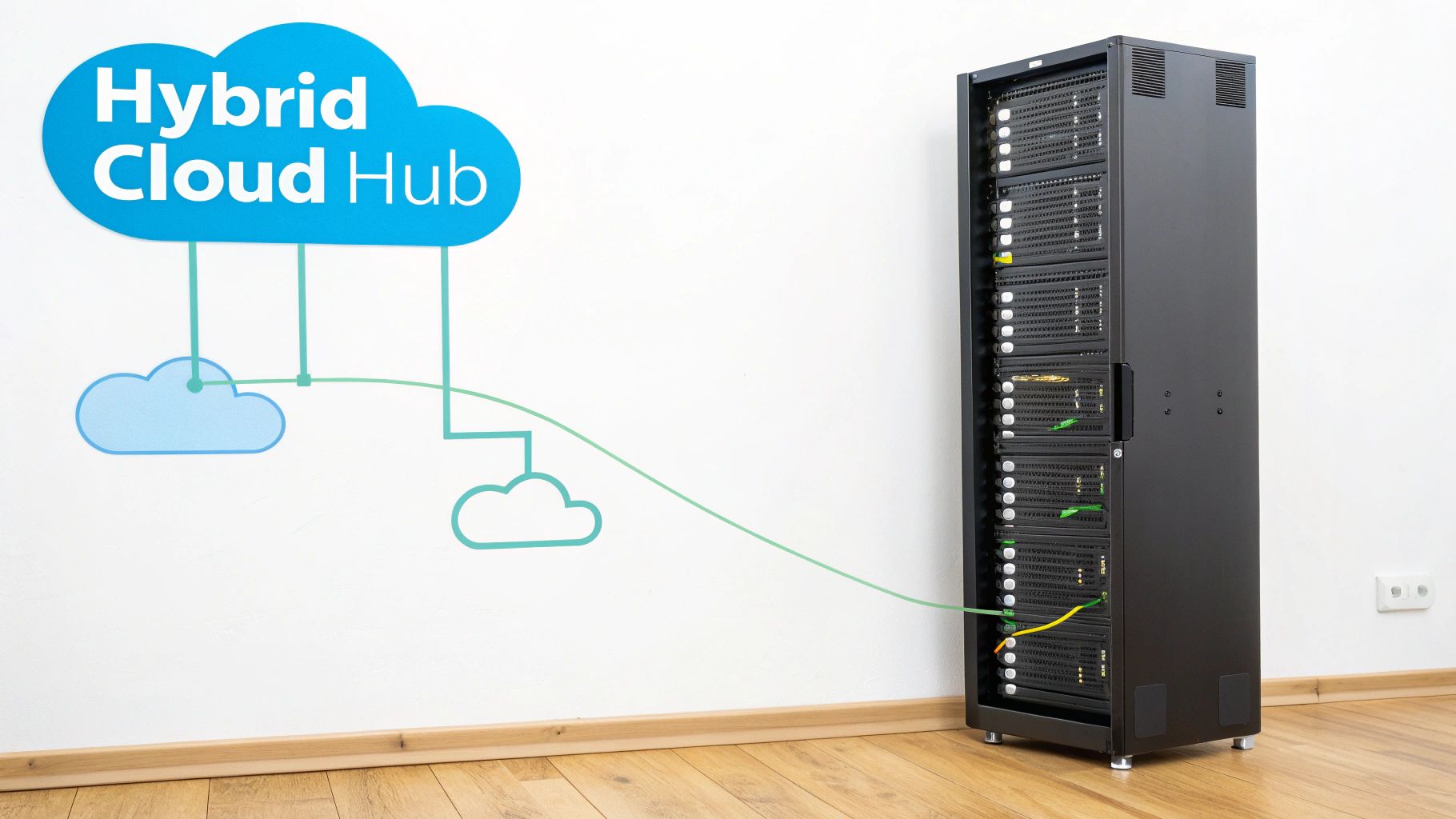
A carrier neutral datacenter is the perfect meeting point for a modern hybrid or multi-cloud strategy. Instead of seeing your on-premise gear and public cloud accounts as separate islands, think of colocation in a neutral facility as the bridge that connects them all into one unified IT environment. This is absolutely critical for any business needing the control of a private cloud with the raw scalability of a public one.
This is where your entire infrastructure strategy comes together. By placing your core hardware inside a carrier-neutral facility, you can build private, secure, and blazing-fast connections directly to the major cloud players like AWS, Microsoft Azure, and Google Cloud.
Bypassing the Public Internet for Performance and Security
By tapping into direct connection services—like AWS Direct Connect or Azure ExpressRoute—you can sidestep the public internet altogether. This one move unlocks three massive advantages for any hybrid setup:
- Drastically Reduced Data Transfer Costs: Cloud egress fees, the cost of pulling your data out of a public cloud, can be a nasty, unpredictable surprise. Direct connections give you far more stable and often significantly cheaper pricing for data transfer.
- Enhanced Security: Your data isn’t hopping across the open internet anymore. Instead, it travels over a private, dedicated link, which dramatically cuts its exposure to cyber threats and potential snooping.
- Low-Latency Performance: You’re creating the shortest, most direct path between your colocated hardware and the public cloud. This ensures your hybrid applications run with minimal delay—a must-have for sensitive databases and real-time workloads.
If you want to dig deeper into how these environments stack up, our guide on private cloud vs. public cloud breaks it all down.
Real-World Use Case: A Proxmox Private Cloud with AWS Integration
Imagine a company running one of ARPHost’s Dedicated Proxmox Private Clouds inside a carrier neutral datacenter. This private cloud hosts their core applications and sensitive customer data, providing the full control and guaranteed performance of dedicated hardware.
At the same time, they use a direct cross-connect to link that private cloud to AWS for heavy-duty data analytics and long-term archival storage. From the same facility, another connection links them to legacy systems running in another location. The entire setup acts as one cohesive, high-performance machine, managed from a single point. This is the power of a modern hybrid environment, made possible by carrier-neutral interconnection.
Scaling This with ARPHost
This powerful hybrid model is precisely what we enable at ARPHost. We deliver the foundational private cloud infrastructure with our Dedicated Proxmox Private Clouds, all built on enterprise-grade hardware with full root access. Our fully managed IT services then step in to handle the complex networking and security, helping you design, build, and maintain the secure, low-latency connections that tie your entire hybrid environment together for peak performance.
Ready to build a powerful hybrid cloud? Explore our Dedicated Proxmox Private Cloud plans starting at just $299/month.
Common Questions About Carrier Neutral Datacenters
When you're thinking about moving your critical infrastructure, a few key questions always come up. Is it worth the cost? Is it overkill for my business? And how does it really help if things go sideways? Let's cut through the noise and tackle the most common questions decision-makers ask before going carrier-neutral.
Is Carrier Neutral Colocation More Expensive?
It’s a fair question, and a common myth is that more choice automatically means a bigger price tag. But in reality, it's usually the opposite. The competitive environment inside a carrier-neutral facility often drives down your total cost of ownership (TCO) for connectivity.
Think about it: when you have dozens of carriers all under one roof, they have to compete for your business. That pressure works in your favor, naturally pushing bandwidth prices down. On top of that, you can set up direct cross-connects to partners and cloud providers in the same building, completely bypassing expensive internet transit fees. Those savings add up fast.
Is This Model Only for Large Enterprises?
Not at all. While huge companies definitely leverage the massive scale and redundancy, the core benefits—performance and reliability—are universal. You don't need to be a Fortune 500 company to hate downtime.
Take a small e-commerce shop running on an ARPHost secure VPS hosting plan. Every minute their site is offline is lost revenue and trust. The rock-solid uptime from a multi-carrier environment is their best insurance policy against a network outage. It ensures customers can always get to their checkout page, making it a smart, affordable investment for any size business.
How Does This Improve My Disaster Recovery Plan?
A solid disaster recovery (DR) plan is all about eliminating single points of failure. A carrier-neutral datacenter is one of the most powerful tools you have for this because it lets you achieve true network diversity.
By connecting to two or more carriers with physically separate network paths, you build a resilient infrastructure that can withstand a major provider outage. If one carrier's fiber line is cut or their network experiences a catastrophic failure, your traffic can be automatically rerouted through your secondary provider with minimal to no disruption.
This multi-carrier failover is the bedrock of modern business continuity. It keeps everything from your bare metal servers to your managed Virtual PBX phone systems online when the unexpected happens. Trying to achieve this level of resilience in a single-carrier facility is next to impossible, which makes the carrier-neutral model the superior foundation for any serious DR strategy.
At ARPHost, our infrastructure is built within premier carrier neutral datacenters to give you the best possible performance, reliability, and flexibility. Our experts can help design a resilient solution that meets your specific business needs. Explore our enterprise-grade Colocation services and secure a future-proof home for your critical systems.