

Choosing the right business phone system feels like standing at a fork in the road. On one path, you have the traditional on-premise PBX—that familiar server rack humming in the closet, giving you total control but demanding serious IT muscle and a big upfront investment. On the other path is the modern cloud-hosted (Virtual) PBX, a flexible, subscription-based service that lives in the cloud and promises lower costs.
Your decision ultimately comes down to your company's IT resources, growth plans, and budget. This technical guide provides a direct, actionable business phone system comparison to help you choose the right architecture, whether that's self-managed on-premise hardware or a fully managed solution like ARPHost's Virtual PBX.
Choosing Your Next Business Phone System
The shift away from legacy hardware isn't just a trend; it's a tidal wave. The global business phone system market is set to hit $44.26 billion by 2025, growing at a 10.9% CAGR through 2034. Why the massive growth? Businesses are finally ditching aging, expensive hardware for agile cloud solutions.
For small and medium-sized businesses, the math is compelling. Cloud systems can slash hardware and maintenance costs by up to 50% compared to a traditional PBX. You can dig into the market projections and find the full research on business phone systems over at Data Insights Market.
This guide will give you a straight-up, practical analysis to help you make a strategic choice—one that fits your technical needs and where your business is headed.
Key Phone System Architectures at a Glance
Before we go any further, let's break down the core differences. Each model has its own set of trade-offs when it comes to cost, control, and your ability to scale.
| Feature | On-Premise PBX | Cloud-Hosted (Virtual) PBX | Hybrid System |
|---|---|---|---|
| Initial Cost | High (CapEx) | Low (OpEx) | Moderate |
| Control & Customization | High | Moderate | High (On-Prem) & Low (Cloud) |
| IT Management Load | High | Low (Managed by Provider) | Moderate |
| Scalability | Rigid; Requires new hardware | High; Add/remove users on demand | Flexible, but can be complex |
| Best For | Businesses with large IT teams needing full hardware control and complex, custom integrations. | SMBs and remote/hybrid teams prioritizing flexibility, low overhead, and rapid deployment. | Organizations transitioning to the cloud or needing a mix of on-site control and cloud agility. |
Key Insight: The real story here is the move from owning hardware (On-Premise) to consuming a service (Cloud). A Virtual PBX takes your phone system off the balance sheet as a depreciating capital expense and turns it into a predictable operating expense that grows with you.
At ARPHost, our job is to cut through this complexity. Our managed Virtual PBX administration service gives you a turnkey solution, delivering all the power of a modern cloud phone system without the headache of managing it yourself.
In this guide, we'll dissect each option so you can decide if you truly need the hands-on control of on-site hardware or if the agility of a managed Virtual PBX is the smarter move. We'll give you the insights to pick a system that not only improves communication but actually supports your long-term goals.
Understanding the Core Phone System Architectures
Before you can even start comparing features, you have to get your head around the foundational architecture of each option. This single choice will dictate everything—from your upfront costs and IT workload to how fast you can scale down the road. Let’s break down the three core models you’ll encounter.
The classic setup is the On-Premise Private Branch Exchange (PBX). Think of this as the traditional approach: you buy the hardware, you rack it in your own server closet, and you manage it yourself. Your IT team gets total control over security, customizations, and how it all integrates. You own it, outright. For example, you might run FreePBX on a dedicated server with full root access to configure custom Asterisk dialplan logic.
But that level of control doesn't come cheap. You’re looking at a significant capital expenditure (CapEx) for the hardware, software licenses, and initial installation. More importantly, your team is on the hook for every single maintenance task, update, security patch, and eventual hardware replacement. This isn't a "set it and forget it" solution; it demands real, ongoing IT expertise.
Cloud-Hosted PBX for Modern Agility
On the complete opposite end is the Cloud-Hosted PBX, which you’ll often hear called a Virtual PBX. This works on a subscription model. Instead of buying a server, you pay a predictable monthly fee to a provider who handles all the heavy lifting—the infrastructure, the redundancy, the security—in their own data centers.
This flips your spending from a huge upfront CapEx hit to a flexible Operational Expenditure (OpEx). It’s the go-to choice for businesses that would rather offload the technical headaches and just focus on their actual work.
A Virtual PBX is the fastest path to modern telephony. It offers enterprise-grade features like auto-attendants, call queues, and analytics without the need for an on-site telecom specialist. It’s built for flexibility, supporting remote and hybrid workforces seamlessly.
For businesses that want to remove this burden entirely, a service like ARPHost's managed Virtual PBX administration offers a true turnkey solution. We handle everything from setup and configuration to ongoing management, so your phone system just works.
The Hybrid System: A Bridge Between Worlds
Stuck in the middle? That's where the Hybrid System comes in, blending elements of both on-premise and cloud. A common scenario is a business keeping its existing on-prem PBX for handling internal calls but using cloud-based SIP Trunks to connect to the outside world.
This approach lets you get more life out of your current hardware investment while still reaping the cost savings and scalability of VoIP for all your external calls. It's an excellent strategy for a phased migration to the cloud or for organizations with specific compliance needs that mandate some on-site hardware.
It's also crucial to remember that a modern phone system is only as good as the network it runs on. Having reliable telephony and data connectivity is absolutely essential, especially for cloud and hybrid models where call quality and uptime depend entirely on it.
Architectural Comparison: On-Premise vs Cloud vs Hybrid
Use this table to quickly compare the core attributes of each phone system architecture, guiding your initial evaluation based on key business criteria.
| Criterion | On-Premise PBX | Cloud-Hosted (Virtual PBX) | Hybrid System |
|---|---|---|---|
| Control | Full control over hardware, software, and security policies. | Provider manages infrastructure; user controls features via web portal. | A mix of on-premise control and provider-managed services. |
| Scalability | Rigid and expensive; requires purchasing and installing new hardware. | Highly elastic; add or remove users and lines instantly via software. | Flexible for external lines via SIP, but internal scaling may still need hardware. |
| IT Burden | High; requires dedicated staff for maintenance, updates, and troubleshooting. | Low; the provider handles all infrastructure management and security. | Moderate; requires managing the on-premise PBX and its integration. |
| Ideal Use Case | Large enterprises with a dedicated IT department and specific security or integration needs. | SMBs, startups, and companies with remote teams seeking agility and low overhead. | Businesses with existing PBX hardware looking to modernize or slowly migrate to the cloud. |
Ultimately, choosing between these architectures requires a clear-eyed assessment of your internal resources, budget, and long-term business goals.
A Practical Comparison of Features and Functionality
The real fight between phone systems isn't about the hardware in your server closet—it's about what you can actually do with them. A straight-up business phone system comparison boils down to how features like call routing, IVR, and analytics are handled. These aren't just line items on a spec sheet; they’re the tools that make or break your customer experience and daily workflow.
With an on-premise PBX, even simple changes often mean rolling up your sleeves. Want to set up an Automated Call Distribution (ACD) queue? Get ready to dig into cryptic config files through a command line or wrestle with a clunky desktop app that looks like it’s from 1998. This puts all the pressure on your IT team to script, test, and maintain every single rule.
Contrast that with a modern Virtual PBX, which is all about a user-friendly, web-based approach. We’re talking intuitive graphical interfaces where a manager can build a complex, multi-level IVR with a drag-and-drop editor. It’s the difference between needing an engineer and empowering your team to get things done themselves.
Call Routing and IVR: In Practice
Think about a common scenario: an e-commerce business needs to direct calls to the right place. Sales goes here, support goes there, and billing gets its own line.
- On-Premise Approach: An IT admin has to log into the PBX server, manually tweak the dial plan logic, and cross their fingers that the changes don't accidentally take the whole system down. It’s slow, risky, and a major bottleneck.
- Cloud (Virtual PBX) Approach: A department manager opens a web portal, creates a new IVR menu, uploads a recorded greeting, and sets the routing rules with a few clicks. The changes go live instantly, and they can see how it's performing right from the same dashboard.
This decision tree gives you a quick visual on where to start based on your team's technical depth.
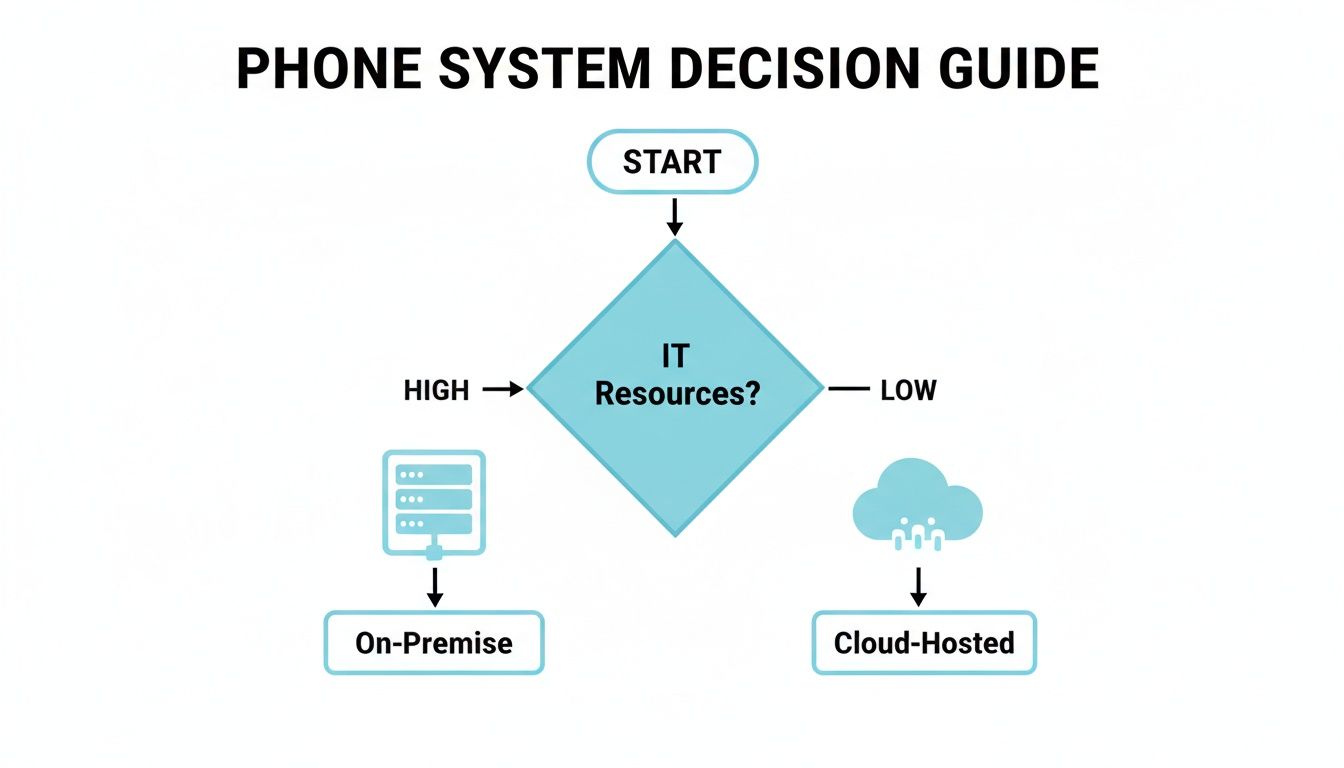
It’s a simple but powerful first step: match the system’s demands to your team’s capacity.
Analytics and Unified Communications
Another massive difference is what you can do with your call data. On-premise systems log calls, sure, but turning that raw data into business intelligence usually means bolting on third-party reporting software or running custom database queries. Cloud platforms, on the other hand, build analytics right in.
Key Takeaway: The core functional divide is between manual, expert-level configuration and empowered, user-friendly administration. Cloud platforms let business users manage their own communications; on-premise systems keep that control firmly in IT’s hands.
Today's business phone systems are also the nerve center for Unified Communications (UC), pulling voice, video, and messaging into one app. This is where cloud-native platforms shine, built from the ground up for hybrid teams with seamless desktop and mobile clients. You can get UC on an on-premise system, but it typically involves expensive add-on modules, complex integrations, and more licensing headaches.
The numbers don't lie. Research shows that productivity jumps 62% for hybrid and remote teams using VoIP. That's a huge deal when 77% of customers expect an immediate response by phone. Despite all the digital channels out there, phone calls still drive 69% of business revenue, making your system's reliability non-negotiable. For a deeper dive, explore the full research on Zoom's blog.
Why ARPHost Excels Here
Even with a user-friendly platform, managing all these features takes time you probably don't have. ARPHost's managed Virtual PBX administration goes a step further by handling the entire setup and ongoing tweaks for you. We become your outsourced telecom experts, making sure your IVR, call queues, and routing are always dialed in to meet your business goals.
We pair this hands-on service with rock-solid infrastructure. By combining our Virtual PBX with a Dedicated Proxmox Private Cloud or high-octane bare metal servers, your entire communications stack runs on dedicated resources that you control. This approach simplifies everything, boosts security, and guarantees performance. Our experts can even help you sort through the best business VoIP providers to find the perfect fit.
Ready to offload the technical headache of managing your phone system? Request a managed services quote at arphost.com/managed-services/ and let our team build a communication solution that just works.
Analyzing Scalability and Total Cost of Ownership
Let’s talk real money. When you’re comparing phone systems, the sticker price is just the tip of the iceberg. The real metric—the one that will make or break your budget down the line—is the Total Cost of Ownership (TCO). It's about looking past the initial invoice and seeing the full financial picture.
This is where the age-old battle of Capital Expenditure (CapEx) vs. Operational Expenditure (OpEx) comes into play. An on-premise PBX is a massive CapEx hit right out of the gate for hardware, installation, and licensing. A cloud-hosted system flips the script, turning that cost into a predictable monthly OpEx subscription, which frees up your capital for things that actually grow the business.
The market is voting with its wallet. The business phone service market, valued at $91.11 billion in 2024, is expected to soar to $144.1 billion by 2032. This isn't just growth; it's a massive shift toward smarter, scalable solutions, with businesses saving up to 60% on initial CapEx by ditching legacy hardware for the cloud.
Calculating the True Cost of Your Phone System
Figuring out the TCO for an on-premise PBX means digging for all the hidden costs that vendors conveniently forget to mention. It goes way beyond the server in the closet and the phones on the desks.
Your real TCO calculation needs to include:
- IT Labor: All those hours your team will sink into maintenance, troubleshooting, updates, and user support.
- Hardware Lifecycle: That PBX server and its components won't last forever. Factor in a full replacement every 5-7 years.
- Software and Licensing: Get ready for the nickel-and-diming of ongoing fees for updates, new feature licenses, and mandatory support contracts.
- Power and Cooling: The server room doesn’t run on good intentions. That’s a 24/7 electricity cost that adds up quickly.
A cloud-based Virtual PBX, on the other hand, wraps all these headaches into one transparent monthly fee. No surprise hardware failures, no surprise support bills. Just a simple, forecastable expense.
TCO in Action: On paper, an on-premise system might look cheaper over a five-year span if you only count the hardware. But the moment you add even 5 hours per month of an IT admin's salary for maintenance, plus funds for eventual hardware replacement, the cloud model almost always comes out ahead.
Scaling On-Demand vs. Scaling with Hardware
This is where the difference between cloud and on-prem really hits home. With an on-premise PBX, growth is painful. Hiring a few new people can mean buying new interface cards, upgrading the server, or worse—realizing you've hit the system's hard limit and need to replace the whole thing. It’s slow, expensive, and disruptive.
Cloud systems, however, scale instantly. Need to add 10 new agents for a seasonal rush? You can get them set up in minutes from a web portal. Once the rush is over, you scale back down just as fast. You only pay for what you use, giving you an agility that on-prem hardware just can't match.
When you're looking at features, it's critical to see how each system manages call flow. A system with powerful call routing software can be the difference between a happy customer and a lost sale.
How ARPHost Fits In
ARPHost gives you a straightforward, cost-effective upgrade path. Our Virtual PBX solutions offer clean, per-user pricing that kills hidden fees and makes your TCO crystal clear. If you already have a PBX you're not ready to part with, our SIP Trunks let you connect to the VoIP network flexibly and affordably, without needing a massive hardware refresh.
Even better, you can pair our telephony services with our managed infrastructure, like our VPS hosting (starting at just $5.99/month). This creates a unified, high-performance tech stack, simplifying management and guaranteeing your communication tools have the power they need to run without a hitch.
Explore our Secure VPS Bundles at arphost.com/vps-web-hosting-security-bundles/ to build a powerful foundation for your communications.
Where the Real Battle Is Won: Security, Uptime, and Integrations
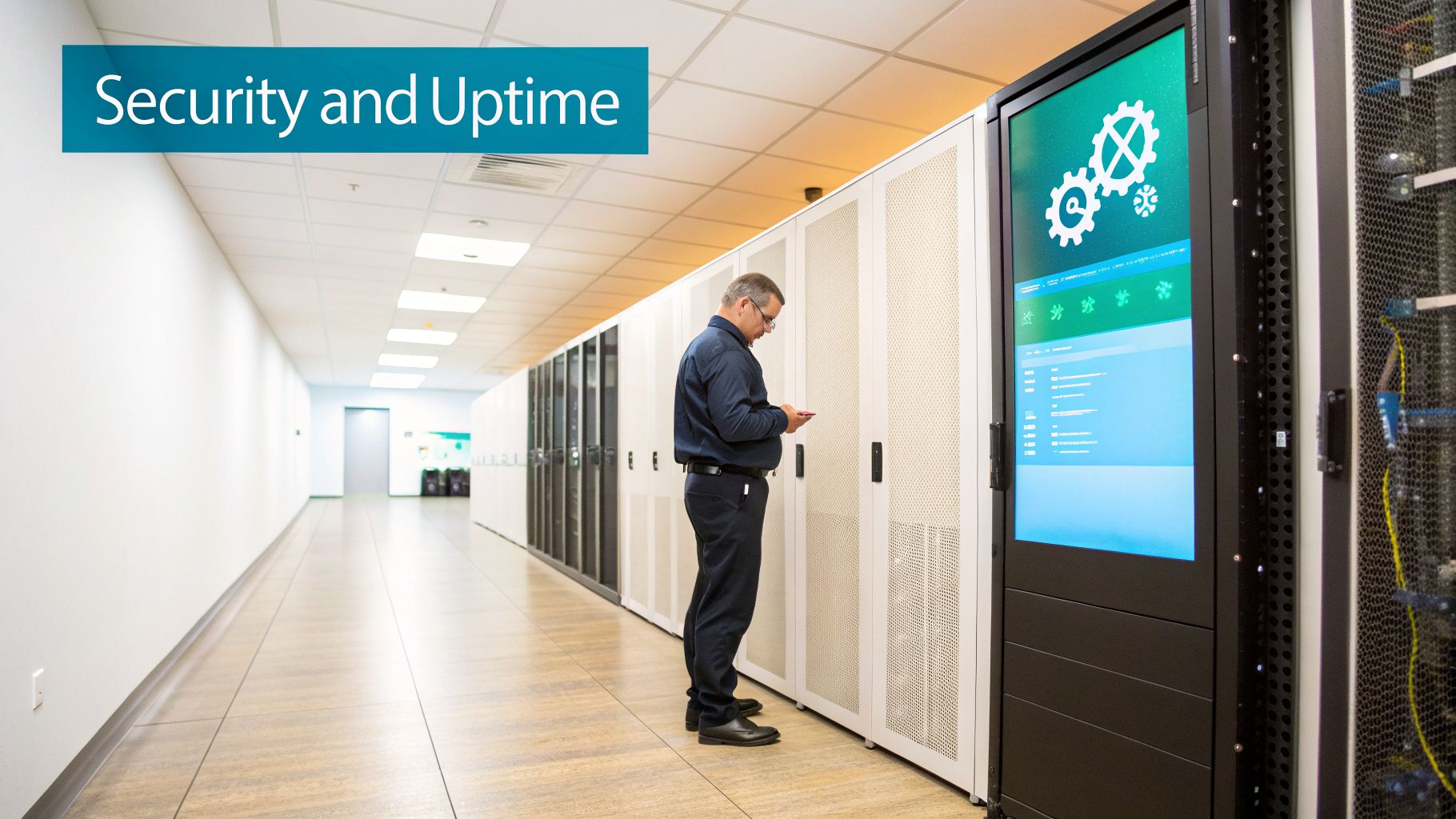
When you're doing a serious business phone system comparison, the flashy features are just the beginning. The real differentiators—the things that determine if your system is an asset or a liability—are security, uptime, and integrations. A phone system that’s down or compromised isn't just an annoyance; it’s a direct hit to your bottom line and your reputation.
This is where the philosophical divide between on-premise and cloud systems becomes crystal clear.
With an on-prem PBX, the entire security burden is on you. Your IT team is on the hook for everything: managing firewall rules, deploying security patches, detecting intrusions, and even physically securing the server room. Sure, this gives you total control, but it also means you own a single point of failure that demands constant, expert attention.
The Shared Responsibility Security Model
A cloud-hosted Virtual PBX flips the script with a shared responsibility model. You handle user permissions and basic policies, while the provider takes on the heavy lifting of securing the underlying infrastructure. For most businesses, this is a massive win. A reputable provider's investment in security infrastructure will dwarf what any typical SMB could ever justify.
Top-tier providers like ARPHost build their platforms inside hardened data centers, complete with:
- Enterprise-Grade Firewalls: Sophisticated network defenses managed around the clock by security pros.
- Proactive Monitoring: 24/7 surveillance to spot and stop threats before they ever affect your service.
- Geo-Redundant Infrastructure: Your services are spread across multiple physical locations, protecting you from localized power outages, fires, or natural disasters.
One of the ugliest threats in the VoIP world is Toll Fraud. This is where hackers break into your system and rack up thousands of dollars in unauthorized international calls on your dime. A managed environment like ARPHost's Virtual PBX has robust fraud detection built-in, something a fire-and-forget on-premise system often lacks.
From a Single Point of Failure to True High Availability
Reliability is another arena where the architectures couldn't be more different. An on-premise PBX is the textbook definition of a single point of failure. If that server hardware dies, the power cuts out, or your office internet goes down, your phones go silent. Period.
Cloud systems, on the other hand, are engineered for resilience. They run on highly available infrastructure, often using the same tech that powers our High-Availability VPS Hosting plans, like CEPH storage and KVM virtualization. If one server in the cluster fails, your service is automatically migrated to a healthy one, often without anyone even noticing. Replicating that level of uptime with on-site hardware is incredibly difficult and expensive.
Unlocking Business Value with Smart Integrations
Let’s be honest: a modern phone system that doesn't talk to your other tools—your CRM, helpdesk, or collaboration software—is just a dial tone. This is where the gap between legacy and modern systems becomes a chasm.
Trying to integrate a clunky on-premise PBX with a modern, cloud-based CRM is often a nightmare of custom development. You’re left with brittle, expensive middleware that breaks every time an API on either end gets updated.
In stark contrast, cloud and SIP-based systems are built with APIs (Application Programming Interfaces) at their core. This design philosophy allows for seamless, out-of-the-box integrations that pipe call data directly into your business workflows. Imagine every incoming call automatically logging a ticket in your helpdesk, complete with a call recording attached to the customer's record. That's the power of an API-first design.
ARPHost can simplify this entire process. Our fully managed IT services cover VoIP administration, where we not only lock down your phone system's security but also help you connect it to the core applications that run your business.
How ARPHost Fits Into Your Communications Strategy
Choosing a business phone system isn't just about features; it’s about aligning the right technology with your team's real-world capacity and long-term goals. This is where ARPHost comes in. We don't just sell you a product; we provide expertly managed solutions that let you get back to running your business instead of wrestling with your infrastructure.
For businesses that want to completely offload the technical heavy lifting, our Managed Virtual PBX service is the answer. Think of it as a turnkey phone system with a dedicated admin team. It’s perfect for SMBs that need enterprise-level features and rock-solid reliability but don't have an in-house telecom expert. We handle everything—setup, security, and maintenance—so you get a modern communications platform that simply works.
Unifying Your Stack for Peak Performance
The real game-changer is consolidating your entire IT stack with a single, trusted provider. Why juggle a separate hosting company, a cloud vendor, and a telecom provider when you can bring it all under one roof? When you host your Proxmox private clouds, bare metal servers, and phone system with ARPHost, you kill compatibility headaches, streamline vendor management, and create a unified, more secure environment.
This snapshot gives you a glimpse of the managed services we cover, from your servers right down to the network.
We’re not just a VoIP provider. We're a full-stack partner, and phone system administration is just one piece of the complete infrastructure management puzzle we solve for our clients.
The Right Solution for Every Scenario
What if you have an existing IP-PBX that’s still doing the job? You don’t have to rip and replace it. Our SIP Trunks provide a reliable and seriously cost-effective bridge to the world of VoIP. This lets you keep using your current hardware investment while tapping into the flexibility and lower costs of internet-based calling. You can see some real numbers on our post about how ARPHost saves businesses thousands with hosted VirtualPBX.
With 24/7 expert support and a robust, secure infrastructure, ARPHost effectively becomes an extension of your IT team. We don’t just hand you a service; we partner with you to build a resilient, modern communication stack that grows right alongside your business.
Whether you need a fully managed, hands-off phone system or a high-performance hosting environment for a PBX you manage yourself, our solutions are built for one thing: dependable performance.
Ready to simplify your communications? Request a managed services quote at arphost.com/managed-services/ to get started.
Frequently Asked Questions
As you dig into a business phone system comparison, a few key questions always come up. Let's get you the answers you need to cut through the noise and make a confident decision.
Can I Keep My Existing Phone Numbers if I Switch to a Cloud PBX?
Absolutely. In almost every situation, your existing phone numbers can come with you. This is a standard industry process called Local Number Portability (LNP), which allows you to transfer your numbers from your old provider to the new one.
Any reputable provider will handle the entire porting process for you. The goal is a seamless switch with zero downtime, so your customers won't even notice a change—they'll just keep calling the number they already know.
What Internet Speed Do I Need for a Reliable VoIP System?
The rule of thumb is about 100 kbps of dedicated bandwidth for every simultaneous call. So, if you have an office that needs 10 calls running at once, a stable 1 Mbps connection dedicated just to voice traffic is a solid baseline.
But raw speed is only half the story. The quality of your connection is far more important. Low latency (delay) and minimal jitter (the variation in that delay) are what really deliver crystal-clear, uninterrupted calls. A stable, high-quality connection will always beat a massive but unstable one.
How Does a Hybrid Phone System Actually Work?
A hybrid system gives you a practical middle ground, blending the best of on-premise and cloud solutions. It typically means you keep your existing on-premise IP-PBX to handle internal calls but connect it to the outside world using SIP Trunks from a cloud provider.
This setup lets you leverage the cost savings and flexibility of VoIP for all your external calls without having to immediately throw out your existing hardware. It's a popular and practical strategy for a phased migration to the cloud, allowing you to modernize at your own pace.
Is a Cloud Phone System Secure Enough for My Business?
For most SMBs, a professionally managed cloud phone system is actually more secure than what they could build and maintain on their own. Top-tier providers pour huge investments into multi-layered security to protect their entire network infrastructure.
This isn't just a basic firewall. We're talking about:
- Encrypted Communications: Using protocols like TLS and SRTP to secure both the call setup and the audio itself.
- Dedicated Firewalls and Monitoring: Proactively defending against costly threats like Toll Fraud and disruptive DDoS attacks.
- Geo-Redundant Data Centers: Ensuring your service stays online even if a physical data center has an outage.
When you're vetting providers, always ask about their security protocols and compliance certifications. Make sure their standards match what your industry requires.
At ARPHost, our managed Virtual PBX and secure SIP Trunking solutions are built on a foundation of robust, enterprise-grade infrastructure. We handle the complex security so you can focus on your business. Explore our Virtual PBX phone systems to see how we deliver secure, reliable, and expertly managed communications.