Most advice about the best managed it services starts in the wrong place. It starts with tickets, password resets, and whether the provider can answer the phone fast enough. That matters, but it's not the first question serious buyers should ask.
A central question is what part of your stack you want someone else to own. Endpoints are one layer. Identity is another. Backups, virtualization, storage, firewall policy, private cloud design, and recovery architecture are separate layers again. If a provider is strong at user support but weak at infrastructure, you can still end up with brittle systems and expensive workarounds.
That distinction matters more now because managed services keep expanding in scope. The global managed services market was valued at about $278.9 billion in 2022 and is projected to reach $834.7 billion by 2032. Growth alone doesn't make every MSP a fit. It just means more buyers are realizing they need outside help somewhere in the stack.
A lot of companies also need to automate your business workflows while keeping tighter control over infrastructure, not less. That's where the usual MSP roundups fall short. They compare helpdesks. They don't compare operating models.
1. ARPHost, LLC
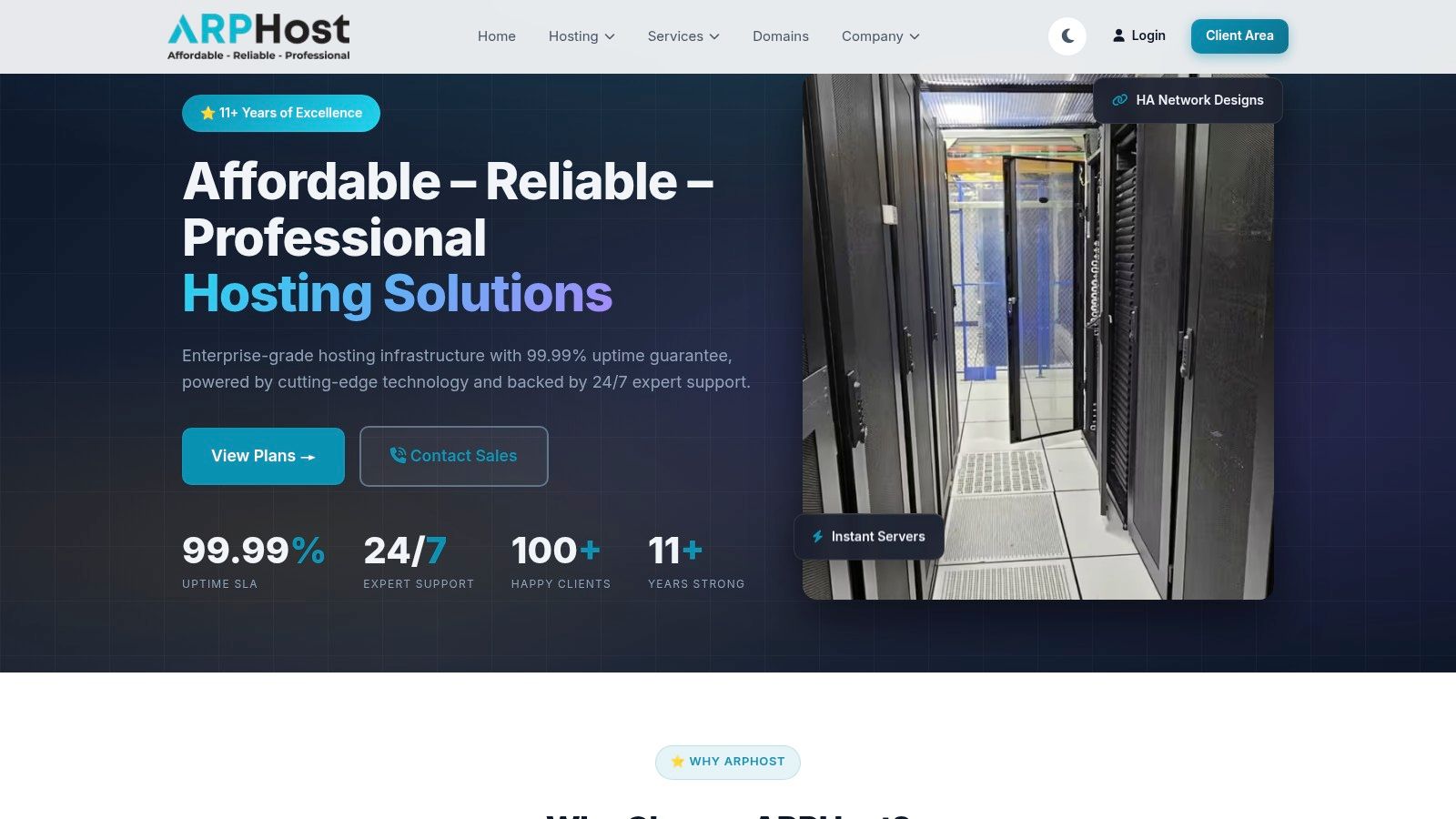
ARPHost, LLC sits in a different part of the managed services spectrum than a typical user-support MSP. If the job is patching laptops, handling M365 admin, and running a standard helpdesk, several providers on this list can do that. ARPHost is more relevant when the harder problem is infrastructure ownership: virtual machines, bare metal, Proxmox clusters, backup design, colocation, and the line between what your team keeps and what you hand off.
That operating model matters. Many companies do not want a provider that takes away administrative control just to offer monitoring and support. They want a partner that can manage the underlying platform while still leaving room for direct access, custom configurations, and in-house operational responsibility where it makes sense.
Where ARPHost fits best
ARPHost fits teams that need infrastructure depth first and managed support second. That includes ecommerce environments with real server-side demands, internal IT teams that want dedicated compute instead of noisy shared platforms, and organizations trying to get out of expensive public cloud sprawl without going back to fully self-managed hardware.
The practical advantage is continuity. A company can start small, standardize on one hosting and operations partner, then expand into more controlled environments as requirements tighten. That is a different buying path from the classic MSP model, where the provider is strong on endpoint support but has limited options once you need private cloud design or dedicated infrastructure.
Practical rule: If a provider cannot discuss hypervisor choice, storage layout, backup immutability, and firewall policy in the same conversation, it is probably a service desk with some infrastructure support attached.
ARPHost also aligns with how managed services spending is shifting. Analysts cited in Business Wire's coverage of Research and Markets describe a U.S. market that keeps expanding as organizations outsource more operational complexity. In practice, that complexity often sits deeper in the stack than endpoint support alone.
What works well and what to watch
The strongest part of ARPHost's position is range at the infrastructure layer. The company covers VPS, web hosting packages, bare metal servers, Proxmox private cloud environments, colocation, instant application deployments, and managed IT services. That gives buyers a realistic upgrade path instead of forcing a vendor change when requirements move from simple hosting to controlled virtualization or dedicated hardware.
The hybrid model is another strength. Teams can keep root or platform-level control where they need it and still outsource monitoring, updates, backups, migrations, or troubleshooting. For technical buyers, that balance matters more than a polished helpdesk pitch because it affects how much freedom you retain after the contract is signed.
ARPHost also offers adjacent services that make the platform more useful in production. VMware migration support, Proxmox Backup as a Service, SIP trunks, DIDs, and VirtualPBX are not the center of a managed IT contract, but they reduce the number of separate vendors involved in the environment.
There is a clear trade-off. ARPHost is a better fit for infrastructure-led environments than for companies that mainly need desktop support across a large user base. If your estate is mostly laptops, SaaS, and M365 with limited server complexity, a traditional endpoint-first MSP may be easier to buy and easier to use. If your risk, cost, and performance concerns live in compute, storage, virtualization, or recovery design, ARPHost is one of the few providers in this list built for that side of the equation.
2. Dataprise
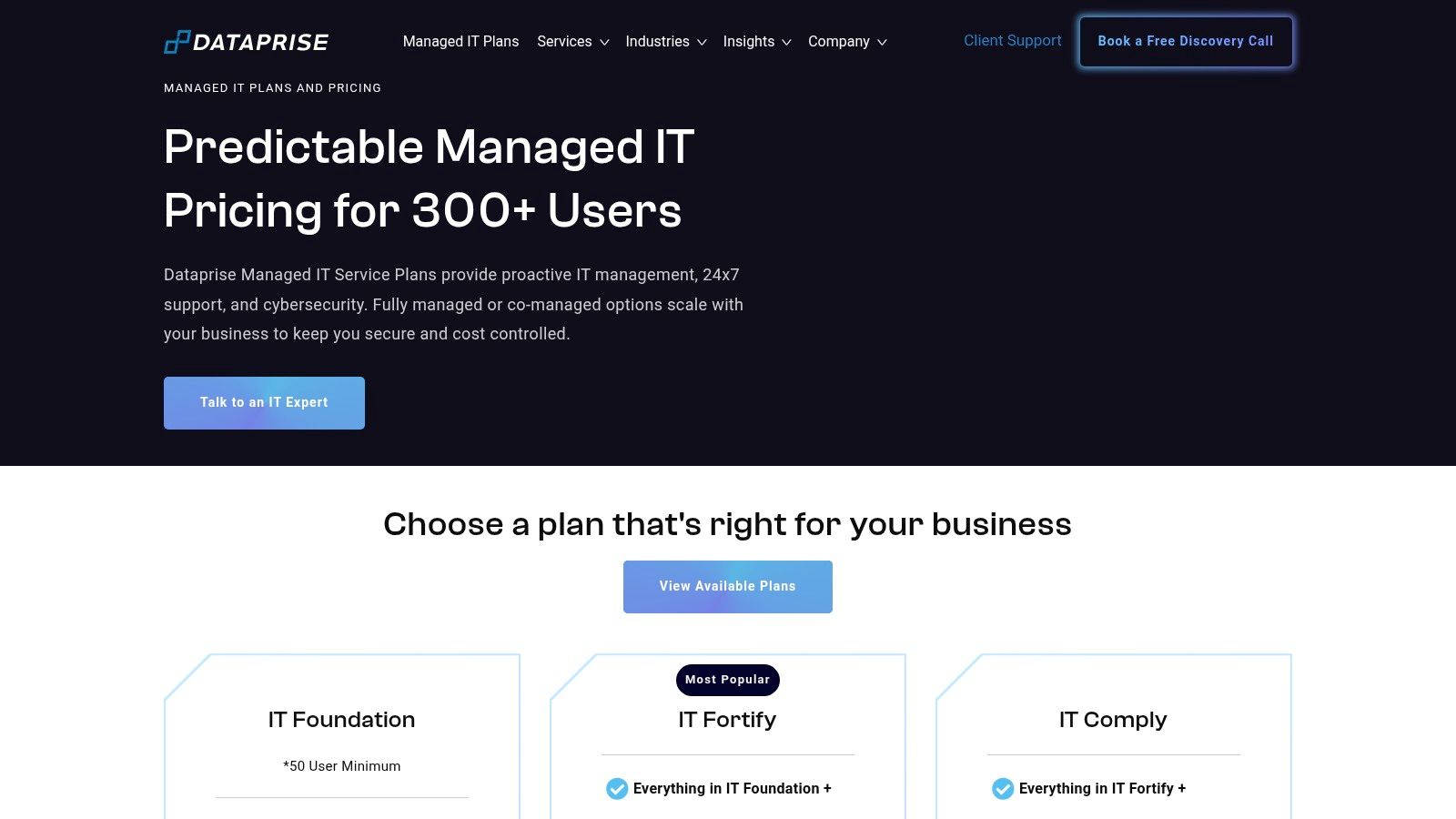
Dataprise is the kind of MSP I'd shortlist when the primary need is mature service desk coverage, co-managed support, and a cleaner security overlay for an SMB or mid-market organization. It looks and feels like a classic U.S. MSP, but with enough structure around planning, compliance, and security that internal IT teams can work with it instead of around it.
Its plan structure is useful because it makes scoping easier. Buyers who don't want to assemble support, backup, security, and advisory services line by line will appreciate that. Dataprise also tends to make sense for organizations that need end-user support and infrastructure management in the same contract, but not necessarily dedicated hosting or private cloud engineering.
Best use case
Dataprise is strongest when your problem is operational consistency. If users need a real service desk, servers need patching, backup and disaster recovery need oversight, and leadership wants vCIO or vCISO guidance, this model fits well.
The main caution is company size and buying process. Dataprise isn't aimed at tiny teams that want public pricing and instant deployment. It's better for organizations with enough scale to justify onboarding, discovery, and a formal managed plan.
Dataprise is a good example of a provider that reduces management overhead for internal IT, but it won't replace an infrastructure-specific partner if you need control over private cloud architecture or bare metal placement.
A practical trade-off: if your environment includes a lot of custom hosting, self-managed virtualization, or performance-sensitive workloads, Dataprise may still need to sit beside another provider rather than replace one. That isn't a flaw. It just tells you where on the MSP spectrum the company sits.
3. Electric
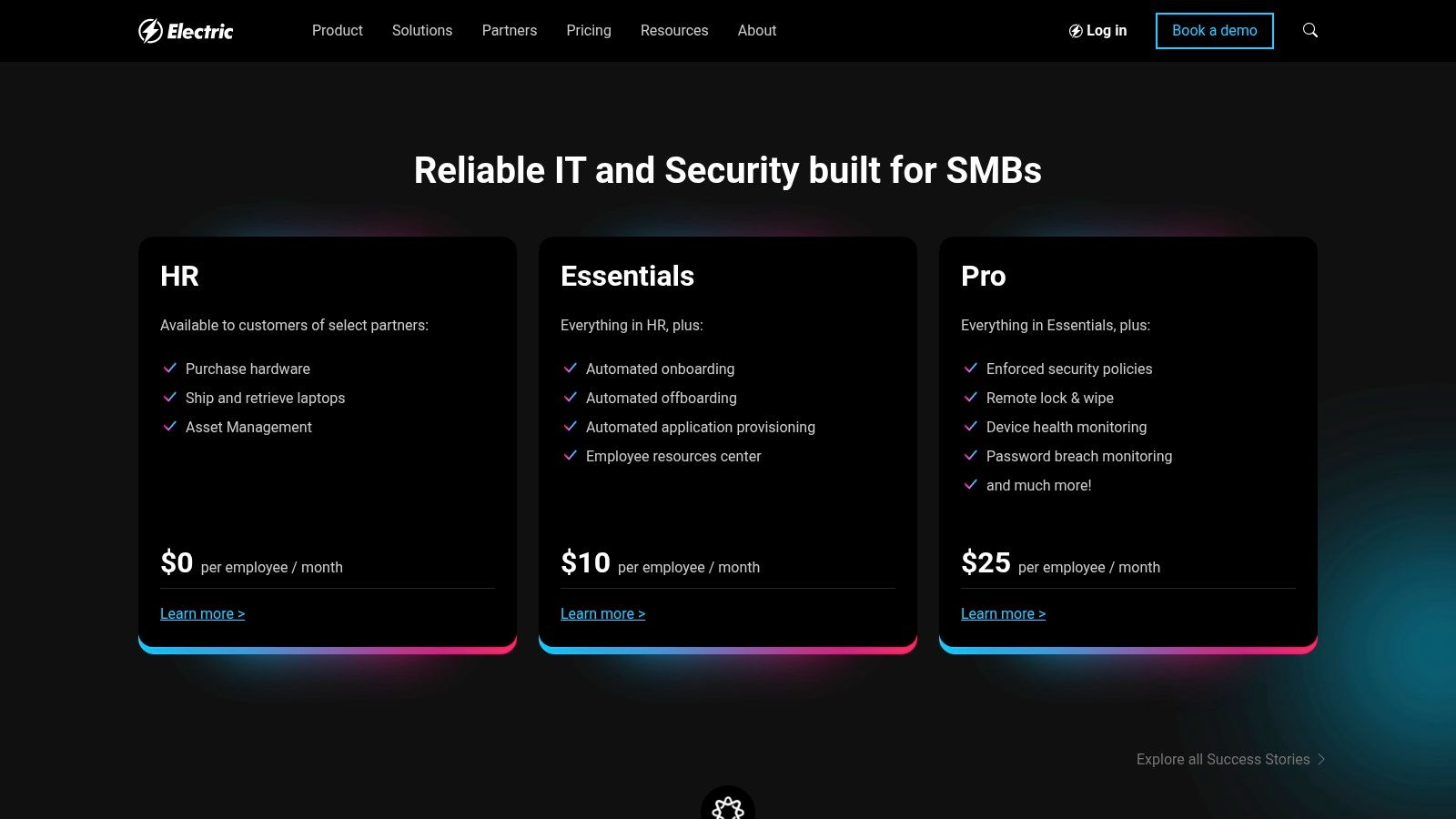
Electric is a different category from ARPHost or Rackspace, and that's exactly why it belongs on this list. Electric is built for standardized IT operations around users, devices, apps, onboarding, offboarding, and security policy enforcement. If you run a remote or distributed company and want predictable device management more than custom infrastructure engineering, it's a strong option.
Many “best managed it services” lists get muddy. Electric isn't trying to be your colocation partner or your private cloud architect. It's trying to make IT operations for growing SMBs simpler, more automated, and easier to cost.
Why teams choose it
The self-serve IT Hub is the appeal. Teams get visibility into employees, devices, and app access in one place, then wrap onboarding, offboarding, and policy controls around that. In a modern SaaS-heavy company, that solves real operational pain fast.
It's also aligned with a broader market pattern. One global market analysis projects managed services at $401.15 billion in 2025 and $847.41 billion by 2033, with managed data center and IT infrastructure services holding a 42% share in 2024, according to Grand View Research managed services analysis. Electric sits on the other side of that spectrum. It's less about infrastructure custody and more about endpoint and workflow standardization.
Trade-offs
- Best for: SMBs with cloud-first operations, remote staff, and repeatable HR/IT workflows.
- Less ideal for: Hybrid datacenters, bespoke virtualization stacks, or teams that need hands-on server and network engineering.
- Buying advantage: Public pricing helps if you want a straightforward first pass before talking to sales.
If you need to lock down laptops, automate account lifecycles, and centralize support without designing a private cloud, Electric is efficient. If you need storage replication, hypervisor migration planning, or bare metal recovery workflows, it won't cover enough ground alone.
4. Integris
Integris is the provider I'd look at when industry context matters as much as technical support. Its positioning is useful for banks, legal firms, manufacturers, and other organizations that don't just need generic managed services. They need a provider that understands compliance posture, policy pressure, and operational risk in their sector.
That vertical orientation can save a lot of time. A technically capable MSP still creates friction if every control, escalation path, and reporting requirement has to be explained from scratch.
Where Integris is strongest
Integris combines managed IT, cybersecurity, cloud, and GRC-oriented services in a way that suits regulated or process-heavy teams. It's also a practical option for organizations that want advisory support without splitting strategy and execution across separate firms.
That approach matches where the market is moving. In one managed information services analysis, managed security services account for 28.92% of the market in 2026 and are projected to grow at 14.18% CAGR through 2031, according to Mordor Intelligence managed information services research. Security is no longer an add-on. It's often the center of the engagement.
Operational lens: A vertical MSP is worth the premium when your audit burden is heavy and your internal team can't spend months teaching a provider how your sector works.
The main drawback is that Integris is still a classic managed services engagement. Pricing is quote-based, scope tends to follow discovery, and the buyer experience is built for organizations prepared to invest time in fit and alignment. That's not bad. It just means Integris is a better match for companies that want a relationship and program structure, not a quick transactional service.
5. Ntiva
Ntiva is a sensible middle-ground provider. It offers the familiar MSP building blocks, managed help desk, RMM, patching, cloud support, cybersecurity, and local field service, but it also does a better job than many providers of explaining cost drivers and scope trade-offs.
That matters because managed services buying often goes sideways before the contract is signed. One side assumes “managed” includes architectural guidance, project work, and deep remediation. The other side prices for ongoing support and routine operations. Ntiva tends to surface those distinctions early.
Where Ntiva works
I'd put Ntiva on the shortlist for organizations that want a conventional MSP relationship with clearer expectations. Healthcare and other regulated sectors are also a reasonable fit because the company leans into industry-specific support rather than pretending every client has the same risk profile.
Its co-managed model is useful too. Teams with one or two in-house admins often need a provider that can handle overflow, after-hours coverage, and specialized security support without taking over everything.
Limits to keep in mind
- Good fit: SMBs and mid-market firms that want full or co-managed support with a national provider.
- Watch for: Quote-based pricing and separately scoped project work for larger initiatives.
- Not ideal if: You need a provider whose core value is hosting, virtualization, or private cloud control.
Ntiva is strong where process, support maturity, and buyer education matter. It's less differentiated if your decision revolves around compute architecture, storage design, or whether to migrate VMware workloads into Proxmox or another stack.
6. Synoptek
Synoptek is for buyers who want one partner across infrastructure, applications, and data operations. That's a very different buying motion from choosing a small MSP to manage endpoints and M365. Synoptek is closer to a managed operations and systems integration partner than a simple support vendor.
That broader footprint can be valuable if you're running ERP, CRM, cloud, ITSM, and data platforms that all affect one another. Instead of handing off incidents between separate providers, you can centralize accountability.
What makes it different
Synoptek's “managed experience” positioning is really about operational breadth. Multi-cloud management, AI-assisted operations, automation, application support, and ServiceNow services appeal to mid-market and enterprise teams that want fewer seams between infrastructure and business systems.
This kind of model works best when your environment is large enough that silos cost more than a broader engagement. If your cloud team, app team, and service management processes are all disconnected, a partner like Synoptek can bring more consistency than a standard MSP.
Synoptek makes sense when your core problem is fragmented operations across infra, apps, and service management, not just reactive IT support.
The downside is complexity. Smaller organizations can easily overbuy here. If your needs are mostly endpoint support, patching, and a standard cloud tenancy, Synoptek may be more platform and process than you need. It's a strong option, but mostly for buyers who already know they need integrated operations.
7. Rackspace Technology
Rackspace Technology is still one of the clearest picks for organizations centered on cloud operations, private cloud management, and hybrid transformation. It isn't the best choice for every buyer. It is a strong choice if your estate already spans AWS, Azure, Google Cloud, or managed private cloud and you need a deep engineering bench behind it.
That's the key distinction. Rackspace is much more cloud-operations-led than SMB helpdesk-led. Buyers looking for classic desktop MSP support may find it misaligned. Buyers tackling modernization, landing zones, cloud governance, or regulated workload operations will see the appeal.
Best fit and trade-offs
Rackspace's engineering pod and managed operations approach works well for enterprises that need continuity between architecture, operations, and security. It also fits organizations that don't want to hire every cloud specialty in-house.
The trade-off is that this usually comes with enterprise-style engagement patterns. Discovery, contracts, scoped work, and program management are part of the package. That can be exactly right for a large hybrid estate and too heavy for a smaller company that just wants practical managed IT.
Where Rackspace differs from ARPHost is control style. Rackspace is a strong fit when the environment is already cloud-first and the priority is managed operation of that complexity. ARPHost is often the better fit when you want to keep tighter ownership of infrastructure foundations such as bare metal, Proxmox private cloud, secure backups, and hosting-level performance.
Top 7 Managed IT Services Comparison
| Provider | Implementation (🔄) | Resource Requirements (⚡) | Expected Outcomes (⭐📊) | Ideal Use Cases (📊) | Key Advantages (💡) |
|---|---|---|---|---|---|
| ARPHost, LLC | Low–Medium: rapid provisioning, one‑click apps; managed ops available. | Low–Moderate: budget plans for self‑managed; managed services cost more. | High reliability and performance; 99.99% SLA, NVMe, DDoS protection. | SMBs, developers, MSPs needing flexible managed or unmanaged infrastructure. | Transparent pricing, US 24/7 support, Proxmox immutable backups. |
| Dataprise | Medium–High: structured onboarding for fully or co‑managed models. | High: national scale support; typical ~50‑user floor and quote‑based pricing. | Operational stability, proactive monitoring, advanced security and compliance. | SMB to mid‑market customers requiring end‑to‑end managed IT/security. | 500+ certified engineers, tiered plans, defined SLAs. |
| Electric | Low: automation‑heavy, self‑serve IT Hub simplifies rollout. | Low–Moderate: clear per‑user pricing; suited to lean IT teams. | Standardized device/app governance and fast onboarding/offboarding. | SMBs wanting transparent per‑user IT, HR/IT workflow automation. | Public pricing, strong automation, centralized visibility (IT Hub). |
| Integris | Medium: advisory plus operational delivery with industry playbooks. | Moderate: engagement sized via estimator; requires intake/quote. | Industry‑aligned managed IT, cloud, security and compliance support. | Vertical industries (community banks, legal, manufacturing) needing compliance. | Vertical expertise, combined vCIO and operational managed services. |
| Ntiva | Medium: proactive RMM, managed help desk and local field support. | Moderate: scoped pricing; on‑site and specialized projects add cost. | Predictable SLAs, ROI‑focused management, regulated‑industry capabilities. | Organizations needing local support and sector‑specific IT (e.g, healthcare). | Transparent ROI discussions, balanced co‑managed and fully managed options. |
| Synoptek | High: end‑to‑end infra, applications and data integration; ServiceNow ops. | High: enterprise resources, multi‑cloud integrations and assessment required. | Automation, AI‑assisted ops, measurable KPI improvements and reduced MTTR. | Mid‑market to enterprise seeking a single partner for infra, apps, data. | Broad stack coverage, AI‑assisted monitoring, strong automation and governance. |
| Rackspace Technology | High: Elastic Engineering pods and Modern Operations for complex clouds. | High: enterprise budgets, certified cloud engineers, contract‑centric engagements. | Deep cloud expertise, hybrid/multicloud modernization and compliance readiness. | Enterprises modernizing workloads or running hybrid/multicloud at scale. | Extensive cloud certifications, flexible engagement models, integrated security. |
Choosing Your Partner Infrastructure vs. Endpoints
A lot of managed IT buying mistakes start with the wrong category. Teams shop for "an MSP" as if endpoint support, service desk coverage, private cloud operations, and bare metal administration are interchangeable. They are not. The better question is where your operational burden sits today, and what you still need to control internally.
If the pain is user-side, device sprawl, onboarding, offboarding, SaaS account control, and standardized support, Electric is often enough. If you need stronger process coverage, compliance alignment, co-managed operations, or a broader service desk function, Dataprise, Integris, Ntiva, and Synoptek sit further along that spectrum.
Rackspace serves a different buyer. It fits teams already dealing with hybrid or multicloud complexity and willing to work with a larger, cloud-centric operator. That can be the right call when transformation, governance, and cloud operations matter more than platform ownership.
The gap in this market sits between those two ends. Plenty of IT leaders need more than endpoint management but do not want to hand core infrastructure to a large cloud integrator. They want managed support around infrastructure they still shape directly. That means private cloud, dedicated servers, VPS, backup, web hosting, and hybrid environments where administrative control stays close to the business.
ARPHost stands out on that infrastructure-heavy side of the spectrum. The fit is strongest for technical buyers who care about performance characteristics, virtualization choice, tenancy model, and recovery options, not just ticket response times. That changes the engagement model. Instead of forcing everything through a traditional MSP playbook, teams can combine managed support with infrastructure they intend to run long term.
That distinction matters in practice. A conventional MSP may be excellent at endpoints, M365 administration, and help desk workflows, yet still have limited depth in hypervisor design, private cloud architecture, storage layout, or dedicated hosting strategy. For organizations running line-of-business systems, latency-sensitive workloads, or environments with tighter control requirements, that trade-off shows up quickly in both cost and operational friction.
If you need a provider that goes deeper than endpoint support, ARPHost is worth serious consideration. It is a practical option for teams that want hosting, bare metal, Proxmox-based private cloud, backups, and managed IT from one provider without giving up infrastructure control. The right choice comes from matching the provider to the layer you specifically need managed. Endpoints, full cloud operations, or the infrastructure in between.