
Choosing a colocation provider is a critical infrastructure decision that directly impacts your organization's performance, security, and scalability. This isn't just about renting rack space; it's about selecting a long-term partner whose facilities, network ecosystem, and support services align perfectly with your technical and business objectives. A well-chosen provider can significantly reduce capital expenditures, eliminate the complexities of managing a private data center, and provide direct access to a robust network of carriers to improve latency and connectivity.
This guide is designed to cut through the marketing noise and provide a clear, technical comparison of the best colocation providers available today. We’ll move beyond generic feature lists to focus on the key evaluation criteria that matter most to IT professionals and decision-makers. You will find a detailed breakdown of each provider, complete with screenshots and direct links, so you can see exactly what they offer and how it applies to your use case.
We will analyze critical factors such as power redundancy (N, N+1, 2N), cooling efficiency, carrier neutrality, physical security protocols, and crucial compliance certifications like SOC 2, ISO 27001, and PCI DSS. Furthermore, we'll dissect the fine print of Service Level Agreements (SLAs) to help you understand what guarantees you're actually getting. Whether you need to deploy a single bare metal server, a high-availability Proxmox private cloud, or a complex hybrid environment, this comprehensive roundup will equip you with the actionable insights needed to make an informed choice and find the right data center partner.
1. ARPHost, LLC
Best For: SMBs, developers, and MSPs seeking a flexible, U.S.-based partner for colocation, managed services, and specialized Proxmox/VMware solutions.
ARPHost emerges as a standout choice among the best colocation providers, particularly for businesses that value a combination of hands-on support, technical expertise, and a comprehensive service stack. Rather than competing with hyperscale cloud vendors, ARPHost carves out its niche by delivering reliable, high-touch infrastructure solutions that act as a direct extension of a client's own IT team. This approach is ideal for small-to-medium businesses, managed service providers (MSPs), and development teams who need dependable infrastructure without the complexity and overhead of larger platforms.
The company’s colocation services are designed with flexibility at their core, starting at an accessible price point of $99.00 per month. This makes it an attainable solution for organizations looking to move their first server into a secure data center or for established companies needing a reliable secondary site. What truly sets ARPHost apart is its expert hands-on approach. The 24/7 U.S.-based support team provides remote hands services that go beyond simple reboots, assisting with everything from hardware swaps to complex troubleshooting, ensuring your critical infrastructure remains online and performant. For those new to the concept or weighing their options, ARPHost provides excellent resources that explain what colocation hosting is and how it can benefit a business.
Why ARPHost Excels Here: A Unified Infrastructure Ecosystem
One of ARPHost’s most significant advantages is its broad, integrated service portfolio. Clients can start with colocation and seamlessly expand into a suite of complementary offerings without needing to manage multiple vendors. This unified ecosystem is a powerful asset for growing businesses.
- Bare Metal & Virtualization: Augment your colocated hardware with dedicated bare metal servers (starting at $99.99/month) or high-performance KVM VPS plans. This hybrid capability allows you to balance capital and operational expenditures effectively, creating a custom private cloud on demand.
- Proxmox Specialization: ARPHost is a specialist in Dedicated Proxmox Private Clouds, offering managed migration services for businesses moving from VMware. This expertise is invaluable for companies seeking a cost-effective, open-source virtualization platform with enterprise-grade features and full root access to dedicated hardware.
- Secure Web Hosting & Backups: Security is paramount, and ARPHost addresses this with Secure Web Hosting bundles featuring Imunify360, CloudLinux, and Webuzo. This is complemented by Proxmox Backup-as-a-Service, featuring immutable and encrypted backups to protect your data against ransomware and accidental deletion.
- Fully Managed IT Services: For teams that need to offload day-to-day operations, ARPHost offers fully managed plans. This allows you to retain root control when needed but delegate routine tasks like proactive monitoring, patch management, network/firewall management, and disaster recovery to their expert team.
User Experience and Support
The user experience with ARPHost is consistently praised for its simplicity and responsiveness. Customers highlight the rapid provisioning of services and the personalized nature of the support. Unlike larger providers where you might be just another ticket number, ARPHost’s team is known for its deep technical knowledge and a proactive, problem-solving mindset, also extending to Virtual PBX phone systems and Juniper network device management.
While the company does not prominently display industry certifications like SOC 2 or HIPAA on its site, its focus on practical security measures, transparent pricing, and expert-level support makes it a highly reliable and cost-effective partner. For organizations in regulated industries, it is advisable to directly verify compliance needs with their team.
Overall, ARPHost, LLC stands as a premier choice for businesses seeking a true infrastructure partner. Its blend of affordable colocation, a wide service stack, and exceptional, hands-on support makes it one of the best colocation providers for achieving reliable, scalable, and secure IT operations.
2. Equinix
Equinix stands as a global titan in the data center industry, making it a top contender for any list of the best colocation providers. Its platform is less of a simple website and more of a gateway to a vast, interconnected ecosystem. Businesses use Equinix.com to explore a network of over 240 data centers, with more than 70 located in major U.S. metropolitan areas like Ashburn, Silicon Valley, and Chicago. The site is primarily a tool for discovery, allowing prospective customers to view detailed data center specifications, browse metro-area marketplaces, and request tours or sales quotes for customized solutions.
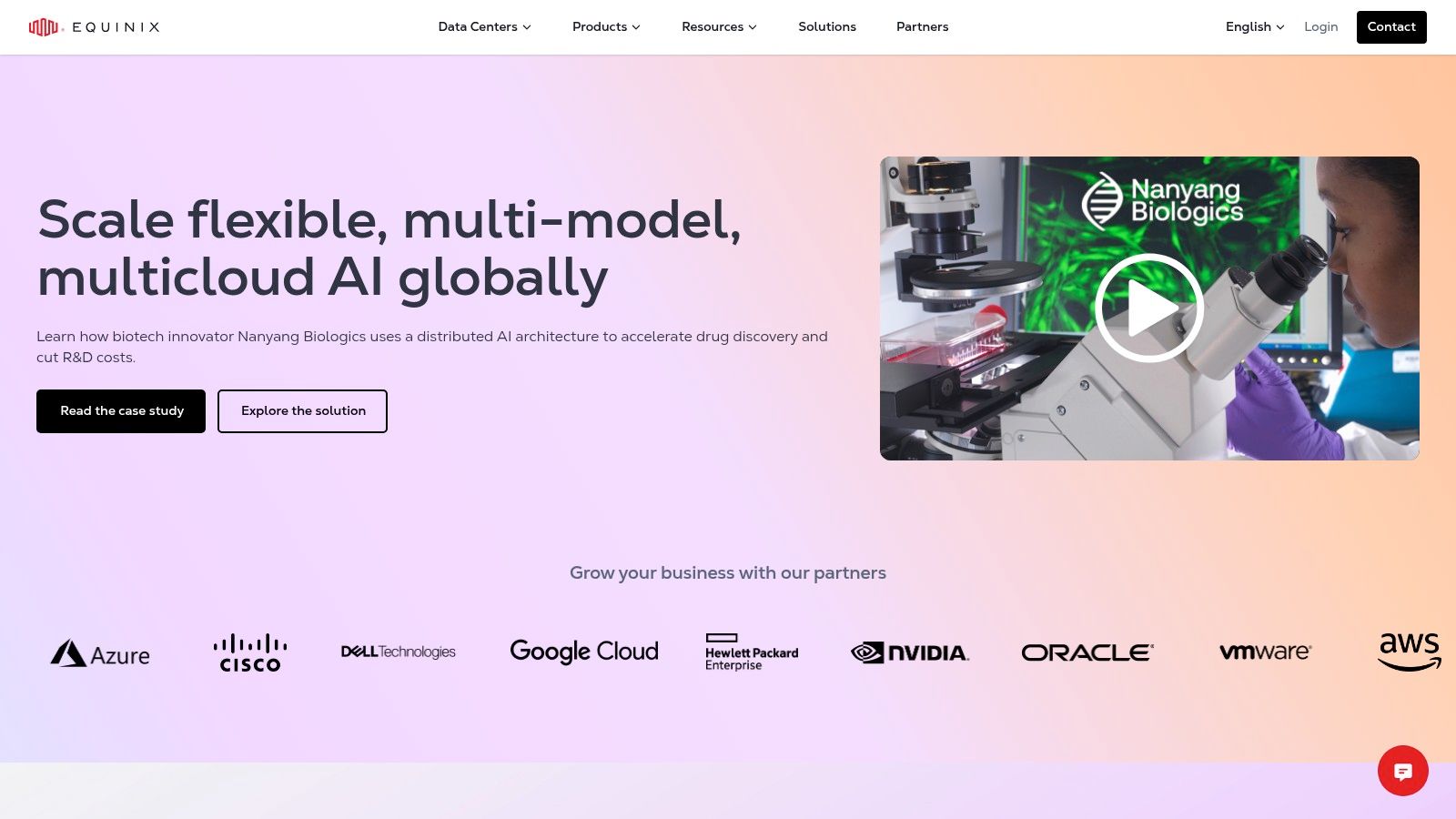
For existing customers, the Equinix Customer Portal (ECP) transforms into a transactional hub. Authorized users can order standardized cabinets, manage cross-connects, and request "Smart Hands" services for remote management tasks directly through the interface. This portal-driven approach streamlines day-to-day operations for established deployments.
Why Equinix Stands Out
Equinix's most significant differentiator is its unparalleled interconnection ecosystem, branded as Platform Equinix®. This isn't just about space and power; it's about connecting to a rich network of partners, cloud providers, and carriers. The platform offers direct, low-latency "on-ramps" to all major public clouds, including AWS, Google Cloud, and Azure. This makes it an ideal choice for enterprises building hybrid cloud architectures, where secure, high-performance connectivity between on-premises infrastructure and public cloud resources is critical.
For businesses looking to deploy bare metal servers within a robust ecosystem, understanding the fundamentals of co-located hosting is the first step toward leveraging this kind of advanced connectivity.
Using the Equinix Platform Effectively
Access & Pricing:
Equinix does not publish its prices publicly. Gaining access to a quote requires direct engagement with their sales team. New customers typically start by submitting a web form or contacting a regional sales office. Be prepared for a consultative sales process where you'll need to detail your power, space, and connectivity requirements. Lead times in popular, high-demand metros can be long, so planning well in advance is crucial.
Unique Offerings & Features:
- Equinix Fabric™: A software-defined interconnection service that allows customers to privately connect to partners and services on the platform without physical cabling.
- Extensive Compliance: Equinix holds a vast portfolio of certifications, including PCI DSS, ISO 27001, SOC 1/2, and HIPAA, making it suitable for regulated industries.
- Global Reach: While this review focuses on its U.S. presence, its global footprint allows for international expansion with a single provider.
| Feature | Equinix Offering |
|---|---|
| Primary Use Case | Hybrid cloud, multi-cloud connectivity, digital supply chains. |
| Key Service | Direct cloud on-ramps and Equinix Fabric™ interconnection. |
| Management | Primarily unmanaged colocation with add-on "Smart Hands" and managed services available. |
| Pricing Model | Quote-based; requires sales engagement. |
| Support | Global Service Desk (GSD) and technical support available via portal, phone, and email. |
Pros:
- Unmatched interconnection and cloud connectivity ecosystem.
- Broad geographic coverage in key U.S. metro areas.
- Strong compliance and security certifications.
Cons:
- Pricing is not transparent and can be complex.
- Long lead times for high-density deployments in popular locations.
- Primarily geared towards enterprise-level deployments.
3. Digital Realty
Digital Realty operates one of the largest portfolios of data centers in the world, making its website a critical resource for enterprises seeking scalable colocation solutions. The site, centered around its PlatformDIGITAL® offering, serves as a comprehensive directory for its facilities, which include over 110 locations across the Americas. Prospective customers can use the site's data center directory to filter locations by metro area, available services, and specific compliance certifications, providing a high degree of transparency before even engaging with a sales team.
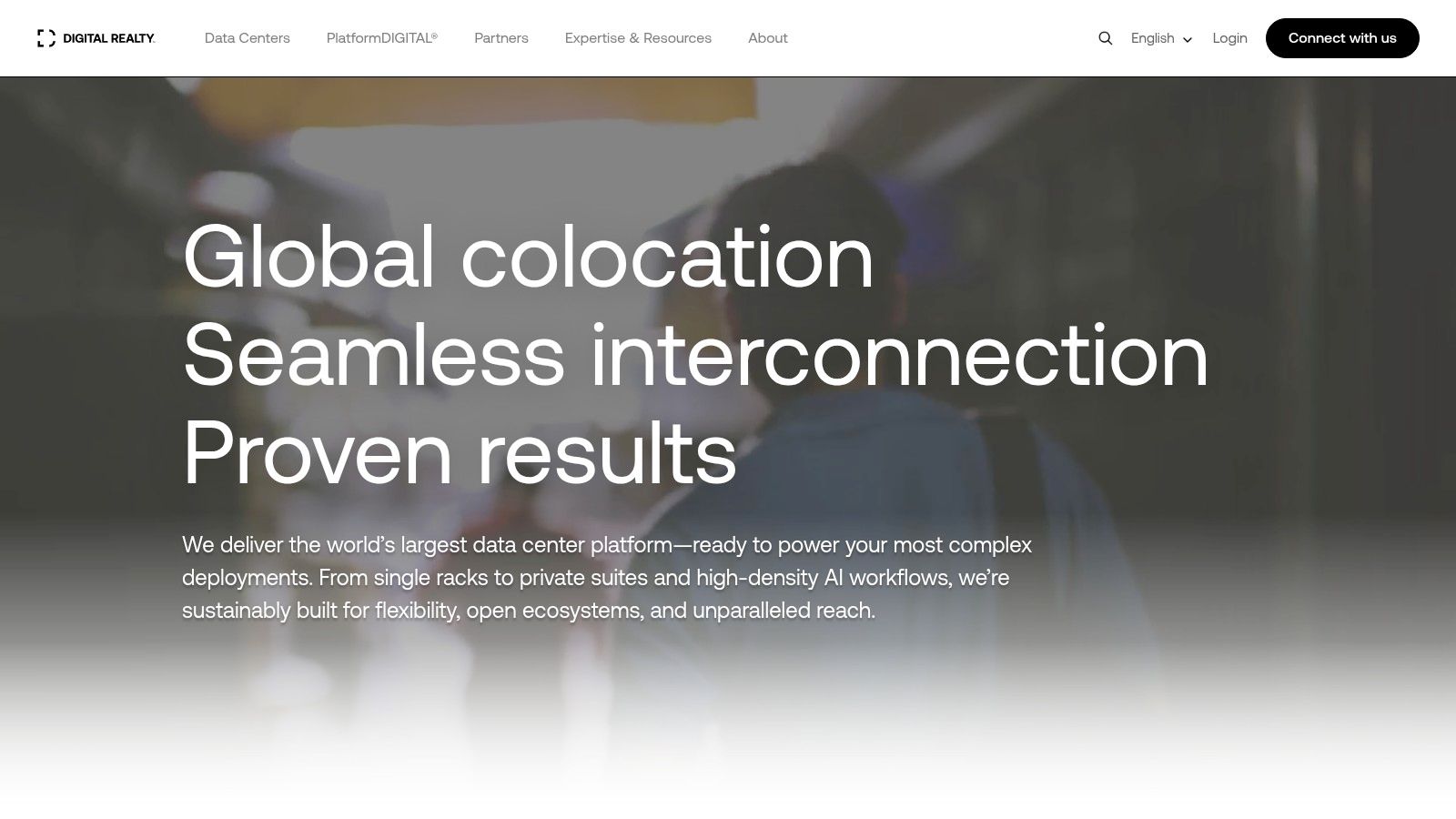
The platform is designed to guide users from initial discovery to procurement. Each data center has a detailed specifications page outlining power capacity, redundancy levels (e.g., N, N+1, 2N), and a list of available network carriers. For existing clients, the customer portal provides a transactional layer for managing services, including requesting "Remote Hands" for on-site assistance and overseeing interconnection services.
Why Digital Realty Stands Out
Digital Realty's key differentiator is its ability to provide a clear growth path from a single retail rack to multi-megawatt wholesale deployments, all within a single platform. This makes it one of the best colocation providers for businesses anticipating significant scale. Its public commitment to sustainability is another major draw; the company powers its entire U.S. colocation portfolio with 100% renewable energy, a critical factor for organizations with ESG (Environmental, Social, and Governance) mandates.
The platform's emphasis on interconnection allows businesses to directly and securely connect to cloud providers, partners, and network fabrics. This focus on connectivity is a core tenet of modern colocation and hosting strategies, enabling hybrid IT environments that combine the security of private hardware with the flexibility of the public cloud.
Using the Digital Realty Platform Effectively
Access & Pricing:
Like other enterprise-grade providers, Digital Realty does not publish pricing online. Access is quote-based and requires engaging with their sales team through a website form or direct contact. The buying process is oriented towards enterprises and typically involves an RFP (Request for Proposal) or a detailed consultation to scope power, space, cooling, and connectivity needs. This process may introduce additional procurement steps for small to medium-sized businesses.
Unique Offerings & Features:
- Scalable Deployments: Offers a full range of services from single cabinets and cages (retail colocation) to private suites and build-to-suit data centers (wholesale).
- Sustainability Focus: Achieved 100% renewable energy coverage for its U.S. retail colocation portfolio, a significant benefit for environmentally-conscious companies.
- High-Density Capabilities: Many facilities are equipped to handle high-density and AI/ML workloads that require advanced cooling and power infrastructure.
- Transparent Certifications: Easily view and download compliance documents for each site, including SOC, ISO, and PCI DSS reports.
| Feature | Digital Realty Offering |
|---|---|
| Primary Use Case | Enterprise-scale deployments, hybrid cloud, high-density computing. |
| Key Service | Scalable colocation from retail racks to wholesale suites. |
| Management | Unmanaged colocation with a robust "Remote Hands" catalog and 24×7 on-site staff. |
| Pricing Model | Quote-based via RFP and direct sales engagement. |
| Support | 24×7 operations and support accessible through a customer portal and direct contact. |
Pros:
- Massive scale allows for growth from a single rack to a private suite.
- Strong, verifiable commitment to sustainability and renewable energy.
- High transparency with published site specifications and certifications.
- Many facilities are capable of supporting high-density AI workloads.
Cons:
- Pricing is not transparent and requires a formal quote process.
- The enterprise-focused sales cycle may be cumbersome for smaller businesses.
- Focus is primarily on space, power, and connectivity rather than managed services.
4. CoreSite
CoreSite operates as a prominent U.S. data center provider, making its platform an essential resource for businesses evaluating hybrid IT and colocation solutions. The website, CoreSite.com, serves as a detailed directory of its data centers across major markets like Los Angeles, Northern Virginia, and Chicago. Prospective customers can use the site to explore individual facility specifications, including available power densities, compliance certifications, and connectivity options, providing a transparent view of each location's capabilities.
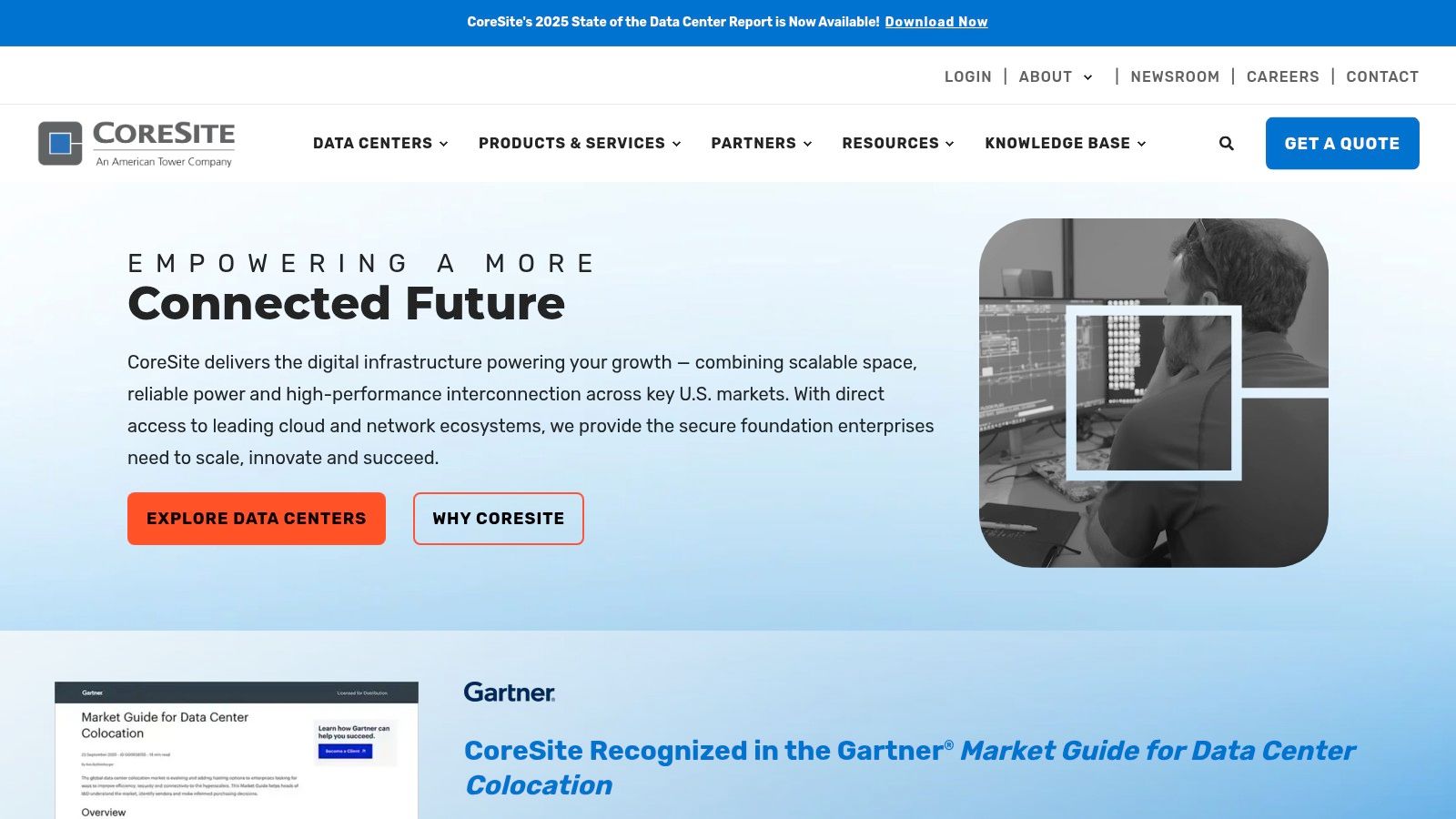
The platform is designed for discovery, allowing users to identify the right environment for their needs, from partial cabinets and full racks to private cages and suites. A key feature is the visibility into market-specific promotions, such as free installations or discounted cabinet pricing. This makes CoreSite particularly attractive for businesses looking to optimize their initial colocation investment.
Why CoreSite Stands Out
CoreSite’s primary strength lies in its powerful interconnection services and clear pathways to hybrid cloud architectures. The Open Cloud Exchange® provides software-defined, direct connections to major cloud providers like AWS, Azure, and Google Cloud, enabling secure and low-latency hybrid deployments. This is complemented by the Any2Exchange® for internet peering, one of the largest and most active peering exchanges in the U.S.
For businesses currently managing their own servers, migrating to a provider like CoreSite is a significant step. Understanding the process of moving physical hardware into a secure, interconnected facility is crucial. Services like ARPHost's colocation offer a managed entry point into this ecosystem, providing the hands-on support needed for a smooth transition.
Using the CoreSite Platform Effectively
Access & Pricing:
Like many enterprise-grade providers, CoreSite does not publish standard pricing on its website. Access to pricing requires engaging with their sales team through a quote request form. Be prepared to provide details on your space, power, and interconnection needs. The occasional promotions listed on their site can offer significant cost savings, so it's worth checking for deals in your target market.
Unique Offerings & Features:
- Open Cloud Exchange®: A platform for creating direct, private connections to multiple cloud service providers from a single physical port.
- Any2Exchange®: One of the largest peering exchanges in the U.S., facilitating efficient traffic exchange between networks.
- Detailed Facility Pages: Each data center has a dedicated page listing its compliance (e.g., SOC, ISO, HIPAA), power infrastructure, and available network carriers.
- Market-Specific Promotions: CoreSite frequently runs offers like discounted cabinet pricing or waived installation fees in certain locations.
| Feature | CoreSite Offering |
|---|---|
| Primary Use Case | Hybrid cloud deployments, network-dense applications, and internet peering. |
| Key Service | Open Cloud Exchange® and Any2Exchange® peering. |
| Management | Primarily unmanaged colocation with remote hands services available for on-site tasks. |
| Pricing Model | Quote-based, with occasional public promotions for specific markets. |
| Support | Customer support is available 24/7/365 via a customer portal, email, and phone for operational needs. |
Pros:
- Strong focus on hybrid IT with excellent cloud on-ramps and peering options.
- Transparent facility specifications available directly on the website.
- Promotions can reduce total cost of ownership, especially for smaller deployments.
- Wide range of colocation solutions from partial cabinets to private suites.
Cons:
- Standard pricing is not public and requires a sales consultation.
- Availability of partial cabinets and specific promotions varies by facility.
- Geographic footprint is focused on major U.S. metro areas.
5. Flexential
Flexential caters to the mid-market with a distributed footprint across the United States, positioning itself as one of the best colocation providers for businesses needing regional presence and cost-effective solutions. The Flexential website serves as a detailed directory of its more than 40 data centers across 18 U.S. markets. Prospective customers can use the site to explore specific locations, viewing key metrics like total power capacity (MW), square footage, and available compliance certifications for each facility. This market-level detail allows for informed initial research before engaging with their sales team through "Get a Quote" or "Request Tour" forms.
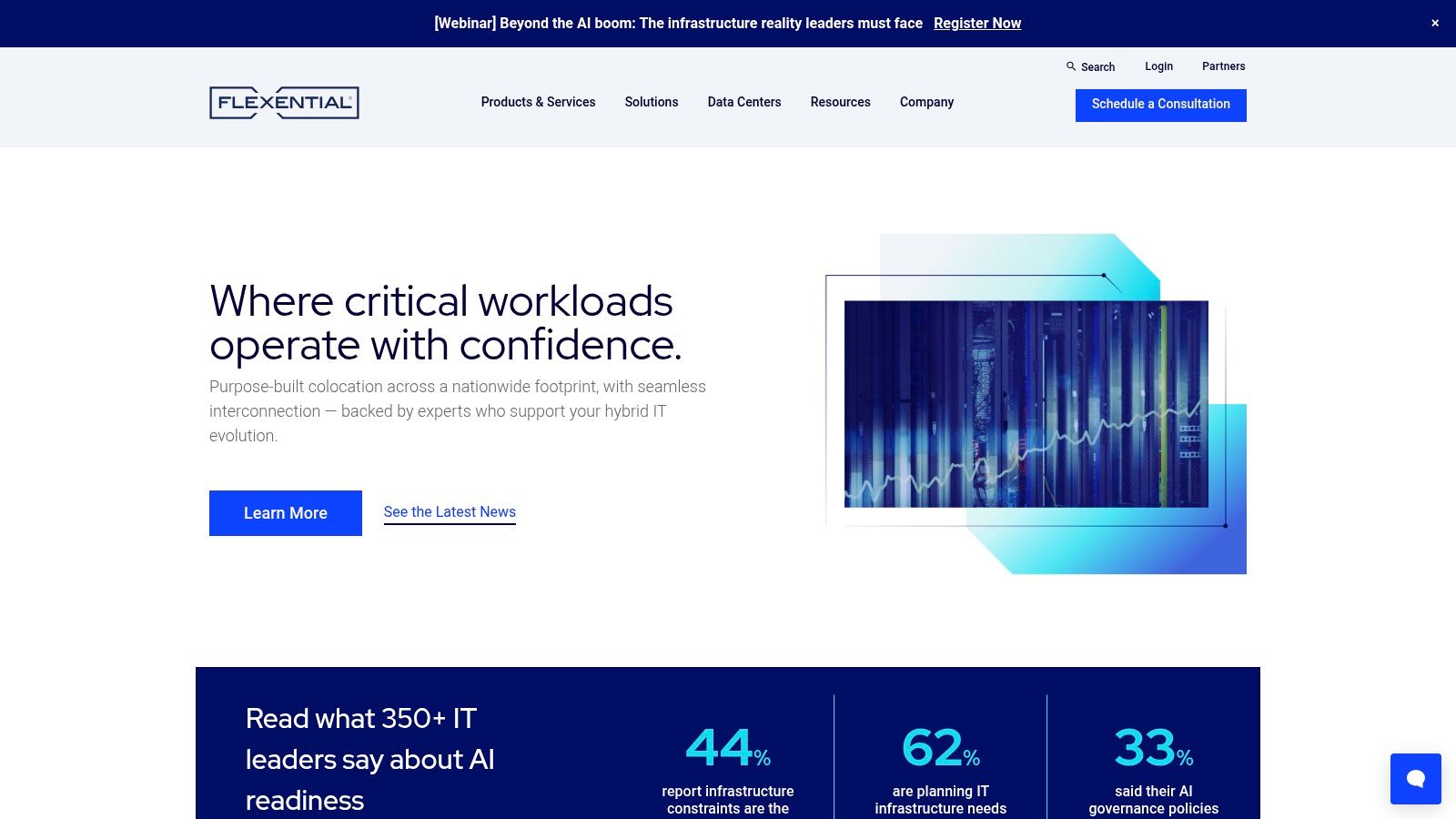
The platform is designed around discovery and connection. It details the FlexAnywhere™ fabric, a 100 Gbps network backbone that interconnects its data centers, enabling customers to build geographically resilient architectures. For existing clients, the Flexential portal provides the necessary tools for managing their deployed infrastructure, requesting support, and overseeing their services, creating a functional hub for operational management.
Why Flexential Stands Out
Flexential’s primary advantage lies in its strong regional presence, including in markets that are often more cost-effective than primary hubs like Ashburn or Silicon Valley. This makes it an excellent choice for businesses implementing edge computing strategies, disaster recovery sites, or simply seeking lower-cost colocation without sacrificing quality. The company's commitment to a 100% uptime SLA on power and bandwidth, clearly stated on its market pages, provides a strong assurance of reliability for mid-market buyers.
This approach is ideal for businesses that have outgrown smaller hosting solutions and need the security and control of dedicated hardware. Transitioning to a model like this often starts with understanding the benefits of bare metal servers, which offer similar raw performance and control within a provider-managed environment.
Using the Flexential Platform Effectively
Access & Pricing:
Like other enterprise-grade providers, Flexential does not publish pricing on its website. Access requires submitting a quote request for a specific market or service. The sales process is consultative, focused on tailoring a solution to your power, space, networking, and compliance needs. The platform's market-specific pages are a great starting point for gathering the necessary data before making contact.
Unique Offerings & Features:
- FlexAnywhere™ Platform: A high-capacity 100 Gbps backbone connecting all data centers for reliable, low-latency interconnection.
- Regional Market Depth: Strong presence in secondary markets like Denver, Portland, and Nashville, offering geographic diversity.
- Comprehensive Compliance: Supports a range of compliance needs, including HIPAA, PCI DSS, and SOC 1/2/3, with certifications varying by location.
| Feature | Flexential Offering |
|---|---|
| Primary Use Case | Distributed deployments, disaster recovery, edge computing, mid-market enterprise colocation. |
| Key Service | Geographically diverse data centers interconnected by the FlexAnywhere™ 100 Gbps network. |
| Management | Unmanaged colocation with a suite of managed services, including cloud and security options, available. |
| Pricing Model | Quote-based; requires direct engagement with the sales team. |
| Support | 24/7/365 customer support available through a customer portal, phone, and email. |
Pros:
- Good regional coverage, including in cost-effective markets.
- Clear 100% uptime SLA for both power and bandwidth.
- Well-suited for mid-market businesses and distributed architectures.
Cons:
- Pricing is not transparent and requires a formal quote.
- Service offerings and facility specifications can vary significantly between markets.
- Less focused on the hyper-scale cloud ecosystem compared to larger global players.
6. Datacenters.com
Datacenters.com operates not as a direct colocation provider but as a critical marketplace and procurement platform. It serves as a comprehensive directory and quoting tool, connecting businesses with a vast network of U.S.-based data center operators. The platform allows prospective buyers to research facilities, compare providers in specific metropolitan areas, and initiate a formal Request for Proposal (RFP) process, all from a single interface. This makes it an invaluable resource for organizations seeking to survey the market without engaging multiple sales teams individually.
For businesses just beginning their search, the site is a powerful discovery engine. Users can browse data centers by city, view high-level specifications, and in some cases, see promotional pricing. The platform streamlines the initial, time-consuming phase of finding available capacity and identifying potential partners, which is especially useful in high-demand markets like Ashburn, Dallas, and Denver.
Why Datacenters.com Stands Out
The primary differentiator for Datacenters.com is its one-to-many quoting model. Instead of contacting individual providers one by one, a buyer can submit their power, space, and connectivity requirements through a single guided workflow. The platform then distributes this RFP to relevant providers in its network, who can respond with customized quotes. This approach saves significant time and provides a clear, competitive snapshot of market pricing and availability, empowering buyers to make more informed decisions.
This model is particularly beneficial for businesses that need flexible solutions, from single-rack deployments to more complex private cages. For those who ultimately select a provider but require hands-on technical expertise, ARPHost offers managed colocation services to bridge the gap between securing space and maintaining the infrastructure within it.
Using the Datacenters.com Platform Effectively
Access & Pricing:
Access to browse the directory and submit RFPs on Datacenters.com is free. The pricing you receive comes directly from the colocation providers themselves, not the platform. The process begins by navigating to a specific metro area or using the RFP tool to outline your needs. Be aware that while some listings feature promotional prices, most require you to submit your requirements to get an accurate quote. The quality and speed of responses can vary depending on the providers you engage.
Unique Offerings & Features:
- Guided RFP Workflow: A structured process that helps you define your technical needs to solicit accurate and comparable quotes.
- Extensive U.S. Directory: One of the largest online directories of data centers, filterable by location, certifications, and other key criteria.
- Marketplace Model: Fosters competition among providers, which can lead to better pricing and terms for the buyer.
| Feature | Datacenters.com Offering |
|---|---|
| Primary Use Case | Market research, provider comparison, and multi-provider quote solicitation for U.S. colocation. |
| Key Service | Centralized RFP and quoting platform that connects buyers with a network of colocation providers. |
| Management | The platform is a procurement tool; management services depend on the chosen end-provider. |
| Pricing Model | Free to use for buyers; pricing is provided via quotes from the individual data center operators. |
| Support | Platform support for using the tool, with direct communication handled between the buyer and potential providers. |
Pros:
- Saves significant time by facilitating quotes from multiple providers simultaneously.
- Excellent tool for discovering available capacity in competitive metro areas.
- Helps buyers understand current market rates and find the best value.
Cons:
- Not all providers publish live or transparent pricing; most listings require sales follow-up.
- The depth and quality of information can vary significantly between provider listings.
- Acts as a middleman, so final negotiations are still handled directly with the provider.
7. Cloudscene
Cloudscene operates differently from a direct provider; it's a global directory and marketplace designed to simplify the search for data centers and connectivity services. Instead of selling its own space, Cloudscene aggregates data on thousands of U.S. data centers and colocation providers, positioning itself as an essential research and procurement tool. The platform allows potential buyers to explore various markets, shortlist suppliers, and issue Requests for Quotation (RFQs) to multiple vendors simultaneously, making it a powerful starting point for finding the best colocation providers.
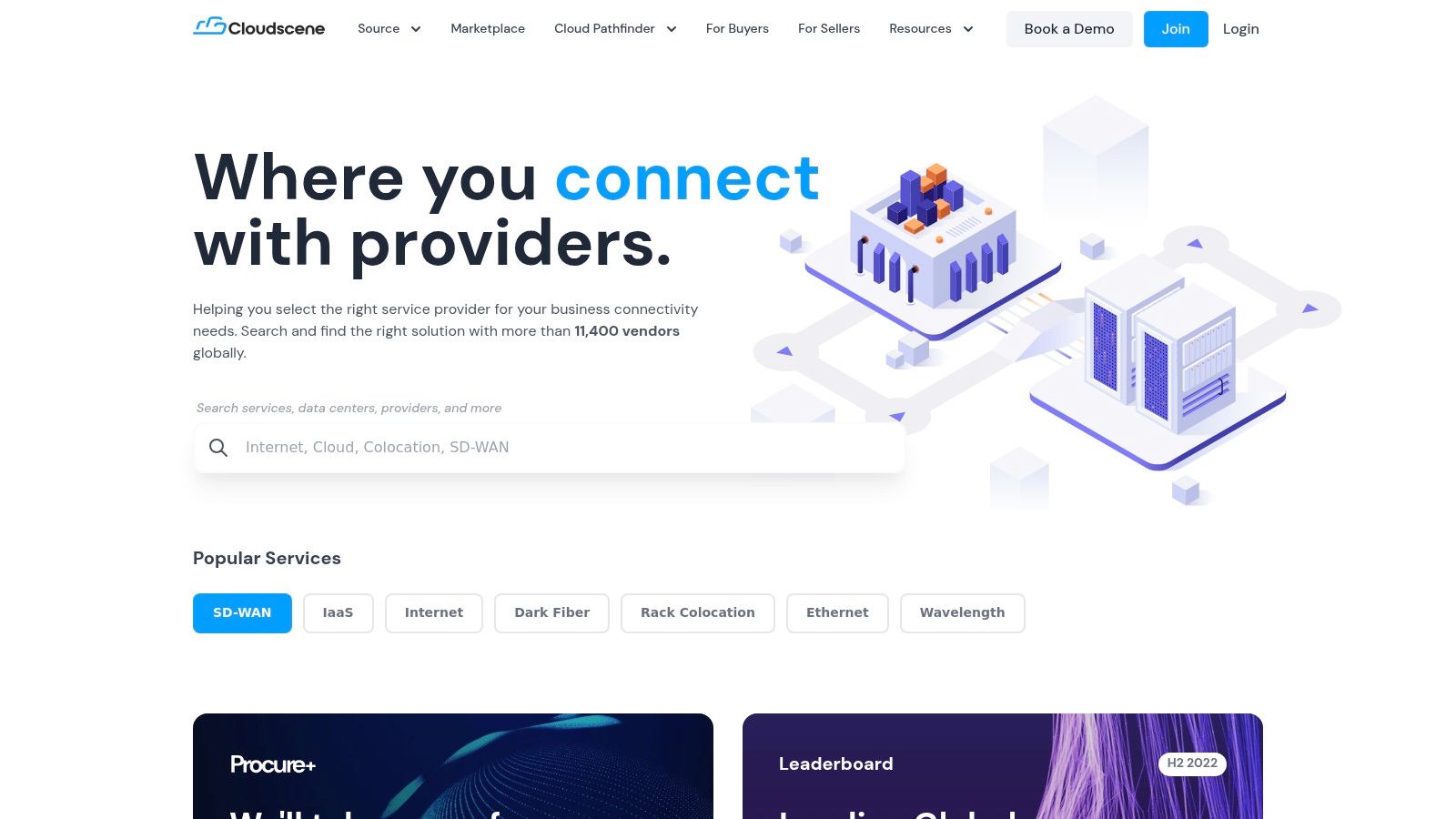
Users leverage the site's U.S. market dashboards to analyze the density of data centers, service providers, and network fabrics in specific metropolitan areas. For businesses in the planning phase, this data is invaluable for strategic decision-making. Once a shortlist is created, the marketplace feature enables users to submit a single RFQ and receive competitive bids, streamlining what is often a lengthy and fragmented procurement process.
Why Cloudscene Stands Out
Cloudscene’s primary differentiator is its function as a neutral, data-driven marketplace. It empowers buyers by providing transparency and fostering competition among providers. Instead of engaging with sales teams one-by-one, you can cast a wide net and compare standardized responses side-by-side. This approach is especially beneficial for small to medium-sized businesses or organizations entering a new geographic market without established provider relationships.
The platform also provides procurement KPIs, such as average time-to-receive-bids, which helps set realistic expectations for the sourcing timeline. For businesses that need a single rack or a custom cage, understanding the procurement landscape before committing is a significant advantage. It allows them to compare offerings from global giants to regional specialists like ARPHost, ensuring they find a solution that fits both technical requirements and budget.
Using the Cloudscene Platform Effectively
Access & Pricing:
Using Cloudscene to browse directories and submit RFQs is free, though creating an account is required to access the full marketplace functionality. The platform itself does not set pricing; pricing is provided directly by the vendors who respond to your RFQ. This means transparency comes after you initiate contact, but the competitive nature of the bidding process often leads to favorable terms.
Unique Offerings & Features:
- Marketplace RFQs: Create public or private requests for quotes and receive multiple, comparable bids from a single interface.
- U.S. Market Dashboards: View high-level data on data center and provider counts by metro area to inform strategic site selection.
- Provider Directory: An extensive, searchable database of colocation providers, cloud on-ramps, and network fabrics.
| Feature | Cloudscene Offering |
|---|---|
| Primary Use Case | Colocation provider discovery, multi-vendor quoting, and market research. |
| Key Service | A centralized marketplace for submitting RFQs and comparing bids. |
| Management | N/A; the platform connects buyers with unmanaged and managed colocation providers. |
| Pricing Model | Free to use for buyers; pricing comes from vendor bids. |
| Support | Platform support is available for using the marketplace tools. |
Pros:
- Efficiently source quotes from multiple providers with a single request.
- Broad U.S. coverage helps in discovering and shortlisting potential partners.
- Transparently compare responses and vendor capabilities.
Cons:
- Detailed pricing is only available after submitting an RFQ and receiving bids.
- The depth of provider data can vary significantly between different markets.
- Full access to marketplace features requires creating an account.
Top 7 Colocation Providers Comparison
| Provider | Implementation 🔄 (complexity) | Resource requirements ⚡ (speed/efficiency) | Expected outcomes 📊 (results/impact) | Ideal use cases 💡 (insights/tips) | Key advantages ⭐ (quality) |
|---|---|---|---|---|---|
| ARPHost, LLC | Low–Medium — rapid provisioning; managed/unmanaged options | Modest — SMB/dev budgets; entry-level pricing | Reliable infra with secure, immutable backups and responsive support | Small–mid businesses, developers, MSPs, Proxmox/VMware migrations | Proxmox specialization, immutable encrypted backups, 24/7 US support |
| Equinix | Medium–High — sales engagement and interconnect setup | High — major metros, enterprise-grade connectivity | Low-latency hybrid/cloud-connected architectures | Large enterprises, low-latency apps, multi-cloud interconnects | Deep interconnection ecosystem, direct cloud on-ramps, strong compliance |
| Digital Realty | Medium–High — RFP/quote-driven procurement | High — large-scale, high-density capacity and sustainability focus | Scalable, certified operations with sustainability guarantees | AI/high-density workloads, enterprises requiring certifications | Scale for growth, 100% renewable U.S. colo portfolio, published certifications |
| CoreSite | Medium — facility-specific availability; quotes required | Medium–High — market-dependent power/connectivity options | Clear hybrid IT paths and customizable colocations | Hybrid IT, customers needing peering/exchange access | Open Cloud Exchange, Any2Exchange peering, promotional offers |
| Flexential | Medium — market-by-market quoting and setup | Medium — distributed footprint, 100 Gbps backbone (FlexAnywhere) | Distributed, SLA-backed connectivity for regional deployments | Mid-market and distributed footprints seeking regional cost-efficiency | Regional breadth, power/bandwidth SLAs, cost-effective markets |
| Datacenters.com | Low–Medium — marketplace RFP workflow simplifies sourcing | Low — aggregator model; saves procurement effort | Multiple vendor quotes and faster market visibility | Buyers seeking one-to-many quotes and capacity in hot metros | Marketplace RFPs, large facility directory, time-saving quoting |
| Cloudscene | Low–Medium — RFQ marketplace; some features require signup | Low — broad directory and RFQ tools for rapid discovery | Broad discovery and multi-vendor bids for shortlisting suppliers | Procurement teams shortlisting providers and planning RFQs | Global directory, RFQ marketplace, procurement KPIs for planning |
Beyond the Rack: Integrating Colocation into a Modern IT Strategy
Selecting from a list of the best colocation providers is a critical first step, but the true value is unlocked when you strategically integrate that physical footprint into a modern, hybrid IT ecosystem. The journey doesn't end once your servers are racked and powered on; it begins. Colocation is no longer an isolated island for legacy hardware. Instead, it serves as a powerful foundation for building high-performance private clouds, a secure bastion for mission-critical data, and a low-latency connectivity hub that bridges on-premises and public cloud resources. This shift in perspective transforms colocation from a real estate decision into a core component of your digital infrastructure strategy.
From Physical Space to a Strategic Digital Hub
The providers we've explored, from global giants like Equinix and Digital Realty to specialized players like ARPHost, all offer unique advantages. However, the ultimate success of your colocation investment hinges on what you build on top of that foundation. The physical security, redundant power, and robust connectivity of a top-tier data center are the raw materials. The real innovation comes from leveraging this environment to create agile, resilient, and cost-effective solutions tailored to your business needs.
A practical example is transforming a colocated bare metal server into a powerful Proxmox Private Cloud. This approach gives you the unparalleled performance and security of dedicated hardware combined with the flexibility and efficiency of virtualization. You can spin up KVM virtual machines or LXC containers in minutes, creating isolated environments for development, testing, and production workloads—all while maintaining full root control over the underlying infrastructure.
Key Takeaway: Modern colocation is not just about outsourcing your data center. It's about gaining access to an ecosystem of power, cooling, and connectivity that enables you to build more sophisticated and reliable hybrid IT solutions than would be feasible on-premises.
Scaling This with ARPHost: Actionable Steps for Success
Once you’ve selected a provider, your focus must shift to implementation and integration. A seamless transition and a well-architected deployment are paramount to realizing the benefits of your new environment. Here's a step-by-step guide to maximizing your investment.
Plan the Migration Meticulously: Moving physical servers and digital assets is a complex process with significant risks. A detailed plan is non-negotiable. To ensure a smooth and successful move without unexpected downtime or data loss, it is essential to consult a comprehensive data center migration checklist. This resource can guide you through every phase, from initial inventory to post-migration validation.
Design for Hybrid Connectivity: Your colocated infrastructure should not operate in a vacuum. Work with your provider to establish secure, high-speed connections to your office locations (via VPN or direct connect) and to public cloud platforms like AWS or Azure. This creates a true hybrid environment where workloads can be placed in the most appropriate location based on performance, security, and cost requirements.
Layer on Managed Services: Don't overlook the operational overhead. Colocation provides the facility, but you are still responsible for managing the servers, operating systems, and applications. This is where managed services become a powerful force multiplier. ARPHost's Fully Managed IT Services can oversee your entire colocated ecosystem, handling proactive server monitoring, patch management, network and firewall administration, and comprehensive disaster recovery planning. This frees your internal team to focus on strategic initiatives rather than routine maintenance.
Build a Scalable Architecture: Use your colocation footprint as a launchpad for growth. By connecting your private cloud to other agile solutions, such as ARPHost's KVM-based High-Availability VPS plans, you can create a resilient, multi-tiered application environment. This allows you to scale non-critical workloads cost-effectively in a virtualized environment while keeping your core database or application servers on dedicated hardware.
Choosing one of the best colocation providers sets the stage for a more secure, scalable, and resilient IT future. By viewing colocation not as an endpoint but as a central pillar of your hybrid strategy, you can build an infrastructure that drives business innovation and delivers a real competitive advantage.
Ready to build a powerful and secure infrastructure foundation? ARPHost, LLC goes beyond just providing rack space, offering a full suite of colocation, private cloud, and managed IT services to create a truly integrated solution tailored to your needs. Explore our colocation and custom infrastructure solutions today and partner with experts who can help you design, deploy, and manage your ideal hybrid environment.