

It’s easy to get tangled in industry jargon, but the core difference between a bare metal server and a dedicated server really comes down to philosophy and technical implementation. Think of it this way: a bare metal server is the purest form of a dedicated server. It’s raw hardware, period. There’s absolutely no provider-installed software or hypervisor waiting for you.
On the other hand, the broader term “dedicated server” can be a bit more ambiguous. It always means you get a single-tenant physical machine, but sometimes it might come with a pre-installed virtualization layer from the hosting provider. For anyone running performance-hungry applications or building a private cloud, that distinction is everything.
Understanding The Core Differences
While people often use “bare metal” and “dedicated” interchangeably, they represent two distinct approaches to single-tenant infrastructure. Getting this nuance right is the first step toward building a solid foundation for your applications, whether that’s a high-traffic e-commerce store or a secure private cloud built on Proxmox VE.
At the end of the day, any dedicated server guarantees you exclusive access to a machine’s physical resources—CPU, RAM, and storage. This immediately solves the “noisy neighbor” problem you find in shared or VPS hosting. But the modern definition of bare metal takes this a step further by focusing on its state at delivery.
What Defines a True Bare Metal Server
A true bare metal server is a completely blank slate. We provision it without any pre-installed operating system or—more importantly—a hypervisor that we control. This puts you in the driver’s seat with complete and direct control over the hardware. You can install any OS or virtualization platform you want, like Proxmox VE 9, directly onto the physical machine.
If you want to go deeper, we have a whole guide on what a bare metal server is.
This direct hardware access is a massive deal for performance. Industry analysis from folks like ColoCrossing.com consistently shows that the hypervisor overhead in virtualized environments can eat up 10-20% of a server’s performance. By eliminating that layer, bare metal delivers lower latency and higher throughput—perfect for workloads like real-time AI models or high-frequency trading where any lag is unacceptable.
The Traditional Dedicated Server
A traditional dedicated server also gives you exclusive hardware, but it might arrive with a pre-configured software stack. This could be an operating system or even a provider-managed hypervisor.
While this approach can simplify the initial setup, it often limits your customization options and wedges a layer between your application and the hardware it runs on. This kind of setup works well for businesses looking for a more managed solution where the provider handles the underlying software environment.
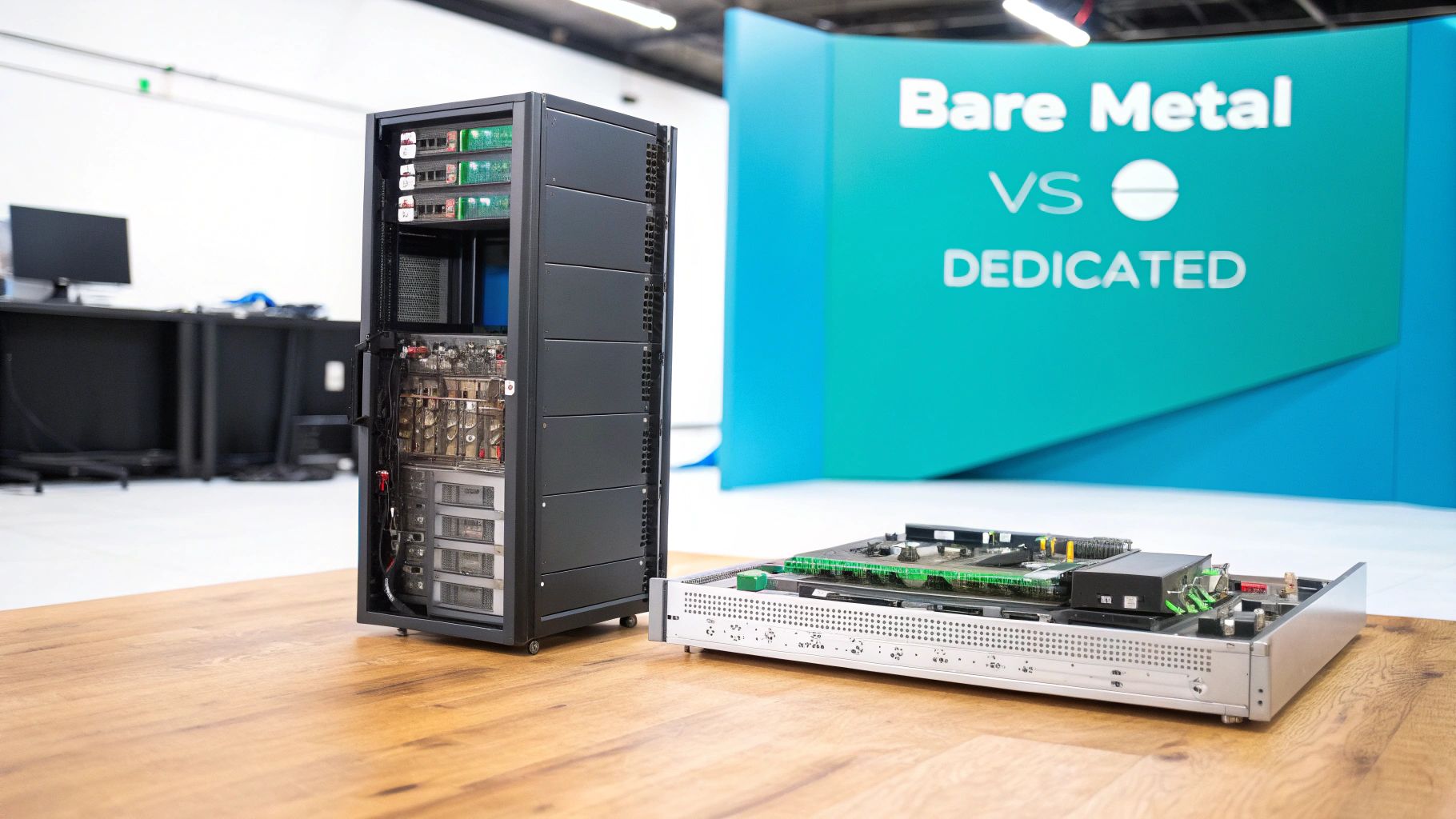
To make things crystal clear, here’s a quick breakdown of the key distinctions.
Quick Comparison: Bare Metal vs. Traditional Dedicated
This table gives you an at-a-glance summary of how these two server types stack up.
| Attribute | Bare Metal Server (ARPHost Approach) | Traditional Dedicated Server |
|---|---|---|
| Software Layer | None by default; full root access to install any OS/hypervisor. | Often includes a pre-installed OS or provider-managed hypervisor. |
| Performance | Maximum, with direct hardware access and no virtualization overhead. | High, but can be impacted by a pre-installed software layer. |
| Control | Absolute OS-level and hardware control, ideal for custom private clouds. | May have limitations depending on the provider’s pre-configuration. |
| Best For | Proxmox private clouds, HPC, large databases, and performance-critical apps. | Managed hosting, standard web applications, and simpler deployments. |
Ultimately, the choice comes down to control and performance. For users who need every last drop of power and the freedom to build their stack from the ground up, bare metal is the only way to go.
At ARPHost, all our solutions are built on this principle of true bare metal. We provide the ideal, unvirtualized foundation for customers building high-performance infrastructure like our Dedicated Proxmox Private Clouds.
Comparing Server Architecture: Performance and Control
When the conversation shifts from simple definitions to raw performance and total control, the line between bare metal and dedicated servers becomes crystal clear. It all boils down to a single, critical architectural difference: the presence of a provider-installed hypervisor. This software layer, while seemingly minor, can introduce subtle yet significant performance overhead, and it’s where a true bare metal server really shines.
A traditional dedicated server often comes with a hypervisor pre-installed by the provider. While this might streamline the initial setup, it effectively places a middleman between your operating system and the physical hardware. This virtualization layer inevitably consumes a small but measurable slice of CPU cycles and memory, which can quickly add up under a heavy workload.
For tasks where every microsecond counts—think high-frequency trading, real-time data analytics, or large-scale AI model training—even a few percentage points of performance loss can have a massive real-world impact. Every instruction has to pass through the hypervisor before it hits the CPU, introducing just enough latency to matter.
Verifying Your Environment: A Practical How-To
So, how can you be certain you’re running on true bare metal? A quick command-line check is often all it takes to see if a hypervisor is lurking underneath. In a Linux environment, the systemd-detect-virt utility is perfect for this.
If you run the command and the output is none, congratulations—you’re on a bare metal machine with no virtualization detected. If you see something like kvm or vmware, you’re actually inside a virtual machine.
# On a true bare metal server, the output will be 'none'
systemd-detect-virt

# On a virtualized server, the output will indicate the hypervisor type
# Example output: kvm
This simple check is crucial for teams needing unfiltered hardware access for maximum performance or compatibility with specialized drivers and hardware-passthrough tech.
The Nuances of Performance: I/O and CPU Scheduling
Direct hardware access on a bare metal server translates into a noticeable performance jump in several key areas:
- I/O Performance: Applications that hammer the storage, like large SQL databases or video transcoding services, need the fastest possible path to the drives. On bare metal, your OS talks directly to the NVMe drives, completely bypassing the hypervisor’s I/O scheduling and any potential bottlenecks.
- CPU Scheduling: Your application gets dedicated, uncontested access to the processor’s full power without a hypervisor trying to manage time slices for multiple VMs. This includes advanced features like Intel TDX for confidential computing.
- Memory Management: The operating system’s memory manager has a direct line to the physical RAM. This avoids the headaches of memory ballooning or overcommitment that can plague virtualized environments, ensuring your application’s performance is predictable.
When you’re pushing for every last drop of performance, understanding these nuances is key. To get the most out of your hardware, it’s essential to validate its capabilities by boosting application performance through load testing.
Building a Private Cloud with Maximum Control
The absolute control offered by bare metal architecture makes it the perfect foundation for building custom private cloud environments. At ARPHost, our Dedicated Proxmox Private Clouds start with true bare metal servers, giving you the keys to build a powerful, multi-tenant virtualization platform from the ground up.
By installing Proxmox VE 9 directly onto ARPHost bare metal, you become the master of your own cloud. You control every single aspect of the environment—from network configuration and storage pools to VM creation and high-availability clustering—without any provider-imposed limitations getting in your way.
This level of control is simply impossible on a dedicated server that ships with a pre-installed, locked-down hypervisor. With ARPHost’s bare metal, you can create a secure, scalable, and high-performance private cloud that is tailored precisely to your business needs.
Ready to build a high-performance infrastructure with full hardware control? Explore our Dedicated Proxmox Private Cloud plans starting at $299/month.
Analyzing Management And Provisioning Workflows
How you manage a server day-to-day—and how you get it up and running in the first place—is where the differences between bare metal and traditional dedicated servers really hit home. These workflows dictate how your IT team interacts with the hardware, directly impacting speed, customization, and your ability to scale.
A traditional dedicated server usually arrives with a pre-installed software layer. Think control panels like cPanel or Plesk, or a specific OS already loaded. This approach makes setup a breeze; it’s a more guided, plug-and-play experience. But that convenience comes with a trade-off: you’re working within a pre-defined framework, which can hamstring any deep OS-level tweaks or kernel modifications.
The Bare Metal Blank Slate Approach
A bare metal server from ARPHost, on the other hand, is exactly what it sounds like: a true blank slate. We deliver the hardware with no pre-installed OS or hypervisor. It’s a pristine environment built for complete autonomy, typically provisioned through an API or an out-of-band management interface like IPMI.
This level of control is non-negotiable for teams that need to build custom infrastructure from the ground up. You’re not just a tenant on the machine; you are the architect of its entire software stack, from the bootloader all the way up to the application.
This unmanaged freedom is the cornerstone of high-performance infrastructure. It allows you to install specialized operating systems, fine-tune kernel parameters for specific workloads, and implement bespoke security hardening without any provider-imposed restrictions.
How-To: Provisioning an ARPHost Bare Metal Server for a Proxmox Private Cloud
Let’s walk through a real-world example to show you what this hands-on control looks like. Say you want to set up a powerful virtualization host using Proxmox VE 9.
- Initial Server Deployment: Once you order your ARPHost bare metal server, our team physically racks it, connects it, and assigns it to your account. You’ll get credentials for IPMI (Intelligent Platform Management Interface) access.
- Mounting the Proxmox ISO: Using the IPMI remote console, you mount the Proxmox VE 9 installation ISO as a virtual drive. The entire process happens right in your web browser, giving you console-level access from anywhere.
- OS Installation and Configuration: Next, you boot the server from that virtual ISO and run through the standard Proxmox installation. You have total control here—disk partitioning (like setting up ZFS), network configuration, root passwords, it’s all up to you.
- Launching Your First Virtual Machine: Once Proxmox is installed, you can log into its web interface and start creating virtual machines or containers (LXC). You’ve just turned a single physical machine into a fully functional private cloud hypervisor.
We break this direct, granular process down even further in our guide to ARPHost bare metal server provisioning.
Scaling This with ARPHost: From Bare Metal to Fully Managed
While total control is powerful, it also means you’re responsible for everything. Once you’ve chosen your server, having the right management workflows in place is critical. For modern DevOps teams, tools that streamline your application deployment with a CI/CD pipeline are absolutely essential on bare metal.
At ARPHost, we get that not every organization has the in-house team to manage every nut and bolt. That’s why we offer a flexible hybrid model. You can start with an unmanaged bare metal server for maximum control and then add our Fully Managed IT Services whenever you need an extra set of expert hands. This blend gives you the best of both worlds:
- Proactive Monitoring: We keep a close eye on your server’s health 24/7.
- Patch Management: We handle all the critical OS and software updates.
- Enhanced Security: We implement and manage endpoint protection and firewall rules.
This approach lets you tap into the raw performance of bare metal without shouldering the entire management burden. The result is a robust, secure, and efficient solution built for your exact operational needs.
Calculating Total Cost of Ownership
When you’re weighing a bare metal server against a dedicated server, just glancing at the monthly price is one of the most common—and most expensive—mistakes you can make. To get the real picture, you need to calculate the Total Cost of Ownership (TCO), which paints a full financial story by including every direct and indirect expense over the server’s life.
A bare metal server might look cheaper on paper, but it can quickly turn into a financial black hole if you haven’t accounted for the costs of management and software.
Beyond the Monthly Fee: The Hidden Costs
The monthly invoice is just the tip of the iceberg. Hidden costs pile up fast, especially if your team doesn’t have deep sysadmin expertise. These expenses often fall into a few key areas that are easy to miss when you’re just trying to get hardware online.
- Software Licensing: A bare metal server is a blank slate. That means you’re on the hook for every license, from the operating system (like Windows Server) to control panels (cPanel, Plesk), and security suites (Imunify360). These are recurring fees that managed dedicated server plans typically bundle into one price.
- Administrative Overhead: This is the big one. Think about the hours your team will pour into the initial setup, OS hardening, patching, monitoring, and inevitable troubleshooting. An unmanaged server demands constant attention, and the salary of the expert you need to manage it is a massive part of its TCO.
- Performance Impact on Revenue: A finely tuned bare metal server can directly boost your bottom line by making your application faster and improving the user experience. But get it wrong, and a poorly managed server leads to downtime, lost sales, and a damaged reputation. The financial hit from poor performance (or the gains from great performance) is a critical part of the TCO calculation.
The real cost of a server isn’t what you pay for the hardware; it’s what you pay to keep it running securely and efficiently. Neglecting management overhead is the fastest way to turn a budget-friendly server into a financial drain.
To get a better handle on these variables, take a look at our complete guide on IT cost optimization strategies.
TCO Scenarios: Bare Metal vs Managed Dedicated
Let’s break this down with a practical example. The table below shows the estimated three-year TCO for two common business scenarios, comparing a self-managed ARPHost bare metal server (running Proxmox) against a traditional managed dedicated server.
This isn’t just theory; it’s the kind of math that helps businesses avoid costly surprises down the road.
| Cost Factor | ARPHost Bare Metal with Proxmox | Traditional Managed Dedicated Server |
|---|---|---|
| Use Case | E-commerce site with a custom stack | Development agency hosting client sites |
| Monthly Server Fee | $150 | $250 |
| Software Licenses (3-Yr Est.) | $1,800 (Control panel, security suite) | $0 (Included in managed plan) |
| Admin Overhead (3-Yr Est.) | $10,800 (5 hrs/mo @ $60/hr) | $1,800 (1 hr/mo for oversight) |
| 3-Year TCO Estimate | $18,000 | $10,800 |
As you can see, the server that started out cheaper ends up costing thousands more once you factor in the real-world costs of software and skilled management. This is where smart planning pays off.
The ARPHost model gives you a smarter path forward. You get the raw performance of our bare metal servers without overpaying for public cloud resources, then you can layer on our Fully Managed IT Services to handle all the heavy lifting. This hybrid approach gives you the power of bare metal with the predictable costs and peace of mind of a managed solution—all without sacrificing an ounce of control or performance.
How to Choose the Right Server for Your Business
Choosing the right infrastructure isn’t just about comparing specs on a sheet. It’s a strategic business decision. The real question is what you want to achieve, because the server you pick impacts everything from raw performance and operational agility to your total cost of ownership.
The choice between a bare metal server and a managed dedicated server comes down to one critical question: how sensitive is your application to performance? To make it simple, we’ve mapped out the decision process for you.
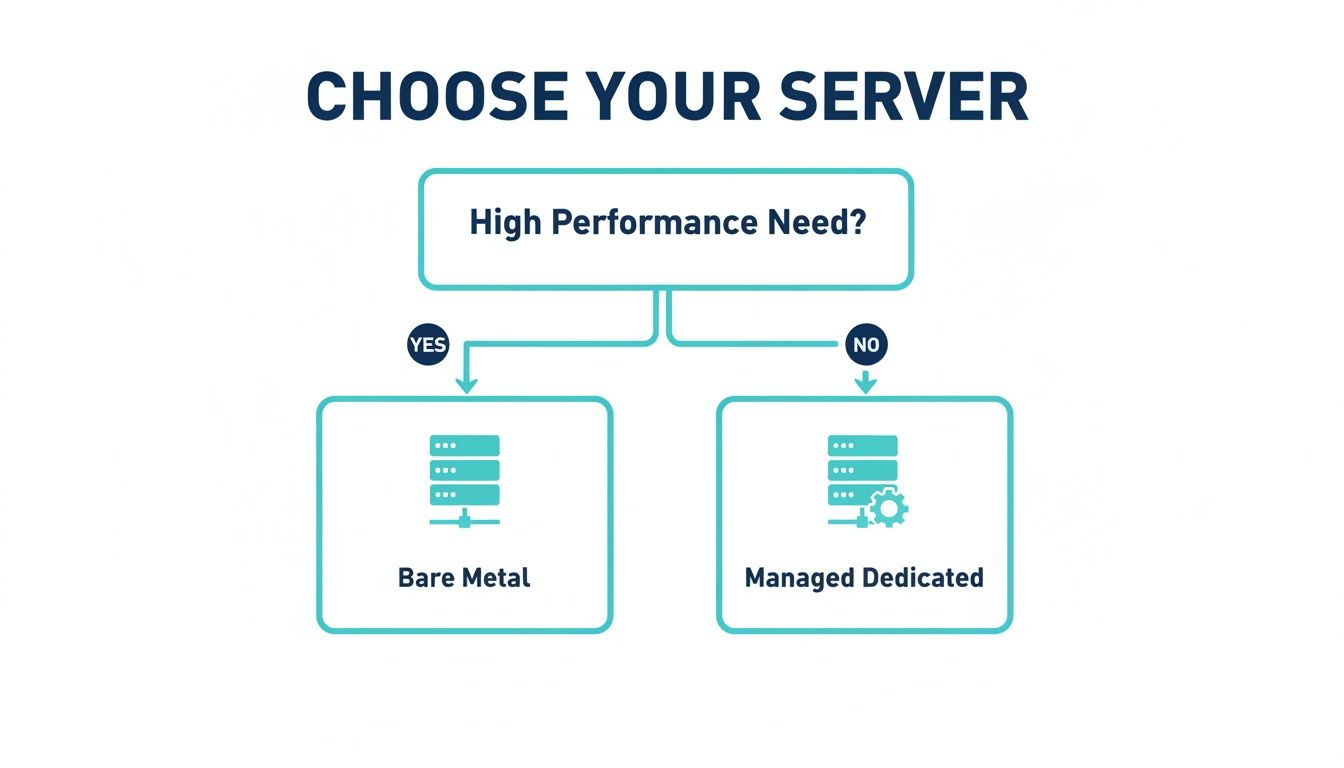
This flowchart cuts right to the chase. If your success depends on squeezing every last drop of power from the hardware—with absolutely zero virtualization overhead—then a true bare metal server is your only move. For everything else, a managed solution delivers the power you need without the hands-on complexity.
When to Choose a Bare Metal Server
A bare metal server is the only answer when performance is non-negotiable and you need total, granular control over the entire software stack. Think of it as the ultimate foundation for building a high-performance, completely custom environment from scratch.
You should be looking at an ARPHost bare metal server if you’re:
- Building a Private Cloud: An enterprise moving from VMware to Proxmox 9 needs the raw power and direct hardware access of our Bare Metal Servers. You can install Proxmox VE 9 straight onto the iron, giving you the perfect platform to build a Dedicated Proxmox Private Cloud engineered to your exact needs.
- Running High-Performance Computing (HPC) Workloads: Think AI model training, massive data analytics, or complex scientific simulations. These applications need every ounce of processing power, and the absence of a hypervisor guarantees 100% of the CPU and RAM resources go directly to your workload.
- Hosting High-Frequency Trading or Gaming Platforms: In these fields, a single millisecond of latency from a virtualization layer can mean the difference between winning and losing. Direct hardware access is essential for the lowest possible latency.
- Deploying a Custom Kernel or OS: If your application requires a specially modified kernel or a niche operating system, a bare metal server gives you the freedom to install whatever you need, free from provider limitations.
Choose Bare Metal when your application’s performance cannot tolerate any virtualization overhead. This is the path for maximum power, control, and customization, giving you a blank canvas to build your ideal infrastructure.
Of course, this level of control demands in-house expertise. For teams that need this raw power without the management burden, ARPHost offers Fully Managed IT Services as an add-on to our bare metal solutions.
When a Managed or Virtualized Solution is a Better Fit
While bare metal offers peak performance, not every business needs it—or is equipped to manage it. For many, a managed dedicated server or even a high-performance VPS is a far more practical and cost-effective choice.
Consider these ARPHost solutions for these common scenarios:
- Secure Web and Email Hosting: A small business needs a reliable and secure platform for its website and email, but doesn’t need the headache of server administration. Our Secure Web Hosting Bundles are perfect, bundling Imunify360, CloudLinux OS, and the Webuzo control panel for robust security right out of the box.
- Development and Staging Environments: A dev agency juggling multiple client projects needs isolated environments for testing. Our High-Availability VPS Hosting is the ideal fit. Starting at just $5.99/month, these KVM-based plans offer instant deployment and scalability without the cost of a full physical server.
- Business Communications: If you need a reliable phone system, running it on a bare metal server is complete overkill. ARPHost’s Virtual PBX phone systems provide a fully managed, enterprise-grade communication solution that plugs right into your business operations.
Ultimately, the “bare metal server vs dedicated server” debate opens up to a whole spectrum of solutions. By matching your real-world business needs to the right ARPHost product, you’re investing in an infrastructure that not only works today but also has a clear path for growth tomorrow.
Ready to build on a foundation of raw power? Explore ARPHost’s Secure VPS Bundles at arphost.com/vps-web-hosting-security-bundles/.
Why ARPHost Excels Here: From Bare Metal to Fully Managed
Picking the right server isn’t just about specs on a page; it’s about laying down a solid foundation that can actually handle your growth. The whole bare metal vs. dedicated server debate just proves you need a provider who gets both raw power and practical guidance. At ARPHost, that’s exactly what we do—we deliver serious, enterprise-grade hardware and the deep expertise to make it solve real-world problems.
It all starts with the metal. We offer true bare metal servers, not some flimsy imitation. We’re talking enterprise-grade components hooked up to a secure, high-speed network running on Juniper gear. This gives you that clean, non-virtualized environment you need for hammering high-transaction databases or building out a private cloud from scratch.
From a Single Box to a Full-Blown Private Cloud
We know that today’s single-server workload could be tomorrow’s multi-node cluster. That’s why we’ve built a scaling path that actually makes sense. You can kick things off with one bare metal server to crush a specific, high-demand task, then seamlessly expand into a fully redundant, high-availability setup as your needs grow.
Our expertise with Proxmox VE 9 is where things get really interesting. We can help you take those bare metal resources and spin them into a powerful Dedicated Proxmox Private Cloud. It’s the perfect middle ground: you get the raw performance and cost savings of dedicated hardware combined with the slick flexibility of virtualization, all without paying the public cloud tax.
Think of it this way: with ARPHost, you’re not just renting a server—you’re plugging into a scalable ecosystem. Our architecture is designed to take you from a single machine to a complex, clustered private cloud, making sure your infrastructure never holds you back.
Managed IT Services That Feel Like Your Own Team
Let’s be honest, not everyone has the time or desire to manage server hardware day-in and day-out. For businesses that need the horsepower without the headache, our Fully Managed IT Services become a genuine extension of your team. We take on the critical, time-sucking tasks so you can get back to building your business.
Our managed services are practical and comprehensive, covering what you actually need:
- Proactive Server Monitoring & Patch Management: We keep a close watch on your systems, keeping them updated, secure, and running smoothly. No surprises.
- Advanced Network & Firewall Management: Our network pros configure and lock down your security to fend off threats before they become a problem.
- Virtual PBX Administration: We can even handle your business communications, ensuring your Virtual PBX phone system is always reliable and crystal-clear.
This hands-on approach, backed by our 24/7 expert support, means you get a powerful, practical solution that just works.
Ready to partner with an infrastructure expert who gets it? Request a managed services quote, and let’s build the right solution for you.
Got Questions? We’ve Got Answers
Digging into server infrastructure always uncovers a few common questions. Let’s clear up some of the key distinctions and what they mean for your real-world technical decisions.
Can a Dedicated Server Also Be a Bare Metal Server?
Yes, and it’s an important distinction. A bare metal server is the purest form of a dedicated server. Think of it this way: “dedicated” just means the physical hardware is all yours, no noisy neighbors. But “bare metal” goes a step further—it means we hand you the keys to that hardware with nothing else on it. No pre-installed hypervisor, no provider software, just raw, unfiltered access.
At ARPHost, we’re all about true bare metal. When you lease a server from us, you get that direct hardware access, which is the perfect foundation for building high-performance solutions like a Dedicated Proxmox Private Cloud.
How Difficult Is Migrating from VMware to a Proxmox Cloud?
Migrating from a platform like VMware over to a Proxmox VE 9 environment is definitely a technical project. The difficulty really depends on how complex your current virtual machine setups are and how comfortable your team is with Proxmox. You have to plan carefully, especially around networking and storage.
The good news? It’s a well-trodden path with plenty of documentation out there. To make it even smoother, ARPHost provides detailed technical guides and, if you’d rather not handle it yourself, we offer fully managed migration support. Our experts can take care of the entire transition, ensuring it gets done with minimal downtime.
How Do You Secure a Bare Metal Server?
Securing a bare metal server is a huge responsibility because you’re in control of the entire software stack. It’s not a “set it and forget it” task; it demands a multi-layered, ongoing strategy. The best practices always include:
- OS Hardening: Lock down the operating system by applying security benchmarks to shrink its attack surface.
- Network Firewall Configuration: Set up strict ingress and egress rules. You can use tools like
iptablesor, for more serious protection, a dedicated hardware firewall. - Proactive Monitoring: Keep a constant eye out for vulnerabilities and any unusual activity.
- Regular Patch Management: Stay on top of security updates for the OS and every piece of software you’ve installed.
Securing bare metal isn’t a one-time setup; it’s an ongoing process. Without constant vigilance, the complete control you gain can become a significant liability.
For businesses that need rock-solid security without the in-house overhead, ARPHost’s Fully Managed IT Services are the answer. We provide comprehensive protection that covers endpoint security, proactive patch management, and expert firewall administration, making sure your server stays secure and compliant.
At ARPHost, we provide the infrastructure and expertise to build powerful, secure, and scalable solutions. Whether you need the raw power of bare metal or the simplicity of a managed service, we are here to help.
Request a quote for our Fully Managed IT services and let our experts handle the heavy lifting.